
Complete guide for immigrants getting a US driver's license. State-by-state rules, IDP requirements, DMV test prep, and the driving rules that surprise international drivers.
Congratulations on your move to the United States. Getting a driver's license is one of the first practical wins of settling into a new country—it means independence, employment opportunities, and the freedom to explore your adopted home.
But the US driving system can feel overwhelming if you're used to different rules, road signs, and licensing processes. Every state has different requirements. The written test covers rules specific to your state. And some of the driving rules here are genuinely unique to North America—you won't find them anywhere else.
This guide walks you through the entire journey: whether your foreign license is valid right now, what an International Driving Permit actually does, state-by-state rules and timelines, documents you need, the US driving rules that trip up every international driver, and exactly how to prepare for and pass your DMV written test.
Key Takeaways:
Yes—with important limits.
If you have a valid driver's license from your home country, you can legally drive in the United States immediately upon arrival, without getting a US license first. Your foreign license is valid right now. Most police officers will accept it as proof of legal driving authority.
But there are strict time limits. Most states let you drive with a foreign license for only 30-90 days before you must get a US license. Some states are more generous (up to a year); others are stricter (as little as 10 days). A few states—particularly California and New York—issue IDs that extend this window if you meet certain residency requirements.
The exact grace period depends on two things: your state of residence and your visa status.
If you're a temporary resident (student, work visa, tourist):
If you're a permanent resident (green card holder, naturalized citizen):
Important: Always carry these documents when driving with a foreign license:
If you're pulled over and can't produce these, you risk a fine or having your vehicle impounded, even with a valid foreign license.
 This is the question that confuses every international driver, and the answer is: it depends on your state, and often, it's optional.
An International Driving Permit is not a license—it's a translation document. It translates your foreign license into multiple languages. It's meant to help police officers in countries unfamiliar with your home country's license format understand that you're a licensed driver.
In the United States, an IDP is:
When an IDP actually helps:
How to get an IDP (before you move): You must obtain an International Driving Permit before you leave your home country. You can't get one after arriving in the US. The process varies by country:
IDP scams to avoid: Many websites advertise "instant online IDPs" that are not legitimate. An IDP must be issued by your home country's official transportation authority. If a website claims to issue you an IDP without you physically going to an official office or submitting documents, it's a scam.
 The US has no federal driver's license—each of the 50 states runs its own DMV and sets its own rules. This means the process to get a license varies significantly.
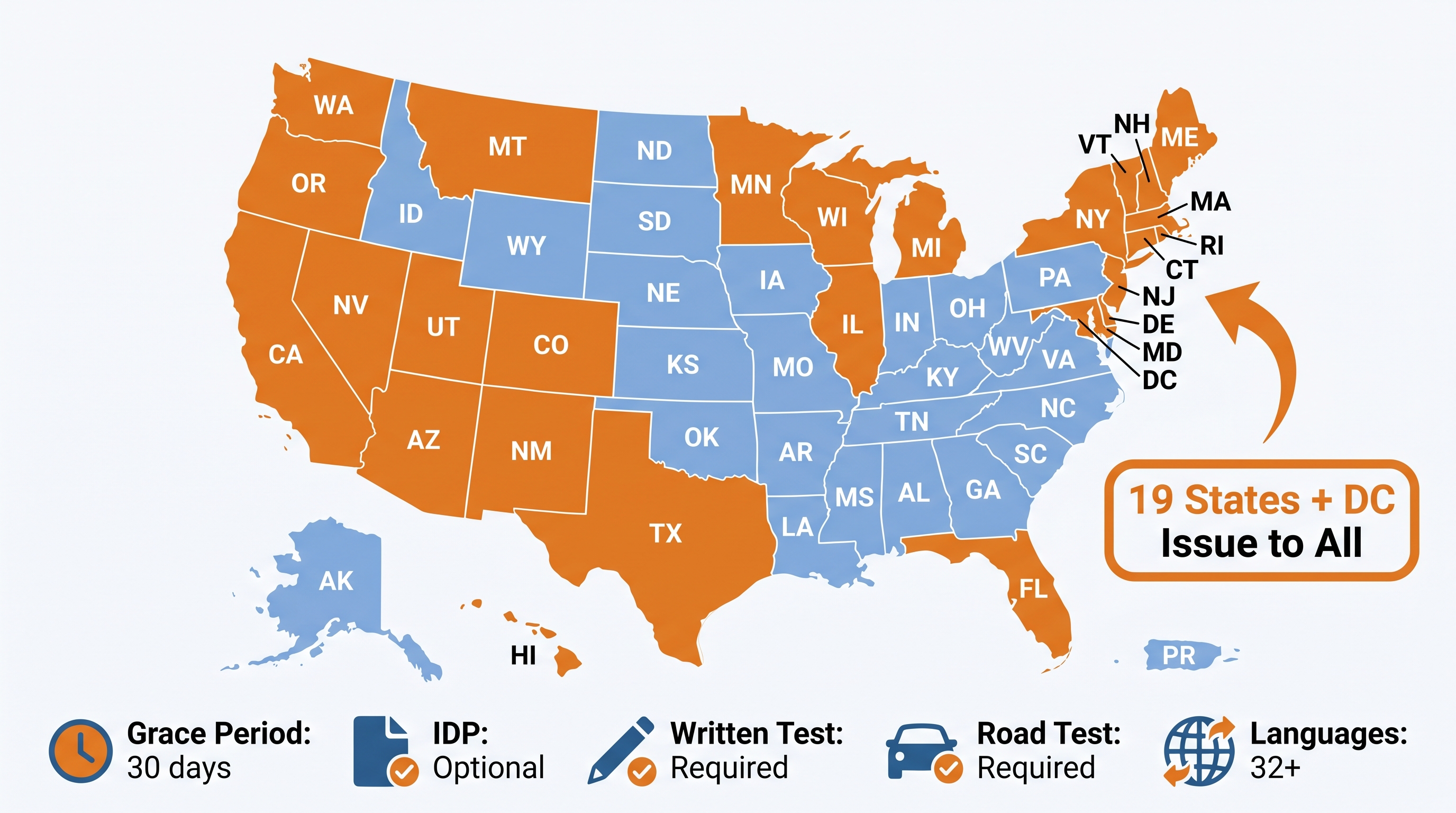
Here's the critical landscape: 19 states plus Washington DC issue driver's licenses to all residents regardless of immigration status. These states (California, Colorado, Connecticut, Delaware, Illinois, Maryland, Minnesota, Nevada, New Mexico, New York, Oregon, Rhode Island, Utah, Vermont, Washington, and Washington DC) don't require proof of legal immigration status. They issue what are commonly called "AB-60 licenses" (after California's pioneering 2015 law) or simply "unrestricted licenses."
The remaining 31 states require proof of legal immigration status to issue a standard driver's license. However, many of these states allow temporary licenses or driving permits for non-citizens.
| Requirement | Grace Period | IDP Required? | Written Test Waived? | Road Test Waived? | Languages Available |
|---|---|---|---|---|---|
| CA (Issues to all) | 30 days | No | No | No (required) | 32 languages |
| TX | 30 days | No | No | No (required) | English, Spanish |
| FL | 30 days | Recommended | No | No (required) | 32 languages |
| NY (Issues to all) | 30 days | No | No | No (required) | 32 languages |
| IL (Issues to all) | 30 days | No | No | Yes (some cases) | English, Spanish |
| Other states | 30-60 days | Varies | No | No (required) | 2-15 languages |
Key insight for your state: Visit your state's DMV website and search "[state] non-citizen driver's license requirements" or "immigrant driver's license [state]" to find the exact requirements for your situation.
This varies by state, but here's the standard checklist. Bring originals plus one copy of each:
Identity Proof (pick one):
Residency Proof (pick one):
Foreign License (if applicable):
Social Security Number or SSN Ineligibility Letter:
Proof of Legal Status (varies by state):
Recent guidance: Many states now accept passport photos as proof of identity, and some accept digital versions of documents. Call your local DMV ahead of time to ask what they accept—you don't want to make a trip with missing documents.
 If you've driven in another country, the following rules will either surprise you or be completely new. These are tested on the DMV written exam, and they're the first things international drivers get wrong on the road.
In the United States, when you're at a red traffic light and want to turn right, you may turn right even if the light is red—if no other traffic is coming. This is legal in all 50 states, though there are exceptions:
This rule doesn't exist in most of the world. In Europe, Japan, and many other countries, you must wait for the green light. International drivers often stop completely at red lights because that's what they learned at home.
This is the #1 rule that surprises foreign drivers, and it's one of the most heavily tested on the DMV exam.
The rule: When a school bus stops (its stop sign arm extends and lights flash), you must stop your car even in the opposite direction of traffic. You cannot pass the bus until the lights stop flashing and the stop sign retracts.
Penalties for violating this rule:
This rule exists because children are the most vulnerable road users. Your examiner will test you on this rule. Know it cold.
In the United States, when four roads meet at an intersection with four stop signs (a four-way stop), the rule is: whoever arrives first goes first. If two cars arrive at the exact same time, the car on the right has the right of way.
This is different from many countries where right-of-way at all-way stops is determined by traffic laws, not arrival time. US drivers treat four-way stops as a polite, first-come-first-served system.
The US uses miles per hour, not kilometers per hour. Common speed limits:
Speeding is enforced aggressively. In most states, going 10+ mph over the limit is a ticket offense.
Pedestrians have the right of way in crosswalks and at intersections when the pedestrian walk signal is lit. You must yield to pedestrians. Hitting a pedestrian is treated as a serious moving violation, even if the pedestrian's judgment was poor.
The DMV written test is a 50-question multiple-choice exam in most states (some states have 36-40 questions). You typically have 1 hour to complete it. You must pass with at least a 70-80% score (varies by state—check yours).
Common test topics:
Available languages: 32+ languages are available in California, 2-3 languages in most other states. The most common: English, Spanish, Chinese, Vietnamese, Korean, and Hindi. Check your state's DMV website to see which languages are offered in your state. If your language isn't available, you can request an interpreter or ask for extended time to use a translation device.
Key strategy for international drivers: The test is not about driving ability—it's about knowing the rules specific to your state. You might be an excellent driver from your home country, but if you don't know the US rules (right on red, school bus laws, speed limits in mph), you'll fail. Practice tests are far more valuable than reading the driver's handbook because they show you the exact types of questions the DMV asks.
See what a typical US driving test looks like:
Car insurance is mandatory in every US state. There's no exception. Driving without insurance is a crime.
The challenge: You have no US driving history, which makes you a statistical unknown to insurance companies. Many insurers will charge higher premiums initially.
How to get insured as a foreign driver:
State minimum insurance varies (typically $15,000–$25,000 for liability coverage). Check your state's requirements. Once you've been driving in the US for 1-2 years with a clean record, your premiums should drop significantly.
The fastest way to pass your test is consistent practice with real questions. Try Wheelingo free — state-specific questions, instant explanations, and a readiness score that tells you when you're ready.
Can I drive in the US without an International Driving Permit? Yes. The IDP is optional in most states. Your valid foreign license is sufficient in nearly all cases. An IDP is just supplementary.
How long can I legally drive with only a foreign license? 30-90 days in most states, depending on your visa status and state of residence. Check your specific state's DMV rules.
Do I have to take a road test if I already have a license from my country? In most states, yes. Some states with reciprocity agreements may waive the road test, but you'll still take the written test. California, Texas, and Florida all require the road test regardless of foreign license.
Can I take the DMV test in my native language? Depends on your state. California, New York, and Texas offer tests in Spanish and 10+ other languages. Montana, Wyoming, and a few other states offer tests only in English. Check your state DMV website.
What happens if I get pulled over and only have a foreign license? If you have a valid foreign license, your passport/visa, and proof of residency, you're fine. If you don't have these documents, you risk a citation or vehicle impoundment.
Do I need a Social Security Number to get a driver's license? Most states require an SSN or an SSN ineligibility letter. If you're not eligible for an SSN, request a letter from the Social Security Administration. Some states (AB-60 states like California) don't require an SSN.
What if I already have a license and move to a different state? You don't need to retake the road test, but you do need to apply for that state's license. Requirements vary slightly by state. Most states waive the road test if you show a valid license from another state.
Week 1: Gather Documents & Understand Your State's Rules
Week 2: Start Studying with Practice Tests
Week 3: Schedule Your DMV Appointment
Week 4: Take and Pass Your Test
Getting a US driver's license as an international driver or immigrant is a straightforward process once you understand your state's specific rules. Your foreign license is valid right now—but use this 30-90 day grace period wisely to study and prepare for your written test.
Focus your energy on learning the US-specific driving rules (right on red, school bus laws, four-way stops) and practicing the exact types of questions your state DMV will ask. The written test is not hard if you know the rules.
Start your free practice tests with Wheelingo—our app has all 50 states' exact DMV questions, instant feedback on every answer, and a study roadmap that matches your state. You'll see the same questions on your real test.
Your next step: Start free practice tests for your state. Most users pass on their first attempt. You will too.
Have questions about getting your US driver's license? Reach out to our team or check our FAQ.