Feel ready for your first solo drive. Learn exactly what to expect, how to prepare, and real strategies new drivers use to stay calm. Step-by-step guide inside.
You turn the key. The engine starts. And then—the realization hits like a wave: nobody else is in this car.
Your instructor isn't adjusting the mirror. Your parent isn't nervously watching the speedometer. Your friend isn't offering running commentary. It's just you, the road, and a silence that feels both terrifying and exhilarating.
This is first time driving alone. And if you're feeling your stomach in your throat right now, that is completely normal.
The first solo drive is one of those rare moments that changes something fundamental. It is not about passing a test or proving a point. It is about stepping from the safe edge of supervised driving into real independence. The weight of that transition can feel enormous.
But here is what nobody tells you: that nervousness is not a sign you are unprepared. It is a sign you understand what matters.
This guide walks through the emotional reality of that first solo moment, what to expect, exactly how to prepare, and the strategies that actually help new drivers survive—and enjoy—their solo debut.
 Before we dive into the practical stuff, let's acknowledge what is actually going on in your head right now.
Your heart will probably be pounding. Your hands might shake slightly on the steering wheel. Every other car on the road might feel like it is inches away (it isn't). Stop signs will feel like they require 10 seconds of contemplation. Mirrors will suddenly become confusing.
This is not you failing at driving. This is your nervous system doing exactly what it evolved to do: keeping you alert when you are doing something new and important.
A study by the American Psychological Association found that 73% of first-time solo drivers report significant anxiety during their first week alone. That is not abnormal—that is universal. Your examiner passed you because you have the skills. Your body is responding appropriately to new responsibility.
The goal is not to eliminate that nervous feeling. It is to build enough preparation and routine that your skills can work through the nervousness.
Most new drivers describe the first solo mile like this:
By the end of a 20-minute drive, most new drivers are still nervous—but they are functional. You are driving.
This is the single most important preparation step.
Do not pick a new route. Do not pick the scenic route. Do not pick the highway.
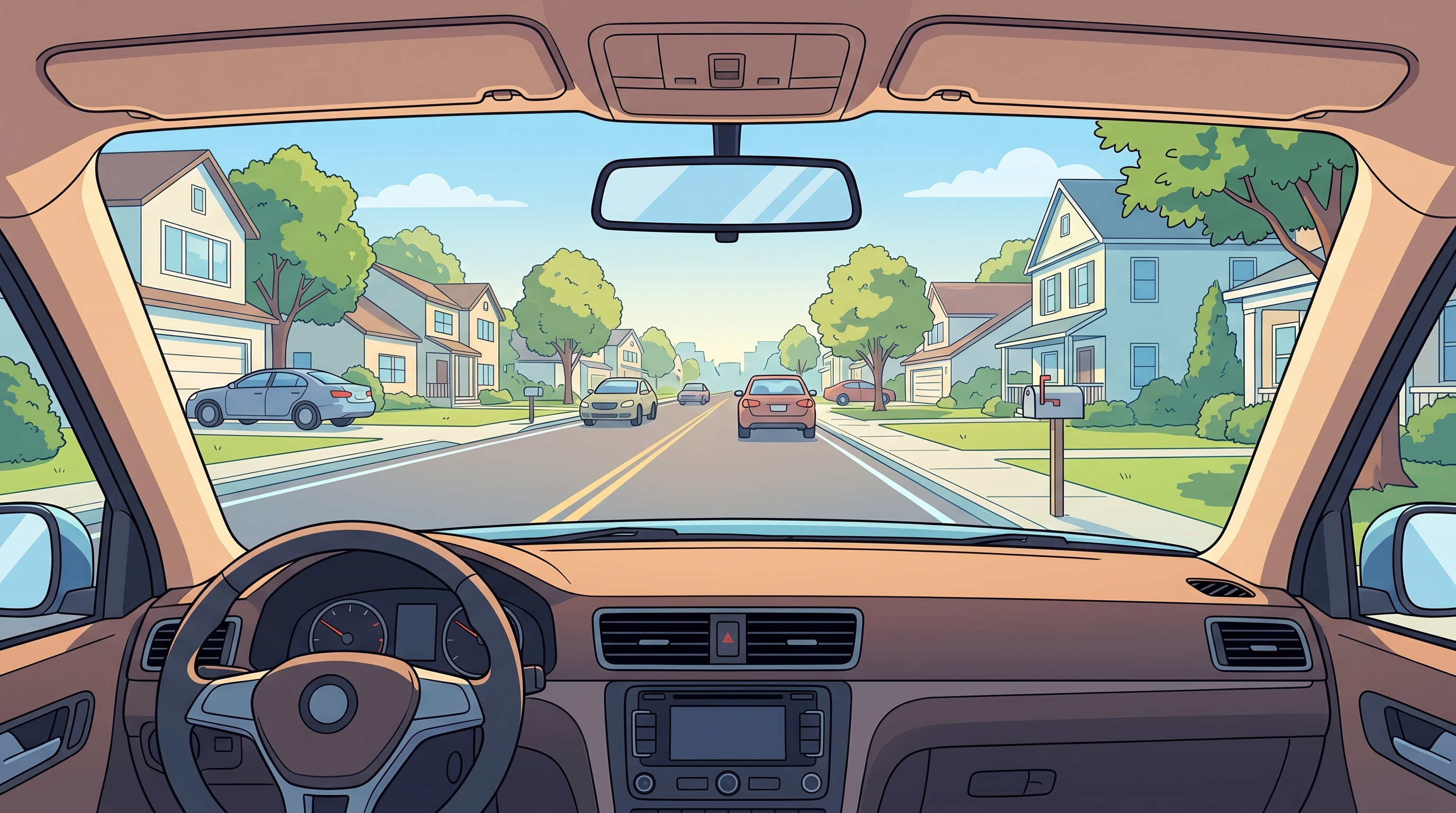
Pick a route you have already driven with supervision. Ideally, a route you have driven 5+ times. Your brain learns by repetition, and the familiar becomes autopilot. When your nervous system is already running hot, autopilot is your friend.
The ideal first-solo route:
If you have practiced this route with your parent 10 times, your muscle memory already knows it. Your brain can focus on managing your emotions instead of remembering "do I turn left at the light or continue straight?"
This is not just a safety thing. It is a peace-of-mind thing.
Tell a parent, guardian, or trusted adult:
If you get in an accident or your car breaks down, someone knows where to find you. But more importantly, knowing someone is expecting you creates accountability that helps you stay focused.
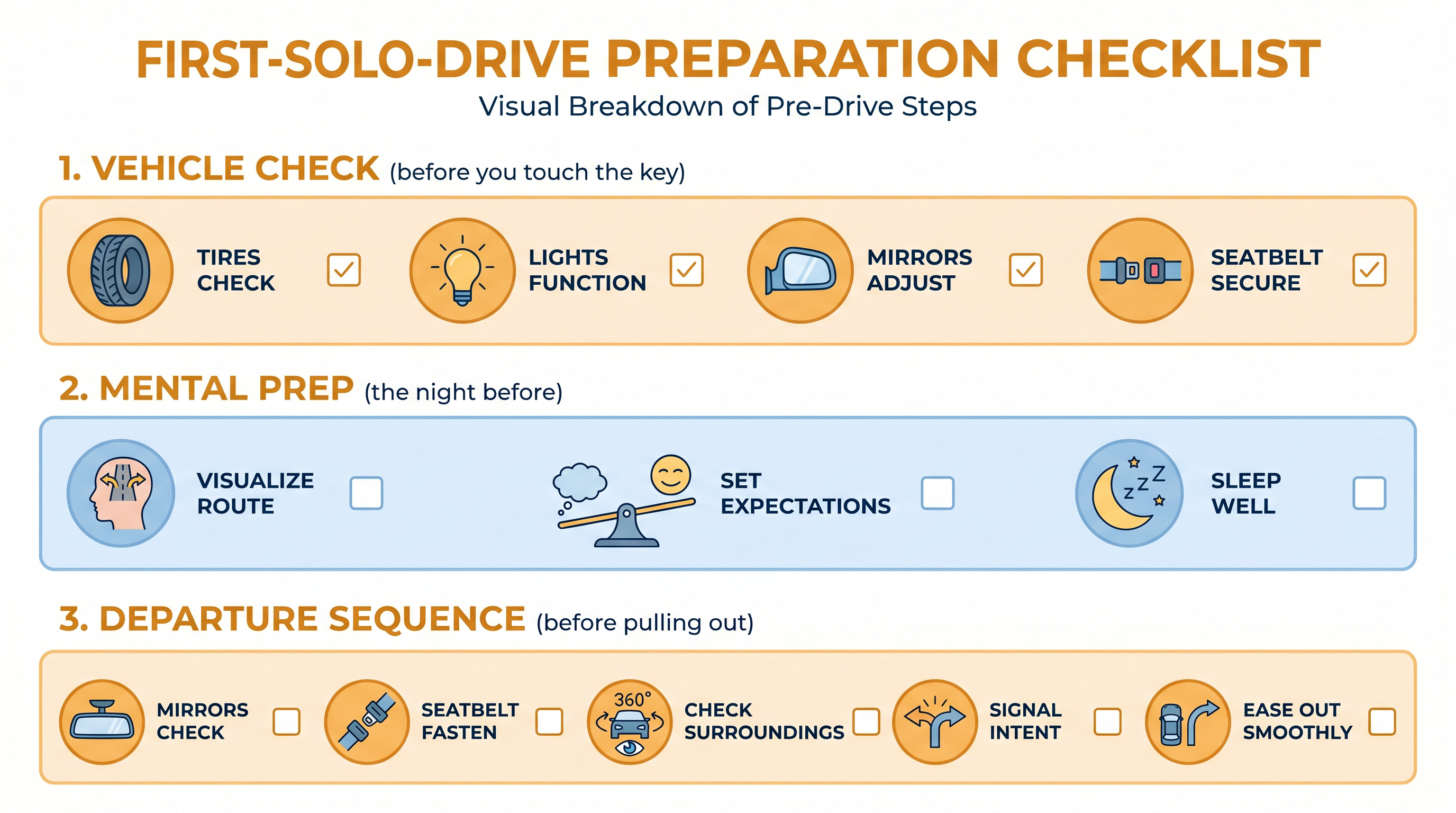
You have probably done this in driver's ed. Do it again.
Outside the car:
Inside the car:
This takes 3 minutes. It is muscle memory that makes a difference.
Before you pull out of the driveway, run through this sequence in order:
Practice this checklist sequence so many times that it becomes automatic. When you are nervous, automatic is safety.
This sounds fluffy. It is not.
The night before your first solo drive:
Your brain needs permission to calm down before your body will cooperate.
Practice this essential maneuver before your first solo drive:
For the first 5 minutes of driving, your nervous system is at peak alert. Minimize decisions.
After 5 minutes, your adrenaline will naturally drop and you will feel more normal.
"Why does every car feel so close to me?"
You are hyper-aware of other vehicles because you are in heightened attention mode. The car behind you at the red light is exactly where it should be. Your nervous system is just screaming at you.
"Why am I driving 5 mph under the limit?"
Excellent. Keep doing that until you feel comfortable. There is no speed test happening right now. Going 30 in a 35 is safer than going 40 in a 35 while panicking.
"Why do I keep checking my mirrors constantly?"
Your habit from supervised driving. Let it happen. Checking mirrors frequently is good practice.
"What if I get lost?"
You won't, because you picked a familiar route. But if you do: pull over safely, check your phone's GPS, and keep going. Getting momentarily lost is not a failure. It is a learning moment.
New drivers often feel disproportionate anxiety at stop signs. Here is why: stop signs require you to (1) come to a full stop, (2) check all directions, and (3) decide when it is safe to proceed. That is three decisions in rapid sequence.
When you approach a stop sign:
If a car is coming and you have to wait, that is fine. Waiting is safe. Rushing is not.
Most new drivers in the US operate under Graduated Driver Licensing (GDL) laws. These vary by state, but typically include restrictions on:
Your first solo drive counts as driving during your GDL period. That means:
Check your state's specific rules because they matter for your insurance and your safety.
| State | Passenger Limit | Nighttime Curfew | Phone Ban | Duration |
|---|---|---|---|---|
| California | No teens (except family) | 11 PM - 5 AM | Yes | 6 months |
| Florida | 3 passengers max (under 21) | 10 PM - 6 AM | Yes | 6 months |
| Texas | 1 passenger (under 21) | 9 PM - 5 AM | Yes | 6 months |
| New York | 1 passenger (under 20) | 9 PM - 5 AM | Yes | 6 months |
| Georgia | No passengers | 12 AM - 5 AM | Yes | 6 months |
| North Carolina | 3 passengers max | 12 AM - 5 AM | Yes | 6 months |
| Pennsylvania | 1 passenger (under 18) | 11 PM - 5 AM | Yes | 6 months |
| Ohio | 1 passenger | 11 PM - 5 AM | Yes | 6 months |
| Michigan | 1 passenger | 12 AM - 5 AM | Yes | 6 months |
| Massachusetts | 1 passenger | 12 AM - 5 AM | Yes | 6 months |
Your state's GDL restrictions exist because they work. Teen crash rates drop 20-40% when these rules are enforced. Your first solo drive should follow them exactly.
Your first solo drive will not be your best driving. That is okay.
The first week of solo driving typically feels like:
By day 10-14, most new drivers report that solo driving feels almost routine.
This is not because you suddenly became a better driver. You are the same skill level. Your nervous system just got used to the responsibility.
"My mom said, 'I'll follow you in my car to the mailbox and back.' That felt humiliating at first, but then I realized: I am about to drive alone. Having her there made it less scary.
I pulled out of the driveway and the silence hit me. No one to point out my mistakes. No one to tell me if I was doing it right. Just me.
I made it to the mailbox—maybe 30 seconds of driving—and the relief I felt was insane. Like my whole body just exhaled. I had done it.
On the way back, I was already more relaxed. By the second day driving to school, I felt like a normal person again. The first solo moment was the scariest; everything after that was just... driving."
"I thought I would be more nervous, honestly. I had driven that route with my dad probably 20 times, so my brain knew the way automatically. The thing that got me was the other drivers. Every car behind me felt like they were waiting for me to mess up.
This older guy honked at me at a red light—I think he was honking at someone else, but my adrenaline spiked. I thought I had done something wrong. I hadn't.
Halfway through my 20-minute drive, I realized I was being way too hard on myself. I turned up the music a little and just drove. No one was watching. No one cared. I was just another car on the road."
"The hardest part was that first right turn out of my driveway. Not because it was difficult—it was a simple turn. But it felt like the moment when I was officially on my own.
I remember gripping the wheel and thinking, 'You got this. You have practiced this 50 times.' And then I turned and... nothing bad happened. I was just turning right, like always.
The whole drive was like that. Every action I had done with my dad a hundred times, but this time I was doing it solo. The nervousness faded after the first couple of turns because I realized: I already know how to do this. I just needed to trust myself."
Let's address the elephant in the room: What if I have an accident on my first solo drive?
First, know this: 43% of new drivers are involved in a car accident during their first year. You are not alone if this happens. It does not mean you are a bad driver or that you were unprepared.
If you get in a minor accident (fender bender):
If you get in a major accident:
The good news: most first solo drives go perfectly fine. No accidents. No near-misses. Just a normal drive where you were worried about nothing.
Your first solo drive is not the finish line. It is the starting line.
Research from the National Highway Traffic Safety Administration shows that crash risk remains highest in the first 250 miles of solo driving. That does not mean you should be scared. It means you should be intentional.
Your first 250 miles should include:
Each new scenario is a skill-building milestone, not a test.
The fastest way to pass your test is consistent practice with real questions. Try Wheelingo free — state-specific questions, instant explanations, and a readiness score that tells you when you're ready.
Q: Is it normal to feel terrified before my first solo drive?
A: Absolutely. 73% of new drivers report significant anxiety. The fact that you are nervous means you understand the responsibility. That is not weakness—that is awareness.
Q: How long should I wait after getting my license to drive alone?
A: Not long. The research suggests: within 1-2 weeks of passing your test. Your skills are fresh and your confidence is highest. Waiting months can actually increase anxiety because doubt creeps in.
Q: What if I panic mid-drive?
A: Pull over safely (find a parking lot or side street). Breathe. Sit for a few minutes. Your nervous system will calm down. Then you can decide: continue the drive or call someone to pick you up. Either choice is okay.
Q: Should I tell my friends I am nervous?
A: Yes. You will probably be shocked at how many of them say, "Oh man, my first solo drive was terrifying too." You are not special for being nervous. You are special for doing it anyway.
Q: Do I need to take a defensive driving course before my first solo drive?
A: Not before. After a few weeks of solo driving, a defensive driving course is actually great for building advanced skills. But it is not a prerequisite for your first solo moment.
Q: Will I feel more confident after one successful solo drive?
A: Most drivers report significant confidence boost after their first solo drive completes successfully. You will have proof: "I can do this." That changes things.
Q: What if I make a driving mistake on my first solo drive?
A: You might. New drivers make mistakes all the time. A mistake is not a failure; it is data. Your brain learns from it. Professionals make mistakes. The goal is to make them safely and learn.
Here is the thing about that first solo drive that nobody talks about:
It is not really about driving.
It is about the moment you realize you can do something hard even though you are scared. That moment changes how you see yourself. You are no longer someone who needs permission or supervision. You are someone who has a responsibility and is handling it.
That realization—that you are capable even when nervous—transfers to other parts of your life too. Tests. Presentations. Job interviews. Difficult conversations. That first solo drive teaches your nervous system: nervousness does not mean I cannot do this.
So yes, prepare strategically. Choose your route. Check your mirrors. Follow the rules.
But also know: you are ready. Your driving instructor would not have signed off if you weren't. Your examiner would not have passed you if you weren't.
The only person who needs convincing is you.
One successful solo drive is not the end of your learning. It is the beginning.
After your first solo drive, challenge yourself progressively:
And beyond solo driving: keep testing your knowledge. The written test you passed is only a snapshot of what you know. Road conditions change. Rules update. Your skills need ongoing practice.
This is where Wheelingo's practice tests come in. After your first solo drive, run through a practice test on your state's rules. You might surprise yourself with what you remember—and what you have gaps on. Closing those gaps makes you safer on the road.
You are ready for this moment. Your first solo drive is not something to survive. It is something to own.
Now go drive. And trust yourself.
Ready to test your knowledge after your first solo drive? Take a free Wheelingo practice test to make sure your knowledge matches your new skills.
Still nervous about driving alone? Read our complete guide to overcoming driving anxiety for deeper strategies that work beyond test day.
Want a full roadmap of every first-year milestone? Check out our first year with a driver's license guide covering month-by-month milestones and what to expect.
Last updated: April 16, 2026