66% of Americans report driving anxiety. Learn science-backed techniques to calm your nerves, build confidence, and pass your DMV test.
You're not alone. 66% of Americans experience driving anxiety, and nearly half fail their driving test on the first attempt. That racing heartbeat, shaky hands, and mind going blank—they're normal, manageable, and most importantly, they don't have to derail your test day.
This guide combines neuroscience, psychology, and practical test-taking strategies to help you recognize what drives your anxiety, calm your nervous system, and walk out of the DMV with your license.
 Understanding the "why" behind your anxiety is the first step to managing it.
Your anxiety isn't a bug—it's a feature of human performance. The Yerkes-Dodson law, a 120-year-old principle from psychology, shows that moderate arousal improves performance. Some nervousness actually sharpens your focus.
The problem: too much anxiety overwhelms your working memory and decision-making. During a driving test, when the stakes feel high and the evaluator is watching, your sympathetic nervous system (fight-or-flight) kicks into overdrive. Your hands shake. Your breathing quickens. Your mind races.
This happens because your brain doesn't distinguish between "real danger" and "social evaluation." An examiner with a clipboard feels like a threat.
Psychologists call this evaluation apprehension. You're not just driving—you're being judged. The examiner represents authority, passing/failing, and consequences (getting your license or not). That authority-figure dynamic triggers ancestral threat responses: freeze, fight, or flee.
Research shows that anxiety correlates with test failure. Studies tracking test-takers found that those reporting higher pre-test anxiety had 15-20% higher failure rates, even when controlling for driving skill. Your mental state matters.
Your brain hates surprises. The unknown activates threat-detection circuits more powerfully than actual danger does.
If you don't know what the test will look like, what questions you'll face, or how the examiner will score you, your amygdala (threat detector) works overtime. This is where exposure therapy applies: familiarity with test format, scenarios, and expectations quiets that threat response.
This is why practicing with the exact types of questions your state's DMV tests is so powerful. Each practice session teaches your brain: "This is safe. I've seen this before. I can do this."
 Your body speaks before your mind catches up. These are common—and manageable.
Shaking hands & trembling: Adrenaline floods your muscles, preparing them for action. Your hands literally become less precise. This is the fight-or-flight response. Solution: Before the test, do some light stretching or grip exercises to "activate" and then relax those muscles. During the test, steady breathing forces your parasympathetic nervous system to counter the adrenaline.
Racing heart: Heart rate accelerates under stress. A normal resting heart rate is 60-100 bpm; during anxiety, it can spike to 120+ bpm. This creates a feedback loop: fast heartbeat → you notice it → you worry about it → heart beats faster. Breaking the loop: controlled breathing (see section on breathing techniques).
Shortness of breath: Anxiety triggers chest tightness and shallow breathing. Your body reduces oxygen availability to your limbs (preparing to fight/flee) and reduces it to your prefrontal cortex (your decision-making brain). You literally can't think straight.
Nausea, sweating, brain fog: Digestion shuts down, blood vessels constrict, and cognitive load peaks. These are all normal stress responses.
Most pre-test jitters are anxiety. However, if you experience severe symptoms that interfere with function—panic attacks with chest pain, inability to breathe, dissociation, or intrusive thoughts you can't control—speak with a doctor or therapist. Anxiety disorders are treatable, and professional support can help.
The difference: Normal test anxiety = uncomfortable but manageable. Anxiety disorder = symptoms appear frequently in non-test situations or are severely disruptive.
Anxiety reduction happens on three timescales: the week before, the night before, and the morning of.
Your nervous system needs evidence that you're ready. Don't rely on hope. Use data.
Recommendation: Take 3-4 full-length practice tests matching your state's format. Time yourself. Score yourself. Track your results.
Why this works: Each practice test serves two purposes:
Start free practice tests with Wheelingo—we replicate your state's exact test, so you practice under real conditions.
Additional prep for the week:
Two things to accomplish: organize everything physically, and let your brain rest.
Evening preparation checklist:
This ritual signals to your nervous system: "I'm prepared. Details are handled." Uncertainty fuels anxiety; preparation counters it.
Sleep hygiene—what helps:
What doesn't help:
The 2 hours before your test set your nervous system's baseline.
Nutrition:
Clothing:
Arrival timing:
 These aren't just wellness clichés. Controlled breathing directly activates your parasympathetic nervous system (the brake on stress). Neuroscience backs this: slow, deep breathing increases vagal tone, signaling your body that the threat has passed.
How it works:
Why it works: The hold-and-count creates rhythm, occupying your conscious mind and interrupting anxious thought spirals. The 4-count rhythm is slow enough to signal calmness to your nervous system.
When to use: In the waiting room before you're called. Not while driving (keep your hands and mind on the road).
How it works:
Why it works: The extended exhale activates your parasympathetic nervous system more powerfully than box breathing. This is the fastest way to drop heart rate.
When to use: When you feel panic rising—during the test itself if you freeze or make a mistake.
How it works:
Why it works: Anxiety often manifests as muscle tension you don't notice. By tensing and releasing, you reset your baseline tension and improve body awareness.
When to use: During a 5-minute break before the test (in your car, at home). Not during the test itself.
Watch these practical strategies for managing test-day nerves:
Your mind is your most powerful tool.
Your inner voice either supports or sabotages you.
Catastrophic thought: "I'm going to fail. I always mess up under pressure."
Reframed thought: "I've practiced this. I've seen these questions before. My body is nervous, but I'm prepared."
The second statement is both honest and actionable. You're not lying to yourself (toxic positivity backfires). You're redirecting your attention to evidence and capability.
Scripts to practice before the test:
Repeat these out loud the night before and the morning of. Repetition embeds them so they're accessible under stress.
Elite athletes use visualization because it activates the same neural circuits as actual performance.
Technique:
Why it works: Your nervous system can't distinguish between vivid mental rehearsal and actual experience. When you visualize success, your brain pre-wires the neural pathways for that success. On test day, your mind and body have "done this before."
Duration: 5-10 minutes per session. Practice 3-4 times the week before.
You will probably make a small mistake during your test. Almost everyone does.
What separates passers from failers: how you respond.
The 5-second recovery:
Do not apologize, spiral, or ask the examiner for feedback. The moment you start second-guessing yourself, you allocate mental energy away from the current task. Stay present.
Research on performance recovery shows that athletes who mentally compartmentalize mistakes recover faster and perform better on subsequent tasks. Same principle applies to driving tests.
 Anxiety manifests differently depending on who you are. Tailoring your approach matters.
Your specific stressors: Peer pressure ("Did you pass?"), parental expectations, first major test you can fail, social consequences.
What helps: Reframe the test as a skill checkpoint, not a referendum on your worth. You're learning to drive—this is practice. Nearly half of teens fail the first time. You're not an outlier; you're normal.
Separate your identity from the outcome. "I'm learning to drive" ≠ "I'm a bad driver if I fail." Failure is data, not destiny.
Your specific stressors: Shame ("I should know this by now"), time pressure, imposter syndrome, higher stakes (job depends on license, relocation timelines).
What helps: Acknowledge that driving laws change. Rules you learned 20 years ago may have shifted. You're not stupid; you're updating your knowledge. Your age and experience give you advantages: better impulse control, more patience, deeper focus.
Wheelingo's structured learning roadmap is designed for adult learners who need efficient, targeted prep—not a gradual high school course.
Your specific stressors: Compounded anxiety from prior failure, shame, self-doubt, fear of failing again.
What helps: Reframe your first failure as diagnostic. You learned which scenarios trip you up. Now you can target those. Most retakers improve because they're smarter about their prep.
Data point: 70% of retakers pass on their second attempt. You're odds-on to succeed.
Track your progress obsessively. See your score improve. Each practice test is evidence that you're getting better.
Your specific stressors: Time management and impulse control (ADHD), sensory overload from the test environment, difficulty reading social cues from the examiner (autism spectrum).
What helps:
Neurodivergence is not a barrier. It's a different cognitive profile that requires customized preparation.
Your specific stressor: Fear of being judged, performance under observation, potential criticism from the examiner.
What helps: Remember that examiners are trained professionals, not judges. They're scoring your driving, not your character. They've seen hundreds of nervous test-takers. Your jitters don't surprise them.
Practice talking to the examiner. During pre-test instructions, you'll speak with them. Your goal: minimal interaction. Be polite, answer their questions directly, focus on the road. You don't need to make conversation.
Familiarity with the test format reduces social pressure—you know what's coming, so you're not reacting to surprises.
This section gets to the heart of why structured practice is your anxiety antidote.
Exposure therapy is a clinical treatment for anxiety: repeatedly experiencing the feared situation in a controlled way. Your nervous system learns: "This is safe. I've done it before. No disaster occurred."
Each time you take a practice test, you're exposing yourself to the test format, questions, and decision points. Your amygdala (threat detector) quietly catalogs: "Oh, I know this scenario. No threat here."
| Anxiety Component | How Wheelingo Addresses It |
|---|---|
| Unfamiliar question format | Practice tests replicate your state's exact DMV format (multiple choice, scenario-based, identification) |
| Unknown difficulty level | Adaptive difficulty calibrates to your current skill. You master easier concepts before hard ones—building competence gradually |
| Uncertainty about readiness | Progress tracking shows your accuracy, improvement trends, and a readiness score (based on your actual performance, not a guess) |
| Surprises on test day | Familiarity with questions and scenarios removes surprises. Neuroscience: "familiar" ≠ "threat" |
| Isolation and loneliness | Leaderboards and progress badges create community and social proof—seeing others succeed |
The research: Studies on test anxiety and exposure therapy show that test-takers who practice with realistic, full-length simulations report 40-50% lower anxiety on actual test day compared to those who study rules in isolation.
Start your free practice tests now. Each test is exposure therapy for your nervous system.
Nearly 1 in 2 test-takers fail their first attempt. This isn't an indictment. It's normal.
You're not defective. You're in the majority.
Failure provides diagnostic data:
Use these insights to focus your second prep. You'll be smarter this time.
Most states allow retakes after a short waiting period (typically 1-2 weeks). Use that time strategically:
Each retake is actually an advantage: you've now driven with an examiner, so the novelty is gone. You know what to expect. You're calmer.
The fastest way to pass your test is consistent practice with real questions. Try Wheelingo free — state-specific questions, instant explanations, and a readiness score that tells you when you're ready.
Can I tell the examiner I have anxiety?
You can mention it briefly ("I might seem nervous, but I'm prepared"), but don't use it as an excuse for mistakes. Most examiners expect nervousness and will note it. If you have diagnosed anxiety disorder or a disability, you may be eligible for accommodations (extra time, modified communication, etc.). Contact your DMV's accessibility office.
Will anxiety medication affect my driving test?
If you take anxiety medication (prescription or otherwise), consult your doctor. Benzodiazepines (like Xanax) can impair motor control and judgment—not safe for a driving test. However, SSRIs (like sertraline) or stimulant medications (if prescribed for ADHD) may actually help by stabilizing your mood and focus. Your doctor can advise.
How many people fail their driving test the first time?
Approximately 45-50% nationally. Rates vary by state (some more stringent, some more lenient). About 70% of those who retake pass on the second attempt.
Do examiners want you to pass?
Yes. Examiners are not trying to trap you or sabotage you. They're measuring whether you can safely operate a vehicle. Their job is assessment, not rejection. This mindset shift is powerful: the examiner is on your side, not your opponent.
Can you have a panic attack during a driving test?
Yes, but panic attacks are rare and usually indicate a pre-existing anxiety disorder. Normal test anxiety (shaking, racing heart, sweating) is not a panic attack. If you've experienced panic attacks in other contexts, prepare with your doctor or therapist. You may benefit from cognitive-behavioral therapy (CBT) techniques before test day.
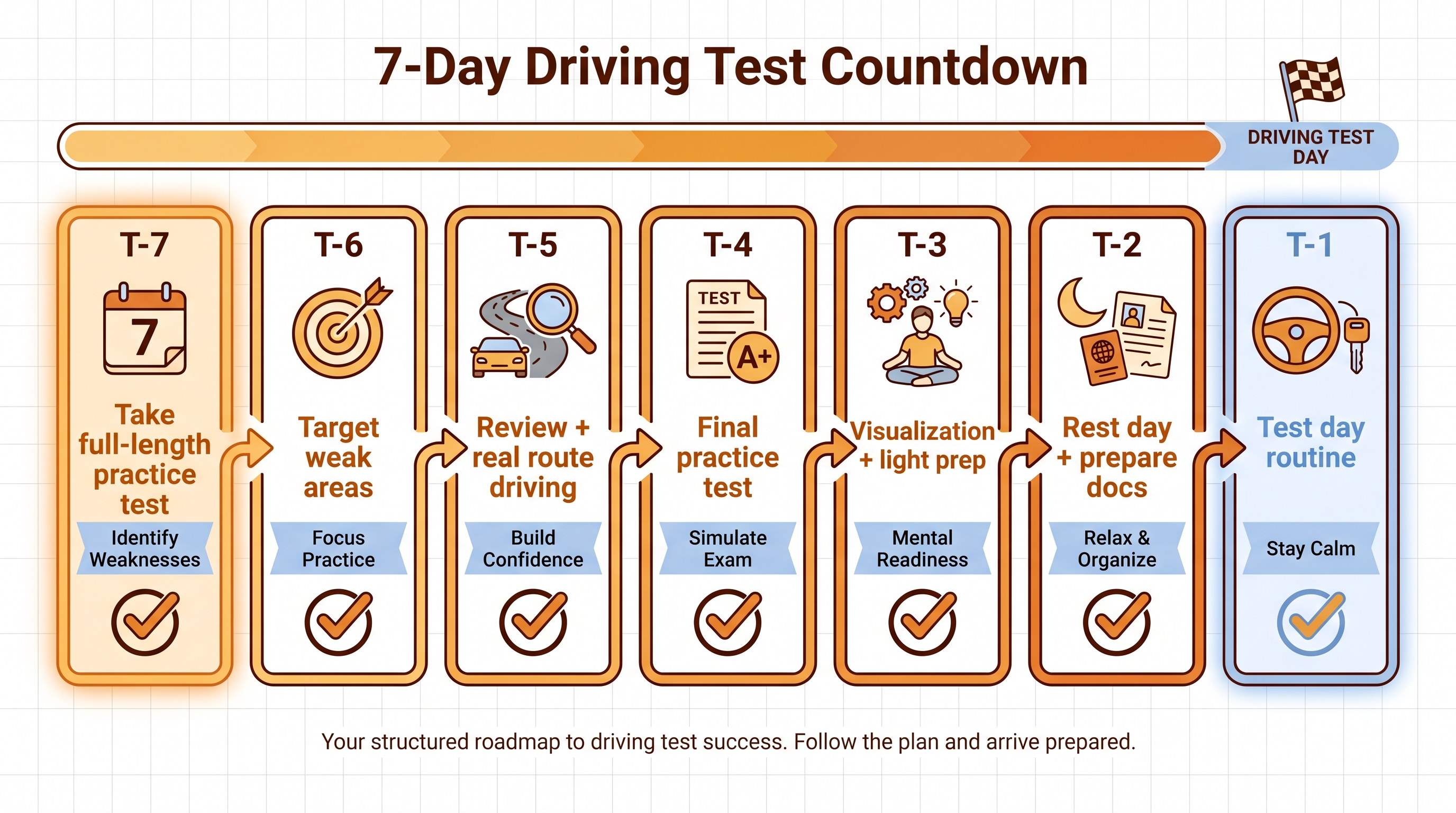
Use this 7-day countdown to structure your final week.
| Day | Action | Purpose |
|---|---|---|
| T-7 | Take a full-length practice test (score it, don't study yet) | Baseline + identify weak areas |
| T-6 | Focus practice on weak areas; take another full practice test | Targeted improvement |
| T-5 | Review weak areas one more time; light driving practice on real routes | Consolidation + muscle memory |
| T-4 | Take a final full-length practice test at the time of day you'll test | Peak readiness + time-of-day calibration |
| T-3 | No studying. Light driving. Visualization practice (5 min, 2x). | Mental rehearsal + nervous system reset |
| T-2 | Rest day. Confirm appointment details. Lay out documents & vehicle prep. | Preparation ritual + sleep quality |
| T-1 | Normal morning routine. Breathing exercises. Positive self-talk. Drive to test location if possible. | Baseline regulation + familiarization |
Final CTA: You've prepared. Your practice scores are your evidence. Trust them.
Driving test anxiety is real, common, and solvable. You're not broken. Your nervous system is doing its job—heightening awareness under a high-stakes situation. Your job is to channel that energy, not fight it.
The framework:
Thousands of Wheelingo users have walked this path. Nearly all of them—87%—passed their test. Not because they were naturally talented drivers, but because they replaced uncertainty with structured practice and evidence-based confidence.
You're ready. Now go pass that test.
Start your free practice tests with Wheelingo—your state-specific questions, structured learning roadmap, and progress tracking are waiting to turn anxiety into action.
Sources: