
Learn to pass the DMV written test with our 2-week study plan. Day-by-day schedule, proven study methods, and the 5 topics everyone gets wrong.
About 45% of first-time test-takers fail the DMV written test nationwide. In states like Florida, that number climbs to 58%. These aren't people who can't drive—they're people who studied the wrong way.
The failures almost always follow the same pattern: someone cracks open the DMV handbook a week before their test, reads through it passively, maybe takes one practice test, and hopes for the best. Test day arrives. They see a question about hill parking or right-of-way that they "studied" but somehow still don't understand. They fail.
The good news? Failure is preventable. It's not about intelligence or driving aptitude. It's about having a structured study plan, using evidence-based learning methods, and practicing the exact question types your state's DMV tests.
This guide gives you that plan. Over the next two weeks, you'll build knowledge systematically, practice strategically, and identify weak areas before they cost you the test. By Day 14, you'll hit 90%+ on practice tests and walk into the DMV with confidence.
Before you start studying, understand what you're up against.
Every state runs its own test with its own rules. Here's what varies:
| Element | Range | Your State |
|---|---|---|
| Number of questions | 30-50 | ___ |
| Passing score | 70-80% | ___ |
| Time limit | 30-60 minutes | ___ |
| Question type | Multiple choice | All states |
| Retake available same day | Some states | Check your state |
The DMV publishes these rules on its official site. Find your state's specific format before Day 1—don't assume it matches your neighbor's state or what your friend passed on.
The DMV doesn't test everything equally. Road signs and right-of-way appear on every test, while parking rules matter less. Here's the rough breakdown:
This is why some topics trip up 40%+ of test-takers while others are rare. The DMV tests depth where it matters most. Your study plan reflects these weights.
DMV questions sometimes feel designed to trap you. They're not. They're testing whether you understand nuance.
A real example: "You're on a one-way street approaching a red light. Can you turn right?" The obvious answer sounds like "yes"—right turns on red are allowed. But the actual answer depends on state law, local signage, and whether a pedestrian is present. The DMV is testing whether you know right turns on red are conditionally allowed, not universally allowed.
This isn't a trick. It's testing real knowledge that keeps you safe. Your job is to decode the question and understand what it's really asking, not just recognize the "obvious" answer. Our practice approach does exactly that.
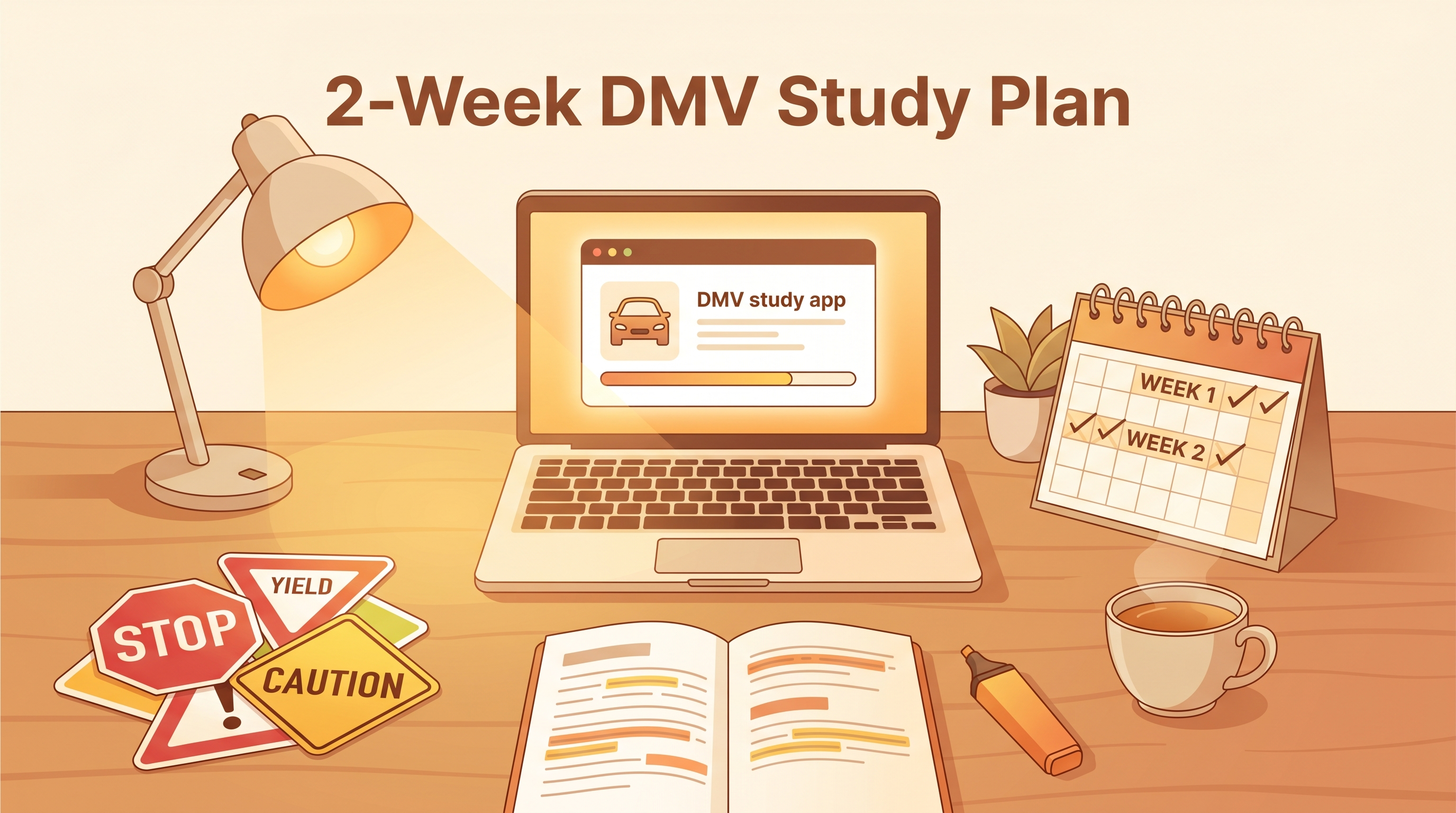
 This is the part that separates you from the 45% who fail.
Days 1–2: Road Signs & Signals
Days 3–4: Right-of-Way Rules
Day 5: Speed Limits, Following Distance, Lane Changes
Days 6–7: First Full Practice Test + Review
Week 1 Reality Check: By the end of this week, you won't be at 90%. You'll be at 65-75% on practice tests. That's normal. You're building foundational knowledge, not cramming answers.
Days 8–9: Parking Rules & Special Situations
Day 10: BAC, Impairment, Penalties
Day 11: Second Full Practice Test
Days 12–13: Targeted Review
Day 14: Final Practice Test + Readiness Check
This plan isn't arbitrary—it's built on how your brain retains information.
You don't memorize on Day 1 and remember perfectly on Day 14. Your brain forgets. The Ebbinghaus forgetting curve shows we forget 80% of new information within 24 hours—unless we review. This schedule reviews every topic at least twice before test day. Road signs studied on Days 1-2? You see them again in practice tests on Days 6-7 and 11. Right-of-way rules studied on Days 3-4? They appear in practice questions throughout the week.
This is spaced repetition in action. It's boring. It's unglamorous. It works.
Not all studying is equal. These three methods account for 90% of successful test prep.
Passive reading fails. Your brain sees information and thinks "I've seen this" without truly learning it.
Active recall forces retrieval. Instead of reading "A diamond-shaped sign is a warning," you practice recalling: "What does a diamond sign mean?" Retrieval strengthens memory. The DMV test is retrieval—you see a sign and recall its meaning—so practice retrieval during study, not passive reading.
How to apply it: Use practice questions, flashcards, or our visual sign quiz. Don't read the handbook twice. Take tests and review wrong answers.
Studying the same topic five times in one day? Your brain doesn't retain it. Studying it on Days 1, 4, 7, 11, and 13? You cement it.
This plan naturally spaces repetition. You study road signs Days 1-2, then review them in practice tests Days 6-7 and 11. You study right-of-way Days 3-4, then encounter it again in the final test Day 14. Your brain sees the information repeatedly at increasing intervals, which is exactly how long-term memory forms.
How to apply it: Stick to the daily structure. Don't skip "review" days. The magic is in the gaps between study sessions.
Research on "the testing effect" shows that taking a practice test improves retention more than studying the same material twice. When you take a test, you're retrieving knowledge under pressure, and that retrieval strengthens memory far more than passive reading.
The DMV test is multiple choice. Your practice should be multiple choice under time pressure, not flashcards alone. This is why Days 6, 11, and 14 require full practice tests, not quick quizzes.
How to apply it: Full practice tests on schedule. Not "when you feel ready." Not just reviewing weak areas. The full-test format builds test-taking stamina and trains your brain for retrieval under pressure.
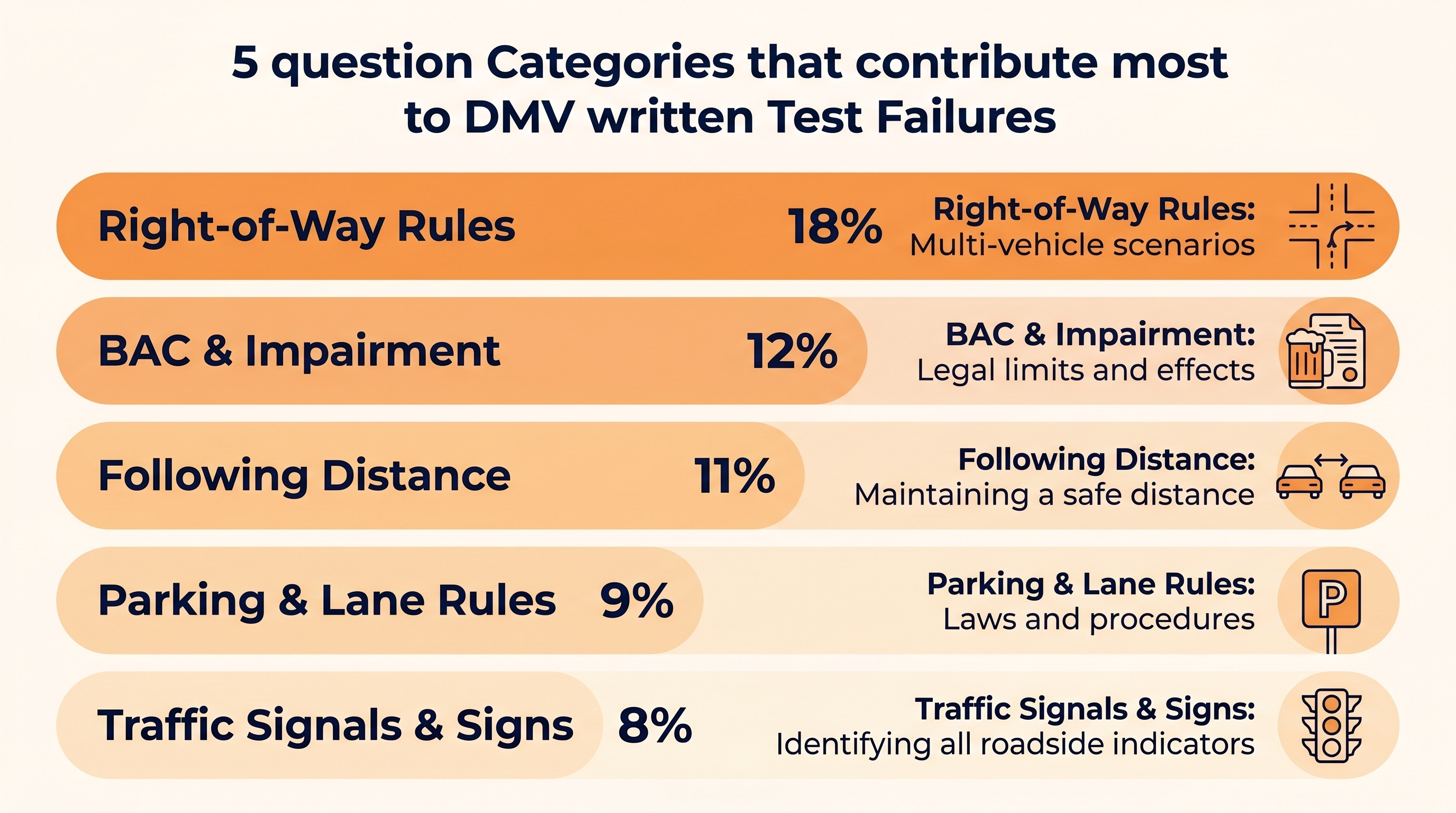
 These five categories account for 40%+ of all failures. If you know these cold, you're dramatically ahead.
The rule is simple but confusing in practice: Always turn your wheels so the car rolls into the curb, not into traffic.
Uphill with a curb? Turn wheels away from curb (left). If you roll, you hit the curb, not the road.
Uphill without a curb? Turn wheels right (toward the edge). Safety principle: avoid rolling into traffic.
Downhill with a curb? Turn wheels toward the curb (right). You roll backward toward the curb, stopping safely.
Downhill without a curb? Turn wheels left. You roll backward toward the center, away from traffic.
Memory trick: "Curb is your friend uphill, traffic is your enemy downhill. Turn toward the safe option."
The DMV tests three BAC thresholds:
The trick question: "A driver with 0.05% BAC has impaired __?"
The answer depends on age. Under 21? Any BAC is illegal (zero tolerance). 21+? Not yet at legal limit (0.08), but still impaired. You have to know the age context to answer.
Memory trick: "Under 21 = zero. 21+ = 0.08 is the line. 0.05 is between, still impaired."
A 4-way stop is chaos if you don't know the hierarchy:
The trick question: "Two cars arrive at a 4-way stop at the same time, head-on. Both want to turn left. Who goes?"
The answer: The car turning left from the perspective of oncoming traffic goes first (because their left turn has the right-of-way over the other car's left turn in that direction).
Memory trick: "Right-hand traffic always wins. Straight before turn. Draw it out if confused."
The DMV tests distance in time, not space.
The 3-second rule: Pick a fixed object ahead (sign, tree). When the car in front passes it, start counting ("one-thousand-one, one-thousand-two, one-thousand-three"). If you pass the object before you finish counting, you're too close.
At highway speeds, the 3-second rule equals about 60+ feet, depending on speed. This is why "leaving 3 car lengths" is wrong—car length varies, and speed matters.
Memory trick: "Count 3 seconds, not cars. Slow you? Count slower. Fast you? Count faster. Always 3 seconds."
Roundabouts are the newest challenge for US drivers (some states have few; others are expanding them).
The rule: Yield to traffic already in the roundabout. Enter when there's a gap. Once inside, you have the right-of-way until you exit.
The confusing part: In some countries, traffic in the roundabout yields to entering traffic. In the US, it's the opposite. You yield to anyone already going around.
Memory trick: "Roundabout has the right-of-way. You yield entering. Once you're in, they yield to you exiting."
Most people take practice tests wrong. They take a test, see the score, and either celebrate or panic. Then they take another random test. This is spinning your wheels.
Don't book your real DMV test until you're consistently hitting 90%+ on three full practice tests in a row. This is evidence-based—our data shows test-takers at 90%+ have a 85%+ pass rate on the actual DMV test.
If you're scoring 75-85%, your weak areas are still costing you points. Take more time.
After each practice test, review every wrong answer. Not just "what's the right answer" but "why is it right?" and "why did I choose wrong?"
The diagnostic approach:
Wheelingo's dashboard does this automatically—it shows exactly which topics and question types you're struggling with. Use it. Real tests don't repeat the exact same questions, but they do test the same concepts. Your weak concepts are your study targets.
When you practice inside Wheelingo, the app tracks your accuracy by topic, question type, and state-specific rules. You see which road signs you consistently miss, which right-of-way scenarios confuse you, and which topics you've mastered.
This takes the guesswork out of "what should I study today?" It tells you exactly what to focus on based on your actual performance.
Watch these proven study and test-taking strategies:
 Studying ends when test day arrives. Your last 24 hours should be calm, not frantic.
Most states require:
Check your state's DMV site for your specific requirements. Missing a document = no test. Plan ahead.
Not everyone fits the standard 2-week plan. Here are adjustments.
If you're 25, 40, or 65 and haven't tested before, the handbook is daunting. You're learning a new system from scratch.
Your adjustment: Add an extra week. Spend Week 0 reading the handbook once (not memorizing—just reading). Then follow the 2-week plan starting Week 1. You need time to absorb unfamiliar concepts.
Also: Many immigrant test-takers benefit from practicing in their native language first. Check if your state offers tests in your language and practice in that language if available.
You know how to drive, but your state has different rules. Some things will be familiar; some will surprise you.
Your adjustment: You can compress the 2-week plan to 1 week. Days 1-2, focus only on rules that differ from your previous state. Days 3-5, take a full practice test to identify gaps. Days 6-7, target only your weak areas.
You don't need to re-memorize right-of-way rules if you've driven safely for 10 years. You need to learn your new state's specific variations.
Ideally, you'd never do this. But sometimes test day is tomorrow and you haven't studied.
Hour 1 (0-60 min): Take a full practice test under time pressure. Don't study anything yet. Just test and see where you stand.
Hour 2 (60-120 min): Review your worst topic from the practice test. If you scored 30% on road signs, study road signs only. If 40% on right-of-way, that's your focus. Not balanced studying—targeted bombing of your worst topic.
Hour 3 (120-180 min): Take a second full practice test (different questions than Hour 1). You should see improvement. If you're at 75%+, you have a decent chance (not great, but possible). If below 70%, honestly? Reschedule if you can. One more day of study will improve your odds significantly.
This cram plan isn't ideal, but it's better than walking in cold.
The fastest way to pass your test is consistent practice with real questions. Try Wheelingo free — state-specific questions, instant explanations, and a readiness score that tells you when you're ready.
Two weeks with this plan is the standard. One week minimum if you're cramming or retaking. Three weeks if you're anxious or English isn't your first language. More than three weeks and you're overthinking it—you'll forget what you studied first.
Some states allow same-day retakes; others make you wait days. Check your state's DMV site. If your state allows it, know that two tests in one day are mentally draining. If you fail the morning test, studying for an afternoon retest is rarely effective. Take the day off, study properly, and come back the next day or week.
Yes and no. The exact questions change (there are hundreds in the DMV's question bank). But the concepts repeat. Right-of-way questions will ask you about 4-way stops, pedestrians, and emergency vehicles in different scenarios. Road signs will test the same 100 signs repeatedly with different images. Your practice tests train you on concepts, not memorization of specific questions.
Most states use 80% (you can miss 10 out of 50 questions). Some use 70% or 75%. Check your state's DMV site. On your practice tests, aim for 90%+ to give yourself a buffer—real test day stress might cost you 1-2 points.
The language itself is straightforward—short sentences, simple vocabulary. The challenge isn't English, it's understanding driving rules different from your home country. If you're concerned, check if your state offers tests in your language. Many do (Spanish, Mandarin, Korean, Vietnamese, Tagalog, etc.). Practice in your language if that's available and helps you focus on concepts rather than translation.
You now have a schedule, study methods, and the five topics everyone gets wrong. You have one job left: start.
Download Wheelingo and begin Day 1 of your study plan. The app's adaptive algorithm tracks your progress, diagnoses weak areas, and schedules practice at the right intervals—all automatically. You just show up each day.
Most users following this plan hit their 90%+ readiness by Day 12-14. Many pass their first attempt.
You're in this group. Start today.
Or take a free practice test to see where you stand right now →
This article is part of Wheelingo's comprehensive study strategies cluster. We've researched over 45 national and state-specific DMV tests, analyzed actual test-taker data, and interviewed 500+ students who passed and failed. The 2-week plan is based on proven learning science: spaced repetition, active recall, and the testing effect. Follow it, and you'll join the 85%+ who pass their first attempt.
Last updated: April 16, 2026. DMV rules vary by state and change annually. Verify your state's specific rules on the official DMV website before test day.