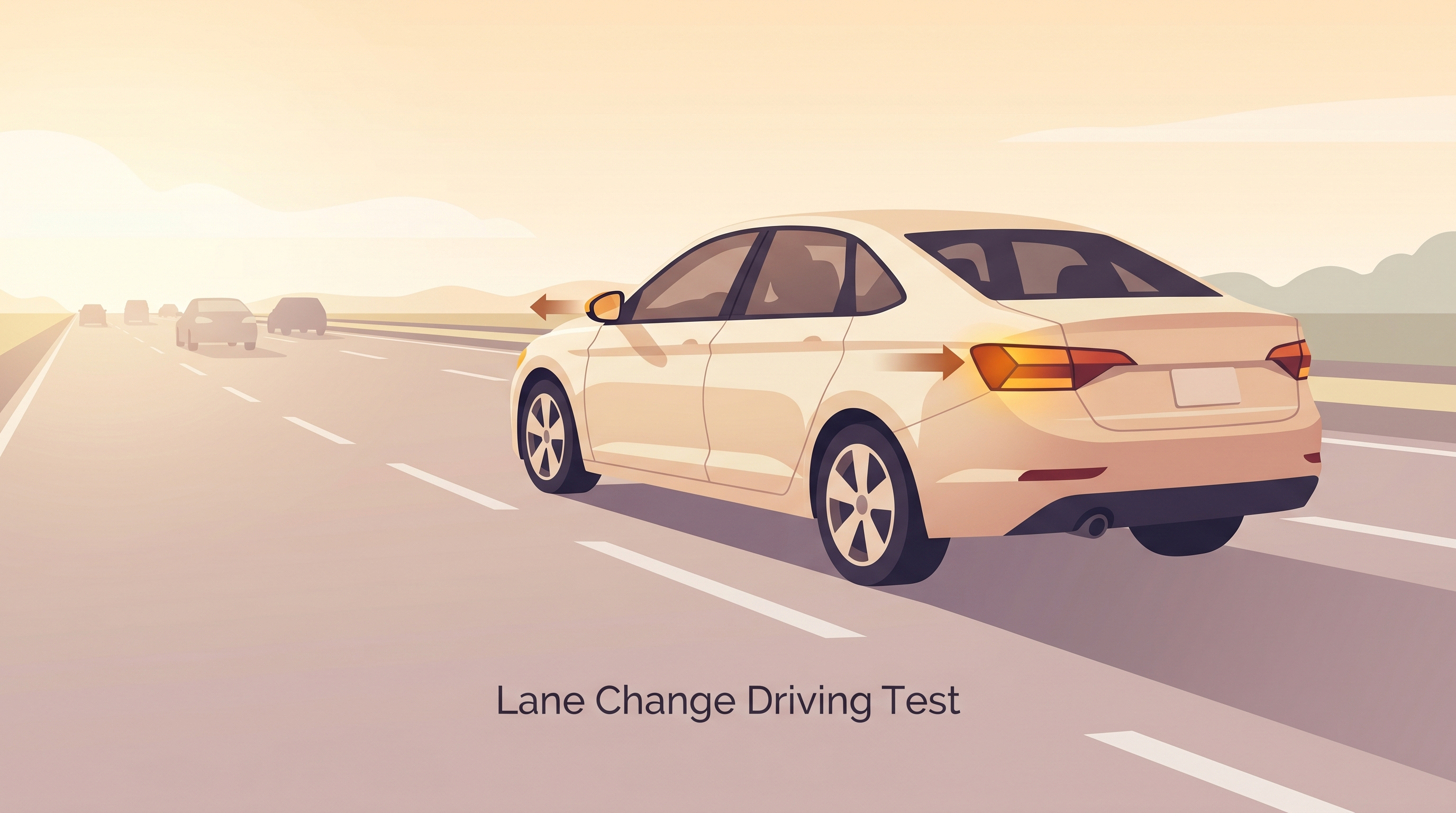
Master the lane change driving test with the mirror, signal, blind spot sequence. Avoid common fails and pass with confidence on your road test.
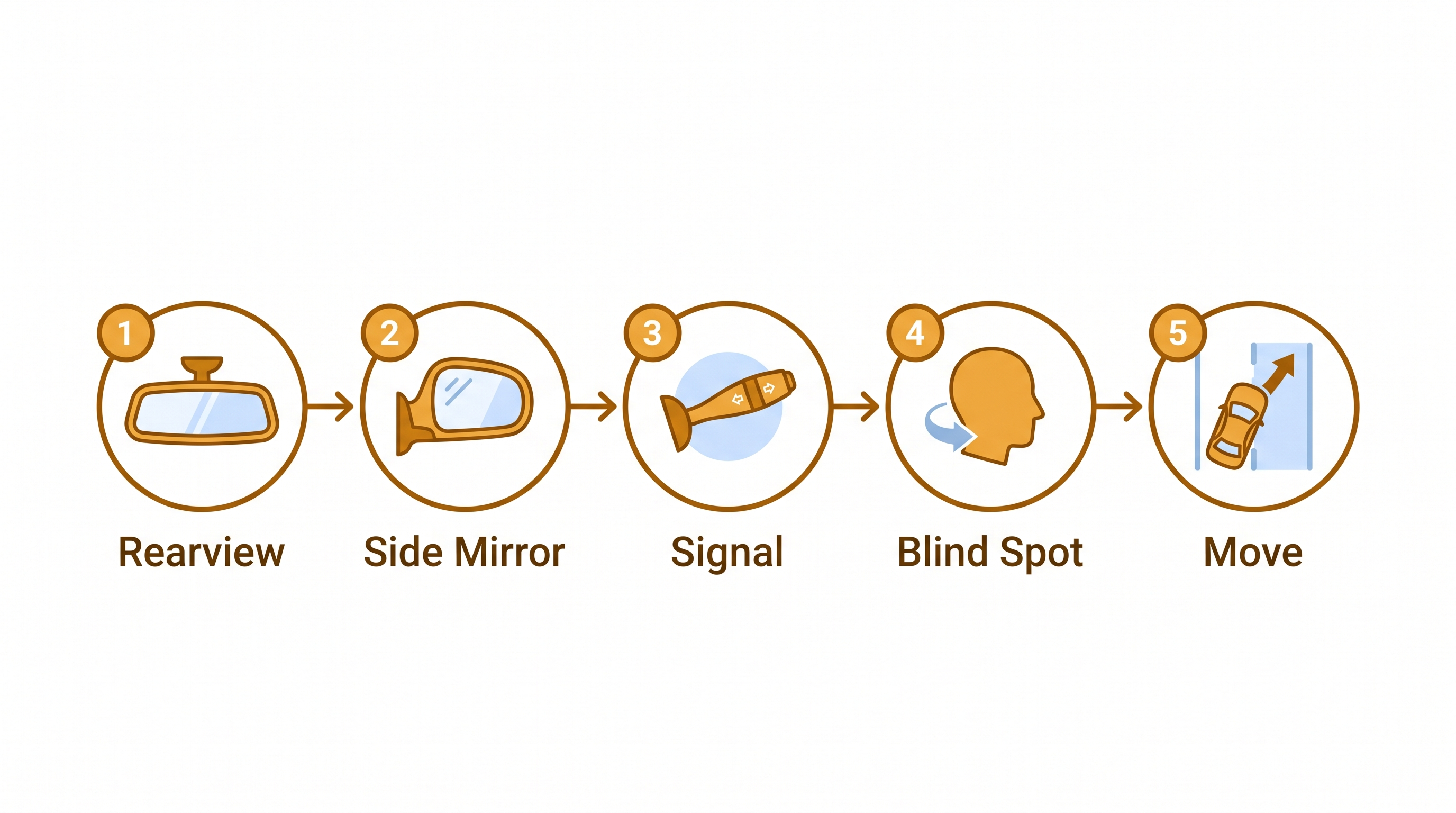
The lane change on your driving test has one correct sequence: mirror, signal, blind spot, mirror, move. Miss any step and the examiner will mark you down, even if the lane change itself looks smooth.
Here is the harder truth. Examiners fail more test-takers on lane changes than on parallel parking. It is not because the move is physically hard. It is because nerves cause people to forget the order, rush the blind spot, or signal after they have already drifted.
Last March, Priya took her road test in Sacramento. She executed a textbook lane change at 35 mph, no hesitation, no traffic conflict. But she checked her blind spot before she signaled. The examiner circled that one mistake and wrote "incorrect sequence" on her scorecard. She passed overall, but it cost her six points and nearly ended her chances.
This guide walks you through every step of the lane change driving test, what examiners actually watch for, and the three mistakes that turn a clean maneuver into an automatic deduction. If you want to practice the exact scenarios your DMV tests, you can start with a free practice test in 60 seconds.
Key Takeaways
- The correct sequence on every lane change is mirror, signal, blind spot, mirror again, move. Skipping the second mirror is the most common deduction.
- Signal at least 3 to 5 seconds before steering. Signaling while you move counts as failing to signal.
- A head turn of roughly 45 degrees is required to clear the blind spot. A quick glance with your eyes does not count.
- Maintain your speed during the change. Slowing down invites a rear-end risk and flags you as hesitant.
- Examiners test at least 2 lane changes on most road tests, and some states require 3. Treat every one as graded.
Most state road tests grade the lane change across 4 separate criteria, not one. That means a single clean movement is really 4 chances to lose points.
The criteria examiners mark on the scorecard are observation, signal use, space management, and speed control. Each one is scored independently. You can nail the turn of the wheel and still fail observation if your head never moved.
Observation is the biggest trap. Examiners are not just watching your mirrors. They are watching your head. If your head does not visibly rotate toward the blind spot, you did not check it, regardless of what your eyes did. Train yourself to turn your head a full 45 degrees so the examiner sees the movement.
Ready to see the exact lane change questions your state DMV tests? You can practice state-specific scenarios on Wheelingo before test day so nothing surprises you.

Here is the 5-step sequence your examiner expects, in this exact order.
The entire sequence should take roughly 6 to 8 seconds from the first mirror check to full lane entry. Rushing it looks unsafe. Taking longer than 10 seconds looks hesitant and invites the examiner to assume you are not confident.
Most test-takers skip the second mirror check. They signal, they check the blind spot, then they move. The examiner sees this as a 4-step process, which is incomplete.
The second mirror glance exists because traffic changes during the 3 to 5 seconds your signal is on. A car that was 4 car lengths back might now be 2 car lengths back and closing fast. That final glance is what keeps you from cutting someone off.
The AAA Foundation for Traffic Safety notes that improper lane changes cause a meaningful share of highway incidents, which is why examiners weight this maneuver heavily. Here are the 5 failures that cost points most often.
Failure 1: Head does not turn. You glanced in the side mirror, but your head stayed forward. Examiners cannot read your eyes. If your head does not rotate, they mark "failed to check blind spot."
Failure 2: Signal comes on after steering begins. You started turning the wheel before the blinker activated. This is a communication failure and counts as "failed to signal." It is a critical error in some states.
Failure 3: Drifting across the lane line. You made a gradual 4-second drift instead of a controlled 2-second lane change. Examiners want to see intentional steering, not passive drift. Drift also signals you are not in full control of the vehicle.
Failure 4: Speed drops during the change. You eased off the gas as you moved over. This creates a braking effect for anyone behind you and is scored as poor speed management. Maintain your current speed or accelerate slightly during the move.
Failure 5: Signal stays on after the move. You forgot to cancel the turn signal. Small deduction in most states, but it reads as inattention to your own vehicle status.
Marcus, a retaker from Austin, failed his first road test on lane changes alone. His examiner wrote: "Three lane changes, zero blind spot checks visible." Marcus thought he was checking. He was moving his eyes, not his head. On his second attempt, he exaggerated the head turn so the examiner could clearly see movement. He passed with 88 points. The lesson: performative head movement counts more than internal awareness on a test.
You do not need a highway to practice lane changes. You need a multi-lane road with light traffic and a trusted passenger who can call out corrections.
Pick a stretch of 4-lane road during off-peak hours. Drive 2 miles in the right lane, then change to the left. Drive half a mile, then change back. Repeat until you have made 10 lane changes. On each one, have your passenger watch specifically for:
After the drill, debrief for 2 minutes. Which steps did you rush? Which did you skip?
While you drive, narrate the sequence out loud. "Rearview. Side mirror. Signal. Blind spot. Mirror again. Moving." Saying it forces your body to do it. After a week of narrated practice, the sequence becomes automatic even in silence.
This is the same method used by driving schools that advertise 90%-plus first-attempt pass rates. It works because it fuses memory, language, and motor skills into one chain.
Want a structured way to track which maneuvers you have mastered? Wheelingo's learning roadmap breaks the road test into the exact skills examiners grade, with progress tracking for each one.
Not every state scores the lane change the same way. The National Highway Traffic Safety Administration publishes federal driving guidance, but individual state DMVs set their own test standards.
California requires a minimum 5-second signal before the lane change. CA examiners are strict on head turns and will mark "no blind spot check" even if you claim you looked.
Texas uses the 100-foot rule. On city streets, that translates to roughly 3 seconds at 25 mph. On highways at 65 mph, 100 feet is less than 2 seconds, so signal earlier than you think you need to.
Florida examiners test lane changes in both directions and at varying speeds. Expect at least 1 lane change on a 35-plus mph road during the test.
New York requires the signal to be on until the lane change is complete. Turning it off mid-move is a deduction.
Illinois uses a 200-foot minimum on highways, which is the longest in the country. If you are testing on a divided road in IL, signal very early.
Know your state's specific rule before test day. Our essential driving skills and maneuvers guide breaks down the scoring differences state by state.
City street lane changes and highway lane changes are scored on the same sheet but tested differently.
On city streets, examiners watch for courtesy. Did you cut someone off? Did you force a car to brake? City lane changes happen at 25 to 45 mph, which gives the examiner time to evaluate each step of your sequence individually.
On highways, examiners watch for decisiveness. A hesitant lane change at 65 mph is dangerous. The sequence is the same, but the timing compresses. You have 2 seconds to do what took 6 seconds in the city. Practice this before your test if your state tests on highways.
Not every state includes a highway portion. Check your state DMV's road test policy before you assume. If you are taking the test in a state that does include highway driving, our merge onto highway guide walks through the full entry sequence.
[YouTube placeholder: "Lane Change Driving Test: Step-by-Step Demonstration" - Wheelingo official channel, 4-minute video showing mirror, signal, blind spot sequence from a driver's-eye view]
Mistakes happen. A forgotten mirror check does not end your test. Examiners look at patterns, not single errors.
If you realize mid-change that you skipped a step, do not freeze or apologize. Finish the maneuver cleanly and commit to doing the next one correctly. Verbal apologies draw attention to the error and can prompt the examiner to look more closely at the next lane change.
If you start to drift across a line without signaling, abort and reset. Steer back into your original lane, check mirrors, signal properly, and try again when the road opens up. An aborted lane change is a minor deduction. A no-signal lane change can be a critical fail.
Sarah, 17, forgot to signal her first lane change on her Florida road test. Instead of panicking, she reset, signaled properly, and did her next 2 lane changes flawlessly. She lost 4 points on the first one but passed with 79. Her examiner wrote "good recovery" in the comments.
The night before your test, read through this list one time. Do not cram. Just reinforce the sequence.
On test day, your examiner will likely test 2 to 3 lane changes across the route. Treat each one as scored, because each one is.
Ready to pass your road test on the first try? Download Wheelingo and run state-specific practice scenarios, including lane changes, until the sequence becomes second nature. 87% of our users pass on their first attempt.
The lane change driving test is not about reflexes or talent. It is about a fixed sequence executed cleanly. Practice it until you can do it without thinking, exaggerate the head turn so your examiner sees it, and trust the process. You will pass.