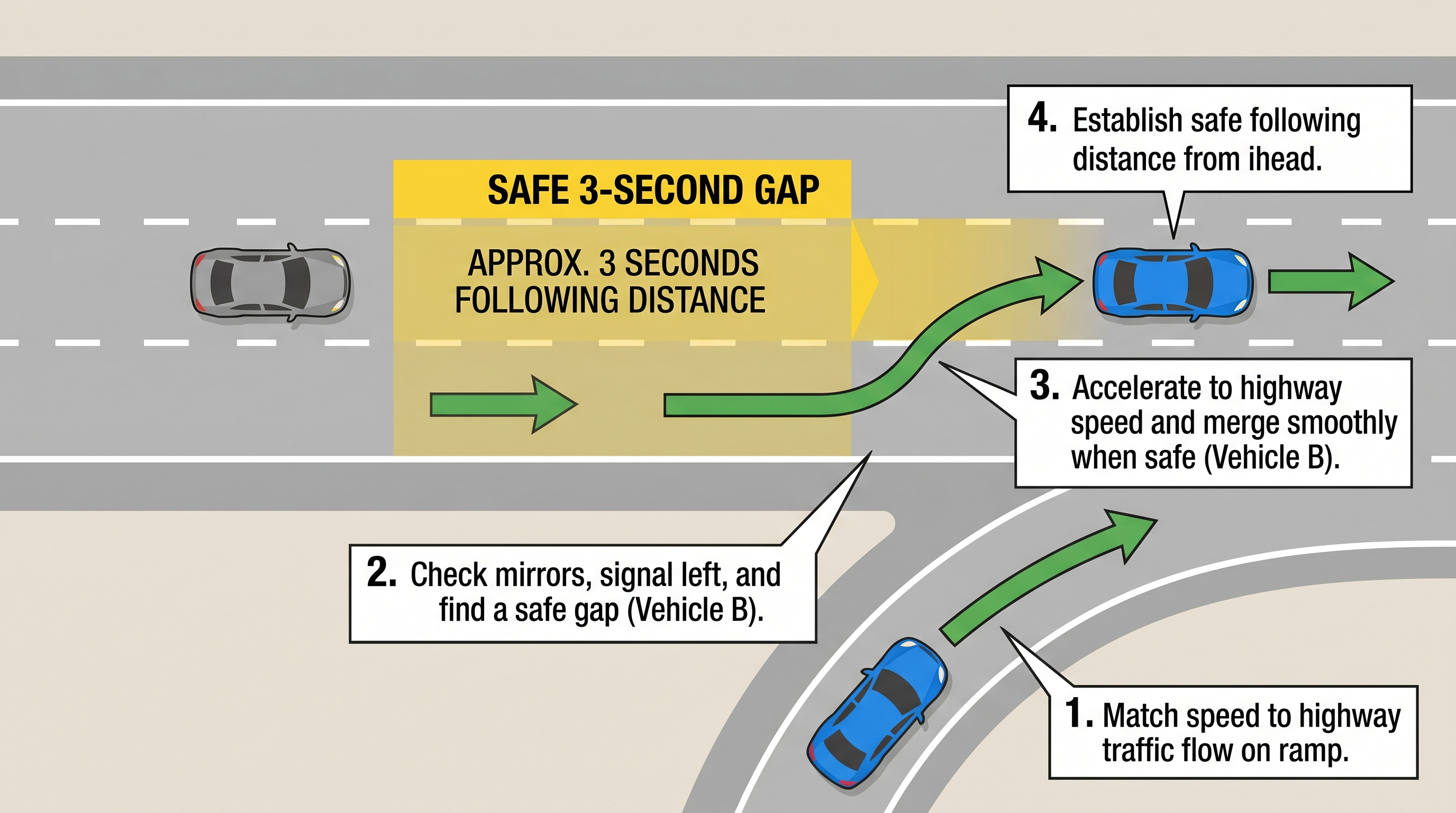
Master highway merging with a 4-step technique: speed matching, gap acceptance, and smooth lane entry. Pass your driving test with confidence.
The acceleration lane stretches ahead. Cars blur past you at 65 mph. Your hands grip the wheel tighter. You have maybe 300 feet to match speed, find a gap, and merge into live traffic. Panic sets in.
This is the moment that terrifies new drivers most: merging onto a highway. Yet it's one of the most controllable maneuvers once you understand the physics and technique.
This guide breaks highway merging into four clear steps, explains how to judge gap safety, shows you where to position your car, and gives you a mental model that turns panic into confidence. Whether you're practicing for your driving test or your first freeway drive, you'll know exactly what to do.
A highway merge is when your on-ramp joins a freeway or interstate, and you shift from the acceleration lane into live traffic. The acceleration lane (also called the entry ramp or merge lane) gives you space to build speed and find a safe gap.
Three things trigger merge anxiety:
The solution is a sequence. Do the steps in order, and the math takes care of itself.
The moment you enter the on-ramp, start accelerating. Don't hesitate.
Speed guidance by road type:
The accelerator should feel gradual, not aggressive. You're not racing; you're merging into a flow.
As you accelerate, continuously scan the highway ahead. You're looking for a gap—an open space at least 4-5 seconds wide between vehicles.
The 4-5 Second Rule: At 65 mph, a safe gap is about 300-400 feet. To estimate: pick a fixed marker (road sign, mile marker), count "one-Mississippi, two-Mississippi, three-Mississippi, four-Mississippi, five-Mississippi." If a car passes that marker during your count, you've got 5 seconds before it reaches you. That's safe.
Where to look:
Avoid these gap mistakes:
By the time you've identified a safe gap, you should be at or near highway speed. Now it's time to position yourself to merge.
The merge angle matters: Your steering should be very gradual—maybe 2-3 degrees. You're not making a sharp left turn; you're drifting into the lane. A smooth angle looks professional and gives you more time to correct if needed.
Once your car is fully in the left lane, straighten your wheels and maintain your speed.
Why you stabilize first: Examiners (and defensive drivers) watch for controlled merges. Merge, then stabilize. Don't merge and immediately change lanes again—that looks panicked or unsafe.
| Mistake | Why It Fails | How to Fix |
|---|---|---|
| Accelerating too slowly (40-45 mph) | Creates a speed mismatch; other cars brake; traffic backs up | Start accelerating immediately; reach highway speed by end of ramp |
| Waiting for a "perfect" gap | Gap never comes; you run out of ramp; forced to brake hard on merge | Any 4-5 second gap is safe. Don't wait for empty lane |
| Not checking blind spot | Motorcycle in your blind spot; dangerous collision risk | Shoulder turn your head left before every merge |
| Jerky steering inputs | Looks unsafe on DMV test; scares passengers; wastes time | Steer gradually; pretend you're aiming for a point 500 feet ahead |
| Merging too close to the end of ramp | Limited time to adjust if gap closes | Start merging by 80% of the ramp length |
| Braking while merging | Dangerous; vehicles behind you brake; chain reaction | Maintain speed or accelerate; never brake during merge |
| Signaling after you've already started moving | Other drivers don't see signal in time | Signal 2-3 seconds before moving |
Amir was terrified of the I-95 merge for his DMV test. On the practice run, his examiner directed him to the on-ramp. Amir accelerated to 40 mph, saw traffic at 65 mph, panicked, and braked. The examiner said, "Keep accelerating. Match their speed."
On the actual test, Amir focused on one rule: "Accelerate first, merge second." He hit 65 mph before the merge point, scanned for a gap, found one, checked his blind spot, and merged smoothly. The examiner nodded. That controlled approach passed the test.
Sarah merged onto the highway successfully but then immediately swerved left again to pass a truck, all within 10 seconds of entering the left lane. The examiner marked it down: "Your merge was good, but you didn't stabilize. Always settle into a lane for 30-60 seconds before changing again."
On her retest, Sarah merged, then held the lane for a full minute before passing. Examiners want to see controlled, predictable driving—not jittery lane hopping.
Most state driving tests score the merge on a 0-3 scale:
| Score | Criteria |
|---|---|
| 3 (Excellent) | Speed matching, smooth merge, proper mirror/blind-spot checks, no sudden braking, merges at safe angle |
| 2 (Good) | Speed slightly off-target, slight hesitation in merge, but safe gap chosen and merge executed |
| 1 (Passing) | Merge completed with minor speed mismatch or delayed blind-spot check, but no safety risk |
| 0 (Fail) | Fails to accelerate, merges into unsafe gap (1-2 seconds), brakes during merge, swerves, or causes other vehicle to brake |
Examiners watch for these specific behaviors:
Before merging:
During the merge:
After the merge:
Hit all eight checkmarks, and you pass this maneuver.
When traffic is bumper-to-bumper (20-35 mph), the merge dynamic changes:
Example: You're merging at 25 mph. A gap opens between two cars. It's only 2.5 seconds. That's usually unsafe at highway speed, but at 25 mph, it's manageable. Check your blind spot, signal, and merge gradually.
Some on-ramps (near major cities) dump you into a 4-6 lane highway. The merge strategy is the same, but you have more options:
This flexibility actually makes multi-lane merges easier than tight two-lane merges. More options = more safety.
Merging at night or in rain requires extra caution:
The fastest way to pass your test is consistent practice with real questions. Try Wheelingo free — state-specific questions, instant explanations, and a readiness score that tells you when you're ready.
Q: What if I can't reach highway speed by the end of the ramp? A: If you're still below highway speed at the merge point, continue accelerating while merging. You're not required to match speed perfectly before merging—it's OK to reach 60 mph while merging into 65 mph traffic. The gap will accommodate the 5 mph difference.
Q: Should I merge left or stay right on a multi-lane highway? A: Merge into whichever lane has a safe gap. On two-lane sections, you have no choice (left is the only option). On multi-lane highways, move into the rightmost available lane to minimize disruption. You can move left for passing later.
Q: What if a car speeds up and closes the gap I was targeting? A: It happens. Stay calm. Let that gap go and target the next one. There's always another gap coming. Never force a merge or brake hard to "defend" a gap.
Q: Is it illegal to merge on a dashed line vs. a solid line? A: A dashed white line means you can merge (it's legal and safe). A solid white line discourages merging but isn't a strict prohibition. Yellow lines (left side of road) separate opposite directions—never cross yellow lines.
Q: How fast should I go on the on-ramp itself? A: Gradually accelerate from entry speed (typically 15-25 mph when exiting a surface street) to highway speed. By the time you reach the merge point, you should be at or very near highway speed. Most on-ramps are 400-700 feet—plenty of distance to reach 65 mph.
Q: Can I merge if I'm in a truck or towing a trailer? A: Yes, but increase your safety margins. Large vehicles need longer acceleration distances and longer gaps (5-6 seconds minimum). Start accelerating earlier in the ramp.
Q: What's the safest speed to merge at? A: Match the speed of surrounding traffic. If traffic is 65 mph, merge at 65 mph. If traffic is 55 mph, merge at 55 mph. Merging at a speed significantly different from traffic (faster or slower) creates instability.
Week 1: Low-Speed, Light-Traffic Practice
Week 2: Mirror and Blind-Spot Checks
Week 3: Tighter Traffic and Peak Hours
Week 4: Final Confidence Building
Most drivers are merge-ready after 8-12 hours of deliberate practice on this skill.
Build your complete highway driving foundation:
Highway merging is not magic. It's a four-step sequence: accelerate smoothly, match speed, identify a safe gap, and merge at a gradual angle. Every merge follows this pattern, whether you're on a quiet state route or a packed interstate.
The panic dissolves when you stop thinking of merging as "fitting into a tiny space" and start thinking of it as "sliding into a continuous flow." Traffic is a river. You're not jumping across it; you're merging into it.
Start with light-traffic practice. Build muscle memory. Understand the 4-5 second gap rule. Do your mirror and blind-spot checks religiously. Within 10-12 hours of practice, merging becomes automatic.
On your DMV test, you'll merge with the confidence of someone who's done it a hundred times. The examiner will see smooth acceleration, proper checks, and controlled steering—not panic.
Ready to master highway driving? Download the Wheelingo app and practice every maneuver with video guides and real-time feedback. Track your progress as you build test-ready confidence.
External References: