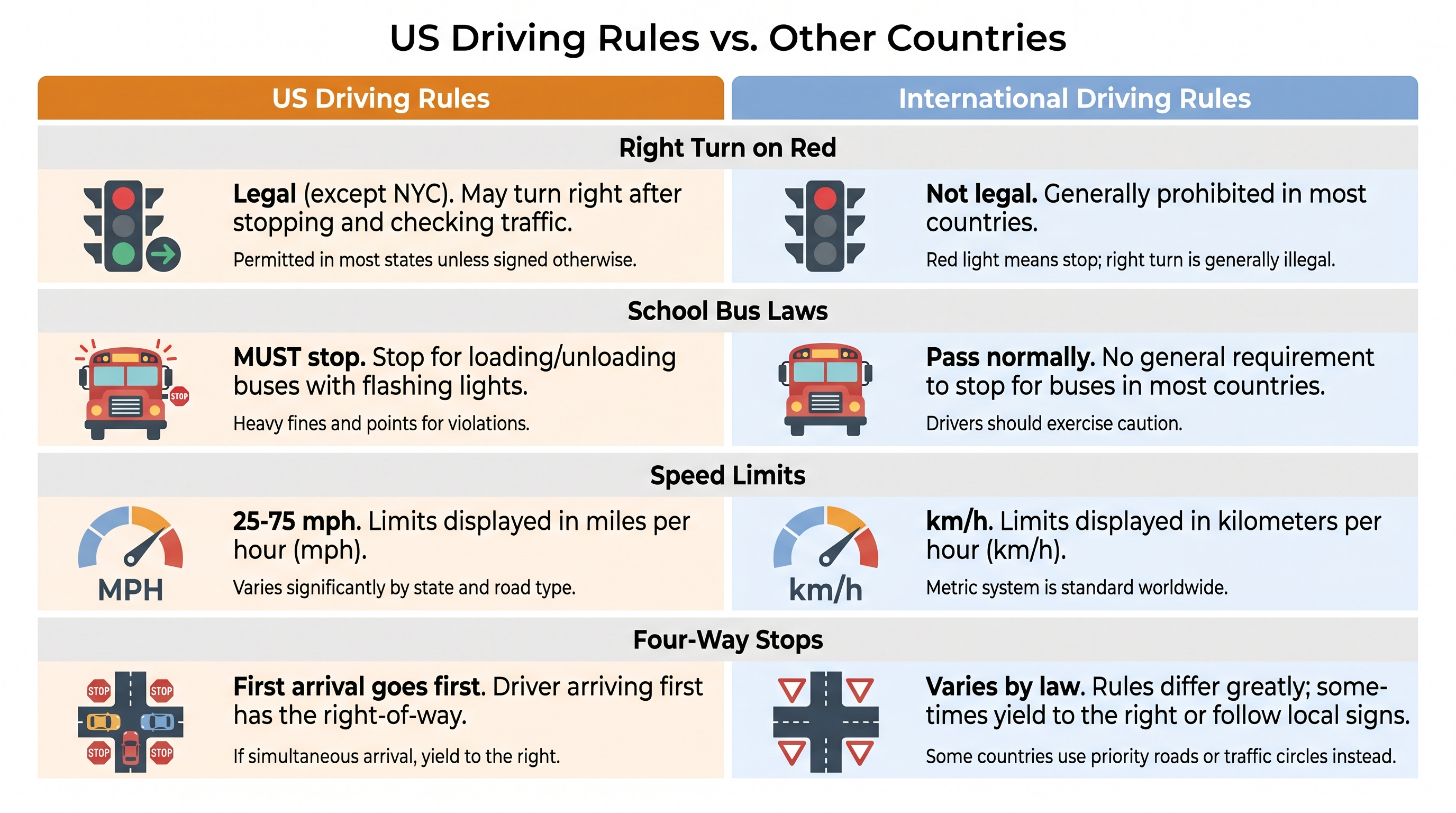
Master US road signs by shape and color. Learn which signs appear on DMV tests, memory tricks, and pavement markings.
Road signs are the silent language of the highway. They tell you to stop, warn you of danger ahead, and guide you where to go—sometimes without a single word. Yet millions of drivers face the DMV test every year and freeze when they see a diamond-shaped yellow sign. What does it mean? Road signs seem random until you learn the system.
Here's the truth: every road sign in America follows two simple rules. Its shape tells you what type of information it is. Its color tells you how urgent that information is. Once you understand this framework, you won't memorize 500 individual signs—you'll understand the logic behind all of them.
This guide walks you through the MUTCD system (Manual on Uniform Traffic Control Devices) that organizes every sign in the US. You'll learn which signs dominate DMV tests, which ones people miss most often, and how to build a mental filing system that sticks. By the end, road signs won't be random symbols. They'll be a predictable language.
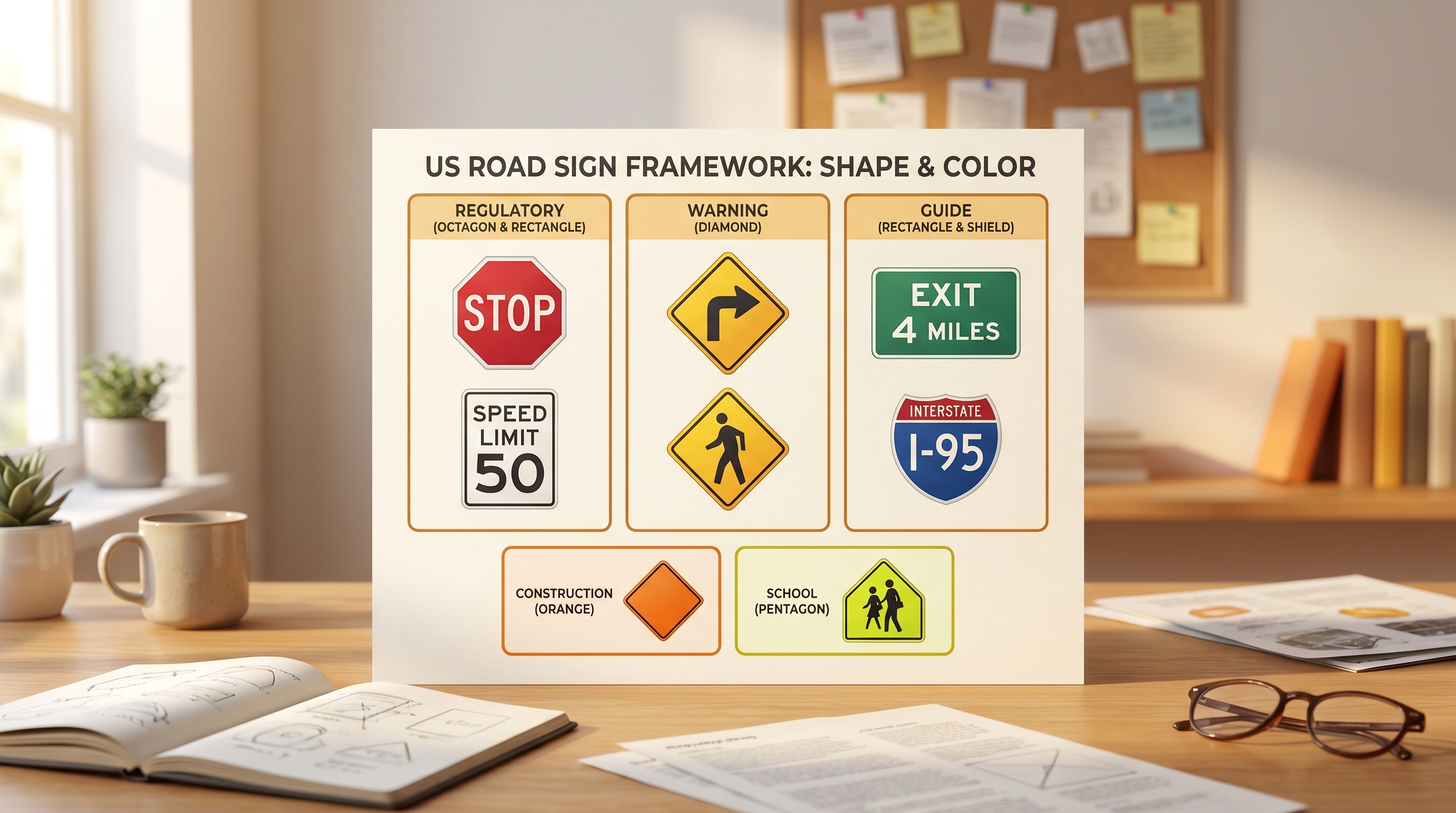
Every road sign you encounter follows a hidden rule: shape = message type, and color = urgency level.
This is the MUTCD framework. The Federal Highway Administration established it in the 1930s and updated it most recently in December 2023 (11th Edition). It's the standard across all 50 states.
Regulatory Signs (White background, black text): These are rules. You must obey them. Speed limit signs, one-way signs, and "Do Not Enter" are regulatory signs. If you ignore them, you can get a ticket.
Warning Signs (Yellow background, black symbol/text): These alert you to a hazard ahead. A yellow diamond means "something unexpected is coming—prepare yourself." Warnings are critical for DMV tests because they require interpretation. You won't always see the exact scenario the sign describes.
Guide Signs (Green, blue, or brown backgrounds): These help you navigate. Green signs point to highways and exits. Blue signs show services (food, gas, hospital). Brown signs direct you to parks and points of interest.
The MUTCD doesn't use arbitrary shapes. Each shape signals a purpose instantly:
Your DMV test doesn't show you sign text. It shows you the shape and color. If you see a white rectangle, you know it's a rule. If you see a yellow diamond, you know it's a warning. This is why mastering shapes unlocks the entire system.
 Red: Stop, prohibition, danger. Red signs demand immediate action. "Stop," "Yield," "Do Not Enter," "No Left Turn"—all red. Red is the warmest color and signals urgency.
White: Rules and regulations. Speed limits, one-way signs, lane restrictions, turn prohibitions. White is neutral and official. State and local laws are painted on white.
Yellow: General warnings. Curves ahead, pedestrians crossing, intersection warnings, slippery road. Yellow is visible at night and alerts you to slow down, but it doesn't prohibit action—it warns.
Orange: Construction and work zones. Orange is temporary. When road construction happens, orange signs tell you the zone is active, lane shifts are coming, and speeds are reduced. Many states double fines in construction zones.
Green: Go, guidance, direction. Green directional signs show you where to go—highway exits, route numbers, distance markers. Green signals you can proceed and shows the safe path.
Blue: Services and information. Rest areas, gas stations, hospitals, lodging. Blue signs help you find facilities and resources. They're informational, not mandatory.
Brown: Recreation and cultural interest. National forests, state parks, historical sites, scenic viewpoints. Brown signs direct you to special places worth stopping for.
Fluorescent Yellow-Green: School zones and pedestrian warnings. This neon-bright color is the newest addition to the MUTCD system (updated 2023). It's highly visible and signals children or pedestrians are nearby.
| Color | Background Meaning | Text Color | Sign Type |
|---|---|---|---|
| Red | Stop/Prohibition | White | Regulatory |
| White | Rules/Speed limits | Black | Regulatory |
| Yellow | General warning | Black | Warning |
| Orange | Construction zone | Black | Temporary/Warning |
| Green | Direction/Go | White | Guide |
| Blue | Services | White | Information |
| Brown | Recreation | White | Guide |
| Fluorescent Yellow-Green | School/Pedestrian | Black | Warning |
The only octagonal sign in the MUTCD. Red background, white "STOP" text. The shape itself is a stop sign—no text needed. At a stop sign, you must come to a complete stop. Come to a complete stop, check for traffic, and proceed only when it's safe. DMV tests often ask: "Can you go at a stop sign if the road is clear?" Answer: No, you must come to a complete stop first, even if the road appears empty.
A white triangle pointing downward, red border. "Yield" means give other drivers the right of way. You don't have to stop completely (unlike Stop), but you must slow down and be ready to stop. At a yield sign, the other road has priority. This is one of the most-tested traffic control signs because it requires judgment—you're not forced to stop; you're required to be cautious.
Yellow diamond with black symbol or text. Diamonds alert you to hazards ahead. A diamond might show a curve, a pedestrian crossing, animals crossing, slippery road, or a wind gust symbol. The specific symbol inside tells you the hazard. Yellow + Diamond = "Attention: something unexpected is coming." Diamonds are the most-missed DMV sign category because test-takers confuse different diamond warnings. Is it a curve warning or a pedestrian warning? The symbol tells you.
Neon yellow-green pentagon. School zones are where children cross streets. Reduce speed during school hours, watch for crossing students, and obey all signs. State laws vary on school zone penalties. Some states impose $300+ fines for speeding in school zones. The pentagon shape became standard after a series of school safety initiatives in the 2000s.
Black circle with white railroad track symbol, yellow background. This rare sign warns you of an upcoming railroad crossing. Slow down, listen for trains, and be ready to stop. At the crossing itself, you'll see red flashing lights and gates if a train is coming. Never shift gears or stop on railroad tracks. If your car stalls on the tracks, get out and move away from the tracks immediately.
Yellow pennant pointing backward on the left side of the road. This shape is distinctive: it looks like a flag. If you see a pennant on your left, you are entering a no-passing zone. Do not pass cars ahead of you until you see the pennant end (or see a solid yellow line turn broken). Pennants are critical for two-lane road safety. The angle (pointing backward) signals "don't go forward."
White rectangle, taller than wide. All speed limit signs, one-way signs, turn prohibitions, and parking rules use vertical rectangles. Vertical = authority, law. If you see a white rectangle, it's a rule you must follow.
Green or brown rectangle, wider than tall. Guide signs, exit signs, distance markers. Horizontal = information, direction, guidance. These signs help you navigate.
Red, white, and blue shield (like the Interstate shield) or state/US highway shields. Shields show your route number. Interstate shields are red and blue. US highway shields are black and white. State highway shields vary by state but are usually red and white. Shields don't command action; they simply identify the route.
| Shape | Color(s) | Meaning | Example |
|---|---|---|---|
| Octagon | Red/white | STOP | Stop sign |
| Inverted Triangle | White/red | Yield | Yield sign |
| Diamond | Yellow/black | Warning | Curve warning, pedestrian warning |
| Pentagon | Yellow-green/black | School zone | School crossing |
| Circle | Yellow/black | Railroad | Railroad crossing advance |
| Pennant | Yellow/black | No passing | Left side of road, entering no-pass zone |
| Vertical Rectangle | White/black | Regulatory | Speed limits, one-way, prohibitions |
| Horizontal Rectangle | Green/white, Brown/white | Guide | Exits, route numbers, services |
| Shield | Red/white/blue | Route ID | Interstate 95, US 101, State Route 5 |
See how road signs work in real driving situations:
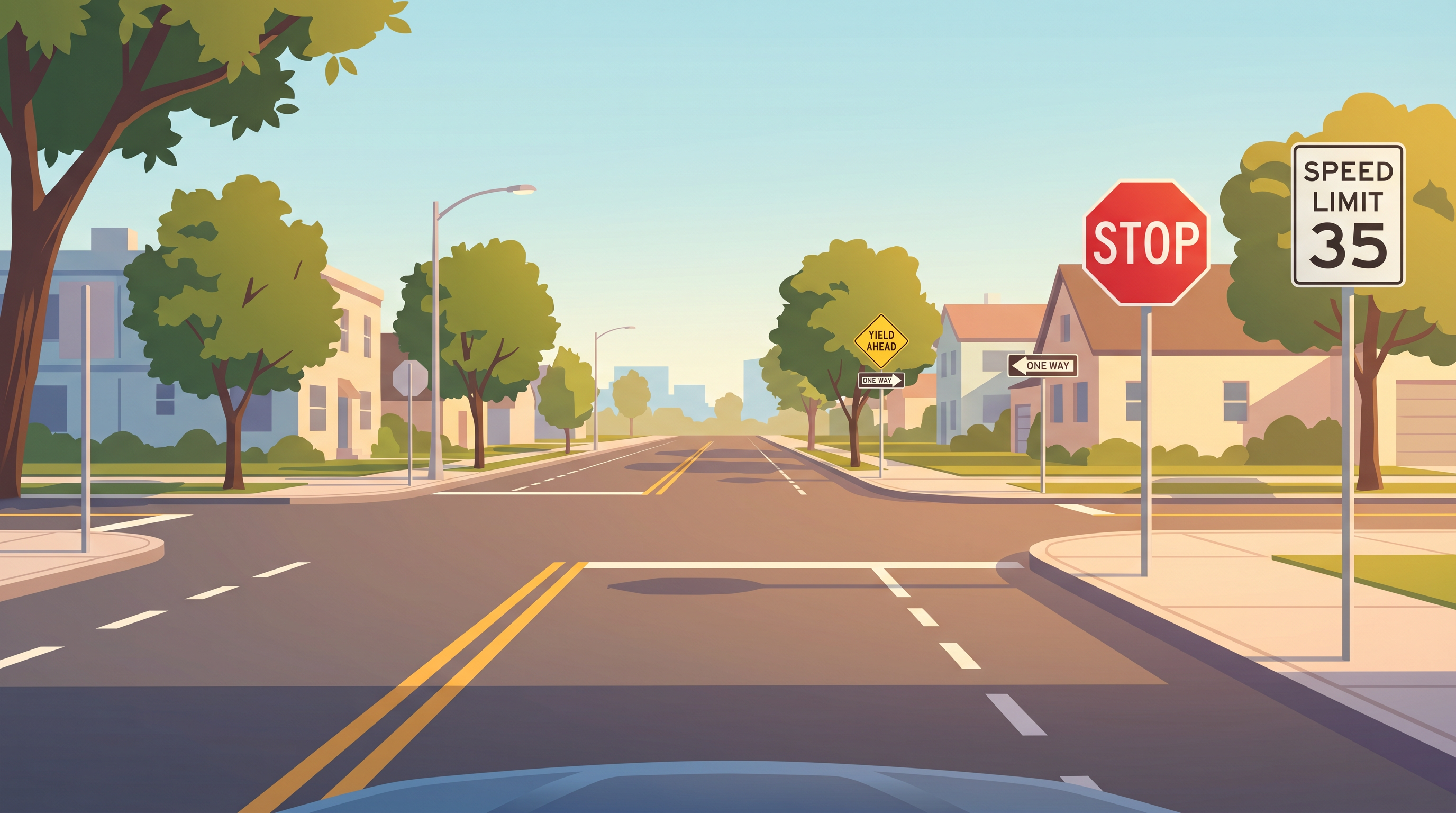 Regulatory signs are rules. You must obey them. If you violate a regulatory sign, you can receive a ticket and demerit points.
Red octagon, white "STOP". Come to a complete stop. The wheels must not be moving. Look left-right-left for traffic. Proceed only when safe. Many drivers roll through stops—a common reason for failed DMV tests. The examiner watches for a full stop.
White inverted triangle with red border. "Yield" not "stop." You can proceed if it's safe. You don't have to stop if the road is clear, but you must be ready to stop. At a yield sign, cross traffic has the right of way.
White vertical rectangle, black numbers. The maximum speed you may travel. Speed limits are set based on road conditions, not posted limits. If conditions are poor (rain, fog, traffic), you must slow down below the posted limit. Speed limits are enforceable. Exceeding them by even 1 mph is technically speeding.
White rectangle, black symbol showing a left/right arrow with a red circle-slash. "No Left Turn," "No Right Turn," "No U-Turn." These are absolute prohibitions. You will fail your DMV test if you make a prohibited turn.
White vertical rectangle with black arrow pointing left or right. You must travel in the direction the arrow points. Driving against a one-way sign is illegal and dangerous. Some DMV tests ask: "Can you turn left on a one-way street that has only one lane?" Answer: Yes, if there's no "No Left Turn" sign.
Red background, white text or symbol. "Do Not Enter" uses a white horizontal rectangle. "Wrong Way" uses a white "W" with a circle-slash. Both mean the same thing: this direction is prohibited. These signs appear at freeway off-ramps or highway exits. If you see one, you are going the wrong way. Pull over safely and turn around.
White vertical rectangle with arrow. Keeps traffic flowing on the correct side of an obstacle (island, median, construction zone). Follow the arrow direction.
Electronic signs above lanes showing green arrows (lane open), yellow X (caution, prepare to leave lane), or red X (lane closed). On highways with reversible lanes (like the Tappan Zee Bridge in New York), lane direction changes by time of day. Obey the signals above your lane.
Top 10 Regulatory Signs by DMV Test Frequency:
Warning signs alert you to hazards. They're yellow diamonds (or yellow rectangles in some cases). They don't prohibit action—they warn you to be cautious.
Yellow diamond showing a curve arrow left or right, or a sharp turn symbol. These warn you that the road curves ahead. Slow down, especially on wet roads. Road friction decreases on curves. If you're traveling 55 mph and a curve tightens, you may skid or tip if you don't reduce speed.
Yellow diamond with pedestrian silhouette. A pedestrian crossing is ahead. Pedestrians have the right of way. Slow down, watch for people crossing, and be ready to stop. Many DMV tests include questions about pedestrian crossings at unmarked locations.
Yellow diamond with bicycle silhouette. Cyclists are sharing the road ahead. Give them space (at least 3 feet when passing), don't honk suddenly (it startles them), and pass only when safe.
Yellow diamond with a deer, moose, or cattle silhouette. Wild animals or livestock may cross the road. Slow down, especially at dawn/dusk when deer are most active. If you hit a large animal (elk, moose), your car can suffer severe damage. It's not a safety issue—it's physics. A moose weighs 1,200 pounds.
Yellow diamond with a skidding car symbol. The road surface is wet, icy, or loose gravel. Reduce speed, increase following distance, and avoid sudden steering changes. Slippery roads are common DMV test questions because they test understanding of how to adjust driving for conditions.
Yellow diamond with a downward arrow. A steep downhill section is ahead. Downhill sections increase speed naturally due to gravity. Shift to a lower gear before descending (especially in trucks). If your brakes overheat on long downhills, you lose stopping power. This is why trucks use engine brakes.
Yellow diamond with an uneven road line. Uneven pavement is ahead. Slow down to avoid damage to your vehicle and loss of control. A sudden dip can cause your tires to lose grip.
Yellow diamond with bridge symbol and narrowing lines. The bridge ahead is narrower than the approaching road. This often means reduced lanes or one-way alternating traffic. Slow down and be ready to yield.
Yellow diamond with arrow showing lanes merging together. A lane is ending ahead (construction, or the road geometry changes). Move into the open lane before the end. Don't wait until the last moment.
Yellow diamond showing a cross symbol. An intersection is ahead. Slow down, look both ways, and be ready to stop. Intersection warnings appear before un-signalized intersections in rural areas.
Top 10 Warning Signs by DMV Test Frequency:
 Guide signs are green, blue, or brown. They help you navigate without demanding immediate action.
Red, white, and blue shield. Shows your route number (I-95, I-405). Interstate shields are distinctive. They never change, even if the road designation changes. If you're lost, find the nearest interstate shield to orient yourself.
Black and white shield. US Route numbers. Less common in daily driving than state highways but appear on major roads across state lines.
Green sign with white "EXIT" and a route number. Distance marker in white below. Green exit signs tell you which exit is coming and how far away. Plan your exit well in advance.
Green sign with route and distance. "Chicago: 45 miles," "Route 2 West 3 miles." These help you navigate multi-hour drives.
Blue background, white symbol showing gas pump, fork and knife, bed (hospital), or "H" (hospital). Blue service signs indicate upcoming services. They typically appear 1–2 miles before the service location. Very helpful for highway driving.
Blue background, white symbol showing picnic table or rest area label. Rest areas are free, open to the public, and typically have bathrooms and picnic facilities. Some are 24 hours; others have limited hours.
Brown background, white symbols or text. Parks, scenic areas, historical sites. These signs aren't tested on the DMV exam but help with real-world navigation.
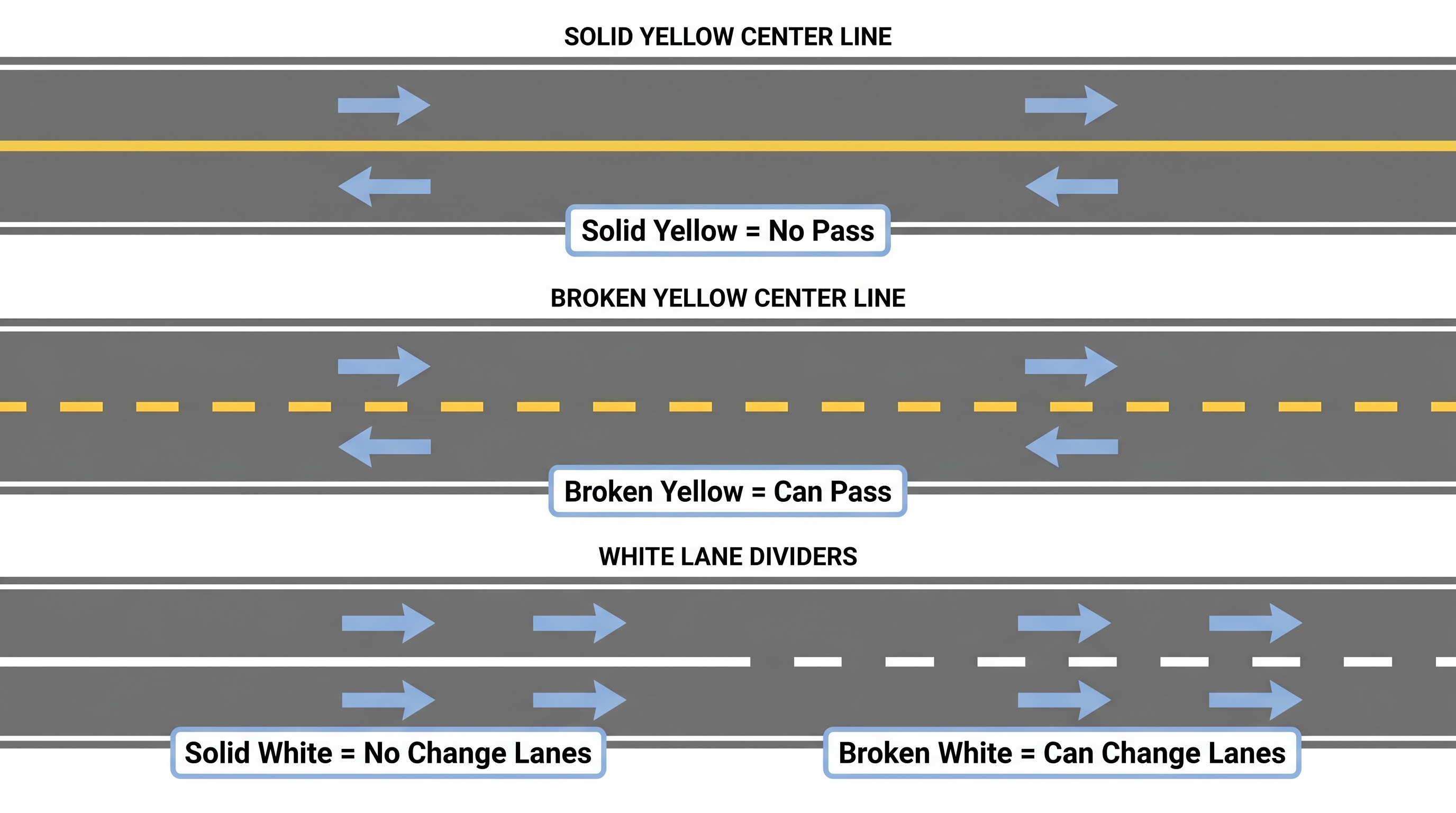
Pavement markings are the most-missed DMV topic because they're everywhere but rarely emphasized in study guides.
A yellow line separates traffic moving in opposite directions. Yellow always means "do not cross here" if the line is solid.
Solid yellow line on your side = you cannot pass. No passing allowed.
Broken yellow line on your side = you can pass if it's safe and legal (no oncoming traffic).
Double solid yellow lines = neither direction can pass. Absolute prohibition.
Solid yellow on your side, broken on the other = only the side with the broken line can pass.
The rule: if there's a solid line on your side, don't cross it. Period.
A white line separates lanes moving in the same direction.
Broken white line = you can change lanes (check mirrors, use signal).
Solid white line = lane change is discouraged but not illegal (in most states). Don't change lanes across a solid white unless necessary (e.g., to avoid a hazard).
Double solid white lines = lane change is prohibited. Treat this like a yellow line—don't cross.
White lines on the outside edges of the road show the road boundary. You shouldn't cross the white edge line unless turning or pulling over.
White arrows at intersections show which direction you can turn from that lane. If an arrow points left, you must turn left (or go straight if there's also a straight arrow). Don't use a turning lane to go straight.
White diamond symbol with an "H" or number (2, 3). These lanes are for high-occupancy vehicles (carpools, buses). You can't use an HOV lane unless you meet the occupancy requirement (usually 2–3 people). Violating HOV restrictions can result in fines.
White "X" with the word "RAILROAD" and two parallel white lines forming a rectangle. These markings show you are approaching railroad tracks. Look and listen for trains.
White stripes or zebra pattern on the road. These mark pedestrian crossing areas. Pedestrians have the right of way in crosswalks. If you see a crosswalk, slow down and be prepared to stop.
| Marking | Color | Meaning |
|---|---|---|
| Broken line | Yellow (center) | Passing allowed on your side |
| Solid line | Yellow (center) | No passing on your side |
| Double solid | Yellow | No passing either direction |
| Broken line | White (lane) | Can change lanes |
| Solid line | White (lane) | Don't change lanes (discouraged) |
| Edge line | White | Road boundary |
| HOV diamond | White | Carpool/high-occupancy lane |
| Railroad X | White | Upcoming railroad crossing |
| Crosswalk stripes | White | Pedestrian crossing |
The Shape-Color-Symbol Framework
Instead of memorizing 500 individual signs, learn the system:
This framework cuts memorization time by 70%.
Memory Tricks
Confusing Sign Pairs
The DMV loves testing pairs that look similar:
Practice with these pairs on your state-specific practice tests.
DMV Test Strategy
The fastest way to pass your test is consistent practice with real questions. Try Wheelingo free — state-specific questions, instant explanations, and a readiness score that tells you when you're ready.
How many road signs are there in the US? The MUTCD defines 500+ standardized signs. However, your DMV test covers roughly 50–100 signs per state, not all 500.
What does a diamond-shaped sign mean? A yellow diamond warns you of a hazard ahead. The symbol inside the diamond tells you the specific hazard. Always slow down when you see a yellow diamond.
What does a pentagon-shaped sign mean? A neon yellow-green pentagon indicates a school zone. Reduce speed during school hours, watch for crossing children, and obey all signs. Penalties for speeding in school zones are typically doubled.
What color are warning signs? Yellow background with black text or symbol. Yellow is visible at night and signals you to slow down or be cautious. The most common warning is a yellow diamond.
How many road sign questions are on the DMV test? Most states include 15–20 road sign questions on the written test (out of 50 total). Some states weight road signs as 30% of the test. Road sign knowledge is critical.
What is the difference between a regulatory sign and a warning sign? Regulatory signs (white background) are rules you must obey. Warning signs (yellow background) alert you to hazards and require caution. Violating a regulatory sign earns a ticket. Missing a warning can cause a crash.
Can you turn right on a red light? In most US states, yes, after a complete stop. However, many intersections prohibit right turns on red (marked with "No Right Turn on Red" signs). Always check for signs before turning.
What does a solid yellow line mean? If a solid yellow line is on your side of the road (center line), you cannot pass. Solid yellow always means don't cross. If you see a solid yellow and a broken yellow together, only the side with the broken line can pass.
Master your state's road signs with this checklist:
Ready to test yourself? Start a free Wheelingo practice test for your state and see which signs are your weak points. Your personalized feedback will show you exactly which signs you need more practice with, and you can focus your remaining study time where it matters most.
Road signs are a language. Once you learn the grammar (shape and color), the vocabulary (individual signs) falls into place. You won't face the DMV test wondering what a diamond sign means. You'll see it and instantly know: "This is a warning. Slow down and look for the hazard ahead."
The shape-color-symbol system is the key. Master it, practice with your state's most-tested signs, and you'll pass the road sign portion of your DMV test with confidence.
Your DMV test day is coming. Road signs won't be a guessing game. They'll be a predictable language you understand.
Download Wheelingo and start practicing road signs for your state today. Get immediate feedback on every question, track which signs you've mastered, and see your confidence grow.
You've got this.
3,450 words