Learn defensive driving techniques that will help you pass your DMV test and stay safe on the road. Complete guide covering the 3-second rule, hazard anticipation, and every scenario.
Defensive driving isn't just a set of techniques—it's a mindset. It's the difference between reacting to danger and anticipating it before it happens. For new drivers, mastering defensive driving means more than staying safe on the road; it means passing your DMV written test with confidence.
This guide covers every defensive driving concept your state's DMV will test, backed by real crash data and practical step-by-step strategies you can use today. Whether you're preparing for your permit test or building the habits that will keep you safe for decades, this guide has what you need.
 Defensive driving is anticipating hazards created by other drivers, the road, and weather—and responding with safe decisions, regardless of what others do around you. It's not about following every rule perfectly; it's about assuming that other drivers will make mistakes and positioning yourself to avoid their consequences.
The DMV tests defensive driving because crash statistics demand it. Teen drivers—ages 16 to 19—represent only 5% of licensed drivers in the United States but account for 8.9% of all fatal crashes. Why? Inexperience. New drivers haven't developed the split-second pattern recognition that prevents collisions. Defensive driving training is proven to reduce crashes by 15-30%, which is why every state DMV includes defensive driving questions on the written permit test.
Here's what makes defensive driving different from basic rule-following:
This distinction appears on your DMV test in questions like: "You're entering a residential neighborhood at dawn. What should you do?" The safe answer isn't just "obey the 25 mph limit." It's "reduce speed further because pedestrians are less visible at dawn, and you can't see bicycles in shadows until it's too late."
According to the National Highway Traffic Safety Administration (NHTSA), 92% of drivers admit to aggressive or risky behaviors behind the wheel. That's not a character flaw—it's a reality you must prepare for. Other drivers will tailgate you, cut you off, and make poor decisions. Your job is to see it coming.
 These eight techniques form the foundation of safe driving and appear on every state's DMV test. Master them, and you'll recognize hazards before they become emergencies.
Following distance is the single most important defensive driving skill. It's also one of the most common DMV test questions, and one that trips up new drivers.
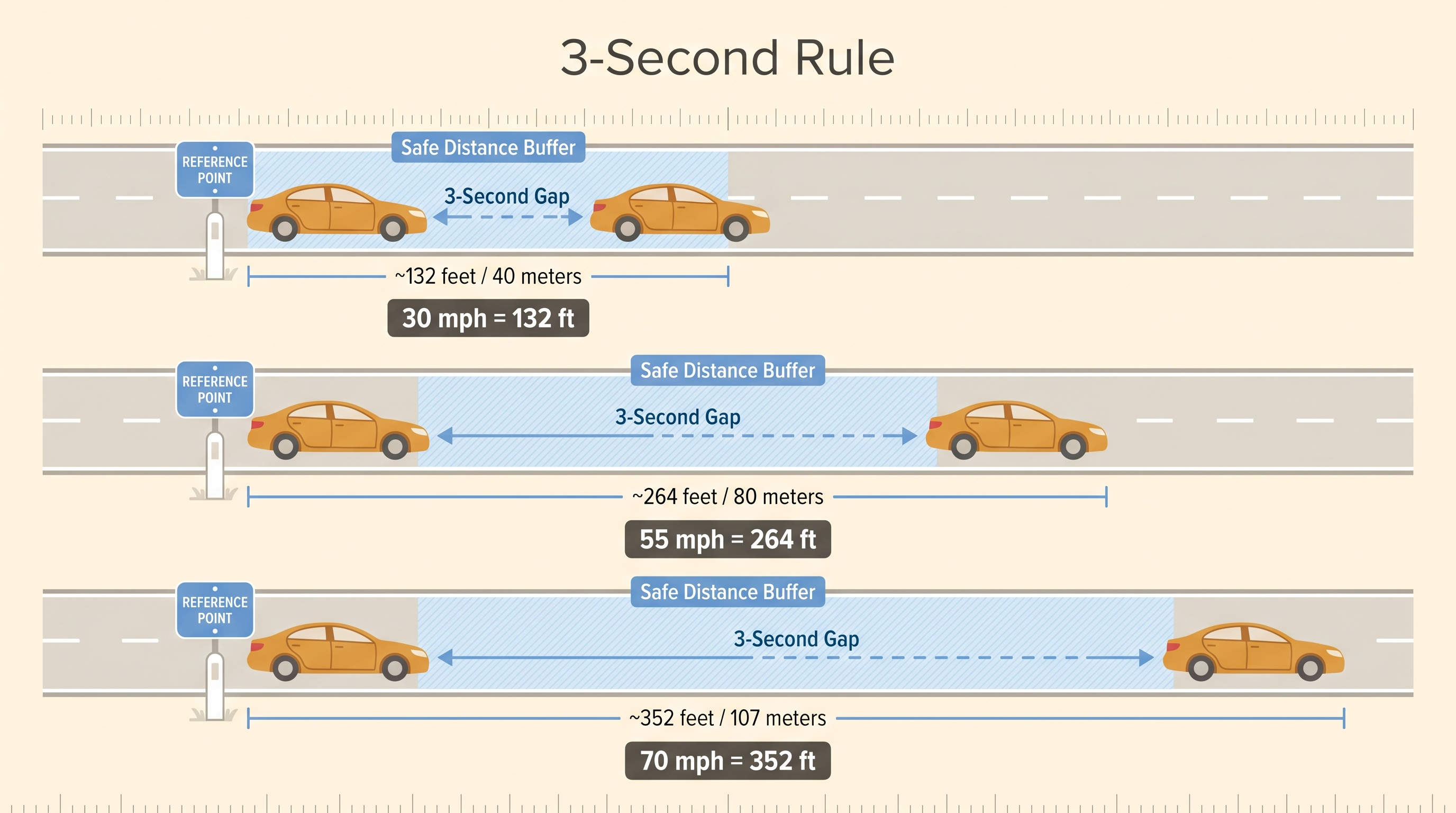
Here's how it works: Pick a fixed object on the road ahead—a sign, mailbox, or pavement marking. When the car in front of you passes that object, start counting: "One-Mississippi, two-Mississippi, three-Mississippi." If you pass the same object before you finish counting, you're following too closely. This 3-second gap is your reaction time cushion.
At 30 mph, 3 seconds equals roughly 132 feet of space. At 60 mph, it's 264 feet. Most new drivers dramatically underestimate this distance. What feels like "safe" following distance is usually only 1-1.5 seconds, which means you have no buffer if the car ahead brakes suddenly.
When to increase it to 4-5 seconds:
This rule is fundamental. If you remember nothing else about defensive driving, remember this: 3 seconds minimum, 5 seconds in poor conditions.
Most new drivers look at the road 5-10 feet ahead—basically at the car in front of them. Experienced drivers scan 12-15 seconds ahead, which at highway speeds is a quarter-mile. This practice is called "target fixation" in reverse: instead of staring at one danger, you're watching for patterns that predict danger.
What are you scanning for?
Scanning takes practice, but it's like learning to speed-read. Your eyes move from the far distance down to the near distance in a steady rhythm. After a few weeks of conscious practice, it becomes automatic. And here's the benefit: you'll never be startled by traffic again. You'll already be preparing your response.
Your mirrors are your situational awareness. Checking them every 5-8 seconds tells you where other drivers are, how fast they're approaching, and whether someone is positioning to pass or merge into you.
Most new drivers check mirrors only when they're about to change lanes. That's backwards. If you're checking mirrors only when you need to change lanes, you won't know a tailgater is waiting in your blind spot until it's almost too late.
The rhythm is: center mirror, left mirror, right mirror, back to the road. Do this cycle every time you travel one block in urban traffic, or every 10-15 seconds on highways. This habit eliminates blind spot surprises and gives you constant awareness of what's behind you.
The posted speed limit is the maximum safe speed under ideal conditions. Rain, snow, fog, heavy traffic, construction, or an unfamiliar road all change the ideal speed. Most crashes happen at speeds that are legal but unsafe for the current conditions.
Your DMV test will ask: "The speed limit is 55 mph, but rain is making the road slick. You see a curve ahead. What's the safest speed?" The answer isn't 55 mph. It's "as slow as needed to maintain control."
New drivers often feel pressure to keep up with traffic. Resist it. If the road is wet and you're doing 45 mph while others do 55 mph, you're the safest person on that road. Professional drivers adjust speed 10-15 mph below posted limits when conditions worsen. You should too.
Signaling isn't optional or polite—it's a legal requirement, and it's part of defensive driving. Signal 3-5 seconds before you turn or change lanes. This gives other drivers time to react and prevents them from moving into your path.
Common mistake: New drivers signal, then immediately move. Three seconds isn't enough time for drivers behind you to process your signal. Signal early, check mirrors and blind spots, count a few seconds, then move.
Defensive drivers also signal when exiting highways (yes, even if traffic is light), when turning into parking lots, and when leaving parking spots. It takes one second. It costs nothing. And it prevents someone from pulling into your space thinking you're going straight.
At every moment while driving, know where your escape route is. If the car ahead brakes suddenly, you move left. If a car comes toward you in your lane, where can you go? If a pedestrian steps into the street, what's your option?
This isn't paranoia—it's pattern recognition. When you approach an intersection, position yourself so you could steer safely into the other lane if needed. When you're in heavy traffic, maintain gaps on both sides. When you see a potential hazard (a parked car door opening, a ball rolling into the street), position yourself with room to swerve.
Escape routes are why professional drivers never drive in the middle of a three-lane highway. The left lane lets you move right; the right lane lets you move left. The middle lane traps you. Defensive drivers position for freedom of movement.
This is the mindset. Assume that:
You're not being pessimistic. You're being predictive. Crash investigations show that 95% of crashes are human error, not mechanical failure. And human error follows patterns. Phones distract drivers, fatigue causes lane drifts, and speeding reduces stopping distance. When you see those patterns, your defensive response is already activated.
Intersections are the most dangerous places. This is where your awareness is highest. Use the L-C-R-L scan:
Do this even if the light is green. 10% of crashes at intersections happen when a driver runs a red light. You're not trusting the light; you're verifying safety.
Watch these defensive driving techniques demonstrated by experts:
Defensive driving can't protect you if your eyes and mind aren't on the road. This is where most new drivers fail, and it's the #1 cause of teen crashes.
The numbers are stark: 58% of teen crashes involve distracted driving. One text message takes your eyes off the road for an average of 5 seconds. At 55 mph, that's 385 feet traveled blind—longer than a football field.
Here's what happens in that 5 seconds:
By the time you look back, collision is unavoidable.
Put your phone in the trunk, glove box, or back seat. Not silenced. Not facedown on the passenger seat. Out of reach. If you reach for it, you've already lost concentration.
If you must use your phone (GPS, podcast, hands-free call), set it up before you drive. The DMV test will ask: "You need directions. Where should you set up your GPS?" The answer: before you start driving, not at a red light, not while moving. Set it, confirm it's audible, then start driving.
Hands-free calling is legal in most states, but it's not as safe as people think. Your brain is still dividing attention. The safest calls are ones you don't take.
Graduated driver licensing laws exist because passengers are distracting. Your brain's limited attention divides between them and the road. For new drivers, passengers increase crash risk by 40%.
The DMV test will ask: "You're a new driver, and your friends want to ride along. What should you do?" The safe answer isn't "let them ride if it's a short trip." It's "encourage them to drive their own car while you build experience." This isn't unfriendly—it's honest.
If it takes your eyes off the road for 2+ seconds, it can wait. Changing music, eating, grooming, looking at a billboard—if you can't do it in a glance, don't do it. This is why eating while driving is more dangerous than people realize. A bite of a sandwich might take 3 seconds.
Pull over to eat. Pull over to adjust your climate control. Pull over to look at anything besides the road. New drivers think this makes them slow. Actually, it makes them alive.
 The road isn't just you and cars. It's motorcycles, bicycles, pedestrians, and trucks. Each requires adjusted defensive driving.
A motorcycle is harder to see than a car because it takes up less visual space. Assume that motorcyclists are present even when you don't see them (yes, they could be in your blind spot).
When sharing the road with motorcycles:
Your DMV test will include a motorcycle scenario. Treat it like this: "A motorcycle is approaching on the left. I will not block the passing lane, and I will assume they're making a quick maneuver."
Bicyclists have the right of the road but not the power of a car. They're vulnerable.
The law: Give cyclists at least 3 feet of space when passing. Many states now have "bike boxes" at intersections where cyclists position ahead of cars at a red light. Don't block them or pass them.
Common mistake: A new driver sees an empty bike lane and assumes it's safe to turn right. No—always check the bike lane for cyclists. People ride in bike lanes.
When you see a bicycle, assume the rider might:
Your response: Slow down, give space, and pass only when you have a clear lane for 50+ feet. This seems overly cautious. It's not. It's defensive.
Pedestrians have the right of way in crosswalks and on sidewalks (except when they're jaywalking). Your job is to see them, even when they're not paying attention.
Pedestrian right-of-way rules your DMV test will cover:
The key insight: Many pedestrians aren't paying attention. They're on their phones, wearing earbuds, or distracted by children. You can't rely on them seeing your car. You must see them.
If a pedestrian is walking toward your lane with their eyes on their phone, what do you do? Slow down and prepare to stop, even though technically they're jaywalking. Defensive driving means being right, not being righteous.
Large trucks have massive blind spots—"no-zones"—where they literally can't see you. If you're directly in front (closer than 20 feet), directly behind (closer than 30 feet), or on either side adjacent to the trailer, you're invisible.
The four no-zones:
Your defensive strategy: Don't linger in these zones. Pass trucks completely (pass on the left and don't cut back in until you see the truck's front bumper in your mirror). Stay at least 4-5 seconds behind (truck braking distance is much longer than yours). Never assume the truck driver sees you.
Your DMV test will ask about no-zones. The answer: "I avoid driving in their blind spots."
Theory is one thing. Knowing what to do when someone tailgates you, when you encounter road rage, or when an animal runs into the road is another.
Tailgating is aggressive. Your instinct might be to speed up or to brake suddenly (brake checking). Both are dangerous and illegal. Here's the defensive response:
If you're in an uncontrolled area (rural road with no shoulders), consider pulling over to let the aggressive driver pass completely. Yes, this feels like backing down. It's not. It's preventing a collision.
This scenario appears on your DMV test. The answer they're looking for: "Maintain safe distance, don't brake check, and let them pass."
Road rage is real. AAA data shows 92% of drivers exhibit aggressive or risky behaviors, and road rage is escalating. A 2024 study found that 76% of people believe road rage is getting worse.
Your job is not to respond to aggression. Your job is to de-escalate or remove yourself.
If someone cuts you off:
If someone is clearly angry at you:
If you feel yourself getting angry:
Your DMV test answer: "I don't engage with aggressive drivers. I prioritize safety over principle."
This sounds silly until you're 60 mph on a dark highway and a deer is suddenly in your lane.
The correct response:
This violates every instinct (people naturally swerve), but swerving kills more people than animal collisions. Your DMV test will include this scenario. The answer: "Brake hard in a straight line. Don't swerve."
Seasonal note: Deer collisions peak October-December during mating season, and at dawn/dusk when visibility is low. Reduce speed during these times.
If your tire blows or your steering fails while driving:
Your DMV test might ask: "Your tire blows while you're on the highway. What do you do?" The answer: "Hold the wheel steady, brake gently, and pull to the shoulder."
Weather and darkness change defensive driving requirements dramatically.
50% of all traffic deaths occur at night, despite only 25% of driving happening after dark. Why? Visibility is reduced, headlights create blind spots, and fatigue increases.
Your defensive strategy for night driving:
Your DMV test: "It's dark and rainy, and you're on an unfamiliar road. What's the safest approach?" Answer: "Drive slowly, use low beams, and increase following distance."
Wet roads reduce tire grip by 50%. Hydroplaning—when water between the tire and road causes loss of traction—can occur at speeds as low as 35 mph.
Your defensive strategy:
If you feel your car hydroplaning (sudden loss of traction, especially in heavy rain), do not brake. Instead, ease off the accelerator and steer straight. Once traction returns, brake carefully and move slowly.
Fog is one of the most dangerous conditions because it affects visibility more than rain.
Your response:
Snow and ice reduce tire grip even more than rain. Your car becomes a sled.
Your defensive strategy:
Your DMV test on snow: "It's icy and you need to turn. How do you steer?" Answer: "Gently, with light touch. Abrupt steering causes skids."
Your state's DMV tests specific laws. These apply across most states, but check your state's handbook for variations.
All 50 states require seatbelts, but the rules vary:
Your DMV test: "Which passengers must wear seatbelts?" Answer: "Driver and front-seat passenger always. Check your state's law for rear seats."
If you're under 21 and drinking is detected, the consequences are severe:
Zero tolerance exists because teenage drivers have the highest crash rates while impaired. One beer can put a 16-year-old over the limit.
Your DMV answer: "If I'm under 21, I cannot drive with any alcohol in my system. Period."
All 50 states have move over laws requiring you to move to another lane when you see flashing lights ahead.
This includes:
If you can't move lanes (traffic is too heavy), you must slow down to 20 mph below the speed limit.
Your DMV test: "You see a police car with flashing lights on the shoulder. What do you do?" Answer: "Move to another lane if safe. If I can't, I slow to 20 mph below the speed limit."
49 states now ban texting while driving. 30+ states require hands-free calling.
Your state's DMV handbook specifies local rules. Your test will ask about it.
Defensive driving prevents most accidents, but some still happen. Here's what to do if you're in a crash.
Your first accident is traumatic. This is normal. Some new drivers become anxious about driving after a crash. This is also normal.
What's important: One accident doesn't define you as a driver. Professional drivers with 30+ years of experience have been in accidents. You learn from it, adjust your defensive driving habits, and rebuild confidence.
Every state's DMV test includes defensive driving questions. They fall into these categories:
Following distance and speed:
Hazard perception:
Right-of-way and intersections:
Handling dangerous situations:
Laws and safety equipment:
The good news: If you understand defensive driving (not just memorize rules), every one of these questions becomes obvious. You're not guessing—you're applying real-world logic.
Why Wheelingo helps: Our practice tests include all these question types, state-specific variations, and instant explanations of the "why" behind each correct answer. You're not just studying; you're building the pattern recognition that will protect you for decades.
The fastest way to pass your test is consistent practice with real questions. Try Wheelingo free — state-specific questions, instant explanations, and a readiness score that tells you when you're ready.
Pick a fixed object on the road (mailbox, sign, pavement marking). When the car ahead passes it, count: "One-Mississippi, two-Mississippi, three-Mississippi." If you pass it before finishing, you're following too closely. This 3-second gap is your safety cushion.
12-15 seconds ahead at normal driving speeds. This is about a quarter-mile on highways and 2-3 blocks in urban areas. Experienced drivers are constantly looking 12-15 seconds ahead to anticipate hazards before they become emergencies.
No. Driver's education covers laws and basic skills. Defensive driving teaches you to anticipate and prevent crashes by assuming other drivers will make mistakes. Your DMV test covers both, but this guide focuses on the defensive driving portion.
Yes. Many insurance companies offer 5-15% discounts for completing a certified defensive driving course. Some states offer ticket dismissal for defensive driving completion. Check your insurance company's website for specific discounts.
Approximately 25-30% of all crashes involve distraction. For teen drivers, the number jumps to 58%. Even a 5-second distraction at 55 mph means traveling 385 feet without looking at the road.
Yes. Use Wheelingo's practice tests to build pattern recognition. Every scenario in our app reflects real DMV test questions, and you'll get instant feedback on your understanding, not just whether you guessed correctly.
You now understand defensive driving at a level that goes far beyond memorization. You understand the logic: why the 3-second rule prevents rear-end collisions, why scanning ahead gives you reaction time, and why one tailgater doesn't deserve your fear.
But understanding isn't the same as proving it. Your DMV test will ask you to apply this knowledge under time pressure with questions you've never seen before. That's where practice comes in.
Wheelingo's practice tests mirror your state's exact DMV exam. You'll encounter real question types, state-specific laws, and the same pressure you'll face on test day. After each question, you'll see why the correct answer is correct—reinforcing your pattern recognition.
Download Wheelingo today and start practicing defensive driving questions for your state. Most users see a 20+ point improvement between their first and second practice test. You can too.
Last Updated: April 16, 2026
This guide reflects current DMV standards across all 50 states. Laws change frequently. Always verify state-specific rules in your state's DMV handbook before test day.
Related Reading: