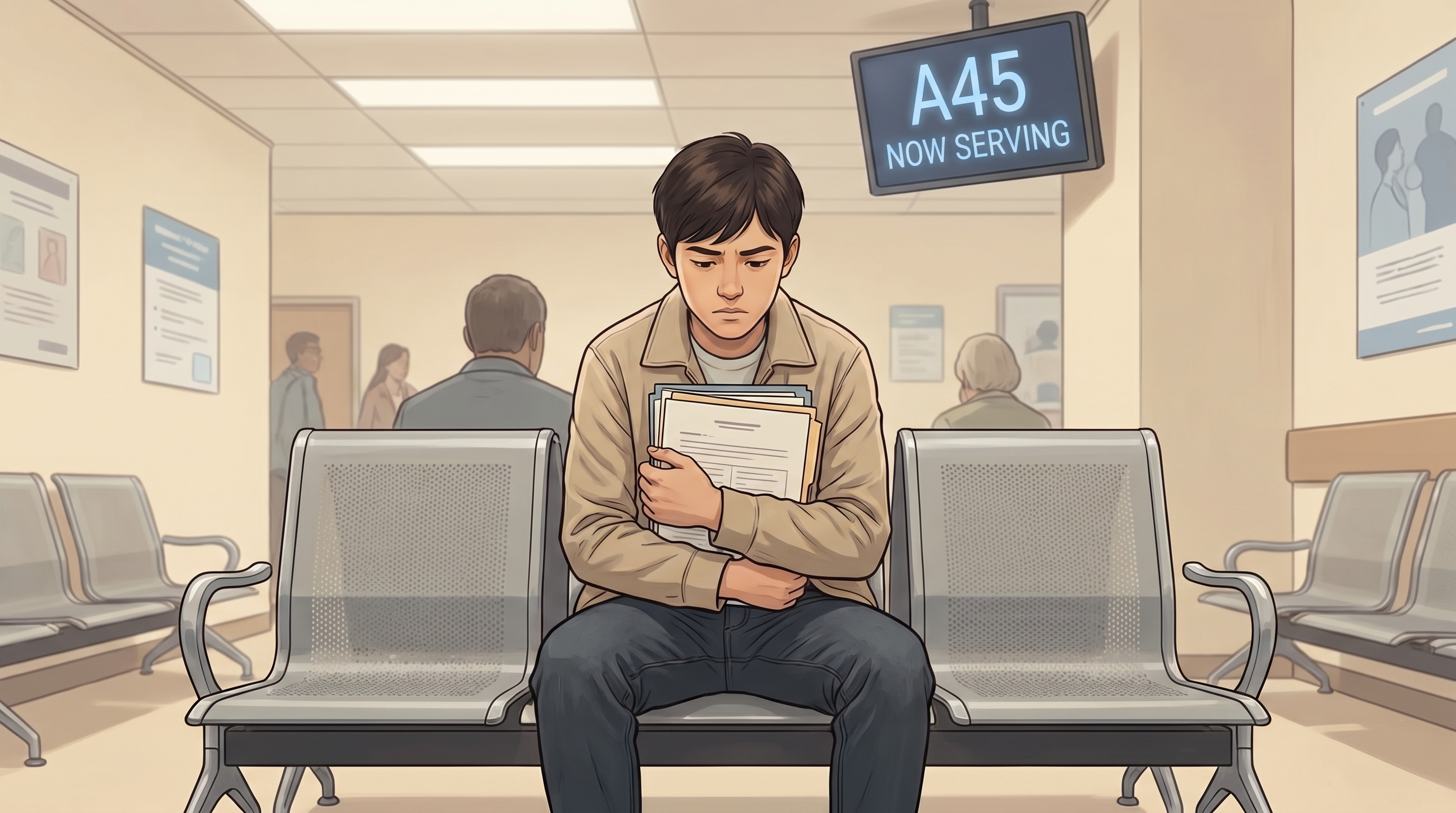
Discover exactly what happens during your DMV road test. Our complete guide covers documents, fees, vehicle prep, the hour-by-hour timeline, and 15 automatic fails to avoid.
You've been prepping for weeks. You know your state's road signs. You've practiced turns, parking, and lane changes. You understand right-of-way rules. But there's still one thing keeping you awake: What's actually going to happen when I get to the DMV?
The uncertainty is the hard part. The test itself, when you understand what's coming, is manageable. That's why we built this guide.
Over the next 30 minutes, you'll see the exact timeline from the moment you arrive until you leave the DMV. You'll know what documents to bring, what your vehicle needs to pass inspection, what the examiner is evaluating during those 25 minutes on the road, and how scoring actually works. You'll learn about the 15 automatic fails (so you'll never make them), the fees for your specific state, and what happens the moment you finish.
The bottom line: 35-55% of drivers fail their test on the first attempt. But that's not because they can't drive—it's because they're surprised by what happens, or they didn't know which mistakes were critical. After reading this, neither of those things will be true for you.
Let's walk through test day together.
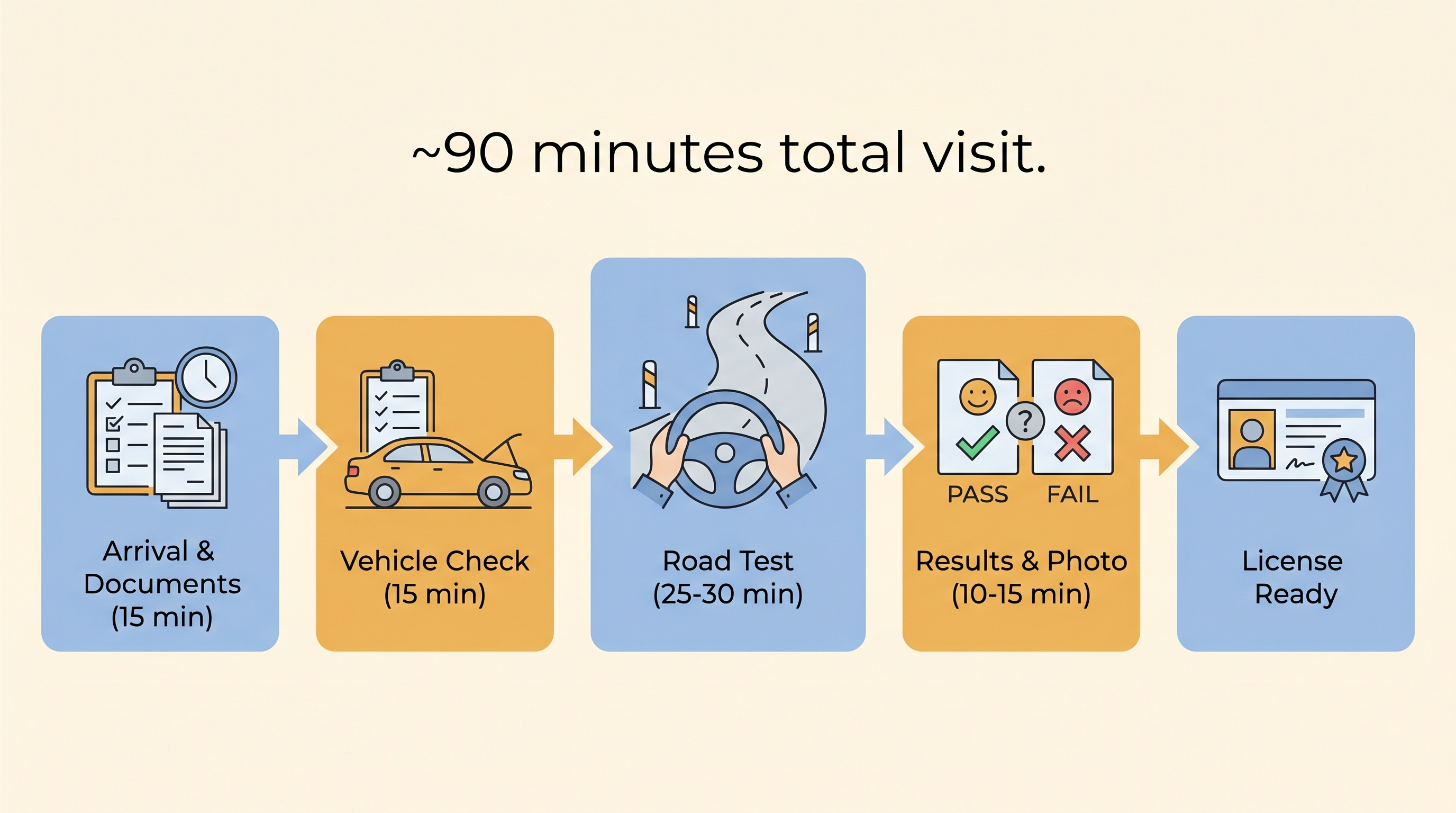
Your entire DMV visit takes about 90 minutes. Here's how it breaks down, hour by hour.
Before You Arrive (Timing Strategy)
Arrive 15-20 minutes early. This gives you time to park, gather your documents, take three deep breaths, and settle your mind. You don't want to rush into the building already stressed. Arriving early also gives the office a buffer if they're running ahead of schedule.
Minute 1-15: Check-In & Document Review
You walk in and head to the DMV window. A clerk checks your documents: driver's license or ID, proof of residency, proof of insurance, vehicle registration, and payment. If you're missing anything here—and this is important—the visit ends. You can reschedule, but the appointment is gone.
Pro tip: All documents must be originals. Copies are not accepted. A photocopy of your birth certificate won't work. A screenshot of your insurance proof won't work. Bring the actual, physical original documents.
The clerk confirms you're eligible to test and adds you to the testing queue.
Minute 15-30: The Vehicle Inspection
The examiner comes out and walks you to your vehicle. This is NOT the driving test. This is the safety check. The examiner will look at:
If the examiner finds a disqualifying issue—cracked windshield, check engine light on, expired registration—the test is canceled. Your appointment is over.
Minute 30-60: The Road Test
You drive for 25-30 minutes. You and the examiner are alone in the car. During this time, the examiner is watching for:
The examiner will ask you to perform specific maneuvers: a three-point turn, parallel parking (in most states), backing up, turning at an intersection. The examiner might also ask you where you're going next or which direction is north—these are usually just conversation starters, but stay focused on driving.
The test duration varies by state. California's test is typically 15-20 minutes of actual driving. New York's is about 20-30 minutes. Texas averages 20-25 minutes.
Minute 60-90: Results & Next Steps
You return to the DMV. The examiner will tell you if you passed or failed immediately. Here's where the outcomes diverge:
If you passed: Congratulations. You'll fill out paperwork, get a temporary license (usually valid for 30 days), get your photo taken, and receive your temporary paper license. Your permanent license will be mailed to you in 2-4 weeks. You're legally allowed to drive alone starting today.
If you failed: The examiner will give you a scoring sheet showing which areas caused the failure. Most states allow you to retake the test within 2-7 days (not immediately). You'll pay a retake fee and schedule a new appointment.
 This is critical. The #1 reason drivers don't complete their test on the first visit is missing documents.
| Category | Documents | Required? |
|---|---|---|
| Identity | State ID or Passport | YES |
| Birth Certificate (original) | YES (most states) | |
| Social Security Card or proof | YES (most states) | |
| Proof of Residency | YES | |
| Driving | Learner's Permit | YES |
| Driver's Ed Certificate | State-dependent | |
| Supervised Driving Log | State-dependent | |
| Vehicle | Registration | YES |
| Proof of Insurance | YES | |
| Vehicle Inspection | State-dependent | |
| Payment | Test Fee | YES |
Pro tip: Make a photocopy of all your documents and keep them at home. Don't bring the copies to the DMV, but if you accidentally forget something, you have proof at home of what you own.
 Your vehicle won't pass inspection if it has any of these issues:
Automatic Disqualifiers
You can use: Your own car, a parent's car, a friend's car, a rental car, or a driving school car. As long as the vehicle passes inspection and it's insured, it's fine.
You cannot use: A vehicle that's uninsured. This is non-negotiable. Some states also restrict driving someone else's car if you don't have permission—bring proof (a note from the owner) if it's not registered to you.
Two days before your test: Do a vehicle walk-around. Check all lights. Make sure your windshield is clean and intact. Top off fluids. If your check engine light is on, get it scanned before test day.
The examiner is evaluating your ability to safely operate the vehicle in real-world conditions. You're being tested on skills, not trick questions.
Most states test these in some form:
The test is typically 25-30 minutes of actual driving. Add 15-20 minutes before the test (arrival, documents, vehicle check) and 10-15 minutes after (results, paperwork). Total DMV visit: about 90 minutes.
The examiner isn't trying to trick you or fail you. They're evaluating whether you can safely operate a vehicle on public roads. They've given this test thousands of times. They know that mistakes don't automatically mean failure—most states allow several minor errors. What they're looking for are patterns of behavior that suggest you're unsafe.
If you miss one stop and then proceed carefully, that's a learning moment. If you miss three stops or blow through a red light, that's a safety risk.
Watch a real DMV road test route walkthrough:
Different states use different scoring systems, but the underlying logic is the same: some errors are critical (instant failure), and some are minor (points deducted).
States like New York allow a certain number of points before failing. New York's test allows up to 30 points of deductions:
You accumulate points throughout the test. If you stay under 30 points, you pass. If you hit 30 points or go over, you fail.
California uses a checklist approach. Each maneuver has critical and non-critical errors:
For example, in a parallel parking maneuver:
You don't need a perfect test. Most states allow several minor errors. The difference between passing and failing is usually not one mistake—it's a pattern of mistakes or a single critical error.
Most people fail because they:
These aren't tricks. These are the reasons people cause accidents. The test is checking whether you know basic road safety.
Some mistakes end the test immediately. If you make any of these, the examiner will stop the test and you fail. No second chances, no partial credit.
Running a red light or stop sign – Complete stops are non-negotiable. If you roll through or miss a stop sign, the test ends.
Speeding – Driving above the posted speed limit or too fast for conditions ends the test.
Not yielding to pedestrians – If a pedestrian is in the crosswalk and you don't yield, you fail.
Striking the curb – If you hit the curb during a maneuver (especially parking), you fail.
Causing another vehicle to swerve or brake – If your driving forces someone else to take evasive action, you fail.
Not shifting into park at a stop – If you roll back or don't secure the vehicle when stopped, you fail.
Not following examiner instructions – If the examiner tells you to turn left and you turn right, or you ignore an instruction, you fail.
Unsafe lane change – Changing lanes without checking mirrors/blind spots or without signaling ends the test.
Loss of vehicle control – If the car jerks, stalls, or you lose control of steering, you fail.
Driving on the wrong side of the road – This is immediate failure.
Ignoring emergency vehicles – If a fire truck or ambulance is approaching with lights and sirens, you must pull over and yield. Failure to do so = fail.
Incomplete stops – Rolling stops don't count. You must come to a complete stop with the brake fully engaged.
Dangerous backing – Backing without checking mirrors or nearly hitting something = fail.
Crossing center/solid lines – Driving in the wrong lane or crossing a solid line when prohibited ends the test.
Aggressive behavior or road rage – If you honk excessively, yell at other drivers, or show road rage, the test ends immediately.
The good news: None of these are mistakes you'll make by accident. These are all conscious decisions. Know these rules before test day, practice avoiding them, and you won't hit any of them.
The driving test fee varies dramatically by state, from $0 to $50+. Here's what the top 10 states charge:
| State | Initial Fee | Retake Fee | What's Included | Notes |
|---|---|---|---|---|
| New York | $0 (first 2 attempts) | $0 (attempts 3-4) | Written + road test | After 4 attempts, $65/attempt |
| California | $45 | $45 | Road test only (written separate) | Appointment required; online-only |
| Texas | $33 | $33 | Written + road test bundled | Valid for 12 months after permit |
| Florida | $48 | $48 | Road test only; written is separate | Photo and license issued same day |
| Illinois | $20 | $20 | Written + road test | Accepted at most DMVs |
| Pennsylvania | $26 | $26 | Written + road test | Plus $5 photo/ID fee |
| Georgia | $20 | $20 | Road test only (written separate) | Appointment required |
| North Carolina | $25 | $25 | Written + road test | Road test only is available separately |
| Virginia | $19 | $19 | Written + road test | Most affordable major state |
| Ohio | $25 | $25 | Road test only (written separate) | Temporary license issued on passing |
National range: $0 to $50+ (including states with bundled services)
What you're paying for: Your test fee covers the examiner's time, the DMV facility, and the temporary license (if you pass). It does NOT cover:
Retake fees: Most states charge the same fee for a retake. A few states (like New York) offer free retakes up to a certain number. Check your state's DMV website.
Scheduling timelines vary wildly by location. Rural areas might have appointments available within 2-3 weeks. Major cities (Los Angeles, New York, Houston) can have 8-12 week waits during peak season (summer, spring break).
Most states now offer online scheduling. Go to your state's DMV website, select "road test appointment," enter your zip code, and you'll see available dates. Book during off-peak times: early mornings (8-9 AM), mid-week (Tuesday-Thursday), and fall/winter (September-February).
Busy times: Summer (June-August), spring break (March-April), right after school year starts
Slower times: October-November, January, weekday early mornings
Pro tip: If your local DMV is fully booked, try a DMV in a neighboring county. Rural locations often have much shorter waits. You don't have to test in your hometown.
If you need to reschedule, most states allow you to cancel with 24-48 hours notice and rebook without losing your fee. If you cancel with less notice, your fee may be forfeited.
You'll get:
Your insurance needs to be updated to reflect your new license status (changing from learner to licensed driver can affect your rate).
Same-day permanent license states: A few states (like Florida, Georgia) issue your permanent plastic license immediately instead of waiting for mail. Check your state.
You'll get:
Most states allow retesting within: 2-7 days (varies)
Your retake strategy: Don't retake immediately. Spend 3-5 days practicing the specific skills that caused the failure. Use Wheelingo's adaptive practice tests to identify weak areas—they show you exactly which driving scenarios and rules are tripping you up. Most users improve by 15-20 points on their second attempt because they target their weak areas instead of general reviewing.
The fastest way to pass your test is consistent practice with real questions. Try Wheelingo free — state-specific questions, instant explanations, and a readiness score that tells you when you're ready.
How long is the actual driving test?
The road portion is 25-30 minutes. Your total visit is about 90 minutes (including waiting, documents, vehicle check, results).
Can I use a rental car for the driving test?
Yes. The vehicle must be insured and pass inspection. Most rental companies allow it, but check your rental agreement first.
What if I'm late to my appointment?
You'll likely be marked as a no-show and your appointment will be canceled. Rescheduling may incur a fee. Arrive 15-20 minutes early.
Do I get my license the same day I pass?
You get a temporary paper license on the spot. Your permanent license is mailed in 2-4 weeks. A few states issue the plastic license immediately.
How many times can I retake the test?
This varies by state. Texas allows 3 attempts in 90 days. New York allows multiple retakes (4 free, then a fee). Check your state's rules.
What if the examiner is unfair or makes a mistake?
You can request a retest or appeal. This is uncommon—examiners follow standardized criteria. If you believe there was an error, contact your state DMV.
Can I request a different examiner?
Not typically. Examiners are assigned based on availability. Requesting a different one may delay your test.
What should I wear to the driving test?
Wear comfortable, practical clothing. Avoid loose clothing that might interfere with controls or safety belt. Wear shoes you can drive in. No extreme distractions.
Can someone ride with me during the test?
No. Only you and the examiner are in the car during the road test. A parent or instructor can be at the DMV, but not in the vehicle.
What if my vehicle breaks down before test day?
Reschedule immediately. Do not bring a vehicle that's not fully functional to the DMV. If you're unsure, get a pre-inspection at a mechanic.
You're ready for the logistics now. You know what to bring. You understand the vehicle inspection. You've seen the timeline. You know the automatic fails.
But logistics are only half the battle. The other half is knowing the rules.
During your road test, you'll make dozens of decisions: When to yield. Whether to signal before a turn. How far to stand back from the car in front of you. When to honk. Whether to accelerate or brake at a yellow light.
These decisions are based on rules. And the 15% of test-takers who don't know these rules well enough will make mistakes.
That's where Wheelingo's state-specific practice tests come in. While you're preparing for the road test, practice the written test too. It's not required, but it teaches you the rules that will keep you safe during the driving test.
Wheelingo's practice tests use:
Most users improve by 20+ points between their first and second practice test because they're learning the actual rules their state tests, not memorizing random questions.
Your test day is coming. You'll arrive early. You'll bring all your documents. Your vehicle will pass inspection. You'll drive the road course, follow the instructions, and avoid the automatic fails. And when you step out of that car after 25 minutes of driving, you'll know you're ready.
Download Wheelingo free and start practicing today. Your state's test is waiting.
Feeling nervous before test day? Read our guide to overcoming driving test anxiety for proven calm-down techniques and morning-of strategies.
Already failed once? Our failed driving test recovery guide walks you through retake strategy and weak-area targeting.
Want to practice those maneuvers? Our driving maneuvers guide breaks down parallel parking, three-point turns, and backing up step by step.
Ready to test your knowledge? Take a free practice test on Wheelingo. Choose your state, and Wheelingo will show you the exact types of questions your DMV tests. Progress tracking tells you when you're truly ready to book your test—no guessing.
Download the app to practice offline, track weak areas, and build confidence before test day. Most users improve by 20+ points on their second attempt because they know exactly what to focus on.
See you at the DMV—and on the other side of it with a valid driver's license.