You're not alone. 22M+ U.S. adults don't drive. Get the exact steps, timelines, and mindset shifts to earn your license at any age. Start today.
You're sitting in a work meeting when a colleague casually mentions carpooling on a road trip. Your chest tightens. A friend asks if you can take a turn driving on vacation. Your stomach drops. At 35 or 45 or 55, you're asking yourself the same question: Is it too late?
It's not.
Every year, more Americans learn to drive for the first time as adults. You're not behind. You're not abnormal. You're just starting—and you're starting with adult advantages that 16-year-olds don't have.
This guide walks you through the exact path to earning your license, no matter your age or where you're starting from. It covers the practical steps, realistic timelines, state-specific requirements, and the emotional reality of becoming a driver as an adult. Whether you're jumping into driving at 30, 40, 50, or beyond, you'll find everything you need here.
Let's start with the facts, because shame thrives on silence.
An estimated 22–27 million U.S. adults don't have a driver's license. That's roughly 8–9% of the driving-age population. According to Pew Research, 1 in 10 Americans rarely or never drive, and the numbers vary dramatically by region: 17% of adults in the Northeast lack licenses, compared to 7% in the Midwest.
Adult behind-the-wheel exam volumes doubled between 2023 and 2024 across multiple state DMV systems. This isn't a small trend—it's a wave.
The reasons are real, and they're not failures:
None of these are character flaws. They're circumstances.
 Here's what you need to know: Adult learners frequently pass their driving tests at equal or higher rates than teenagers.
Why? Because you bring something 16-year-olds don't.
You have impulse control. Your brain finished developing 15 years ago. Teen drivers' brains are still developing judgment and risk assessment. As an adult, you're neurologically wired to think before you swerve.
You have road knowledge. You've been a passenger, a pedestrian, a cyclist for decades. You already understand intersections, lane changes, and road patterns. You're not learning the road from scratch—you're learning how to drive on it.
You have clear motivation. You're not learning because your parents made you. You're doing it because you want independence, a better job, the ability to help friends, or to drive your kids to school. That intrinsic motivation matters.
You have patience. Teenagers are (mostly) learning in peer groups where mistakes feel like public failures. You're learning for yourself. You can mess up in a parking lot without humiliation.
The data backs this up: Adult pass rates for the written DMV test often exceed teen pass rates, and behind-the-wheel pass rates are comparable when adult learners have equivalent practice hours.
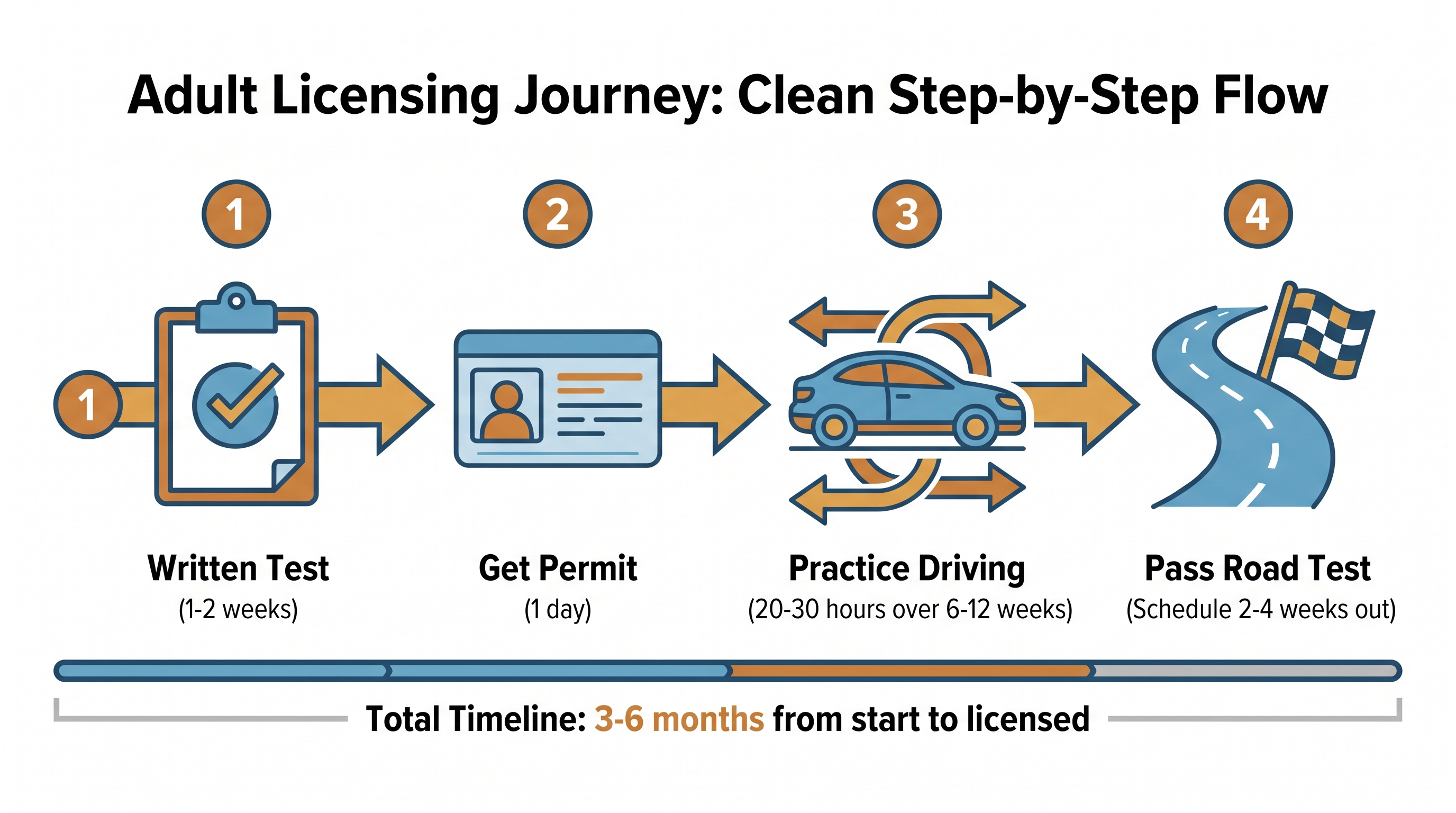 Here's the exact path from zero to licensed. The process is mostly the same everywhere, but the rules vary by state—we'll show you how to handle that.
Watch these essential tips for new drivers of any age:
This is critical. Your state's DMV website has specific rules for adults, and they vary wildly.
Some states skip the learner's permit requirement for adults over 18. Washington State, for example, lets adults test directly for a license if they're over 18. No permit required.
Other states mandate adult education courses. Illinois requires a 6-hour adult driver's education course before you can even take the written test. Many states require classroom time, online modules, or both.
Some have different age brackets with different rules. California distinguishes between 18–24 and 25+. Nevada has different requirements if you're applying from out of state.
Referencing the table below, find your state category:
| State Category | Permit Requirement | Adult Ed Requirement | Hold Period | Example States |
|---|---|---|---|---|
| Direct License (No Permit) | No learner's permit for 18+ | None | N/A | WA, OR, AK, HI |
| Permit Required (No Adult Ed) | Yes, standard hold | None | 6 months typical | TX, CO, AZ, GA |
| Permit + Adult Education | Yes | Classroom or online | 6+ months | CA, IL, NY, VA, MA |
| Adult Education Only | Optional permit | Required course | Varies | FL, NC, SC |
Action: Visit your state DMV's website right now. Search "adult driver's license requirements" or "how to get a license if you never had one." Write down three things: (1) Do you need a permit? (2) Is adult ed required? (3) When can you take the road test?
Before you touch a car, you'll pass a written test on road signs, traffic laws, and right-of-way rules. This is your first win, and you can do it in 1–2 weeks.
What's on it:
The test is typically 25–50 questions, and you need 70–85% to pass depending on your state.
Here's the shortcut: Use Wheelingo. Practice tests mirror your state's actual DMV questions. You'll see the exact road signs, the exact right-of-way scenarios, the exact state-specific laws you'll be tested on. After 1–2 weeks of 20–30 minute practice sessions, you'll walk into the DMV knowing exactly what to expect.
Pro tip: Adult learners often pass the written test on the first try because you're not cramming the night before—you're practicing deliberately with real questions. That builds confidence before you even get near a car.
Visit your local DMV office with:
You'll take the written test at the DMV (or, in some states, you'll have already passed it online). Once you pass, you'll get your learner's permit. This permit lets you practice driving with a licensed adult in the car.
Important: Write down the restrictions on your permit. Most states require:
Your hold period (time you must wait before taking the road test) varies: Some states give you 6 months, others 2 weeks, others none. Check your state-specific rules.
You have three main paths:
Professional Driving School
Friend or Family Member
Hybrid (Most Adults Do This)
What works best for adult learners: Most adults benefit from 4–6 professional lessons (foundation building and weak-area targeting) plus weekly practice with a friend or family member. You get expert feedback upfront, then confidence through repetition with someone you trust.
How much driving do you need? Most adults need 20–30 hours behind the wheel before they're test-ready. That's less than teenagers typically need (50+ hours) because you already understand traffic and road patterns.
What to practice:
The practice rhythm that works:
You'll be surprised at how quickly it clicks. By week 4, driving feels natural. By week 8, you're ready.
Once you've logged your practice hours (and your state's hold period is up), schedule your road test through your state DMV. Book 2–4 weeks ahead—slots fill up.
On test day:
Adult learners' advantage here: You're not nervous like a 16-year-old. You're focused. You know what you know. You've practiced the skills. Most of the test is just showing the examiner what you already can do.
The timeline, the cost, the stress level—all depends on which path you take. Here's how to decide.
Professional Driving School is worth it if:
Friend or Family Teaching is OK if:
Hybrid Approach (Recommended for Most Adults)
 You know what's not in the DMV manual? The shame spiral.
It goes like this: You think you should already be able to drive. You're embarrassed you can't. So you avoid thinking about it. That avoidance makes the embarrassment worse. Eventually, the emotional weight feels bigger than the actual skill gap.
Let's break that.
Embarrassment: "I'm 35 and still need to learn." Reframe: You learned to drive when you were ready and when circumstances aligned. That's maturity, not failure. Everyone you see driving learned at different ages. Many of them learned much later than you're planning to.
Anxiety: Adult brains are risk-aware. You know cars weigh 4,000 pounds and travel at 60 mph. That's not irrational fear—that's respect for a powerful machine. The anxiety isn't a sign you can't do this; it's a sign you're taking it seriously. Channel that into careful practice.
Frustration: "Teenagers learn this so easily. Why is it hard for me?" Because you're an adult taking on a new skill. That's always harder than learning as a kid. Your brain isn't plastic the way it was at 16. So of course it takes more conscious effort. That's normal. That's not weakness.
Imposter syndrome: "What if I'm not cut out for this?" You are. Adult pass rates on licensing tests equal or exceed teen rates. You're neurologically capable. The fact that you're thinking this through carefully (not just rushing through like a teenager) is a strength.
The timeline and motivation shift across decades. Here's what each looks like:
Typical trigger: Career needs (new job farther out, commute required), family planning (kids on the way), relationship (partner drives, you want independence), relocation (moved to a car-dependent area).
The mindset: "I put this off so long. I need to do it now."
The advantage: You have structure. You have disposable income for lessons. You know what you want. You're disciplined enough to show up consistently.
The challenge: Time. You're balancing work, maybe a relationship, maybe friends. Finding 3–4 hours per week for driving practice takes planning.
The timeline: 3–4 months (written test in week 1–2, road test 8–12 weeks in, once you've practiced consistently).
Typical trigger: Life transition (divorce, job change, kids need rides, parents aging and can't drive you around), moved to suburbs (car suddenly necessary), independence (tired of relying on others).
The mindset: "I'm reclaiming my independence."
The advantage: You've made life changes before. You're good at handling transitions. You're patient with yourself in a way you weren't at 30.
The challenge: Physical confidence. Your reflexes aren't as fast as at 25. That's normal. Doesn't matter—you're more cautious anyway.
The timeline: 3–5 months (same practice path, but you might need an extra 1–2 weeks if you're building confidence slowly).
Typical trigger: Retirement planning (independence while you still can), kids pushing you to get license, health concerns (can't rely on others forever), pride (never thought you couldn't, now you want to prove it).
The mindset: "It's now or never. I'm doing this."
The advantage: You have time. You're retired or close to it. You can practice as much as you want without work stress. You're not rushed.
The challenge: Vision and reflexes slow down naturally. That's real, and it requires honest self-assessment. Good news: driving isn't about reflexes—it's about anticipation. You're excellent at that.
The timeline: 4–6 months (practice is more important than rushing. You're taking time to build solid habits, not just pass a test).
Let's get specific.
Written test: 1–2 weeks of regular practice (20–30 minutes daily using Wheelingo) Learner's permit hold period: 2 weeks to 6 months (depends on your state) Behind-the-wheel practice: 20–30 hours, spread over 6–12 weeks (typically 2–4 hours per week) Road test scheduling: 1–4 weeks to get an appointment Total: 3–6 months from zero to licensed
Variables that speed it up:
Variables that slow it down:
Real example: Sarah, 38, decided to learn to drive after her divorce. She took 4 professional lessons (weeks 1–4, $320), then practiced with her sister 2x per week (weeks 5–10). She passed the written test in week 2, waited 3 months for her state's hold period to expire, took the road test in week 15, and passed. Total: 15 weeks. That's 3.5 months, with time built in for vacation and her sister's schedule.
Here's why we're emphasizing this: Passing the written test first builds momentum.
You don't need to feel like a driver yet. You just need to prove you know the rules. That you can do in 1–2 weeks. That early win—walking out of the DMV with your learner's permit in hand—changes the emotional math. You're not trying to learn to drive anymore. You're already a permitted learner. Now you're just practicing.
What's on the test:
How to pass:
Real example: Marcus, 42, used Wheelingo for 10 days (about 30 minutes per day). He passed the written test on the first try with 88%. That same person had been avoiding the DMV for 20 years. A structured, state-specific practice path changed everything.
The fastest way to pass your test is consistent practice with real questions. Try Wheelingo free — state-specific questions, instant explanations, and a readiness score that tells you when you're ready.
Do I need a learner's permit if I'm over 18? Depends on your state. Some states (WA, OR, AK, HI) don't require a permit for adults. Most require one, but you might be able to skip it if you're already a licensed driver in another state. Check your state DMV website.
Can I take the driving test without professional lessons? Yes, if you have a patient friend or family member to practice with. Many adults do this successfully. Professional lessons aren't required—consistent practice is.
How much does it cost to learn to drive as an adult?
Is it harder to learn to drive when you're older? Neurologically, yes, learning new skills is harder as an adult. But the comparison to teenagers is unfair. Adults have risk awareness, discipline, and road knowledge that teenagers lack. The test difficulty is the same; the path to readiness is different.
Do I need to tell the DMV I've never driven before? No. You just apply as a first-time driver. The DMV doesn't ask why you haven't driven yet. You're starting now, and that's all that matters.
Will my car insurance be higher as a new adult driver? Possibly, but less than a teenage driver. Insurance companies consider age and experience. You'll pay more as a brand-new driver, but most insurers have lower premiums for drivers over 25 with no accidents. Get quotes from 3–5 insurers before assuming it'll be expensive.
Week 1: Research + Start Prepping
Week 2: Written Test Prep
Week 3–4: Learner's Permit
Week 5+: Behind-the-Wheel Practice
Timeline: Weeks 12–16
Final CTA: Start today. Download Wheelingo. Take one practice test. Write down your state's requirements. That's it—you've started. The rest is just showing up.
You don't need to be 16 to learn to drive. You don't need to be embarrassed or behind or unlikely to succeed. You just need a path, a plan, and the decision to start.
Twenty-two million Americans are in your shoes. Adult behind-the-wheel exam volumes doubled in the last two years. This is a wave, and you're in good company.
The path is simple:
You can do this in 3–6 months. You'll be a better driver for having taken your time to learn it right. And you'll have the independence you've been thinking about for years.
Start with Wheelingo. Practice the written test questions that your state actually uses. Pass that first milestone. Then you're a permitted learner, and the rest is just practice.
You're ready. You're not behind. You're starting.
Ready to start? Download Wheelingo and take your first practice test today—free, no card required. See your state's exact questions. Start your 1–2 week sprint to the written test.
Or explore your state's specific requirements to map out your personal timeline.
You've got this. Now go get your license.