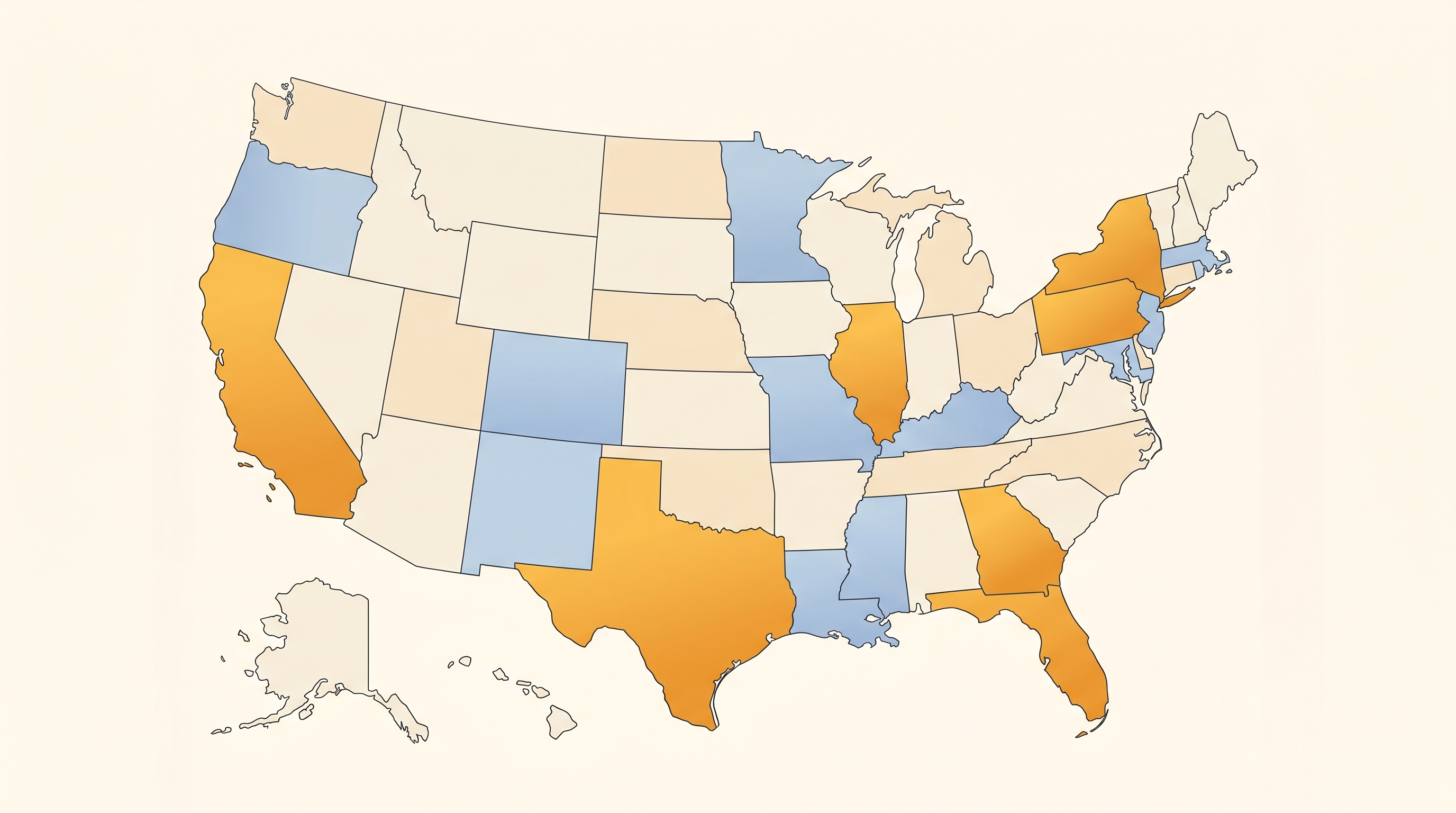
See the permit test passing score for every US state, question counts, retake rules, and state-specific quirks all in one updated guide.
The permit test passing score in the United States ranges from 70% to 85%, depending on your state. Most states require you to answer between 20 and 50 questions correctly, with 80% being the most common threshold. This guide lists every state's passing score, question count, and retake policy so you know exactly what you are walking into.
Here is why this matters: a 70% score in Texas and a 70% score in California are not the same. Texas will pass you. California will fail you. Knowing your state's exact threshold changes how you prepare and how many questions you can afford to miss.
Below you will find a full state-by-state table, common patterns, surprising quirks, and advice for states with unusually strict or lenient tests.
Each state's DMV sets its own permit test standards. Some states aim for rigor. Others prioritize throughput. The difference reflects legislative choices, traffic fatality data, and administrative capacity.
Samira moved from Michigan to California in January 2026 and assumed her Michigan permit prep would translate directly. It mostly did, but she underestimated California's 83% threshold. On her first attempt she missed 9 of 46 questions. She needed to miss 8 or fewer. A small gap, but enough to cost her a week and a $7 retake fee. The lesson: even if you know driving rules cold, you need to know your state's specific threshold.
Find your state's exact test content with a free practice test. Take a diagnostic quiz now and see how you score against your state's real passing threshold.
The table below lists each state's passing score, total questions, and minimum correct answers. Scores are current as of April 2026. Always verify with your state's DMV before test day since rules can change.
| State | Questions | Minimum Correct | Passing % |
|---|---|---|---|
| Alabama | 30 | 24 | 80% |
| Alaska | 20 | 16 | 80% |
| Arizona | 30 | 24 | 80% |
| Arkansas | 25 | 20 | 80% |
| California | 46 | 38 | 83% |
| Colorado | 25 | 20 | 80% |
| Connecticut | 25 | 20 | 80% |
| Delaware | 30 | 24 | 80% |
| Florida | 50 | 40 | 80% |
| Georgia | 20 | 15 | 75% |
| Hawaii | 30 | 24 | 80% |
| Idaho | 40 | 34 | 85% |
| Illinois | 35 | 28 | 80% |
| Indiana | 50 | 42 | 84% |
| Iowa | 35 | 28 | 80% |
| Kansas | 25 | 20 | 80% |
| Kentucky | 40 | 32 | 80% |
| Louisiana | 40 | 32 | 80% |
| Maine | 30 | 22 | 73% |
| Maryland | 25 | 22 | 88% |
| Massachusetts | 25 | 18 | 72% |
| Michigan | 20 | 16 | 80% |
| Minnesota | 40 | 32 | 80% |
| Mississippi | 30 | 24 | 80% |
| Missouri | 25 | 20 | 80% |
| Montana | 33 | 27 | 82% |
| Nebraska | 25 | 20 | 80% |
| Nevada | 50 | 40 | 80% |
| New Hampshire | 40 | 32 | 80% |
| New Jersey | 50 | 40 | 80% |
| New Mexico | 25 | 18 | 72% |
| New York | 20 | 14 | 70% |
| North Carolina | 25 | 20 | 80% |
| North Dakota | 25 | 20 | 80% |
| Ohio | 40 | 30 | 75% |
| Oklahoma | 25 | 20 | 80% |
| Oregon | 35 | 28 | 80% |
| Pennsylvania | 18 | 15 | 83% |
| Rhode Island | 25 | 20 | 80% |
| South Carolina | 30 | 24 | 80% |
| South Dakota | 25 | 20 | 80% |
| Tennessee | 30 | 24 | 80% |
| Texas | 30 | 21 | 70% |
| Utah | 25 | 20 | 80% |
| Vermont | 20 | 16 | 80% |
| Virginia | 35 | 30 | 85% |
| Washington | 40 | 32 | 80% |
| West Virginia | 25 | 19 | 76% |
| Wisconsin | 50 | 40 | 80% |
| Wyoming | 25 | 20 | 80% |
For state-specific preparation materials, visit the DMV.org state page directory or your state's official Department of Motor Vehicles website.
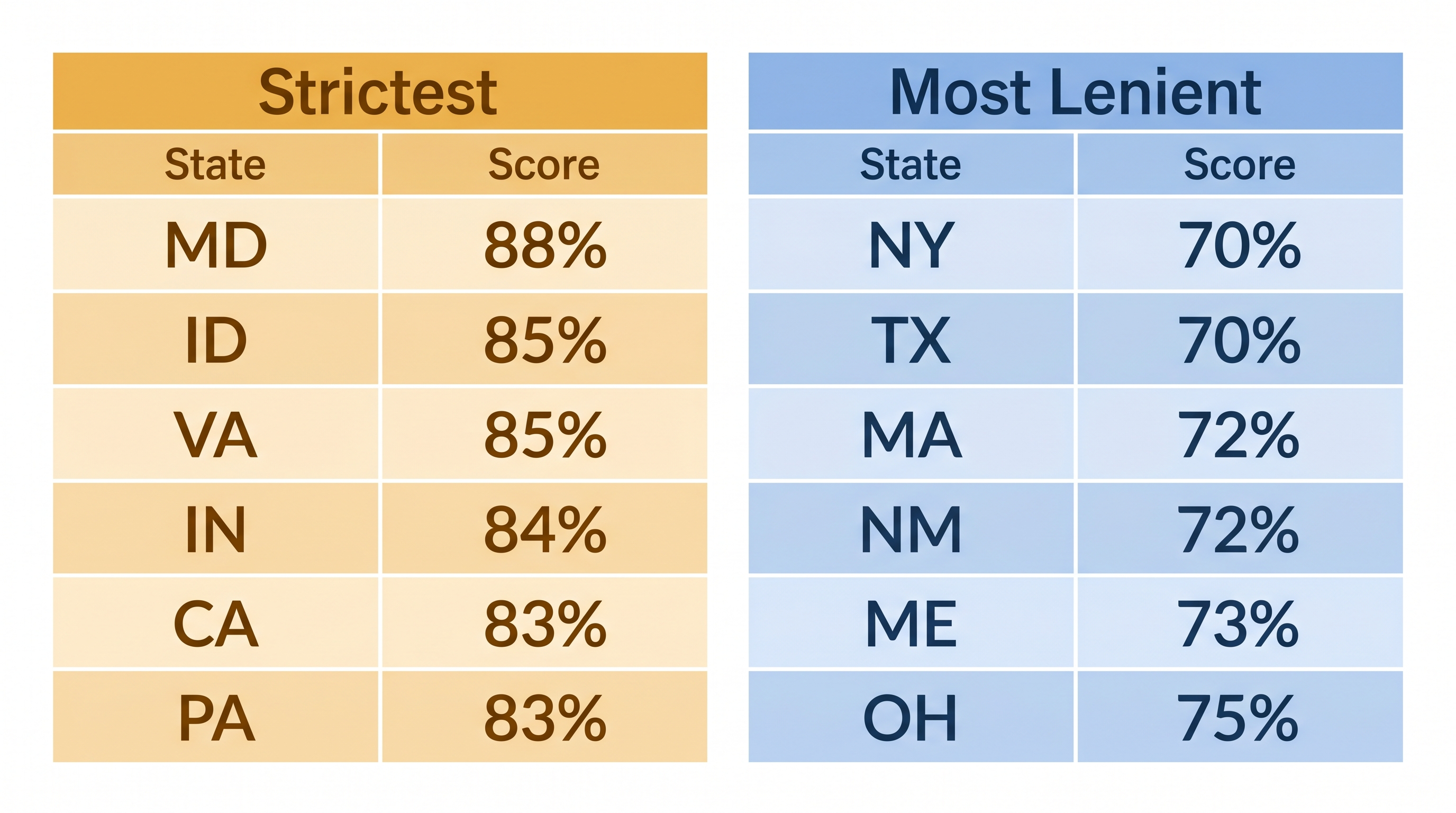
A handful of states demand near-perfect performance. If you live in one of these, your margin for error is thin.
If you live in one of these states, you cannot rely on luck. You need to be prepared to answer virtually every question correctly.
On the other end, some states set lower thresholds, which can feel like a gift until you realize the questions themselves are still specific.
Lower threshold does not mean easy. It means you get more room to miss the questions you overlooked.
Passing score is just one number. Each state adds its own wrinkles:
Florida uses an adaptive test that may end early if you have clearly passed or failed. Do not be surprised if your test stops at question 40.
California requires you to complete driver education before the permit test if you are under 17.5 years old. The course is online, usually 30 hours, and ends with its own certificate.
Texas requires a 6-hour Impact Texas Teen Drivers (ITTD) course for drivers under 18 before they can take the written test.
New York runs the permit test at DMV offices only, not online, even after pandemic-era changes expired.
Georgia requires 30 hours of parent or guardian-supervised driving logged before you can schedule the road test, though this does not affect the written test itself.
Pennsylvania offers only 18 questions on the knowledge test, but you cannot miss more than 3. The low count actually makes the test feel riskier.
Our state-by-state DMV test guide covers these quirks in more depth for each state.
Retake policies vary as much as passing scores. Here is a general breakdown:
Most states cap the number of attempts. For example, California allows 3 attempts per application. After that you must wait and reapply, which often means paying a new application fee.
Jamal failed his first California permit test by 2 questions. Instead of cramming and retrying in a week, he used the 7-day wait strategically. He identified his weak topics (right-of-way and parking distances), took 5 full-length practice tests, and passed his second attempt with a 91% score. The wait period turned into an advantage.
For more on recovering after a failed attempt, see our driving test retake wait times guide.
[YOUTUBE EMBED PLACEHOLDER: "Permit Test Passing Scores Explained by State" - authoritative DMV prep channel, 16:9 embed]
Generic permit test prep apps give you generic questions. Your state's test uses specific language, specific scenarios, and specific numbers that matter.
Three steps to state-specific prep:
Wheelingo's learning roadmap adjusts to your state's test content, highlights rules that vary from neighboring states, and tracks your readiness score so you know when you are actually ready, not just hopeful.
Want to see your state's exact question format? Start your first practice test for free and find out where you stand in under 10 minutes.
Does the passing score change if I take the test online vs in person? No. Your state's passing score applies regardless of format. Florida, for example, requires 80% whether you take the test online or at a DMV office.
Can the passing score change in the middle of my application period? Rarely. If your state's legislature updates the standard, you are usually tested under the rules in effect at the time you applied. Call your DMV to confirm.
Do commercial driver's license tests use the same passing scores? No. CDL knowledge tests use different thresholds, typically 80%, but with separate sections for general knowledge, air brakes, and combination vehicles. Each section has its own passing score.
Why does Maryland have the highest passing score? Maryland's MVA historically emphasizes strict standards to reduce early-driver fatalities. The 88% threshold forces thorough preparation.
Do I get partial credit for partially correct answers? No. Permit tests use binary grading. An answer is either correct or incorrect.
What if I need accommodations? Most states provide accommodations for disabilities including extended time, audio testing, and oral questioning. Contact your DMV at least two weeks before your scheduled test to request accommodations.
Passing score is only half the picture. The difficulty of individual questions varies too.
Easier question pools (straightforward wording, clear choices): New York, Texas, Ohio, Georgia, Massachusetts. These states use direct questions pulled from handbook examples.
Harder question pools (scenario-based, complex wording): California, Virginia, Maryland, Washington. These states test deeper comprehension with scenario-driven questions that require applying multiple rules at once.
Sign-heavy pools (high percentage of sign identification): Illinois, Pennsylvania, Michigan, New Jersey. Expect 20 to 40% of your questions to involve identifying a road sign by image or description.
Number-heavy pools (lots of speed limits, distances, thresholds): Florida, California, Wisconsin. Memorize every number in your handbook if you live in one of these states.
Our most missed DMV test questions guide breaks down the national pattern of common wrong answers so you can study the questions that trip people up most.
Your passing score should dictate how much buffer you need in practice.
If your state requires 70% (NY, TX): Aim for 90%+ consistently in practice. You can handle a few nervous slips on test day and still pass.
If your state requires 80% (most states): Aim for 95%+ in practice. An 80% floor feels comfortable until test-day anxiety eats into it.
If your state requires 83%+ (CA, PA, ID, VA, IN, MD): Aim for 98%+ in practice. The margin for error is tiny. Overprepare deliberately.
Andrea lives in Maryland. She built her practice plan around the state's 88% threshold. By the time she took the real test she was scoring 96 to 100% on 15 consecutive practice tests. She passed with 24 of 25 correct. "I needed the overkill," she said. "The threshold doesn't leave room for a bad day."
Knowing your state's permit test passing score transforms how you prepare. An 80% threshold in one state is a 70% threshold in another. Three missed questions can be the difference between walking out with a permit and scheduling a retake.
Look up your state in the table, note your minimum correct answers, and build your practice plan around that specific number. Preparation that aligns with your state's standards is the fastest path to passing.
Your state, your rules, your test. Learn them all, then ace them.