Discover how long you'll wait to retake your driving test. State-by-state guide with fees and strategies to pass faster.
You just left the DMV feeling gutted. The examiner handed you a pink slip, and now you're wondering: how fast can I try again? The answer depends entirely on where you live—and it's more complicated than a single number.
Some states let you retake the test within days. Others make you wait weeks or even months. And every state has its own fees, scheduling quirks, and unofficial workarounds that candidates rarely know about. The wait time difference between California and Texas? Stark. The cost difference? Hundreds of dollars.
This guide breaks down retake wait times for 20+ states, the real costs involved, and strategies to minimize your waiting period and actually pass next time.
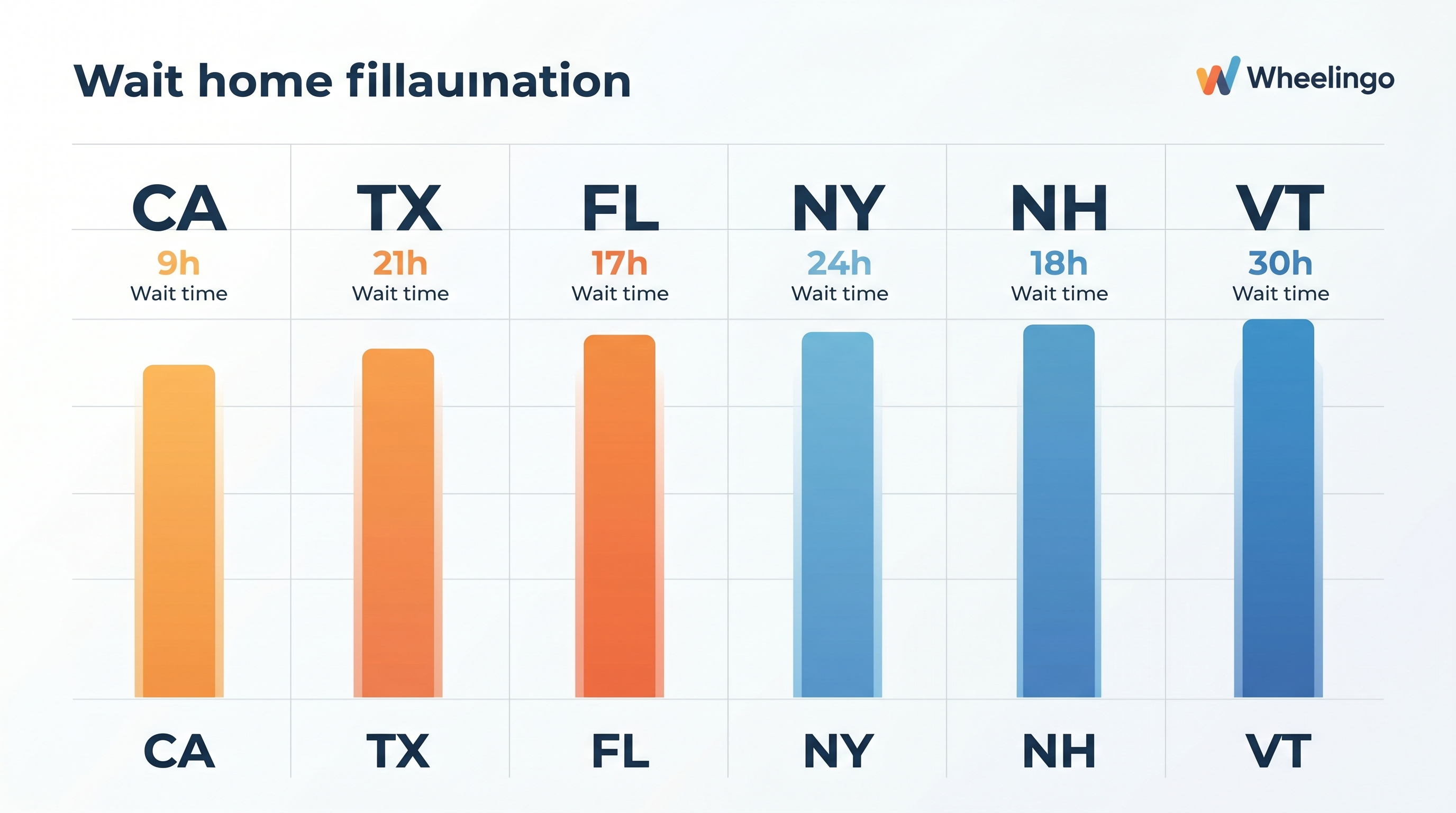
The gap between the minimum wait time and actual availability can be shocking. Here's what the numbers actually mean:
| State | Minimum Wait | Typical Wait to Appointment | Road Test Fee | Written Test Fee |
|---|---|---|---|---|
| Alabama | 1 day | 2–4 weeks | $30 | Free |
| California | 7 days | 8–12 weeks | $65 | Free |
| Colorado | 1 day | 3–6 weeks | $31 | $10 |
| Connecticut | 7 days | 4–8 weeks | $35 | $20 |
| Delaware | 1 day | 1–2 weeks | $30 | Free |
| Florida | 10 days | 6–10 weeks | $48 | Free |
| Georgia | 1 day | 2–4 weeks | $35 | Free |
| Illinois | 1 day | 4–8 weeks | $60 | Free |
| Massachusetts | 7 days | 6–12 weeks | $50 | Free |
| Michigan | 1 day | 3–6 weeks | $35 | Free |
| Minnesota | 3 days | 2–4 weeks | $20 | Free |
| Missouri | 1 day | 2–4 weeks | $25 | Free |
| Nevada | 1 day | 3–5 weeks | $35 | Free |
| New Hampshire | 1 day | 1–3 weeks | $30 | Free |
| New Jersey | 20 days | 8–16 weeks | $35 | Free |
| New York | 2 days | 6–10 weeks | $65 | Free |
| North Carolina | 1 day | 2–4 weeks | $20 | Free |
| Ohio | 1 day | 3–6 weeks | $35 | Free |
| Pennsylvania | 1 day | 4–8 weeks | $45 | Free |
| Texas | 14 days | 4–8 weeks | $30 | Free |
| Utah | 1 day | 2–4 weeks | $15 | $10 |
| Vermont | 1 day | 1–2 weeks | $25 | Free |
| Washington | 1 day | 4–6 weeks | $20 | Free |
The DMV isn't understaffed by accident—it's underfunded by design. Budget constraints mean fewer examiners and testing slots. Meanwhile, demand keeps climbing. Every teenager, immigrant, and adult learner is competing for the same 20–30 road test slots available each week in a typical county.
Sarah from Austin, Texas spent three weeks waiting for her retake appointment. "I passed my written test on the first try," she said, "but failed the parallel parking section on the road test. I had to wait until my sixth week in Texas residency to book the retake, and even then, my appointment was 8 weeks out. I literally couldn't take the test any sooner even though I was ready."
Summer (May–August) is chaos. Every high school senior who didn't pass last year is rushing to get their license before college. Winter (January–February) is also packed as students retake before the new term. Off-peak months like October and March have shorter waits—sometimes 2–3 weeks shorter.
Some states intentionally close road testing during winter months due to weather. Montana, North Dakota, and Minnesota dramatically reduce road test availability from November through March, which locks people out for months even if they're ready to test.
Your retake wait isn't just about calendar days. It's about dollars, stress, and opportunity cost.
| Waiting Scenario | Hard Costs | Hidden Costs |
|---|---|---|
| 3-week wait, failed written test | $20–30 (retake fee) | Gas, parking, time off work |
| 8-week wait, failed road test | $30–65 (retake fee) | Driving lessons ($150–400), vehicle rental if yours is down, missed job/education opportunities |
| 12-week wait (California) | $65 (road test) | Potential car insurance surcharge, job start date delays, college move-in complications |
| Multiple retakes (3+ attempts) | $90–195 total | Anxiety, confidence erosion, study material costs ($50–200), instructor fees ($300–800) |
Maya from Los Angeles failed her road test and had to wait 10 weeks for a retake slot. "I had a job offer contingent on having my license by September," she said. "The long wait forced me to pay $800 for an intensive driving course to guarantee I'd pass. A shorter wait time would've saved me that money—and my sanity."
Most states let you schedule your retake during your visit. If your examiner offers this, take it immediately. You're guaranteed a spot and won't get caught in the online scheduling rush.
Pro tip: Even if a slot looks far away (6–8 weeks), grab it. Most cancellations happen 2–4 weeks before the appointment, and you can reschedule into an earlier slot.
If you have flexibility, fail strategically (well, not really). Retake during October, March, or April when fewer people are testing. You could cut your wait time in half.
Big states like California, Texas, and Florida have multiple DMV locations. The main downtown office might have a 12-week wait, but a suburban or rural satellite office might have slots in 3–4 weeks. The test is identical; the location just matters for availability.
Afternoon and Saturday appointments fill up fastest. Early morning slots (7–8 AM) and Wednesday appointments are usually the last to book. If you're flexible, grab these unpopular times.
Some states' online systems haven't been updated since 2003. Calling a human at your local DMV can reveal cancellation slots that never hit the website. Get your local DMV's phone number and call 20 minutes after they open—staff are clearing overnight cancellations.
You have three weeks, eight weeks, or twelve weeks. Don't waste it.
Identify exactly why you failed. If it was a written test, order a detailed score report from your DMV. Most states tell you which topics tripped you up: speed limits, right-of-way, safety equipment. Most don't tell you which specific questions you missed.
If it was a road test, write down what the examiner said. Nervous about parallel parking? Failing lane changes? Shaky at stop signs? Be specific.
Use Wheelingo's practice app to drill your weak areas. If you failed written, focus on the topics you marked as uncertain. If you failed road test, book 2–3 lessons with an instructor who specializes in the maneuvers you struggled with.
Professional driving instructors are expensive ($50–100 per hour), but three focused lessons are cheaper than retaking the test three times.
Stop learning new material. Instead, take full-length practice tests and simulate the exact road test route in your county. Use Wheelingo's progress tracking to measure improvement week-to-week.
The night before your retake, don't cram. Review your error log (the specific mistakes from your first attempt), get 8 hours of sleep, and eat a good breakfast. Panic studying will hurt your confidence more than it helps your score.
The fastest way to pass your test is consistent practice with real questions. Try Wheelingo free — state-specific questions, instant explanations, and a readiness score that tells you when you're ready.
Q: What if I fail my retake? How long do I have to wait for a third attempt? A: Same rules apply. You'll be bound by the same minimum wait time and availability window. Most states don't distinguish between a first retake and a second retake. However, some states (New Jersey, for example) impose longer waits after a third failure to encourage more preparation. Check your state's DMV handbook.
Q: Can I test in a different state if my state's wait is too long? A: Not easily. Your test results are specific to the state where you got your learner's permit. Some states have reciprocity agreements, but most don't. Moving to Utah to test faster isn't practical. However, if you genuinely moved states, you can transfer your learner's permit and take the test in your new state.
Q: Do driving schools or instructors have priority booking? A: No official priority, but some states' online systems accidentally reveal slots before they're fully released. Instructors who spend all day booking students sometimes stumble into earlier availability. A private lesson might cost $100, but saving 4 weeks might be worth it if you have a time-sensitive deadline.
Q: What if the DMV website shows no available slots for months? A: Call your local office and ask if they've released all appointment slots or if more drop on specific days. Many DMVs release slots in batches (e.g., every Monday at 8 AM). Catching a batch release is faster than refreshing every day. Also ask about walk-in testing—some states still allow it for small fees.
Q: Should I hire a driving instructor for my retake, even if I didn't for my first attempt? A: If you failed the road test, yes. A professional instructor can pinpoint your specific weak points and fix them faster than a friend can. Cost is $50–150 per hour; four lessons = $200–600. If you failed the written test, an instructor won't help (they don't teach written tests), but practice tools like Wheelingo will.
Q: If I'm relocating, can I take my test in my new state before moving? A: Not usually. You must establish residency in your new state (typically 30–60 days) before testing. Some military personnel and transplants can get exceptions—call the DMV in your new state to ask. Planning your move around your test date might add stress but can help you avoid long waits.
Your driving test retake wait time isn't a punishment; it's a scheduling reality shaped by your state's capacity and season. But it's also an opportunity.
The states with the longest waits (California, New Jersey, New York) are also the states where more people fail on their first attempt. That's not a coincidence. More competition, tougher examiners, and complex driving environments mean people need better preparation.
Use your waiting period to genuinely improve, not just kill time. Work with Wheelingo's practice platform to identify and fix the exact skills causing your failure. Book your retake slot early, test during off-peak seasons if you can, and consider investing in a professional instructor if the road test tripped you up.
Thousands of people retake the driving test every week. Most pass on their second or third attempt. You will too—especially if you use these next weeks strategically instead of anxiously.
Your next test is closer than you think.