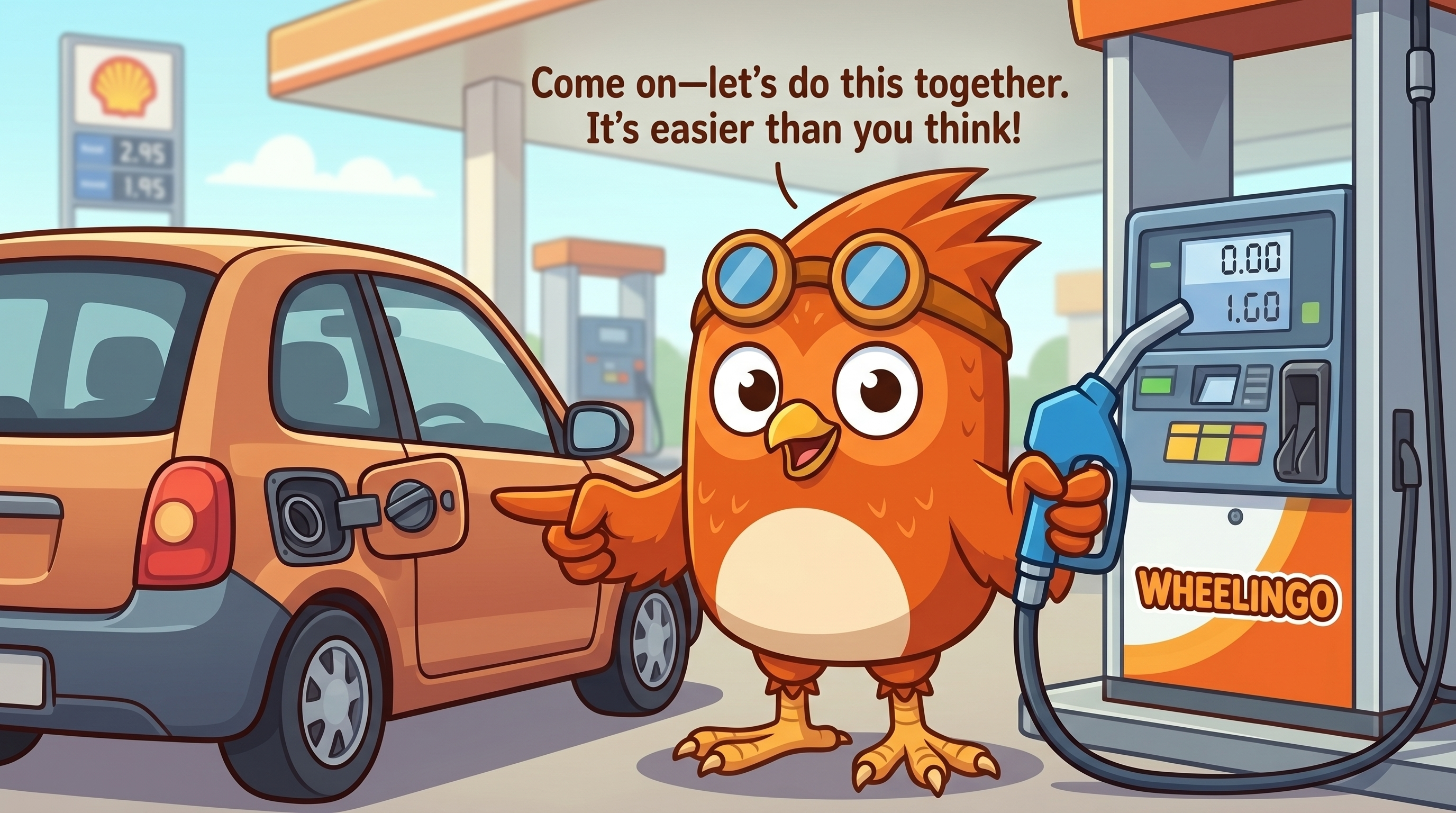
Learn to pump gas in 5 minutes. Step-by-step instructions, safety tips, fuel types, and what to expect at any gas station. Beginner-friendly guide.
You've just gotten your driver's license. You're driving on your own for the first time. And then it happens: your fuel gauge dips toward "E," and you realize you don't know how to pump gas.
Here's the truth: you're not alone. Every year, new drivers pull into gas stations and feel a moment of panic. Is this hard? Is it dangerous? What if I do it wrong?
It's not hard. It's not dangerous. And you absolutely cannot do it wrong (seriously—the pump won't let you).
This guide will walk you through pumping gas in five minutes so you can do it confidently from now on. You're about to add another practical skill to your driving toolkit, and spoiler alert: it's easier than parallel parking.
The first step happens before you even arrive at the gas station. Open your fuel door (instructions below) and look at the inside of the door. You'll see a label that says something like:
Pro tip: Take a photo of this label with your phone now. When you're at the pump and someone asks "what kind of gas does your car take?" you can check your phone.
Here's the reality: 95% of cars use regular unleaded (87 octane). If your car needs premium, the fuel door will clearly state it. If you're unsure, regular unleaded is the safe choice—it works in every car.
Octane is a measure of fuel stability. Higher octane (premium) is more refined and is needed by high-performance engines to prevent pinging or knocking.
If your manual says "regular," don't waste money on premium. If it says "premium," don't use regular.
Drive into a gas station and pull up to an empty pump. It doesn't matter which pump—they all work the same way. Park so the fuel door is on the pump side.
Which direction? Some stations have pumps facing one direction; just align your car so your fuel door faces the pump.
Pro tip: If you're right-handed, pull up so the pump is on your driver's side. If you're left-handed, pull up so it's on your passenger side. This makes reaching easier.
This is important for safety and is often a legal requirement. Turn off your car.
Why: Fuel vapors are flammable. A running engine could ignite them in rare circumstances. Additionally, turning off the engine is required by law in most states—it's for everyone's safety.
Most modern cars have a fuel door that opens outward (you can push or pull it). Some older cars require you to unlock it from inside your car.
How to find it: Your fuel door is on the exterior of your car, near your rear wheels. Look for a small rectangular panel.
How to open it: Push on the door gently—it should pop out or swing open. If it doesn't, check your owner's manual or ask a gas station attendant.
For safety: Your fuel door might have a warning label with a picture showing how to open it. That's there for you. Pictures work in any language.
Once the fuel door is open, you'll see a screw-on cap in the center. Turn it counterclockwise (lefty-loosey) to unscrew it.
How tight is it? Usually just tight enough to not fall off while driving. One full turn is typically enough to loosen it completely.
Where does it go? Some modern cars have caps that attach to the inside of the fuel door with a tether (a small chain or strap). If yours does, leave it there—it won't fall off. If it's a loose cap, you can set it on top of your car (not inside the car—you might drive off without it).
Real story: Marcus, a 17-year-old from Colorado, was nervous about the cap. "I wasn't sure if I'd lose it or if I was supposed to hand it to someone. Turns out, the tether held it right there. I felt silly for worrying, but now I know."
You'll see the pump panel with buttons for different octane grades (87, 89, 91, etc.). You'll also see a payment option or be directed to prepay inside or at a card reader on the pump.
Payment methods:
Choose your fuel grade: Select 87 (regular unleaded) unless your car requires premium. The button is clearly labeled.
Safety note: You don't need to go inside to ask which fuel to use. Your manual (or the label inside your fuel door) tells you. If you're ever unsure, regular 87 is the safe choice.
The pump nozzle hangs on the pump (you'll see it clearly). It's a handle attached to a hose.
What does "bottoms out" mean? The nozzle slides into your fuel hole until it won't go any further—you don't need to force it. Once it's fully inserted, it's seated correctly.
Don't worry about: Spilling gas, damaging your car, or inserting it wrong. The nozzle is designed to fit snugly in your fuel hole. It's literally impossible to insert it incorrectly.
There are typically three settings on the pump handle:
Which should you use? Any of them—they all work fine. Most people use lock mode because it's hands-free (you squeeze, the trigger locks, gas pumps while you wait).
Once you've selected your method, the pump should start. You'll see the numbers on the display increasing (gallons and price).
What happens next: Gas flows into your tank. You'll hear the hissing/gurgling sound of gas flowing. This is normal.
Watch for: The nozzle will automatically stop when your tank is full (it has a shutoff sensor). When it stops, your tank is full. Don't keep pumping—it won't add more.
How long? 3-5 minutes for a typical fill-up.
Once the pump has stopped automatically:
That's it. You've pumped gas successfully.
If you didn't prepay and used a card at the pump, you're done—payment already processed. If you prepaid in cash, you can go back inside and ask for a receipt or your change.
Most people just leave—the transaction is complete.
| Step | Action | Duration | Notes |
|---|---|---|---|
| 1 | Pull up to pump; park so fuel door faces pump | 1 min | Any pump works; position for convenience |
| 2 | Turn off engine | 30 sec | Required for safety |
| 3 | Open fuel door | 30 sec | Push/pull; if stuck, check owner's manual |
| 4 | Unscrew fuel cap | 30 sec | Turn counterclockwise; may be tethered |
| 5 | Choose fuel grade and payment | 30 sec | Select 87 unless manual says premium |
| 6 | Insert nozzle into fuel hole | 30 sec | Push straight in; it bottoms out automatically |
| 7 | Start pumping (select mode) | 1-2 min | Lock mode is easiest; watch the numbers |
| 8 | Monitor; wait for auto-stop | 2-4 min | Pump stops automatically when full |
| 9 | Return nozzle; close fuel door; start engine | 1 min | Screw cap back on; fuel door closes |
| 10 | Pay (if necessary) | 0-1 min | Usually already paid at pump |
| TOTAL | 5-10 min | Most of time is just watching gas pump |
Derek, a gas station attendant in Oregon, shares: "New drivers sometimes ask me what to do. Here's the truth: just insert the nozzle, squeeze or lock, and wait. If something goes wrong, the pump has emergency features. You literally cannot cause damage. And it's totally fine to ask me questions—I'd rather help than see someone struggling."
The fastest way to pass your test is consistent practice with real questions. Try Wheelingo free — state-specific questions, instant explanations, and a readiness score that tells you when you're ready.
Q: What if I spill gas while pumping?
A: It happens. Gas spills are small and evaporate quickly. If you spill, don't panic. Most pumps have paper towels or rags nearby. Wipe it up, and you're done. It's not dangerous.
Q: What if I insert the nozzle and it doesn't fit?
A: Check that you're inserting it straight into the fuel hole (not the fuel door or side panel). The nozzle should slide in smoothly. If it genuinely doesn't fit, stop and ask a gas station attendant—your car might be different than you thought.
Q: What if I pump premium gas but my car needs regular?
A: Your car will be fine. It might run slightly differently (premium burns cleaner but isn't "better" for regular cars), but no damage occurs. Just use regular next time.
Q: What if I pump regular gas but my car needs premium?
A: Some cars will run fine; high-performance cars might "ping" or knock. Check your manual. If your manual says premium, fill up with premium going forward. If you accidentally use regular once, no permanent damage—just don't make it a habit.
Q: How do I know when to stop pumping?
A: The pump stops automatically. You don't stop it. It has a sensor that detects when your tank is full and shuts off the flow. Trust the pump.
Q: Can I leave the pump in lock mode while I go inside?
A: No. You should stay with your car while pumping. Not for safety reasons (the pump stops automatically), but because it's good practice and expected etiquette.
Q: What if the pump is really slow and my car takes forever to fill?
A: Some pumps are slow; some cars have smaller tanks. Just wait. It's normal for fill-ups to take 3-10 minutes depending on how empty the tank was.
Q: Do I need to use a specific payment method?
A: No. Cash, credit card, or debit card all work. Prepay inside or at the pump—either way works fine.
Q: Is it cheaper to pump at certain times?
A: Gas prices fluctuate daily but are the same at any pump during the same day. Time of day doesn't usually matter. Shop around for stations with cheaper prices per gallon if you want to save.
Your fuel tank has an overflow prevention system. Here's how it works:
When your tank is full, a small flapper inside the nozzle closes. This is why the pump stops automatically. You physically cannot overfill your tank past the fill hole.
Some newer vehicles have sealed fuel systems that prevent vapors from escaping. If you see a small line inside the fill hole, that's your overflow return tube—it's there by design and is normal.
Pumping gas is one of many practical skills new drivers need:
For more information:
Pumping gas is one of the simplest, most straightforward things you do as a driver. It's designed to be foolproof—and it is. There's literally no way to mess it up.
The anxiety you might feel right now is totally normal. But after you've done it once, it becomes automatic. You'll pull in, pump, and leave without a second thought.
Here's what to do: the next time you need gas, take a deep breath, park at a pump, and follow the steps in this guide. You'll be done in five minutes, and you'll have conquered another new-driver milestone.
And remember: everyone started where you are. Gas station attendants aren't judging you. Other drivers aren't watching. This is a normal part of driving, and you absolutely can do it.
Ready to build confidence in all aspects of driving? Practice with Wheelingo to master everything from fuel management to emergency responses before test day.
Last updated: April 16, 2026