Realistic Driving Test Questions You'll Actually See
25 realistic driving test questions with answers, explanations, and the rule behind each one. Built from real DMV tests across the US.
Realistic driving test questions fall into 6 categories that show up on nearly every US state DMV test: road signs, right-of-way, speed limits, alcohol and drug laws, parking rules, and sharing the road. The 25 questions below are modeled on real DMV item banks and reflect the format, difficulty, and wording you will actually see on test day.
Most online practice tests are too easy. They test trivia. Real DMV tests look at judgment in a pressured multiple-choice format, often with 2 similar-sounding answers to separate drivers who memorized from drivers who understood. This guide skips the fluff and gives you the tough questions.
When Emma in Columbus took a generic practice test app and scored 95 percent, she assumed she was ready. Her real Ohio DMV test felt like a different language. She missed 8 questions because the wording tripped her up. The examples below use real-test phrasing so you never get blindsided.
Key Takeaways
- Real DMV tests often include 2 answers that are technically true but only one is the best answer. Read every option before choosing.
- Right-of-way and parking rules are the 2 most commonly missed categories in every state.
- Most states fail you at 80 percent or below. That means you can only miss 5 to 8 out of 40 questions depending on state.
- Wording matters. "Usually," "always," and "never" turn easy questions into traps. Slow down and notice them.
- Practice on your specific state's test bank. Rule variations between California, Texas, Florida, and New York are small but test-relevant.
What Real DMV Questions Look Like
DMV questions generally follow 3 formats: multiple choice with 4 options, true or false, and sign identification. Multiple choice is the most common, and it is where test-takers lose the most points.
Real questions are short. Usually 1 to 2 sentences. They test one concept at a time. The tricky ones embed a qualifier like "usually," "always," "never," or "except when," and the correct answer hinges on that qualifier. If you skip it, you pick the wrong answer every time.
Sign identification questions often show a color and shape without any words. You are expected to know that a yellow diamond is a warning sign, a red octagon is a stop sign, and a fluorescent yellow-green pentagon is a school zone. The US Department of Transportation publishes the Manual on Uniform Traffic Control Devices, which is the source of every standardized sign in the country.
Want an unlimited bank of realistic questions graded by your state? Try Wheelingo's practice tests and see which categories you miss most.
Category 1: Road Signs
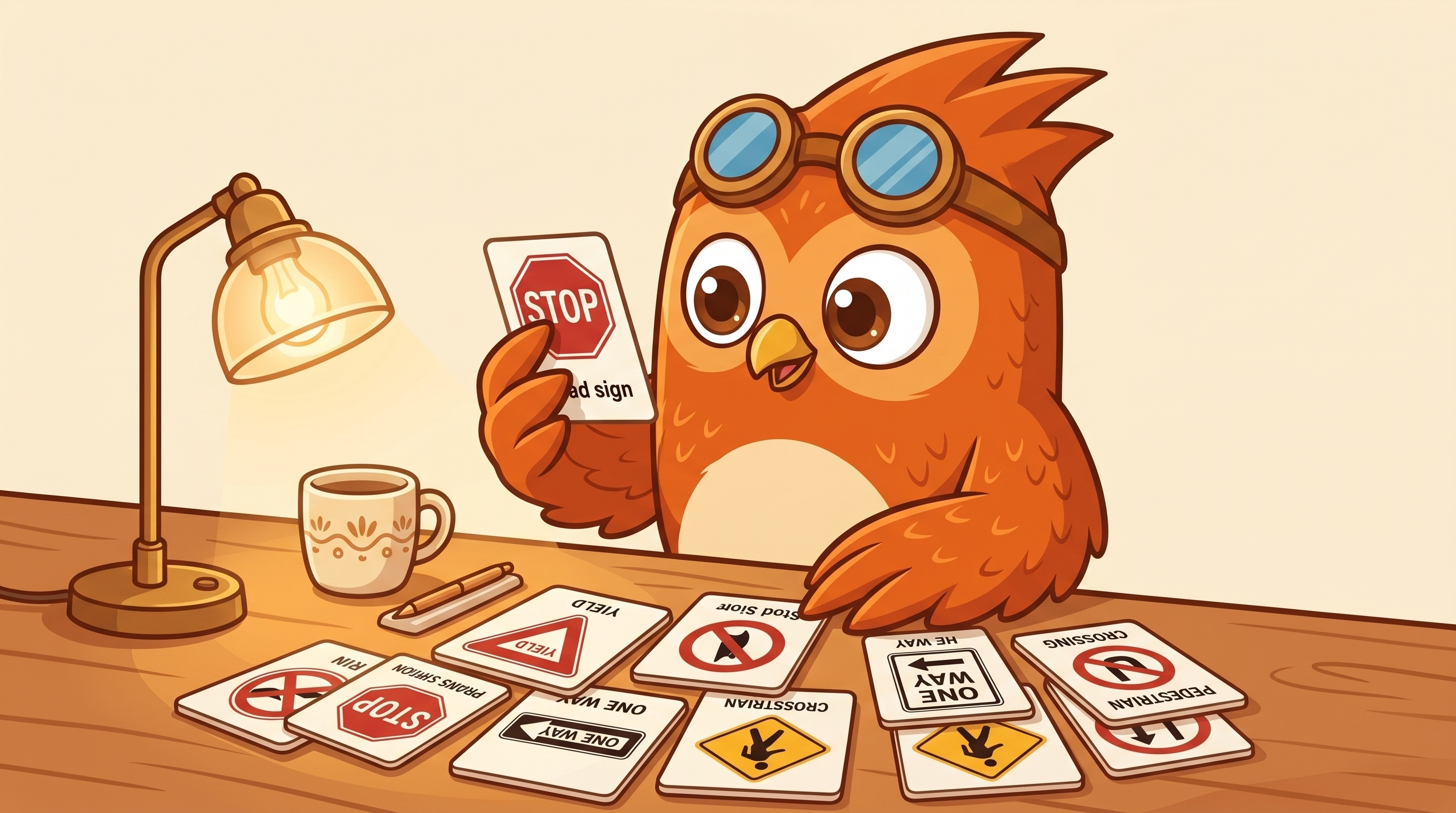
Road signs show up on almost every state's test in at least 5 to 8 questions. You need to recognize shape, color, and meaning.
Question 1: A red and white triangular sign means:
- A. Stop ahead
- B. Yield
- C. Do not enter
- D. Wrong way
Correct answer: B. Yield. The inverted triangle outlined in red means you must slow down, prepare to stop if needed, and let other traffic or pedestrians go first.
Question 2: A yellow diamond-shaped sign indicates:
- A. A regulatory rule
- B. A warning of possible hazards
- C. A construction zone
- D. A guide or information sign
Correct answer: B. A warning of possible hazards. Diamond yellow signs warn you about conditions ahead: curves, slippery roads, merging lanes, or animal crossings. Regulatory signs are white with black or red lettering. Construction zones use orange.
Question 3: A fluorescent yellow-green pentagon typically marks:
- A. A pedestrian crossing
- B. A school zone or school crossing
- C. A bicycle lane
- D. A hospital ahead
Correct answer: B. A school zone or school crossing. This color was standardized nationwide in the early 2000s to make school zones unmistakable.
Question 4: A round sign with a black X and 2 R's means:
- A. Railroad crossing ahead
- B. Rest area
- C. Rural route marker
- D. Railway closed
Correct answer: A. Railroad crossing ahead. Round signs with letters are reserved for railroad warnings. The "RR" under the X is a hint.
Category 2: Right-of-Way
Right-of-way is the most commonly missed category on road-rule tests. The trick is that "having the right-of-way" does not mean you can insist on it. The rule is always to yield when in doubt.
Question 5: At a four-way stop, if 2 cars arrive at the same time, which has the right-of-way?
- A. The car on the left
- B. The car on the right
- C. The larger vehicle
- D. The car that arrives from a higher-numbered road
Correct answer: B. The car on the right. When 2 cars arrive simultaneously at a 4-way stop, the one on the right goes first. If 3 arrive, the order goes clockwise from the first to stop.
Question 6: You are at a T-intersection. Traffic on the through road:
- A. Must yield to you because you arrived first
- B. Has the right-of-way over traffic entering from the stem
- C. Must stop if you are signaling
- D. Has the right-of-way only during daytime
Correct answer: B. Has the right-of-way over traffic entering from the stem. Vehicles on the through road always have priority at a T-intersection unless a sign or signal says otherwise.
Question 7: A pedestrian is crossing at an unmarked crosswalk. You must:
- A. Proceed if no paint is visible
- B. Honk to warn them
- C. Stop and yield
- D. Continue because unmarked crosswalks are not legal
Correct answer: C. Stop and yield. Every intersection has a crosswalk, marked or not. This single rule trips up a huge share of test-takers.
Question 8: An emergency vehicle with sirens is approaching from behind on a 2-lane road. You must:
- A. Maintain speed and stay centered
- B. Stop wherever you are
- C. Pull to the right when safe and stop
- D. Speed up to clear the intersection ahead
Correct answer: C. Pull to the right when safe and stop. Pulling right is the universal rule. Stopping in place is only correct if you cannot safely pull over.
Want a deeper breakdown of right-of-way? Read our right-of-way rules at intersections guide for every scenario you will see.
Category 3: Speed Limits
Speed limit questions test whether you know your state's default speeds. These vary enough that you should study your state's handbook, not generic ones.
Question 9: In most states, the default speed limit in a residential area without a posted sign is:
- A. 15 mph
- B. 25 mph
- C. 35 mph
- D. 45 mph
Correct answer: B. 25 mph. Most states set 25 mph as the default for residential zones, though a few use 20 or 30. Always obey posted signs over defaults.
Question 10: A school zone speed limit typically applies:
- A. Only during school hours on school days
- B. 24 hours a day year-round
- C. Only when children are present
- D. Only during morning drop-off
Correct answer: A. Only during school hours on school days, though the exact wording varies by state. Many states use "when children are present" interpreted broadly. If a sign shows specific hours, follow those.
Question 11: You must reduce speed when approaching:
- A. A bridge or overpass
- B. A school bus with flashing red lights
- C. A yellow diamond warning sign
- D. All of the above
Correct answer: D. All of the above. Bridges can be icier, school buses with flashing lights require a full stop in most states, and warning signs indicate potential hazards ahead.
Category 4: Alcohol, Drugs, and Impairment
Every state tests DUI rules, BAC limits, and implied consent laws. These questions are usually straightforward but critical because they appear on both written and road tests conceptually.
Question 12: In all 50 US states, the legal blood alcohol concentration (BAC) limit for drivers 21 and over is:
- A. 0.05 percent
- B. 0.08 percent
- C. 0.10 percent
- D. 0.12 percent
Correct answer: B. 0.08 percent. As of 2026, Utah uses 0.05, but the other 49 states use 0.08. Test questions usually ask about the national norm unless your state is Utah.
Question 13: Under "implied consent" laws, if you refuse a breathalyzer after being lawfully stopped:
- A. Nothing happens
- B. Your license may be automatically suspended
- C. You get a warning
- D. You can only refuse once
Correct answer: B. Your license may be automatically suspended. Implied consent means by holding a state license, you already agreed to chemical testing. Refusal triggers administrative penalties separate from any criminal charges.
Question 14: Prescription drugs can impair driving if they:
- A. Cause drowsiness
- B. Slow reaction time
- C. Affect judgment or vision
- D. All of the above
Correct answer: D. All of the above. Legal prescriptions can still result in impaired-driving charges if they compromise your ability to operate a vehicle safely.
The National Institute on Drug Abuse confirms that even over-the-counter cold medicines can impair driving enough to fail a field sobriety test. Read every label.
{{< youtube VIDEO_ID >}}
Category 5: Parking Rules
Parking questions test whether you know legal distances and special zones. These are easy points if you memorize 4 or 5 key numbers.
Question 15: When parking near a fire hydrant, you must stay at least:
- A. 5 feet away
- B. 10 feet away
- C. 15 feet away
- D. 25 feet away
Correct answer: C. 15 feet away in most states. California uses 15 feet. Some states use 10. Know your state's exact number.
Question 16: When parking uphill next to a curb, your front wheels should be turned:
- A. Toward the curb
- B. Away from the curb
- C. Straight ahead
- D. Parallel to the street
Correct answer: B. Away from the curb. If the parking brake fails, the wheels guide the car into the curb rather than into traffic.
Question 17: When parking downhill with a curb, your front wheels should be turned:
- A. Toward the curb
- B. Away from the curb
- C. Straight ahead
- D. Either direction
Correct answer: A. Toward the curb. Same logic. Failed brake, curb catches the car instead of a pedestrian.
Question 18: You cannot park:
- A. Within 20 feet of a crosswalk at an intersection
- B. In front of a driveway
- C. Within 50 feet of a railroad crossing
- D. All of the above
Correct answer: D. All of the above. These are near-universal no-park zones across states.
Category 6: Sharing the Road
Modern DMV tests have added questions about bicyclists, motorcyclists, pedestrians, and autonomous vehicles. Expect 3 to 5 questions in this category.
Question 19: When passing a bicyclist on a 2-lane road, you should:
- A. Pass within 1 foot
- B. Leave at least 3 feet of space
- C. Honk before passing
- D. Pass only at an intersection
Correct answer: B. Leave at least 3 feet of space. Most states have passed 3-foot laws. A few use 4 feet or "a safe distance."
Question 20: Motorcyclists in most states are allowed to:
- A. Share a lane with a car
- B. Use a full lane
- C. Ride on the shoulder
- D. Exceed the speed limit to avoid traffic
Correct answer: B. Use a full lane. Lane splitting is legal in California and some other states, but the universal answer is that motorcyclists are entitled to the full lane.
Question 21: A blind pedestrian with a white cane steps off the curb. You must:
- A. Stop completely and yield
- B. Honk to let them know you are approaching
- C. Slow down and pass carefully
- D. Continue if you have the green light
Correct answer: A. Stop completely and yield. A white cane (often with a red tip) signals a blind or visually impaired pedestrian. You stop regardless of signal.
Question 22: When a school bus stops with red lights flashing on an undivided 2-lane road, traffic in both directions must:
- A. Continue at reduced speed
- B. Stop until the lights stop flashing
- C. Only stop if children are visible
- D. Slow to 10 mph
Correct answer: B. Stop until the lights stop flashing. This is one of the most strictly enforced rules, and it is a common test item.
Category 7: Tricky Wording and Edge Cases
The last category is not a topic. It is a style of question. DMVs include a few "gotcha" items to test reading comprehension.
Question 23: You should always use your high-beam headlights:
- A. At night
- B. In fog
- C. On unlit rural roads when no oncoming traffic is present
- D. Behind another vehicle
Correct answer: C. On unlit rural roads when no oncoming traffic is present. "Always" is the trap. High beams are only appropriate in dark, empty conditions. In fog, they actually reduce visibility.
Question 24: If you are involved in a minor collision with no injuries, you should:
- A. Leave the scene if damage is minor
- B. Move vehicles out of traffic if safe, exchange information, and report if required
- C. Wait for police before moving the vehicles
- D. Only report if the other driver wants to
Correct answer: B. Move vehicles out of traffic if safe, exchange information, and report if required. Most states require a report above a certain dollar threshold, even for minor crashes.
Question 25: The "3-second rule" refers to:
- A. How long to look in each mirror
- B. The minimum following distance in good conditions
- C. The time to signal before a lane change
- D. How long to wait at a stop sign
Correct answer: B. The minimum following distance in good conditions. Pick a fixed point, count 3 seconds after the car in front passes it. If you reach it before 3, you are too close. Double the time in rain or fog.
Our DMV trick questions guide covers the wording traps that catch even well-prepared drivers.
How to Study These Questions Effectively
Reading questions is not the same as studying them. Use this protocol to turn practice into retention.
Pass 1: Read and answer cold. No hints, no skipping. Write your answers.
Pass 2: Check answers and study explanations. For every missed question, write the rule in your own words. This cements it.
Pass 3: Redo only the missed questions 24 hours later. Spacing is how memory sticks.
Pass 4: Take a full mixed test 3 days later. This simulates real test conditions and reveals whether the rules moved from short-term to long-term memory.
The American Driver and Traffic Safety Education Association cites spaced repetition as the most effective study strategy for DMV tests. Cramming produces 2-day knowledge. Spacing produces 2-month knowledge, which is what you need on test day.
Conclusion: Study Real Questions, Not Generic Ones
Realistic driving test questions do 3 things generic questions do not: they mirror the exact wording style DMVs use, they test judgment rather than trivia, and they include the traps designed to separate memorizers from learners. Spending 30 minutes a day with questions like the ones above builds the pattern recognition you need when a real test question appears.
Quick recap:
- Road signs, right-of-way, speed, alcohol, parking, and sharing the road are the 6 core categories.
- Wording matters more than most test-takers realize. Slow down on qualifiers.
- Spaced practice beats cram sessions. Aim for 3 short sessions across 2 days over 1 long session.
- Always use your state's own item bank, because rule variations are real.
Start a free state-specific practice test with Wheelingo → and see which of the 6 categories needs the most work before your test day.