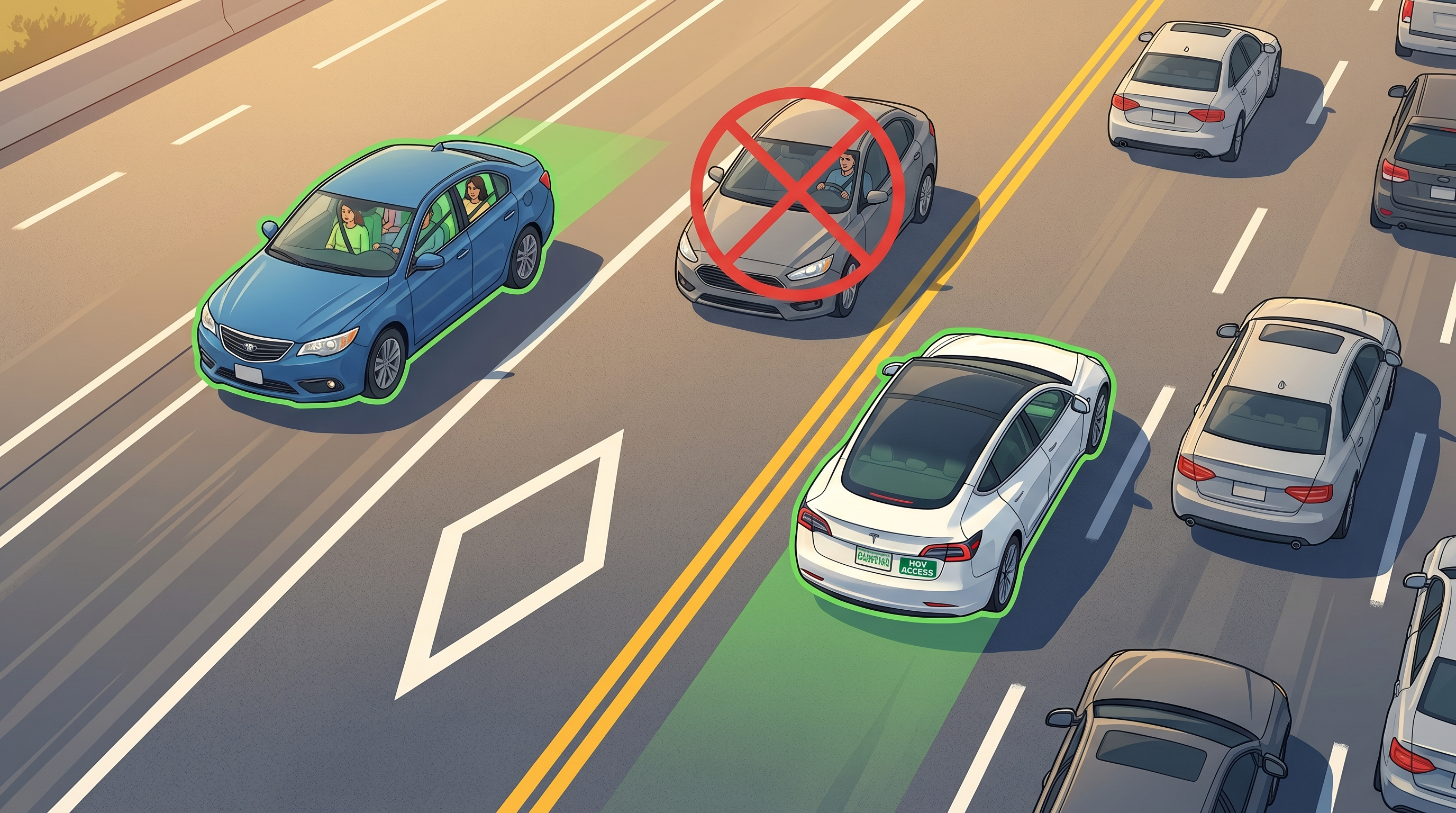
Master right-of-way rules: stop signs, yield signs, four-way stops, uncontrolled intersections. DMV test preparation with clear rules and examples.
Right-of-way rules determine who has the legal right to proceed first at intersections, and they're among the most heavily tested topics on DMV written exams. The reason is practical: every driver will encounter multiple intersections on their first day of driving, and an error in right-of-way judgment causes accidents. The DMV tests right-of-way not as trivia but as a measure of whether you understand the hierarchy of control at intersections: traffic signals override everything, then signs like stop and yield, then basic rules for uncontrolled intersections. This guide covers every scenario: what happens when you meet at a four-way stop, how to yield at a yield sign, what to do when there are no signs at all, and how to recognize the rare but dangerous situations where right-of-way rules break down. Master these rules and you'll answer 15–20 intersection-based DMV questions correctly.
The core principle is simple: the road system is designed to prevent conflicts. Traffic signals create clear alternating rights. Stop and yield signs create clear hierarchies. Only when both drivers have equal rights do tie-breaking rules apply (right of way goes to the right, straight-on beats a turn). Understanding the hierarchy makes every intersection rule logical instead of memorizable.
Not all intersections are equal. Some have traffic lights, some have signs, and some have nothing. The rules change depending on what's controlling the intersection. Understanding this hierarchy prevents confusion.
Traffic signals are the supreme authority at intersections. A green light gives you the right to proceed; a red light means you must stop, period. The only exception is when a police officer directs traffic differently than the signal shows; the officer's hand signals override the light.
Green Light
You have the right to proceed. You must still check that the intersection is clear before entering—there may be vehicles running a red light or pedestrians still in the crosswalk. But the law gives you right of way.
Red Light
You must stop. At a red light, you may turn right if it's safe and no sign prohibits right turns on red (some do). In some states, you may turn left on red from a one-way street into another one-way street, but this varies. The DMV rule is simple: Red means stop unless your state and the specific intersection permit right on red.
Yellow Light
A yellow light is a warning that the light is about to turn red. If you can safely stop, you should. If you're already in the intersection or so close that stopping would be dangerous, you may proceed through. The DMV doesn't test yellow lights as extensively as red and green, but the principle is: yellow = caution, not permission.
Green Arrow
A green turn arrow is an exclusive turning lane. You may turn in the direction of the arrow, and oncoming traffic is stopped. No conflicts are possible during a green arrow. This is the safest type of turn.
When there are no traffic signals, stop and yield signs control the intersection. These signs create a legal hierarchy: stop signs impose a higher obligation than yield signs.
Stop Sign
You must come to a complete stop. "Complete" means your vehicle is fully stationary, wheels not rolling. You do not need to see oncoming traffic to be required to stop—you must stop regardless. Only after stopping can you evaluate whether it's safe to proceed. On the DMV test, if it asks "What must you do at a stop sign?", the answer is "Come to a complete stop." Everything else (checking traffic, proceeding if clear) is secondary.
Yield Sign
You must yield the right of way to traffic that has priority, but you don't need to stop if you can proceed safely without stopping. This is a critical distinction. At a yield sign, if the intersection is clear, you may proceed without stopping. At a stop sign, you must stop even if the intersection is clear. Many drivers confuse these; the DMV frequently tests the distinction.
When there are no traffic signals or signs, basic rules determine right-of-way. These are uncommon in urban areas but appear on rural roads. The DMV tests them because they're still part of the road system.
Rule 1: Straight Traffic Beats Turning Traffic
If you're going straight and another driver is turning, you have the right of way. This makes sense: the turning driver is changing direction and needs to clear the intersection; the straight driver continues in their lane.
Rule 2: Right-Turning Traffic Beats Left-Turning Traffic
If both drivers are turning and there are no other rules, the driver turning right has priority over the driver turning left. A right turn is simpler and faster; a left turn crosses more of the intersection.
Rule 3: Approach from the Right Has Priority
If two vehicles approach the same intersection at roughly the same time and neither rule above applies, the vehicle on your right has the right of way. This is the tiebreaker: when all else is equal, yield to the right.
 Four-way stops—where all four directions have stop signs—are common in residential areas and are frequently tested on DMV exams. The rule is absolute: the driver who stopped first and is farthest through the intersection has the right to proceed first.
You stop before any other vehicle arrives at the intersection. You waited momentarily; now it's safe to proceed. You may go.
Two vehicles approach from opposite directions (perpendicular approaches). They stopped at roughly the same time. If one is turning and one is going straight, straight traffic has right of way. If both are going straight, they're going in opposite directions, so no conflict exists—both may proceed. If both are turning (unlikely), the one turning right has priority.
You and another vehicle are in adjacent lanes, both approaching the intersection from the same direction. If you're both going straight, you can both proceed—no conflict. If one is turning and one is straight, straight wins. This scenario rarely occurs in DMV test form because it's usually obvious.
This is rare and often tested because it requires keeping track of multiple rules. The principle: rightmost vehicle goes first, then left, then opposite-side left. If you're at the top of the T, the vehicle to your right goes first; then the vehicle to your left; then the vehicle opposite you (assuming they're turning). In practice, drivers use courtesy: the rightmost driver waves others through or waits until the intersection clears.
| Situation | Right of Way | Example |
|---|---|---|
| You arrive first at four-way stop | You (you can proceed first) | You stop, wait, no other vehicles, proceed |
| Two vehicles, perpendicular, both straight | Both can proceed (opposite directions) | One going north, one going south; both go straight; no conflict |
| Two vehicles, perpendicular, one turning | Straight traffic | Vehicle going straight has priority over turning vehicle |
| Two vehicles, perpendicular, both turning | Right-turn vehicle | Vehicle turning right beats vehicle turning left |
| Four vehicles arrive simultaneously | Rightmost vehicle first | Vehicle to your right proceeds, then left, then across |
Jake studied DMV rules but didn't practice four-way stop scenarios. On his test, he saw: "You and two other vehicles arrive at a four-way stop at the same time. You're going straight. The vehicle to your left is turning right. The vehicle to your right is turning left. Who proceeds first?" He guessed "Me, because I'm going straight." But the correct answer was "The vehicle to my right, because right-turn traffic beats left-turn traffic, and the vehicle to the right is turning right." Jake failed that question because he didn't understand that at simultaneous four-way stops, position (rightmost) takes priority over direction. After using Wheelingo's scenario-based drilling, he practiced multiple four-way variations and never missed this type of question again.
Yield signs appear where a secondary road joins a primary road, where entering a highway, or where traffic patterns make it necessary to give priority to certain traffic. The key distinction: a yield sign does not require a stop; it requires that you yield to traffic with priority.
When to Stop at a Yield Sign
You stop at a yield sign only if traffic is approaching that would create a conflict. If the intersection is clear, you may proceed without stopping. This is why many drivers roll through yield signs—if the road is clear, a stop is unnecessary. But if a car is approaching, you must stop and wait until they pass.
Merging and Yielding
On entrance ramps to highways, you'll encounter yield signs. The rule is absolute: you yield to traffic already on the highway. You accelerate on the ramp to match the speed of highway traffic, find a gap, and merge in. You do not force your way in; you wait until traffic in the right lane slows or creates space.
Zipper Merging
In heavy traffic where lanes must combine (construction zones, lane closures), the correct method is zipper merging: vehicles alternate—one from the closing lane, one from the continuing lane. Many drivers don't know this rule and merge too early, creating traffic. The DMV may test understanding of proper merging even if it doesn't test the word "zipper."
Rural roads sometimes have intersections with no traffic signals or signs. These situations require you to apply basic right-of-way rules.
Straight vs. Turning
If you're proceeding straight and another vehicle is turning across your path, you have right of way. The turning vehicle must yield. This applies even if you're on a small road and they're on a larger road—straight traffic beats turning traffic.
Right vs. Left
If both vehicles are turning and there are no other rules, right-turn traffic has priority. This makes sense from a safety perspective: a right turn is simpler and faster.
The Right-Hand Rule
If you're approaching an uncontrolled intersection at roughly the same time as another vehicle, and the above rules don't apply, the vehicle approaching from your right has priority. Yield to vehicles on your right. This is sometimes phrased as "on your right" or "driver on the right."
| Scenario | Right of Way | Reason |
|---|---|---|
| You going straight, other vehicle turning left across your path | You (straight traffic beats turning traffic) | Straight traffic has priority |
| You turning right, other vehicle turning left | You (right-turn beats left-turn) | Right turn is simpler and faster; left turn crosses more of intersection |
| You both going straight, approaching from perpendicular directions | Both can proceed; no conflict | You're traveling in different directions; both clear the intersection |
| You and another vehicle arrive simultaneously; neither sign applies | Driver on your right | Right-hand rule applies; yield to the right |
Right-of-way rules extend beyond cars to pedestrians, bicycles, and emergency vehicles. The DMV tests these because they're often misunderstood.
Pedestrians in Crosswalks
Pedestrians have the right of way in marked crosswalks and at pedestrian signals. A pedestrian with a green "Walk" signal has absolute right of way; all turning vehicles must yield. Even if you have a green arrow to turn right, you must yield to pedestrians in the crosswalk.
Pedestrians Without Signals
In areas without pedestrian signals, pedestrians are allowed to cross if it's safe. You must yield to them. The DMV's principle is: drivers must always be prepared to yield to pedestrians for safety.
Pedestrians Illegally Crossing
If a pedestrian crosses against the signal or outside a crosswalk, they're in the wrong legally. But you still must try to avoid hitting them. The law does not give you the right to hit an illegally crossing pedestrian—you must avoid them if possible.
Bicycles have the same rights and responsibilities as vehicles in most states. A bicycle in a bike lane has the right of way over turning vehicles. A bicycle at an intersection with a green light has right of way. The DMV may test whether you understand that bikes are vehicles and have vehicle-level right-of-way.
Police, fire, and ambulance vehicles responding to emergencies have the right of way over all traffic. You must yield even if you have a green light. You should pull to the side and stop until the emergency vehicle passes. The DMV tests this: "An ambulance with lights and sirens is approaching. What should you do?" The answer is "Pull to the side and stop."
The fastest way to pass your test is consistent practice with real questions. Try Wheelingo free — state-specific questions, instant explanations, and a readiness score that tells you when you're ready.
Q: What's the difference between a stop sign and a yield sign?
A: A stop sign requires a complete stop regardless of traffic. A yield sign requires you to yield to approaching traffic but doesn't require a stop if the intersection is clear. Many DMV questions test this distinction.
Q: At a four-way stop, how do I know who goes first?
A: The driver who stopped first goes first. If multiple vehicles stopped at the same time, rightmost vehicle goes first, then left, then across. When in doubt, wave another driver through.
Q: Can I turn right on a red light?
A: In most states, yes, if it's safe and no sign prohibits it. You must stop first, then turn if clear. Some intersections have signs saying "No Right Turn on Red"—you cannot turn in those cases.
Q: What if a traffic signal and a traffic officer direct me differently?
A: Follow the officer's instructions. The officer's hand signals override traffic signals.
Q: At an uncontrolled intersection, who has right of way?
A: Straight traffic beats turning traffic; right-turn beats left-turn; if all else is equal, vehicle on your right has priority.
Q: Do pedestrians have right of way over turning vehicles?
A: Yes, always. A pedestrian in a crosswalk has right of way even if you have a green arrow to turn right. You must yield to pedestrians.
Q: What should I do if I approach an intersection and no one else is there?
A: At a stop sign, you still must stop completely even if no traffic is present. At a yield sign, you may proceed if clear without stopping.
Q: Is it legal to block an intersection while waiting to turn left?
A: No. You should not enter the intersection until you're sure you can clear it. Even if you have a green light, don't enter the intersection if you can't complete your turn before traffic from the opposite direction arrives.
Right-of-way rules are one piece of intersection safety. To build comprehensive DMV knowledge:
Take Wheelingo's full-length practice tests to see how right-of-way is tested in context. Flashcards organized by scenario (four-way stops, yield situations, pedestrians) make the rules stick faster than reading alone.
Right-of-way rules are interconnected and build on each other. Here's a one-week approach:
Day 1: Hierarchy of control. Learn traffic signals > stop signs > yield signs > uncontrolled rules. Understand that signals create clear rights; signs create hierarchy.
Day 2: Four-way stop mastery. Practice 10 four-way stop scenarios. Who arrived first? If simultaneous, rightmost first. Drill until you can answer instantly.
Day 3: Yield sign scenarios. Practice merging, entering highways, and yield-at-intersection situations. Understand when you can proceed without stopping.
Day 4: Uncontrolled intersections. Drill straight vs. turning, right vs. left, and right-hand rule scenarios. Create flashcards for each type.
Day 5: Special situations. Study pedestrian crossing, emergency vehicles, bicycles. Then take a full-length practice test and focus on intersection questions.
Day 6: Review weak areas. Identify which scenario types you missed and drill those. Most people miss either four-way stops or uncontrolled intersection rules.
Day 7: Mixed scenarios and test simulation. Take a second practice test with right-of-way questions mixed throughout to simulate actual test conditions.
Right-of-way rules exist to prevent the collisions that happen at intersections. Every intersection is a point where traffic from different directions meets, and without clear rules, accidents would be unavoidable. Your DMV test is assessing whether you understand these rules well enough to navigate intersections safely. When you see a stop sign, a yield sign, or an uncontrolled intersection on your test, you should know instantly what you must do and why.
More importantly, these rules will protect you when you're driving. Every time you approach an intersection, you'll apply these rules to decide whether to proceed, stop, or yield. Getting them right on your test is practice for getting them right on the road.
Ready to master right-of-way rules? Start with Wheelingo's scenario-based drilling for interactive four-way stop and intersection practice. Then use full-length practice tests to see how the DMV tests these rules in realistic contexts.
Next in your prep: Study pavement markings, which interact with right-of-way rules at intersections. Then review Wheelingo's complete roadmap for your full DMV prep sequence, or choose your state to access state-specific right-of-way variations.