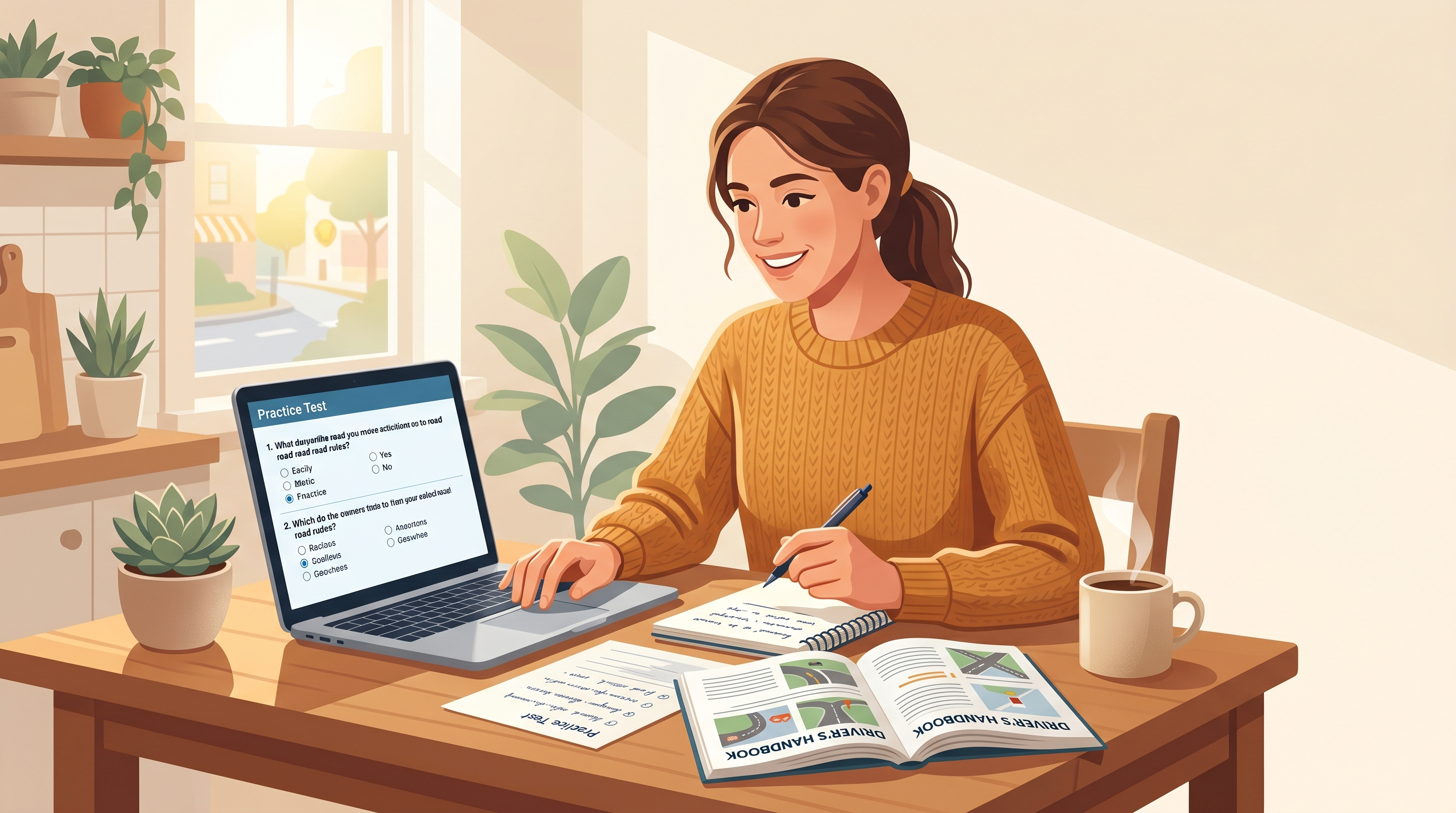
Pass your drivers license test without paying for driving school. Complete self-study roadmap, free resources, and proven 30-day plan for any state.
Yes, you can study for and pass the drivers license test without a driving school in most US states. Adults in the majority of states can self-study using the official driver's handbook, free practice tests, and 50 hours of supervised driving practice. Drivers under 18 have stricter requirements, usually including mandatory driver education.
Driving schools are convenient but expensive, with full programs costing between $300 and $800. For many adult learners, relocators, and budget-conscious families, that price tag is a barrier. The good news: the DMV does not care where you learned, only that you can demonstrate knowledge and safe driving.
This guide shows you the exact self-study path: what to read, what to practice, how to log driving hours, and how to pass both the written and road tests without ever stepping into a classroom.
In most states, yes. The DMV distinguishes between "mandatory" and "recommended" driver education. Mandatory means you cannot take the road test without a course certificate. Recommended means the state suggests it but does not require it.
Driver education is mandatory for all new drivers under 18 in: California, Texas, Florida, New York, Illinois, Ohio, Georgia, Michigan, New Jersey, Virginia, North Carolina, Massachusetts, Pennsylvania, Washington, and most other states.
Adults (18 and older) can typically skip driver education in: Most states, including Texas (drivers 25+), California (18+), New York (18+ in most cases), Florida (18+ with TLSAE course only), Illinois (18+), and the majority of other states.
Even when driver education is not required, supervised driving practice usually is. Most states require 30 to 50 hours of logged driving time before the road test, regardless of age.
Ethan moved from Florida to Colorado at age 24 in early 2026 and did not have a driver's license. Colorado allowed him to skip driver education as an adult. He spent $0 on driving school. He passed the written test after 3 weeks of self-study and the road test after 8 weeks of practice with a coworker who had a license. Total cost: DMV fees only, roughly $35.
Ready to start your self-study journey? Take a free state-specific practice test to see exactly where your knowledge stands before you build your study plan.
Every state publishes a free PDF handbook covering everything on the written test. This is the single most important document in your self-study journey.
Where to find it:
How to use it:
Read for 30 to 45 minutes per day for the first week. Do not try to memorize everything. Your goal is broad familiarity.
Reading the handbook alone will not teach you how to answer test questions. You need active recall.
Free practice test sources:
Practice test strategy:
Priya, a 32-year-old who never got her license as a teen, self-studied for New Jersey's permit test in March 2026 using only free resources. She took 27 practice tests over 4 weeks. Her scores went from 64% on the first to 94% on the last. She passed the real test with 46 of 50 correct. "Practice tests were everything," she said. "The handbook gave me context, but the tests taught me to answer."
For a broader breakdown of test strategy, see our practice test strategy guide.
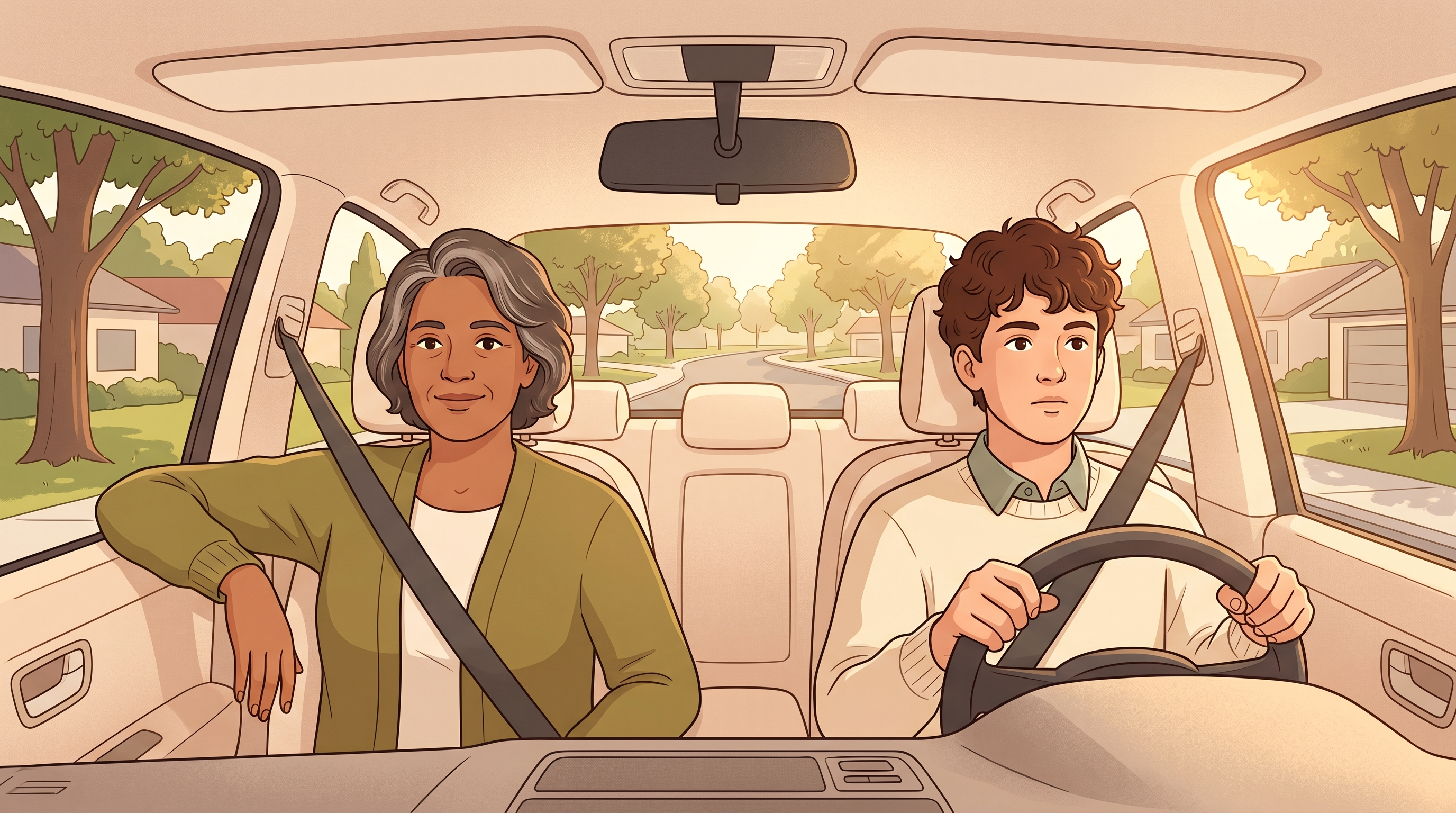
After you pass the permit test, you need behind-the-wheel practice. This is where self-study gets practical.
Who can supervise:
What to log: Most states require written logs of your supervised hours, often 30 to 50 hours total including 10 hours at night. Keep a simple notebook or use a free driving log app.
Practice priorities:
Our practice driving schedule guide offers a 50-hour breakdown by skill and difficulty.
Road signs are the single most missed category on written tests. Study them until recognition is automatic.
Categories to memorize:
Print out a one-page sign sheet and quiz yourself daily for 5 minutes. Flip it face-down and recite what each sign means. By week 3 you should know every shape, color, and meaning instantly.
For deep practice, check our US road signs complete guide.
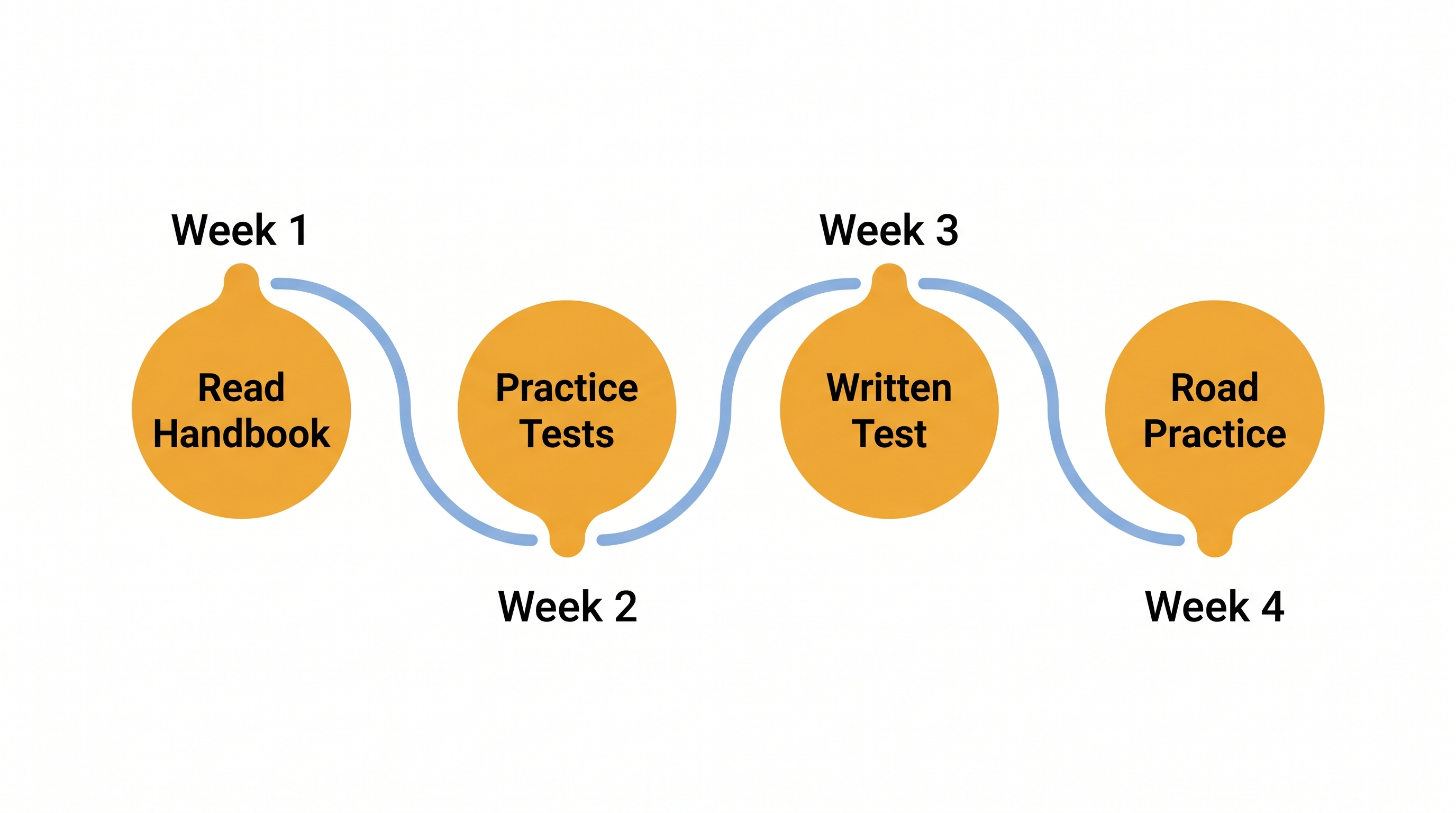
Once you are scoring 90%+ on practice tests, schedule your written test. Most states allow online scheduling through the DMV.
Day-of preparation:
After passing, you receive your learner's permit. Now the driving practice begins in earnest.
Want structured support for your written test? Download Wheelingo for a free adaptive roadmap tailored to your state. No subscription required to start.
The road test evaluates your actual driving. Practice the exact maneuvers examiners score.
Common road test maneuvers:
Your licensed supervisor should quiz you on each maneuver until you can perform them without hesitation.
Most states require you to schedule the road test separately, usually a few weeks after your permit. Some require you to show proof of supervised driving hours.
Road test day:
Our road test walkthrough covers the exact examiner checklist and what they are scoring at each moment.
[YOUTUBE EMBED PLACEHOLDER: "How to Pass the Drivers License Test Without Driving School" - authoritative DMV prep channel, 16:9 embed]
Self-study works for most adults. But driving school still makes sense if:
Many insurers offer 10% to 20% discounts for drivers who complete an approved course. Over 3 years that can exceed the cost of driving school. Weigh your insurance savings before deciding.
Can my parent count as my driving instructor? Yes, in every state. A licensed parent, guardian, or any licensed adult 21+ can serve as your supervising driver. They do not need a special teaching license.
Do I need to insure the car I practice in? Yes. The car must have current insurance, and in most states permit holders are covered under the owner's policy as a "permissive driver." Check with your insurer to confirm.
What if I fail the road test without driving school? Self-study failure rates are similar to driving school failure rates once you account for practice hours. A failure usually means you need more practice, not more instruction. Identify which maneuver failed you and drill it in a parking lot before retesting.
How long does self-study take? Most self-study adults pass in 4 to 8 weeks. Teens take longer due to mandatory holding periods (usually 6 months of permit holding before the road test).
Can I self-study if I have never driven a car? Absolutely. Start in empty parking lots with a patient licensed adult. Practice basic controls (gas, brake, turning, parking) before ever hitting public roads. A quiet cul-de-sac is your next step.
Do self-taught drivers get lower road test pass rates? No data supports that claim. Road test success correlates with total supervised practice hours, not with whether the supervisor was paid.
Formal driving schools offer one thing self-study cannot easily replicate: a structured environment with zero judgment. Teachers have seen it all. Family members have not.
Carlos, 28, decided to get his license in Texas without driving school. He planned to practice with his older brother but found that every lesson ended in an argument. His brother corrected him constantly. Carlos got defensive. After 3 tense sessions he switched to his best friend, a patient licensed driver. The dynamic changed instantly. "Same car, same streets, totally different vibe," Carlos said. He passed his road test on attempt 1 after 40 hours of practice.
The lesson: your supervisor matters as much as your hours. Choose someone who communicates clearly, stays calm, and gives specific feedback (not vague criticism). If your first choice does not work, try someone else.
You do not need a classroom to get structured practice. These free or low-cost tools work:
Our complete driving skills and maneuvers guide covers every skill you need to master for the road test, broken down by difficulty.
Here is how the two paths usually unfold:
Driving school (8 to 12 weeks):
Self-study (4 to 12 weeks):
Self-study can be faster or slower depending on how often you practice. Adults with licensed spouses or friends available most days finish in 4 to 6 weeks. Teens with mandatory holding periods take 6 months regardless of hours logged.
You can absolutely study for the drivers license test without a driving school. The handbook is free. Practice tests are free. A licensed friend or family member can supervise driving for free. The only real cost is DMV fees, which run $35 to $100 depending on your state.
The self-study path works in 30 to 60 days for most adults who put in 30 to 45 minutes of daily study plus regular supervised driving. You keep the money, you keep control of the schedule, and you pass on your own terms.
Your license is waiting. Go earn it.