The things driving instructors won't tell you, from scoring quirks to real test-day shortcuts. Learn what most students never hear until after they fail.
The things driving instructors will not tell you, but absolutely should, include how much your pre-test routine matters, why the first 90 seconds of your road test decide most of your score, and why "practice until it is boring" is the only reliable predictor of a first-time pass. Most instructors teach you to drive. Few teach you how the test actually works.
This is not an attack on driving instructors. Most are excellent. But they work on tight schedules, they are trained to teach driving mechanics, and they rarely have time to cover the psychology, logistics, and scoring quirks that separate a confident test-taker from a nervous one.
In this guide, we will unpack the 10 things your driving instructor probably did not have time to mention, sourced from conversations with instructors, examiners, and drivers who have taken tests in half a dozen states. Let us pull back the curtain.
Key takeaways
- The first 90 seconds of your road test set the examiner's mental baseline for your entire score.
- Most instructors teach driving, not test-taking. The two are different skills.
- Pre-test rituals (sleep, food, arrival time) move scores more than an extra lesson.
- Examiners remember candidates who stay calm after mistakes, not ones who never make them.
- The highest-ROI prep is mock tests in the actual car and route, not more open-road practice.

When your examiner settles into the passenger seat, they start forming a mental model of you immediately. The first 90 seconds, pulling out of the DMV lot, setting your mirrors, checking your seatbelt, include some of the easiest points on the whole test and the ones most students throw away.
Most test sheets give you points for:
Nail those, and your examiner's baseline read of you is "competent." Fumble them, and every later decision gets extra scrutiny. The effect is documented in examiner training materials from the AAMVA, which explicitly instructs examiners to "anchor your initial impression and adjust only with clear evidence."
Ready to practice those first 90 seconds until they are automatic? Start your free Wheelingo practice and drill the pre-drive routine alongside the driving.

Here is the counterintuitive truth. Making a mistake on the test does not automatically fail you. Handling a mistake badly often does.
Examiners are trained to score behaviors, not moments. If you roll a stop sign, that is one deduction. If you roll a stop sign, panic, freeze at the next green light, and then swerve to correct, that is four deductions in 15 seconds. The original rolling stop was recoverable. The panic was not.
Jordan, 18, taking his Ohio road test last fall, turned the wrong way down a correctly posted one-way street. He realized it within about three seconds. He calmly pulled over to the right, activated his hazards, looked over his shoulder, and reversed carefully back to the intersection he had turned from. Then he continued the test.
His examiner marked the wrong-way turn as a major error. But she did not fail him outright. Jordan's score, after deductions, was 76 out of 100. Ohio's passing threshold is 70. He passed. Her written comment: "Candidate demonstrated composure and correct recovery procedure."
The lesson is the one most instructors skip. Practice recovering from mistakes, not just avoiding them. Use mock tests, deliberately make small errors, and train the recovery response. Our failed test recovery guide has specific drills for this.
Most DMV offices use a small set of pre-planned routes. Some states rotate three or four. Some use only one. These routes are designed to test specific skills in a fixed order.
You can often find your local DMV's route online through Reddit threads, local driving schools, or (in some states) official publications. This is not cheating. It is preparation. The California DMV officially publishes many of its route maps.
Driving the likely route three to five times before your test dramatically reduces test-day anxiety. You already know where the tricky left turn is. You already know which intersection has the bad sightline. You can focus your cognitive energy on your driving, not on navigation.
Instructors almost universally tell students to "get a good night's sleep" without explaining why. The reason is neurological. Sleep consolidates motor learning. The practice you did three days ago is more available after a full night's sleep than the cramming you did at 11 pm the night before.
A meta-analysis of motor skill studies found that subjects who slept seven to eight hours before a skill assessment outperformed those who practiced an additional two hours but slept only five. The effect size was substantial.
Translation: an extra hour of practice at 9 pm the night before is worth less than an extra hour of sleep. If you are tired, stop and sleep.
Most test-takers imagine the examiner is making holistic judgments about "how you drive." In reality, most examiners fill out a standardized scoring sheet with specific categories: signal use, mirror checks, speed control, intersection behavior, parking, emergency response.
If you think in those categories during practice, you will score them during the test. Our DMV road test walkthrough maps out the categories state by state.
Want to train category by category instead of randomly? Download Wheelingo and practice state-specific scoring categories.
Instructors often say "just calm down" or "do not be nervous." It is terrible advice because nervousness is not a choice.
Nervousness is your nervous system responding to uncertainty. The solution is not willpower. The solution is reducing uncertainty. Every piece of test-day information you can lock down ahead of time makes you measurably calmer:
The more of these you control, the less your nervous system has to freak out about. This is the same principle behind breathing exercises for test anxiety, but it works on the input side rather than the response side.
Most students assume that asking the examiner "can you repeat that?" counts against them. It does not. In fact, asking once is safer than guessing wrong.
The only caveat is do not ask for help deciding what to do. "Can you repeat the direction?" is fine. "Should I turn here?" is a problem because it shifts the decision onto the examiner.
Priya, 23, taking her Florida road test, did not hear her examiner's direction to "take the next right after the school." She almost missed it. She asked, "Can you repeat the last direction?" The examiner did, Priya made the turn, and her examiner's notes said "candidate appropriately requested clarification." No points lost.
For more on examiner communication, see our guide to DMV test-day logistics.
Most instructors will happily let you book extra lessons to "perfect" your parallel parking. That is revenue for them. It is not always the best use of your time.
If your parallel parking is already passable (you can do it in three tries, within the cones, with appropriate mirror checks), pouring more hours into it offers diminishing returns. Those hours would be better spent on whatever your weakest skill actually is.
Honest self-assessment is hard. Use a structured progress tracker to see where your accuracy is lowest and prioritize those categories first.
[Embed YouTube video: "Driving Instructor Reveals Test Secrets" - placeholder for relevant driving instructor channel]
This one is uncomfortable to say, but it is true. Examiners cannot read your mind. They can only score what they see.
That means exaggerated mirror checks, obvious head turns for shoulder checks, deliberate signaling in plenty of time, and a calm, composed posture all add up. The driver who does a mirror check but barely turns their head scores worse than the driver who does the same check with an obvious motion.
This is not about faking skill you do not have. It is about making sure the skill you do have is visible. Driving experts on channels like Smart Drive Test on YouTube emphasize this in every test-prep video. The technical term is "demonstrative driving," and it is a real category on some state rubrics.
Passing thresholds vary by state, but almost all of them are between 70% and 80%. California passes at 70. Texas passes at 71. New York passes at 70. Florida passes at 75.
This means you can lose a meaningful number of points and still pass. You do not need perfection. You need to be solidly above the threshold across the categories that matter.
Maria, 28, relearning to drive after moving from Brazil, took her Massachusetts road test convinced she had failed. She forgot to signal once, hit the curb lightly during parallel parking, and took a turn slightly wide. She got in the passenger seat ready to schedule a retake.
Her examiner handed her the pass slip. Her score was 81. Massachusetts passes at 75. Maria had spent the whole test catastrophizing over mistakes that the examiner had already absorbed into routine deductions.
The lesson is to understand your state's passing rubric so you know exactly how much margin you have. If you are well-prepared, you have more margin than you think.
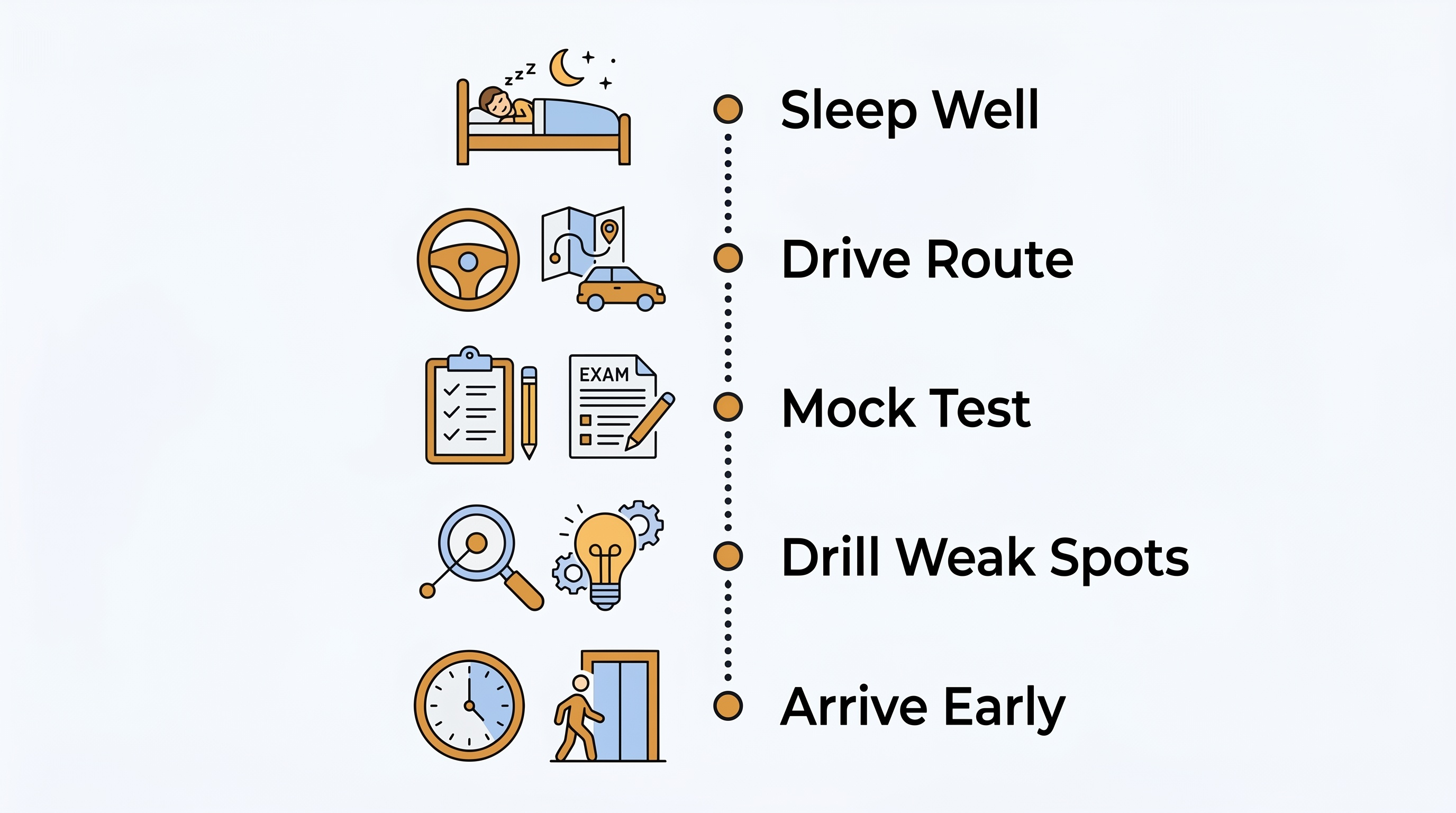
Here is the action plan. It is simple, but almost no one does it all.
Want a step-by-step roadmap that covers all ten secrets? Start your free Wheelingo practice and follow a structured prep plan instead of guessing.
Driving instructors teach you to drive. The difference between passing your test first time and retaking it often lives in the gap between "driving" and "test-taking." That gap is where this guide lives.
You now know that the first 90 seconds matter disproportionately, that recovery from mistakes counts more than avoidance, that the test route is usually knowable, and that sleep beats last-minute cramming. You know your examiner has a checklist, and you can think in its categories. You know the passing threshold gives you room to be imperfect.
Most importantly, you know that your instructor probably never had time to tell you any of this. Now you do. Use it, prepare deliberately, and show up on test day knowing that the secrets are on your side. Download Wheelingo and turn these secrets into a passing score.