Uncontrolled intersection rules every new driver must know. The yield-to-the-right rule, test scenarios, and how to pass your DMV exam.
At an uncontrolled intersection with no signs or signals, the vehicle on the right has the right of way. If both of you arrive at the same time, the driver on the right goes first, full stop.
Most new drivers never practice uncontrolled intersections because they assume every intersection has a sign. In rural areas, residential neighborhoods, and some older urban streets, that assumption is wrong. Examiners know this and often route tests through uncontrolled intersections specifically to grade right-of-way judgment.
Jonah grew up in suburban New Jersey. Every intersection in his town had a stop sign or light. When his rural Pennsylvania road test took him through 2 uncontrolled intersections in quick succession, he froze. He stopped unnecessarily at the first and failed to yield at the second. Both errors cost him points. He passed by only 3 points.
The Insurance Institute for Highway Safety classifies intersection crashes as one of the top causes of collision injuries, and uncontrolled intersections are disproportionately represented. That is why DMV examiners test these scenarios even though they are less common.
This guide covers every uncontrolled intersection rule, the right-of-way tie-breakers, and the common failures new drivers make. For state-specific practice, start a free Wheelingo test and focus on right-of-way questions.
Key Takeaways
- An uncontrolled intersection has no stop signs, yield signs, or traffic signals. Priority is determined by position and arrival time.
- The yield-to-the-right rule applies when 2 vehicles arrive at roughly the same time.
- Left-turning drivers always yield to oncoming through traffic, even at uncontrolled intersections.
- Pedestrians always have absolute right of way at any intersection, including uncontrolled ones.
- Examiners watch for confident scanning and correct yielding, not full stops. Full stops at uncontrolled intersections without reason are marked as unnecessary.
An uncontrolled intersection has no traffic control devices. No stop signs, no yield signs, no traffic lights, no flashing beacons. Priority is determined entirely by driver judgment based on right-of-way rules.
Uncontrolled intersections appear in:
On your driving test, uncontrolled intersections are most common on rural or residential portions of the route. City and suburban routes rarely include them, but examiners in states with varied test routes will route you through at least 1.
Want a structured path to master every intersection type? Wheelingo's learning roadmap includes a dedicated right-of-way module with adaptive difficulty.
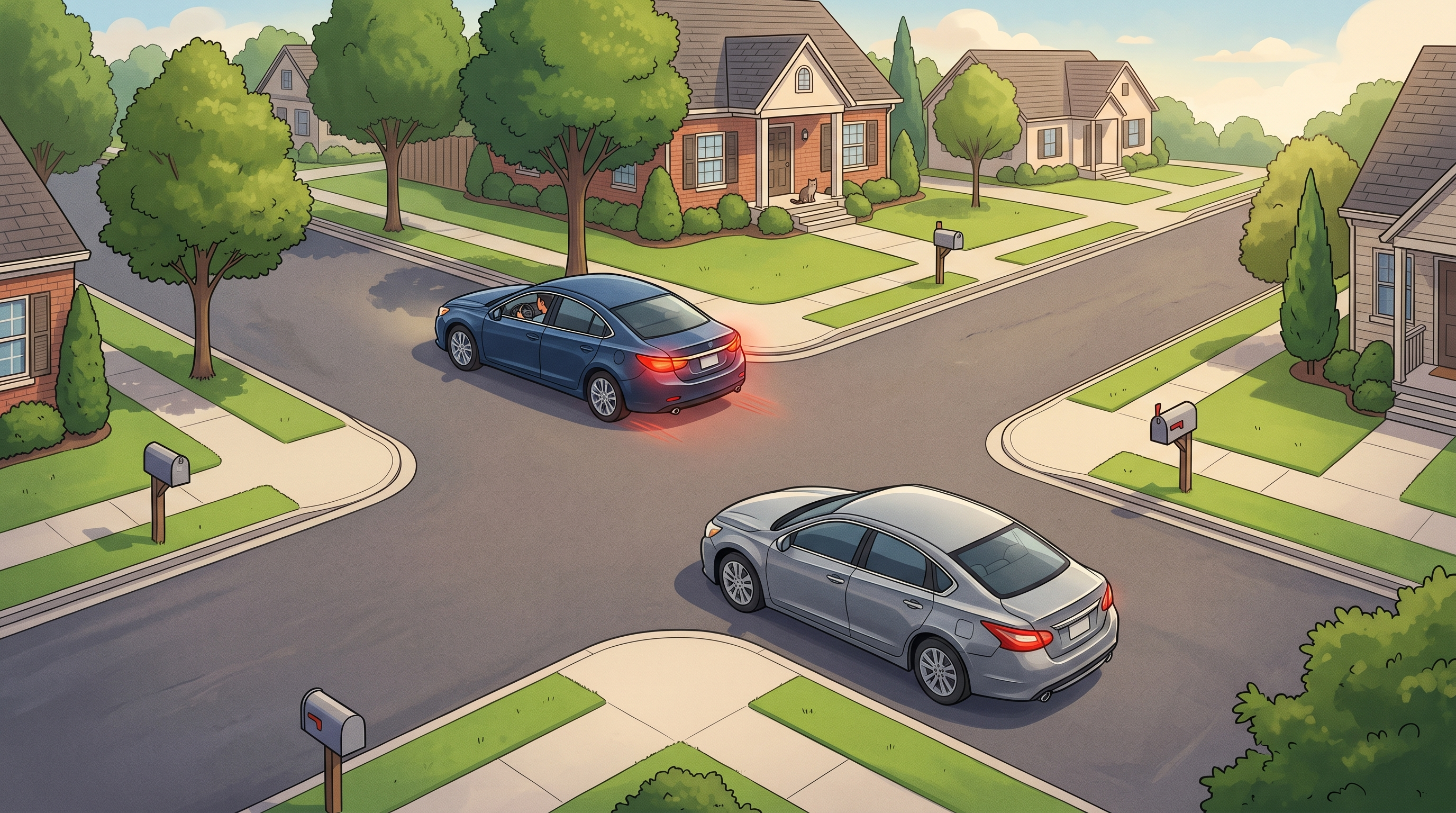
The yield-to-the-right rule is the default tie-breaker at uncontrolled intersections across all 50 US states. When 2 vehicles arrive at roughly the same time, the vehicle on the right has priority.
Example: You are heading north and another car is heading west. You both arrive at an uncontrolled intersection simultaneously. The westbound car is on your right. They go first. You yield.
This rule is simple on paper and confusing in practice. Here is why:
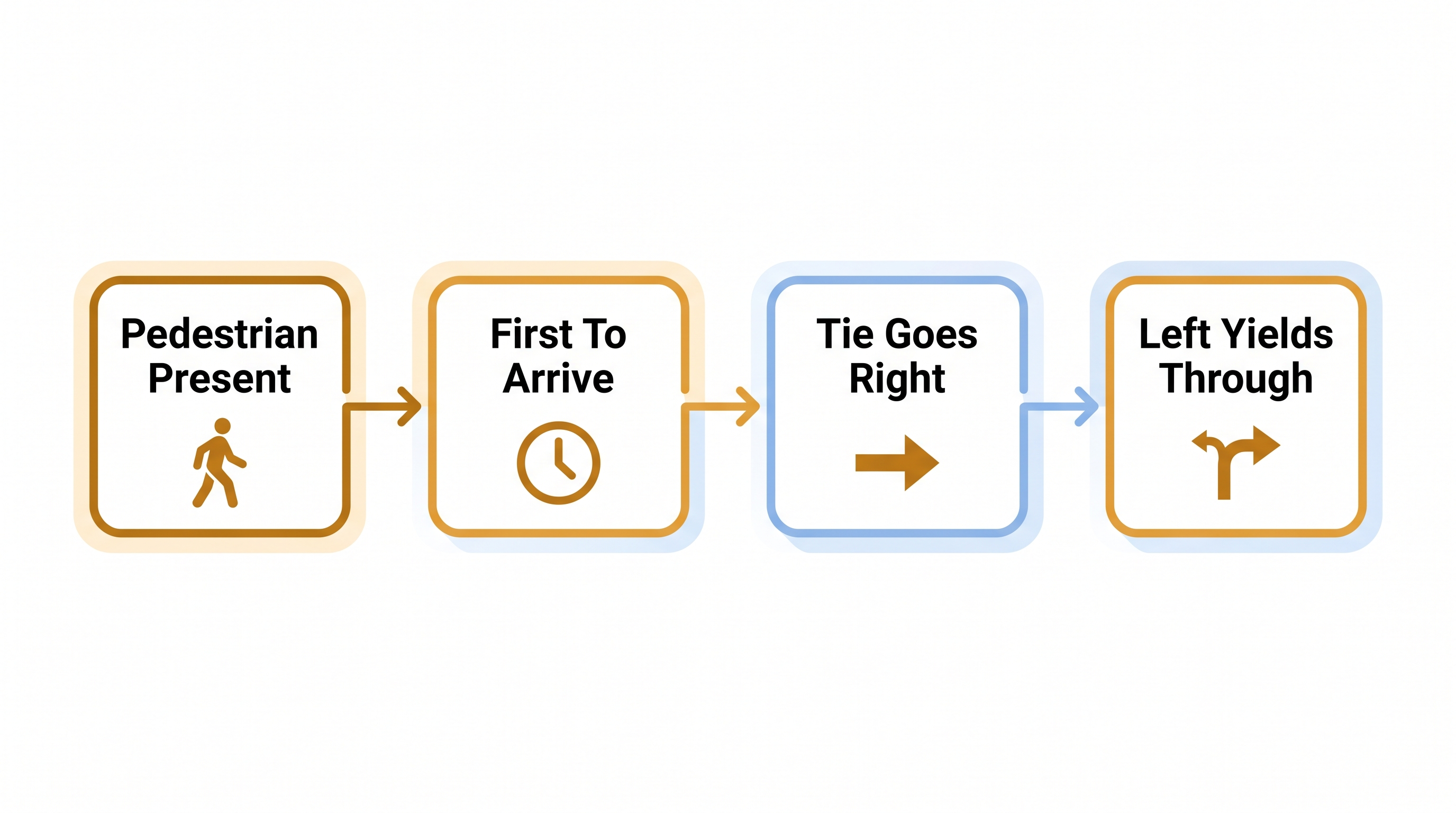
Simultaneous arrival is a judgment call. If you clearly arrived 2 seconds earlier, you have priority regardless of position. If they arrived 2 seconds earlier, they have priority. Only at true ties does the right-side rule kick in.
Speed matters. A vehicle approaching at 40 mph has less time to stop than one approaching at 20 mph. The faster vehicle has practical priority even if the slower is on the right, because forcing them to brake hard is dangerous.
Visibility matters. If the other driver cannot see you yet, yielding to them is safer than asserting your theoretical right of way.
On your test, examiners grade safe judgment, not rulebook rigidity. If the other driver is clearly going, you yield, regardless of what the rule says.
Left turns at uncontrolled intersections follow their own rule, which overrides the yield-to-the-right default. Any vehicle turning left yields to oncoming through traffic.
This means if you are making a left turn at an uncontrolled intersection and another vehicle is coming toward you going straight, the oncoming vehicle has the right of way even if you are on their right.
Correct left-turn approach at an uncontrolled intersection:
Ready to drill intersection scenarios? Wheelingo's practice tests include state-specific right-of-way questions from actual DMV test banks.
Pedestrians always have the right of way at intersections, whether marked, unmarked, or uncontrolled. Every intersection has legal crosswalks extending the sidewalks across the road, even if unpainted.
On your test, if a pedestrian is at the corner of an uncontrolled intersection waiting to cross, yield to them before proceeding. Even if the yield-to-the-right rule gives you priority over a vehicle, the pedestrian outranks both of you.
Failing to yield to a pedestrian at any intersection is an automatic fail on every state road test.
The correct approach sequence to any uncontrolled intersection:
Examiners want to see confident scanning and clear decision-making. A driver who crawls through at 5 mph looking nervously in every direction is marked down for poor judgment. A driver who confidently scans, decides, and proceeds is marked up.
No, not by default. If the intersection is clear of vehicles and pedestrians, you may proceed at a reduced speed without stopping.
You must stop only when:
Unnecessary stopping at a clear uncontrolled intersection is marked as poor judgment. Learn more about when to stop in our yielding rules guide.
The 5 most common failures examiners mark:
Failure 1: Unnecessary full stop. Stopping when no traffic or pedestrians were present. Marked as poor judgment.
Failure 2: Failing to yield to the right. Proceeding when another vehicle was on your right and arriving simultaneously. Marked as failure to yield.
Failure 3: Left turn against oncoming traffic. Turning left without waiting for oncoming cars. Marked as failure to yield, sometimes an automatic fail.
Failure 4: Not scanning. Proceeding without visibly turning your head to check for traffic. Marked as failure to observe.
Failure 5: Rolling through without slowing. Treating the intersection as if no threat existed. Marked as excessive speed for conditions.
Ravi, 28, failed his first road test on a single uncontrolled intersection failure. He did not slow down because he assumed all intersections had signs. A car on his right had priority and had to brake hard. "Failed to yield to the right" ended his test. On his retake, he spent 2 weeks practicing in his own neighborhood, specifically looking for intersections without signs. He passed on his second attempt. Deliberate practice in the right environments is how you master these scenarios.
A T-intersection is a 3-way intersection where one road terminates into another. Even without signs, the vehicle on the terminating road (the stem of the T) yields to traffic on the through road (the top of the T).
This rule overrides the yield-to-the-right default. The through road has priority at every T-intersection, controlled or uncontrolled.
On your test, if you are driving on the terminating road:
Parking lots are full of uncontrolled intersections between aisles. The same rules apply: yield to the right, left-turners yield to through traffic, and pedestrians always have priority.
Examiners on urban test routes may end the test in a parking lot and grade your navigation through internal intersections. Do not let your guard down just because you are off the main road.
Ready to pass every intersection type your examiner tests? Download Wheelingo and practice all right-of-way scenarios with adaptive difficulty.
[YouTube placeholder: "Uncontrolled Intersection Rules Explained" - Wheelingo official channel, 4-minute walkthrough of yield-to-the-right, left turn yields, and pedestrian priority at signless intersections]
Most right-of-way rules are consistent nationwide, but test scoring varies.
California rarely tests uncontrolled intersections because most CA roads have signs. Expect more 4-way stop testing instead.
Texas includes rural test routes where uncontrolled intersections are common. Know the yield-to-the-right rule cold.
Pennsylvania and Ohio test uncontrolled residential intersections more than most states. Examiners route through neighborhoods with no stop signs.
New York rarely tests uncontrolled intersections in NYC but does in upstate routes.
Illinois grades uncontrolled intersections explicitly on the scorecard.
Know your state's test-route characteristics before you test. Our right of way rules at intersections guide covers state-specific differences.
Find a residential neighborhood near you with at least 5 uncontrolled intersections. Drive through the area during low-traffic hours and practice every intersection deliberately.
After a week, uncontrolled intersections will feel as routine as stop signs.
Have a passenger call out priority as you approach each intersection: "You have right of way. Proceed." or "Car on right. Yield." This builds decision-making speed.
Learn the full right-of-way framework for every intersection type, controlled or uncontrolled.
Ready to pass your road test on the first try? Download Wheelingo and drill state-specific intersection scenarios with adaptive practice. 87% of our users pass their first attempt.
Uncontrolled intersections are not about fancy rules. They are about confident judgment. Scan actively, apply the yield-to-the-right rule, watch for pedestrians, and commit to your decision. Examiners reward clean, decisive driving over excessive caution. Practice the scenarios, know the rules, and you will pass.