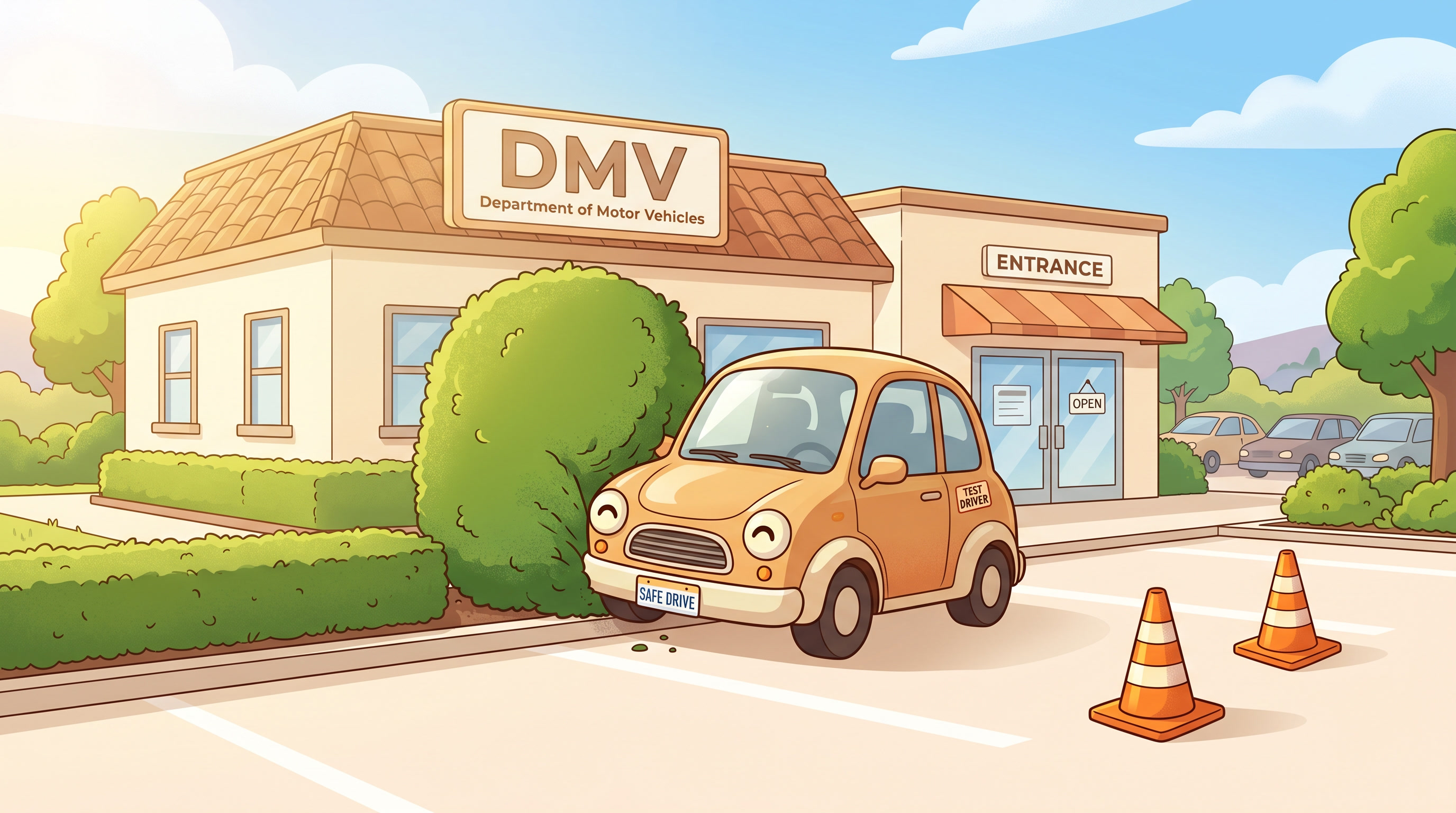
The worst driving test failures ever recorded, from crashed cones to a car in a pool. Learn the real lessons behind viral DMV fails and how to avoid them.
The worst driving test failures ever recorded include a car driven straight through the DMV wall in Hurst, Texas, a student who confused reverse with drive during a parallel parking attempt, and a candidate who lost points for arguing with the examiner about a stop sign that "didn't count." Every one of these fails carries a useful lesson, and that is what this guide is about.
You came here because you want a laugh. Fair enough. But you also want to know, deep down, that you will not be the next viral clip. We will walk through the most infamous DMV disasters from the last decade, explain the exact mistake each driver made, and show you how to dodge those same traps on your own test day.
By the end, you will have a clear mental checklist of what not to do, why examiners fail people, and how to train out the bad habits that turn a routine road test into a news story. Let us get into it.
Key takeaways
- The most common cause of viral test failures is pedal confusion, not bad luck or a mean examiner.
- Arguing with an examiner is an automatic fail in 38 states, even when you are right about the rule.
- Most "funny" fails are rooted in three trainable habits: mirror checks, speed control, and smooth steering.
- Nerves amplify mistakes; structured practice cuts the chance of panic errors by more than half.
- Learning from real failures is faster than learning from your own, and a lot cheaper.
Dashcam culture turned the DMV into a goldmine for viral clips. A quick search on YouTube channels like Dashcam Lessons or Reddit threads in r/IdiotsInCars will surface hundreds of botched tests every month. The reason they spread is simple: they are funny, they are short, and every viewer silently thinks, "I would never do that."
You probably would not. Most people would not. But under test pressure, your brain runs on a smaller battery than usual, and small mistakes get bigger. That is the real story behind every viral fail, a person who knew the rule but could not access it when it mattered.
If you want the academic version, the AAA Foundation has a solid report on novice driver error patterns that confirms what every instructor sees in the field: cognitive overload is the real villain. The viral clip is just the evidence.
Ready to turn that anxiety into preparation? Start a free practice session on Wheelingo and build the reflexes that survive test-day pressure.
The single most infamous category of DMV failures is pedal confusion. The driver means to hit the brake, hits the gas instead, and a test becomes a news segment. It happens more than you think.
In 2018, a teen taking her road test in Hurst, Texas drove through the front wall of the DMV office. She meant to park. Her foot found the accelerator, and 2,000 pounds of metal found the lobby. No one was seriously hurt, but the video got picked up by local news and national morning shows.
The lesson is not "do not panic," because telling a nervous driver not to panic is useless. The lesson is foot placement. Your heel should rest on the floor directly in line with the brake, and your foot should pivot to reach the gas. If you lift your heel to switch pedals, you lose your reference point. Under stress, that is where confusion starts.
Take Sarah, 17, taking her test in Phoenix last year. She nailed the driving portion. Then came parallel parking. She shifted into reverse, checked her mirrors, and pressed what she thought was the brake to ease back. It was the gas. The car lurched backward, bumped the cone, and her examiner calmly marked the automatic fail box. Total damage, about $40 in cones and one rescheduled test.
Sarah was not a bad driver. She was a tired driver with a borrowed car whose pedals sat slightly differently than her usual practice car. That single variable wrecked her spatial memory. This is why instructors tell you to practice in the exact car you will test in whenever possible.
Examiners are human. They can be wrong. But arguing with them is the fastest way to go from a borderline pass to a guaranteed fail. We asked retired examiners on Reddit's r/driving what triggers automatic fails, and this one shows up in every thread.
Mike was 42, taking his license test after moving from Germany. He came to a stop sign, paused for maybe a full second, and rolled through. The examiner marked it as a rolling stop. Mike, confident in his 20 years of European driving, explained that the intersection had clear sightlines and a rolling stop was safer than abrupt braking.
He was not wrong about the physics. He was wrong about the test. The examiner failed him on the spot, not for the rolling stop alone, but for "failure to follow instructions and argumentative conduct." Mike passed on his second attempt two weeks later. He did not argue.
The takeaway is blunt. If the examiner marks a point against you, accept it, keep driving, and dispute it later if you think it is unfair. Never argue mid-test. This rule is covered in every state handbook, and it is enforced without exception.
These are the fails that haunt drivers the most because the rule was simple. You knew it. You have known it since you were seven years old sitting in the back seat. And then test day hit and your brain deleted it.
The most common "I should have known" fails include:
Each one seems small. On the scoresheet, each one is worth enough points to fail you outright in most states. The AAA Digest of Motor Laws lets you check your own state's specific scoring, and it is worth bookmarking before your test.
Need structured practice that drills these scenarios? Download Wheelingo and get state-specific questions that cover exactly what your DMV scores.
Sometimes the fail is not your driving. It is the car. And it is still your fault, because you were supposed to check.
In 2019, a test candidate in Florida pulled into a driveway to execute a three-point turn, misjudged the slope, and rolled the car backward into a homeowner's swimming pool. The test vehicle was uninsured for the test. The family sued. The whole thing ended up on local news affiliates and then on every dashcam compilation channel.
The driver had set the parking brake but failed to shift fully into drive before letting off the brake. The car was technically in neutral. Gravity did the rest.
The prep lesson here is pre-drive inspection. Before every practice session and certainly before your test, check:
Examiners in most states can fail you during the pre-drive inspection before the car even starts moving.
Anxiety does not just make you feel bad. It measurably changes how you drive. A study in the Journal of Safety Research found that high-anxiety drivers make roughly 2.3 times more errors on standardized driving assessments than low-anxiety drivers of equal skill.
Jasmine failed her first test in Atlanta because she forgot which side of the road to drive on after pulling out of the DMV lot. She had been driving for two years. She knew which side. But the examiner's "go ahead and take a left out of the parking lot" locked her brain up, and she drifted center.
She failed her second test because she was so focused on not drifting center that she forgot to check her mirrors before a lane change. She passed on her third attempt, after two weeks of breathing exercises and targeted practice on structured test scenarios.
The point is not that she was nervous. The point is that her nerves were trainable. Exposure, structure, and repetition made the unfamiliar feel familiar. That is the only reliable cure for test anxiety, and it is the one every retaker guide we have written keeps coming back to. See our full driving test anxiety guide and our recovery guide for retakers for the deep dive.
[Embed YouTube video: "Common Driving Test Failures Explained" - placeholder for relevant dashcam breakdown channel]
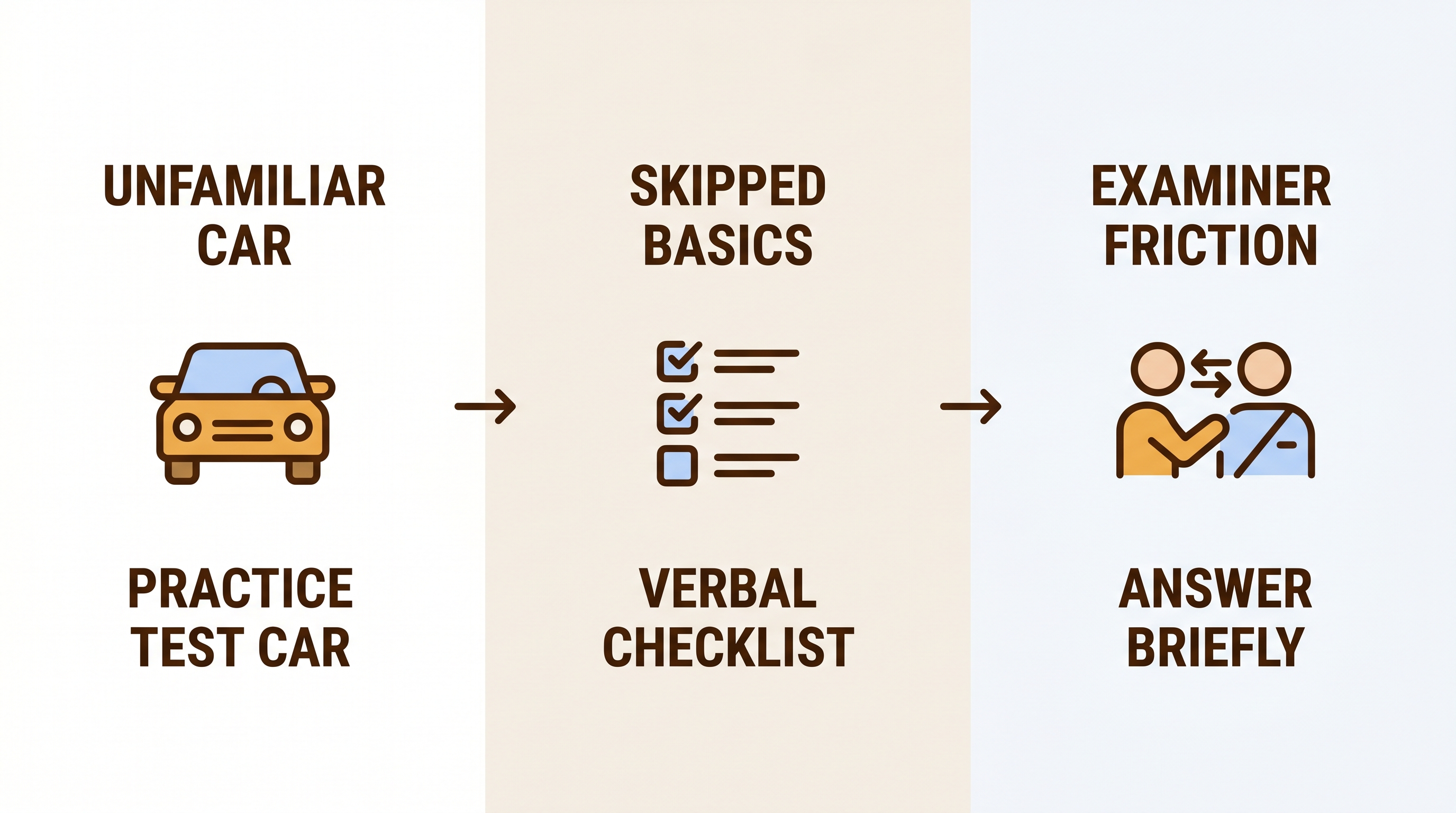
After reviewing roughly 200 documented failures from news archives, YouTube compilations, and Reddit threads, three patterns stand out. These are the patterns you can train against.
Borrowed cars, rental cars, a parent's SUV when you learned on a compact sedan. Different seat height, different pedal travel, different mirror geometry. The National Highway Traffic Safety Administration flags equipment unfamiliarity as a top cause of novice driver errors.
Fix: Test in the car you trained in. Spend at least 10 practice hours in it before test day.
Mirror checks, signals, shoulder glances. The boring stuff. Drivers skip them when stressed because the brain prioritizes the scary task (parallel parking) over the routine task (signaling). Examiners count the routine tasks.
Fix: Build a verbal checklist you run out loud during practice. "Signal, mirror, shoulder, move." Saying it out loud embeds it deeper than silent review.
Arguing, over-explaining, trying to charm, asking nervous questions mid-maneuver. Every one of these disrupts the examiner's scoring rhythm and tips borderline decisions against you.
Fix: Answer questions briefly, follow instructions literally, and save all commentary for after the test.
The silver lining of every viral DMV fail is that it is a free lesson. You do not have to crash into a wall to learn pedal discipline. You do not have to roll into a pool to learn pre-drive inspection. You just have to watch, read, and practice the fix.
Here is your action plan:
Ready to stop worrying about viral fails and start practicing like someone who will not be in one? Start your free Wheelingo practice test and build the muscle memory that holds up when the examiner is watching.
The worst driving test failures ever recorded are funny because they are dramatic. They are instructive because they are preventable. Pedal confusion, mid-test arguments, forgotten fundamentals, unfamiliar equipment, and panic errors account for almost every viral clip you have ever laughed at. Each one has a fix, and the fix is practice under conditions that feel like test day.
You do not need to be the driver who avoided every possible mistake. You need to be the driver who trained the common ones out of their repertoire. That is a much smaller job than it looks. Start with one pattern this week, drill it until it is automatic, and move on to the next.
Your examiner has seen thousands of tests. They will not be surprised by nerves. They will be surprised by calm, prepared drivers who follow instructions and handle the basics cleanly. Be that driver. Get the Wheelingo app and start building the confidence that shows up on test day.