ADHD executive function challenges during DMV tests. Strategies for medication timing, working memory support, and test accommodations.
You've practiced the driving skills a hundred times. You know the route. You know the rules. But on test day, your brain feels scattered. You miss a turn because you weren't listening carefully. You space out on a traffic light. You remember the examiner's instructions 10 seconds after you needed them. You second-guess every decision.
Or the opposite happens: you hyperfocus so intensely on one task (perfect hand positioning) that you miss the bigger picture (the road ahead). Your strengths become liabilities under test pressure.
For people with ADHD, the DMV test is uniquely challenging. Driving itself—the sensorimotor feedback, the varied stimulation, the need for quick reaction—often feels natural and even enjoyable. But a test, with its structured pressure and high cognitive demands, exposes ADHD's core difficulties: executive function, sustained attention, impulse control, and working memory.
This guide walks you through exactly how ADHD affects test performance, which ADHD subtypes struggle most, and practical strategies to compensate—including medication timing, working memory supports, request for accommodations, and leveraging hyperfocus as a strength.
 ADHD is not primarily an attention problem (despite the name). It's an executive function problem. Your brain struggles to regulate attention, inhibit impulses, manage working memory, and maintain sustained effort on non-preferred tasks.
Executive Functions Involved in Passing a Driving Test:
| Executive Function | Normal Brain (Non-ADHD) | ADHD Brain | DMV Test Impact |
|---|---|---|---|
| Working Memory | Holds instructions in mind while executing them | Drops or distorts instructions mid-task | Miss turn; can't remember "next right after light" |
| Sustained Attention | Maintains focus on task for 30+ minutes | Attention drifts after 10–15 min or hyperfocuses on wrong detail | Misses road signs, traffic changes, or examiner feedback |
| Impulse Control | Considers consequences before acting | Acts first, thinks after | Turns too early, jerks wheel, cuts off other cars |
| Task Initiation | Knows task, starts it immediately | Procrastinates or blanks on how to start | Freezes when told "Take a left"; slow to react to instructions |
| Task Switching | Fluidly shifts between tasks | Takes time to shift; gets "stuck" on previous task | Takes too long turning; can't quickly switch from following GPS to road signs |
| Emotional Regulation | Manages frustration and stress | Frustration spikes quickly; stress cascades | One mistake → shame spiral → panic |
| Time Awareness | Intuitive sense of time | Poor time perception; no sense of duration | Doesn't realize you've been driving 20 minutes; underestimates speed |
The Core Struggle: ADHD brains can do these things, but they require active effort and usually external support structures. Non-ADHD brains do many of these automatically, leaving mental resources free for the primary task. ADHD brains must consciously manage working memory, impulse control, and attention—which consumes the mental bandwidth you need for driving.
 ADHD presents differently across individuals. Knowing your subtype helps you understand your specific test vulnerabilities.
Predominantly Inattentive ADHD:
Predominantly Hyperactive-Impulsive ADHD:
Combined ADHD:
If you take ADHD medication, test timing matters enormously.
How ADHD Medication Works: Most ADHD medications (stimulants like adderall, methylphenidate) reach peak effectiveness 30–60 minutes after ingestion, depending on formulation.
Peak Effectiveness Lasts:
DMV Test Duration: 25–40 minutes (varies by state; average 30 min)
The Strategy:
If you take immediate-release medication:
If you take extended-release medication:
Never skip your medication on test day thinking you'll "just try harder." That's like running a race on one leg. Your medication is your tool. Use it.
Real Example: Marcus, 24, takes immediate-release methylphenidate. He scheduled his test for 10:00 AM. He took his medication at 9:20 AM (40 minutes before test). At 10:00 AM, he was at peak effectiveness. He felt focused, his working memory was sharp, and he could track the examiner's instructions. He passed.
Your working memory is finite. Writing things down frees up brain space for the actual driving.
Pre-Test Preparation:
Write Down the Test Route:
Create a Checklist of Common Mistakes:
Voice Memos:
During the Test:
Verbal Confirmation:
No Shame in Asking:
Slow, Deliberate Responses:
If your ADHD leans hyperactive-impulsive, impulse control is your test challenge.
ADHD brains need stimulation. If you're restless before the test, you'll bring that restlessness to the drive.
20 Minutes Before Test:
Why It Works: Intense physical activity releases adrenaline and dopamine. You'll feel more settled and focused in the car.
Real Example: Raquel, 20, has hyperactive-impulsive ADHD. Before her test, she was bouncy and restless (nervous energy). 30 minutes before the test, she ran up and down the parking lot stairs 10 times. She felt calmer. During the test, she was focused and controlled. Passed.
ADHD hyperactivity often shows up as rushed responses. You turn the wheel before fully processing the instruction. You accelerate without fully assessing the road.
Before Each Action, Pause for 1 Second:
This 1-second pause might be the difference between a safe turn and a rushed error.
Practice This: During regular driving (not on the test), practice the 1-second pause before every turn for 2 weeks. It will feel awkward at first but becomes automatic.
Fidgeting helps ADHD brains focus. You're not distracted by fidgeting; you're more focused because of it.
Car-Safe Fidget Tools:
DMV Policy: Most examiners allow fidgeting as long as it doesn't distract from driving. A stress ball in your lap while stopped is fine. A fidget spinner in your hand while driving is not.
Use fidget tools only at stops (red lights, stop signs), not while driving.
 ADHD paradoxically can involve hyperfocus—intense, laser-focused attention on an engaging task. Driving can be hyperfocus-inducing because it's novel, stimulating, and has real-time feedback. The problem is hyperfocus can become too narrow, missing the big picture.
You hyperfocus on:
How to Manage Hyperfocus:
1. Widen Your Focus Circle:
2. Use External Anchors:
3. Awareness Script:
If you have a formal ADHD diagnosis, you may be entitled to testing accommodations.
Common ADHD-Friendly Accommodations:
| Accommodation | Why It Helps ADHD | How to Request |
|---|---|---|
| Extended Time | More working memory buffer; less pressure-induced rushing | Ask DMV ahead of time; bring medical documentation |
| Breaks Between Tasks | Resets attention; prevents fatigue-related cognitive decline | Request during the test itself if needed |
| Written Directions | Working memory support; can refer back if you forget | Ask examiner to write directions on clipboard |
| Quiet Testing Area | Reduces distraction; fewer competing stimuli | Request ahead via DMV; may get private examiner |
| Verbal Confirmation of Instructions | Double-checks working memory encoding; reduces mistakes | Ask examiner to repeat and confirm each instruction |
| Small Reward/Break First | Builds confidence; dopamine boost from small success | Ask if you can start with an easy task first |
How to Request:
Real Example: James, 26, has documented ADHD. He contacted his DMV 1 month before his test, provided a letter from his psychiatrist, and requested written directions and extended time. DMV approved. On test day, the examiner wrote directions on paper and gave him 50 minutes instead of 30. He used the extra buffer to double-check himself. Passed.
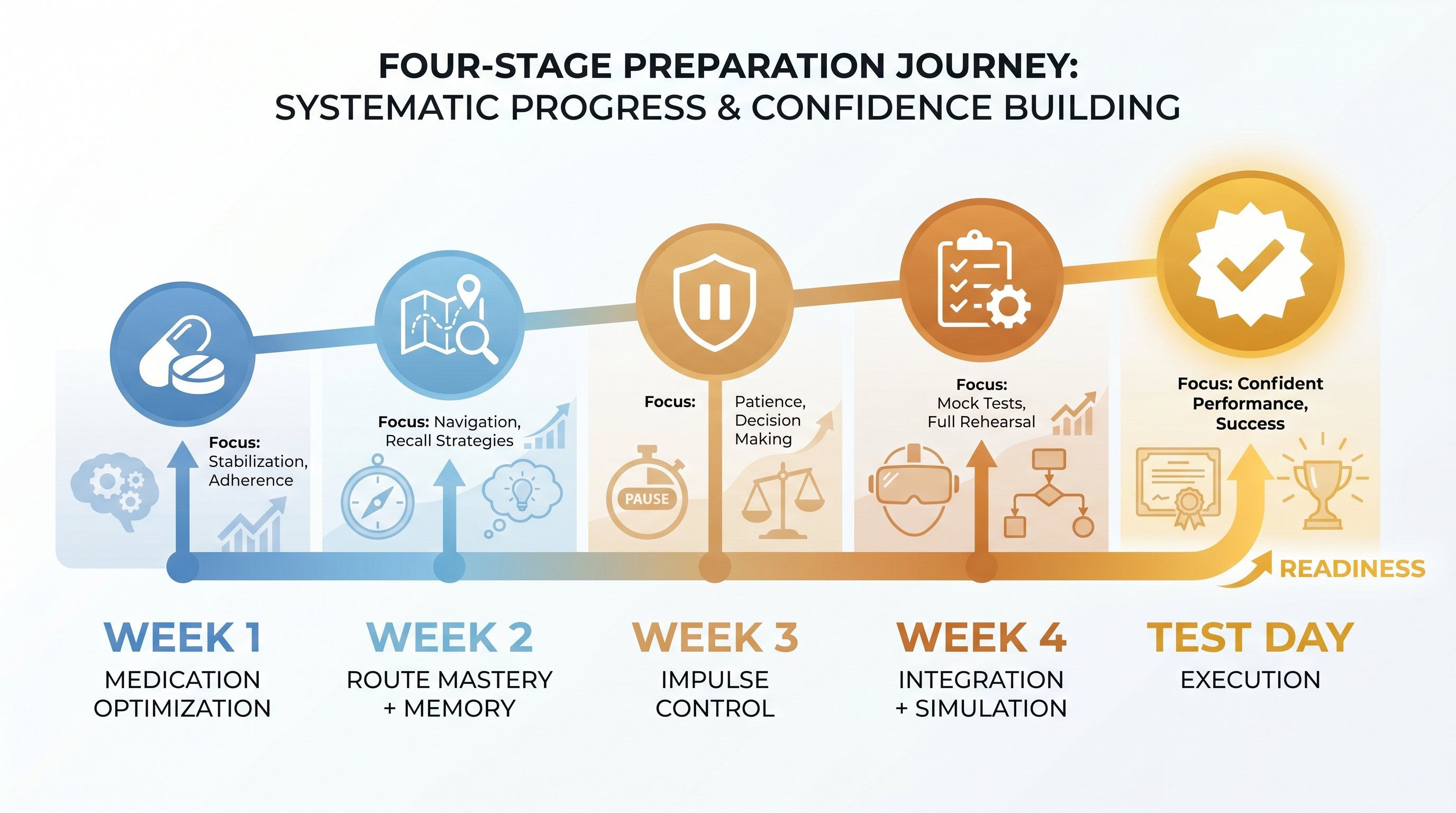
| Week | Focus | Action | Goal |
|---|---|---|---|
| Week 1 | Medication Optimization | Identify optimal medication timing; test it on a practice drive | Know exactly when to take meds for best performance |
| Week 2 | Route Mastery + Working Memory | Learn route; create written map + voice memo; review 5x daily | Can do route in autopilot or with minimal instructions |
| Week 3 | Impulse Control + Attention Management | Practice 1-second pause; practice attention scan; fidget tools in car | Feel controlled and present, not rushed or scattered |
| Week 4 | Integration + Simulation | Full test simulation with accommodations; practice exact conditions | Confidence for actual test; proven systems work |
| Test Day | Execution | Medication 45 min before; early arrival; checklist review; one practice drive | Peak performance during actual test |
Marcus, 24 (Inattentive ADHD) Marcus struggled with working memory. He'd forget directions mid-drive. He created a voice memo of the test route and listened to it 10 times before the test. On test day, the examiner gave him directions verbally, and he immediately asked for confirmation ("Turn left at the light on Main, right?"). This double-encoding helped. He passed.
Raquel, 20 (Hyperactive-Impulsive ADHD) Raquel's problem was impulse control. She turned too quickly, didn't fully stop. She practiced the 1-second pause ritual for 3 weeks on regular drives. On test day, before every turn, she paused and breathed. The examiner even commented: "Very controlled driving." Passed.
Jordan, 28 (Combined ADHD) Jordan struggled with everything: working memory, impulse control, attention. Jordan got formal accommodations approved (extended time, written directions). Jordan's psychiatrist also adjusted medication timing. On test day, Jordan felt supported by the external structures and medication optimization. Passed on third attempt.
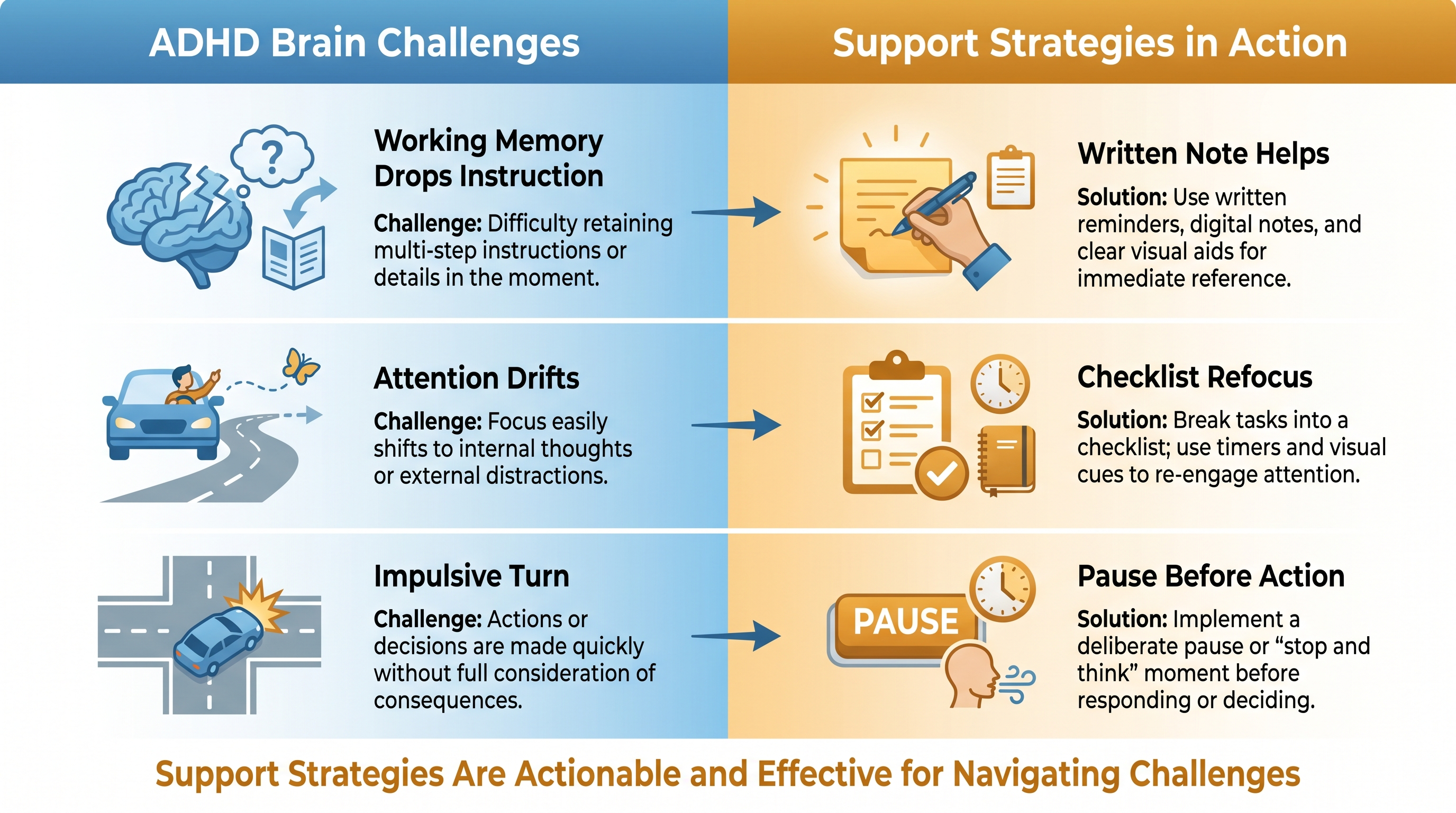
| Challenge | What Happens | Solution |
|---|---|---|
| Missed turn | Didn't hear/process examiner's direction | Ask examiner to repeat; request written directions; use voice memo |
| Impulsive turn | Turned too quickly without full assessment | Practice 1-second pause ritual; physical movement before test |
| Spacing out | Attention drifted; missed multiple road cues | Practice attention scan (road → mirrors → speedometer); set timer reminders |
| Rushedacceleration | Pressed gas before fully assessing speed needs | Practice deliberate response timing; medication optimization |
| Hyperfocus on one thing | Focused so hard on hand position, missed road ahead | Practice widening focus; external anchor reminders |
| Panic after one mistake | One error → shame spiral → more errors | Emotional regulation support; therapy; reframing |
| Examiner presence makes you chatty | Nervous energy → talking too much | Physical movement before test; fidget tools at stops; remind yourself to focus |
| Losing track of time | Didn't realize you'd been driving 20 minutes | Practice clock-checking; examiner can tell you time remaining |
The fastest way to pass your test is consistent practice with real questions. Try Wheelingo free — state-specific questions, instant explanations, and a readiness score that tells you when you're ready.
Q: Will the examiner know I have ADHD? A: Only if you disclose it or have formal accommodations. If you have accommodations, the examiner will know. Otherwise, your ADHD is private.
Q: Should I take my medication on test day? A: Yes, unless your doctor advises otherwise. Your medication is a tool. Use it.
Q: What if I forget my medication on test day? A: Call your testing location immediately. Ask if you can reschedule or take the test without medication. Most DMVs allow rescheduling with 24 hours notice. It's better to reschedule than test unmedicated if your medication is crucial to your function.
Q: Can I take a break during the test? A: Policies vary. Some DMVs allow a bathroom break mid-test (and pause the timer). Ask at the start: "If I need a bathroom break, can we pause the test?"
Q: Is ADHD a disability that exempts me from driving? A: No. ADHD is a difference in executive function, not a driving safety risk. Many people with ADHD are safe, skilled drivers. What matters is how you manage the condition.
Q: What if I fail due to ADHD struggles? A: Adjust your strategy. Work with a therapist or ADHD coach on executive function. Optimize medication. Request accommodations. Schedule a second attempt.
ADHD Coach: A certified ADHD coach specializes in executive function strategies. 4–8 sessions before your test can yield substantial improvement.
Cognitive Behavioral Therapy (CBT): Helps manage impulse control and emotional regulation around test performance.
Psychiatrist (medication management): Ensure your medication type and dose are optimal for your ADHD.
Occupational Therapist: Specializes in real-world function and may offer sensorimotor strategies tailored to driving.
ADHD creates unique challenges in test-taking, but these challenges are manageable with the right systems. You don't need to "fix" your ADHD. You need to build external scaffolding (working memory supports, impulse-control rituals, medication timing) that compensates for executive function differences.
Many people with ADHD are excellent drivers. Your brain's tendency toward hyperfocus, quick reactions, and novelty-seeking can actually enhance real-world driving once you manage the test-taking environment.
Executive function challenges improve with real-world practice and feedback. Wheelingo provides unlimited practice scenarios with immediate feedback, so you can build working memory for routes and impulse control for defensive driving.
Start practicing with Wheelingo today—no sign-up required. The more you practice, the more automatic these skills become, reducing working memory load on test day.