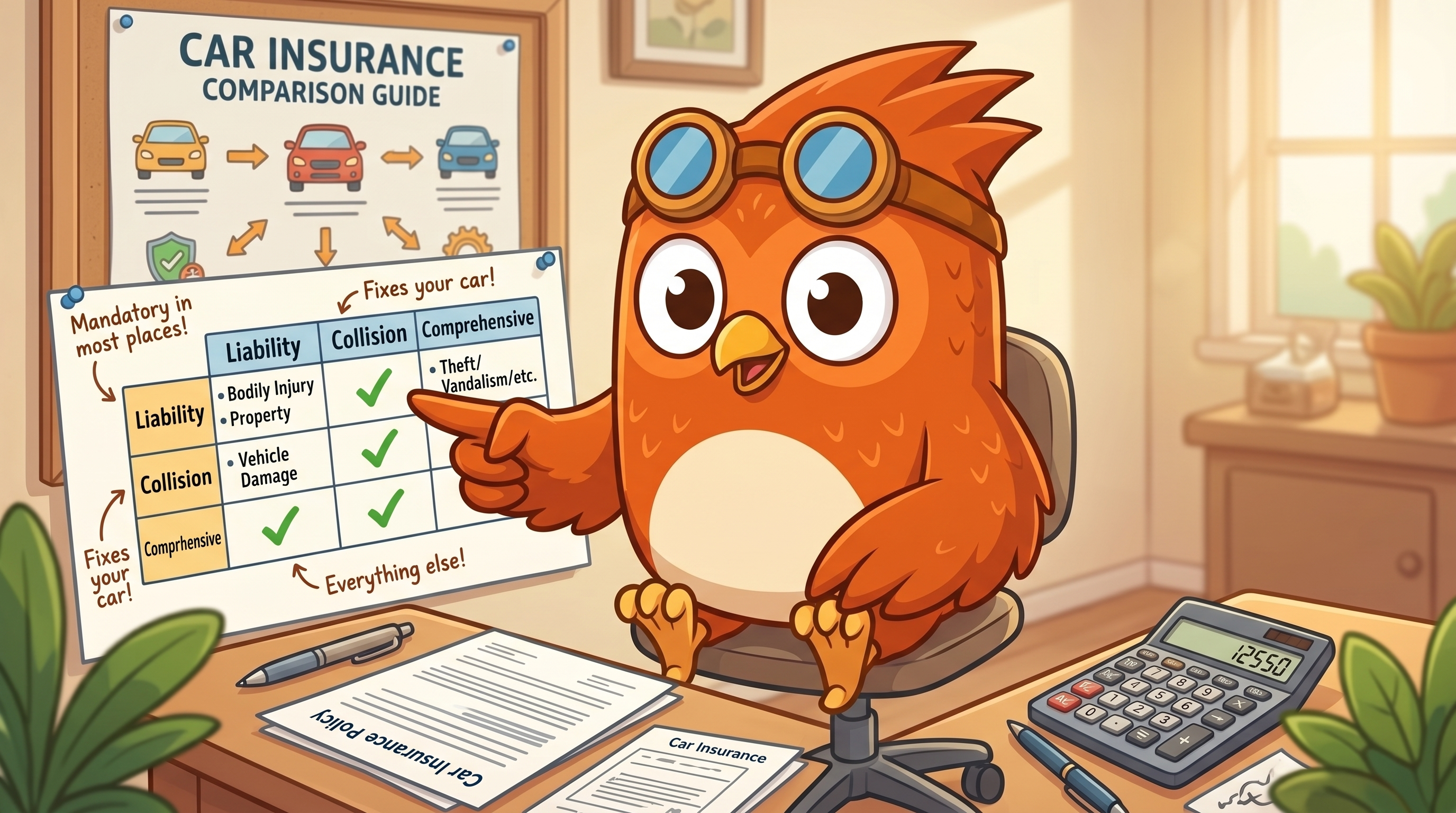
A guide to car insurance for new drivers. Learn coverage types, costs, discounts, and how to choose the right policy for your situation.
You've passed your driving test. You've got your license. Now comes a topic that feels less exciting but is absolutely critical: car insurance.
If you're a new driver, car insurance might feel overwhelming. There are so many terms—liability, collision, comprehensive, deductible—and your parents (or insurance agent) might be throwing them all at you at once. This guide breaks down car insurance into plain language so you understand what you're paying for, why you need it, and how to find the best policy for your situation.
The simple truth: car insurance isn't optional. It's legally required in all 50 states and Canada. But beyond legal compliance, it's your financial safety net. One accident without proper insurance could cost you tens of thousands of dollars out of pocket and damage your credit for years.
Car insurance is a contract between you and an insurance company. You pay a monthly or annual premium, and in return, if you're in an accident or your car is damaged, the insurer helps pay for repairs, medical bills, or other covered losses.
Think of it like a safety net: you hope you never need it, but if something goes wrong, you're protected financially.
Legal requirement: Every state requires a minimum amount of liability insurance. Drive without it, and you face:
Financial protection: If you cause an accident, damages can easily exceed $10,000, $50,000, or more. Without insurance, you'd pay this yourself—and potentially lose your wages to lawsuits for years.
Peace of mind: Knowing you're covered means you can focus on driving safely instead of worrying about catastrophic financial consequences.
There are several layers of insurance. Here's what you need to know:
What it covers: Damage you cause to other people's vehicles, property, or injuries to other people.
Example: You're at fault in an accident and the other person's medical bills total $15,000 and their car repair costs $8,000. Your liability insurance covers this (up to your policy limit).
Minimum requirements by state: $15,000-$25,000 per person for injury; $30,000-$50,000 per accident. These minimums are low—many experts recommend higher limits.
Recommended coverage: $100,000 per person / $300,000 per accident (often written as 100/300)
What it covers: Damage to your own car from a collision (hitting another car, a tree, a guardrail, etc.).
Example: You rear-end someone and your car's repairs cost $5,000. Collision insurance covers this (minus your deductible).
When to get it: If your car is newer (less than 10 years old) or you're financing/leasing it, collision is usually required by your lender. If you own an older car outright, it's optional but still recommended.
Cost: Varies widely; typically $300-$1,000+ per year depending on the car, your age, and your driving record.
What it covers: Damage to your car from events other than collisions—theft, weather (hail, flooding), animals, vandalism, glass damage, etc.
Example: A tree branch falls on your car during a storm. Comprehensive covers this (minus your deductible).
When to get it: Usually required if you're financing or leasing. Recommended if you live in areas with severe weather, high theft, or park outdoors.
Cost: Typically $100-$500+ per year.
What it covers: Injuries to you and your passengers if you're hit by a driver who has no insurance or insufficient insurance.
Example: An uninsured driver hits you and your car needs $4,000 in repairs plus you have $2,000 in medical bills. Uninsured motorist coverage protects you.
Why it matters: Roughly 1 in 8 drivers nationwide has no insurance.
Cost: Usually cheap—$50-$200 per year.
What it covers: Medical bills for you and passengers, regardless of who's at fault.
Example: You're hit by another car and you have whiplash. Medical payments coverage covers your treatment.
Cost: Usually $100-$300 per year.
What it covers: Similar to medical payments but often more comprehensive; available in "no-fault" states.
Cost: Varies by state.
New drivers pay significantly more than experienced drivers. Here's a realistic breakdown:
| Driver Profile | Estimated Annual Cost | Why |
|---|---|---|
| 16-year-old on parent's policy (good grades) | $1,200-$2,000 | Legally allowed to add as dependent; parent's safe driving helps |
| 18-year-old with first policy (average record) | $2,000-$3,500 | Highest insurance group; no driving history |
| 20-year-old (no accidents/tickets) | $1,800-$2,800 | Slightly lower risk than 18-year-old |
| 25-year-old (no accidents/tickets) | $1,200-$1,800 | Risk level decreases significantly at 25 |
| Parent's policy + teenager (good grades) | $600-$1,200 additional | Cheaper than separate policy; discounts stack |
Why new drivers cost more:
| Factor | Impact | How to Improve |
|---|---|---|
| Age | Huge (if under 25) | Time; not much you can do immediately |
| Driving record | Huge | Drive safely; no tickets, accidents, or DUIs |
| Type of car | High | Avoid sports cars; choose safe, reliable vehicles |
| Location | Medium | Can't always control, but urban = higher rates |
| Coverage level | Medium | Higher deductibles lower premiums |
| Good grades (under 25) | Medium | Maintain B average or higher; provide proof |
| Defensive driving course | Low-medium | Saves 5-10% with many insurers |
| Bundling policies | Low-medium | Insure car + home = 10-25% discount |
| Miles driven annually | Low-medium | Low mileage can mean discounts |
| Safety features | Low | Anti-theft devices, airbags help slightly |
Never accept the first quote. Compare at least three, but preferably five. Use online tools or call directly.
Major insurers to compare:
Cost: Free quotes in 5-10 minutes each.
After getting your base quote, ask about these:
Real story: Jenny, a 19-year-old from California, was quoted $3,200/year initially. After asking about discounts, she got:
A deductible is what you pay out of pocket before insurance kicks in. Common options: $250, $500, $1,000.
For new drivers: $500 is usually the sweet spot. You save on premiums while keeping out-of-pocket costs manageable.
Your driving record directly affects rates. One accident or ticket can increase your premium by 20-40% for 3-5 years.
Invest in safe driving now—it pays off.
Premium: The amount you pay for insurance (monthly, quarterly, or annually).
Deductible: The amount you pay out of pocket before insurance covers the rest.
Coverage limit: The maximum amount your insurance will pay for a claim.
Policy: Your insurance contract; outlines what's covered and at what limit.
Claim: A request for payment from your insurance company after an accident or damage.
At-fault accident: You caused the accident; your insurance pays (or you pay if uninsured).
Adjuster: Insurance company representative who investigates claims.
Underwriting: The process insurers use to assess your risk and set rates.
The fastest way to pass your test is consistent practice with real questions. Try Wheelingo free — state-specific questions, instant explanations, and a readiness score that tells you when you're ready.
Q: Can I stay on my parents' insurance instead of getting my own?
A: Yes, and it's usually cheaper. You're added as a dependent/occasional driver. You must live in their household and use their vehicles. This is the best option for most new drivers under 25.
Q: What happens if I get a speeding ticket? Will my insurance go up?
A: Likely, yes. A minor ticket (under 10 MPH over) might have minimal impact; a serious violation (20+ MPH over) can increase your premium 10-30%. It depends on your insurer and the severity.
Q: I was in an accident (my fault). How much will my rates increase?
A: Typically 20-40% for 3-5 years. The amount depends on the claim size and your insurer's formula.
Q: What if I hit someone but don't have insurance?
A: You're legally liable for all damages. If they sue, you could owe tens of thousands. Your license will be suspended. This is a major financial and legal crisis. Get insured before you drive.
Q: Do I need to tell my insurance company about tickets/accidents?
A: Yes, always. Non-disclosure can lead to claim denial and policy cancellation. It's better to report proactively.
Q: Is usage-based insurance (the app that tracks driving) worth it?
A: For new drivers with safe habits, yes. Discounts of 10-30% are common, and it encourages safe driving since you know you're being monitored.
Q: Can I get full coverage for a car I own outright?
A: Yes, but collision and comprehensive are optional (not required by law). It's recommended if the car is newer or you couldn't afford to replace it out of pocket.
Q: What should I do if I'm in an accident?
A: (1) Check for injuries; call 911 if needed. (2) Move to a safe location if possible. (3) Call police for a report. (4) Get the other driver's information and take photos. (5) Call your insurance company and file a claim. (6) Don't admit fault at the scene.
Understanding car insurance is part of a bigger picture of responsible driving:
For more information:
Car insurance might not be exciting, but it's essential. The good news: new drivers can get affordable coverage by shopping around, asking about discounts, and staying on a parent's policy when possible.
Here's your action plan:
The cheapest insurance is the insurance you don't need to use. Drive safely, stay focused on the road, and practice defensive driving skills. Use Wheelingo to master these techniques before you hit the road on your own.
Last updated: April 16, 2026