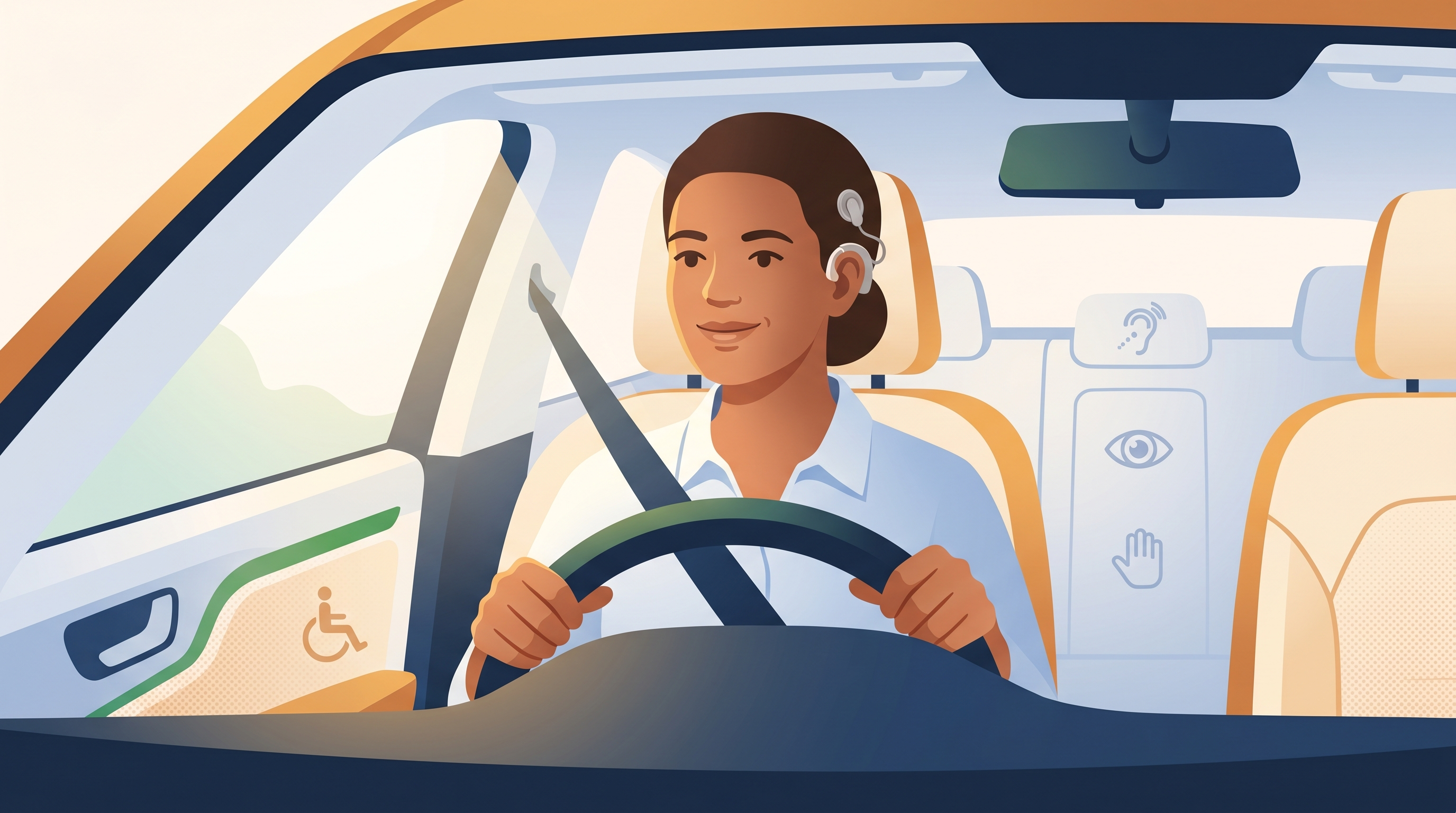
DMV test accommodations for drivers with hearing loss, vision, mobility, or cognitive disabilities. Learn your rights under the ADA and how to request support.
Drivers with hearing loss, vision impairment, mobility limitations, or cognitive disabilities can legally drive in all 50 states and are entitled to reasonable DMV test accommodations under the Americans with Disabilities Act (ADA). The most common accommodations include sign language interpreters, written or visual communication during the road test, extended test time, oral administration of the written test, adaptive vehicles, and restricted licenses that match your specific abilities.
If you've been putting off the DMV because you weren't sure what was possible, you're in the right place. Hearing loss does not disqualify you. Wheelchair use does not disqualify you. Many cognitive and learning differences do not disqualify you. What matters is that you can operate the vehicle safely and communicate clearly enough to follow test instructions.
This guide covers your rights under the ADA, exactly how to request accommodations, what each state typically offers, and how to prepare when the format is adapted to your needs. We'll also walk through real stories of drivers who passed with accommodations, the restricted license categories, and how to find a certified driver rehabilitation specialist if you need an adapted vehicle. Your first step can be as simple as taking a free Wheelingo practice test to baseline your knowledge before you request your accommodations.
The Americans with Disabilities Act, passed in 1990 and strengthened by amendments in 2008, requires public entities (including state DMVs) to make reasonable accommodations for people with disabilities. For DMV testing, this means:
The US Department of Justice ADA website is the authoritative resource for what qualifies and how to file complaints if a DMV fails to comply.
Want to start preparing before you even request accommodations? Try Wheelingo practice tests in your state's exact format, with visual explanations that work across accessibility needs.
No US state requires a minimum hearing level to hold a standard driver's license. You can be profoundly deaf and legally drive in all 50 states. Research including studies cited by the National Association of the Deaf shows deaf drivers have comparable or better safety records than hearing drivers, largely because they compensate with stronger visual scanning.
For the written test:
For the road test:
Before your test:
Most states don't require medical documentation for hearing loss. A few states (New Jersey, for example) ask you to disclose on the license application. Disclosure typically does not affect your license; it just informs the DMV's records.
Story: Jamal in Nashville. Jamal, 24, is profoundly deaf and uses ASL as his primary language. He was nervous about the Tennessee road test. He called the DMV's ADA coordinator 3 weeks ahead and requested a certified interpreter. "The examiner was great. We agreed on simple hand gestures for 'turn left' and 'stop' before we started. The interpreter sat in the back. I passed on the first try." His tip: practice your routes with your interpreter once before test day so everyone's comfortable with the communication flow.
Most states require 20/40 corrected vision in at least one eye and a peripheral field of about 140 degrees. Below these thresholds, many states still allow driving with restrictions or specialized aids.
Common vision-related restrictions:
If you have a condition like macular degeneration, albinism, or optic nerve damage, bioptic driving may be an option. The American Academy of Ophthalmology and state-specific bioptic programs train drivers to use the telescopic device safely. You'll typically need:

Drivers with paraplegia, limb amputation, cerebral palsy, muscular dystrophy, and similar conditions drive daily across the US. The key is adaptive equipment matched to your specific needs.
A CDRS evaluates your driving abilities and recommends specific equipment. Find one through the Association for Driver Rehabilitation Specialists (ADED). Evaluations typically cost $300 to $800 and may be covered by:
Every state allows you to take the road test in your own adapted vehicle. You'll:
Your license may include a code indicating adaptive equipment is required (for example, "Code 45: must use hand controls").
Story: Sofia in Los Angeles. Sofia, 31, is a T6 paraplegic wheelchair user. She went through the California Department of Rehabilitation, which funded her CDRS evaluation and 12 hours of training. Her van has hand controls and a wheelchair lift. "The DMV scheduled my road test at an office with a wider parking area and added 10 minutes for my transfer. The examiner had never seen hand controls before but asked thoughtful questions. I passed. My license has Code 45." Her advice to other disabled drivers: "Start with the CDRS. They'll make the entire process make sense."
Conditions like ADHD, dyslexia, autism spectrum disorder, traumatic brain injury, and learning disabilities can all benefit from DMV test accommodations. The condition does not automatically disqualify you from driving.
Our ADHD driving test preparation guide has specific strategies for medication timing, focus techniques, and reducing cognitive load during the test.
Story: Marcus in Denver. Marcus, 17, has dyslexia. Reading comprehension on the written test was a concern. He requested oral administration and extended time. "I took the test in a quiet room, the examiner read each question, and I answered verbally. I passed 28/25 required." For his road test, he used a simple agreement with the examiner: "one instruction at a time, and repeat if I ask." He passed the road test on his second try.

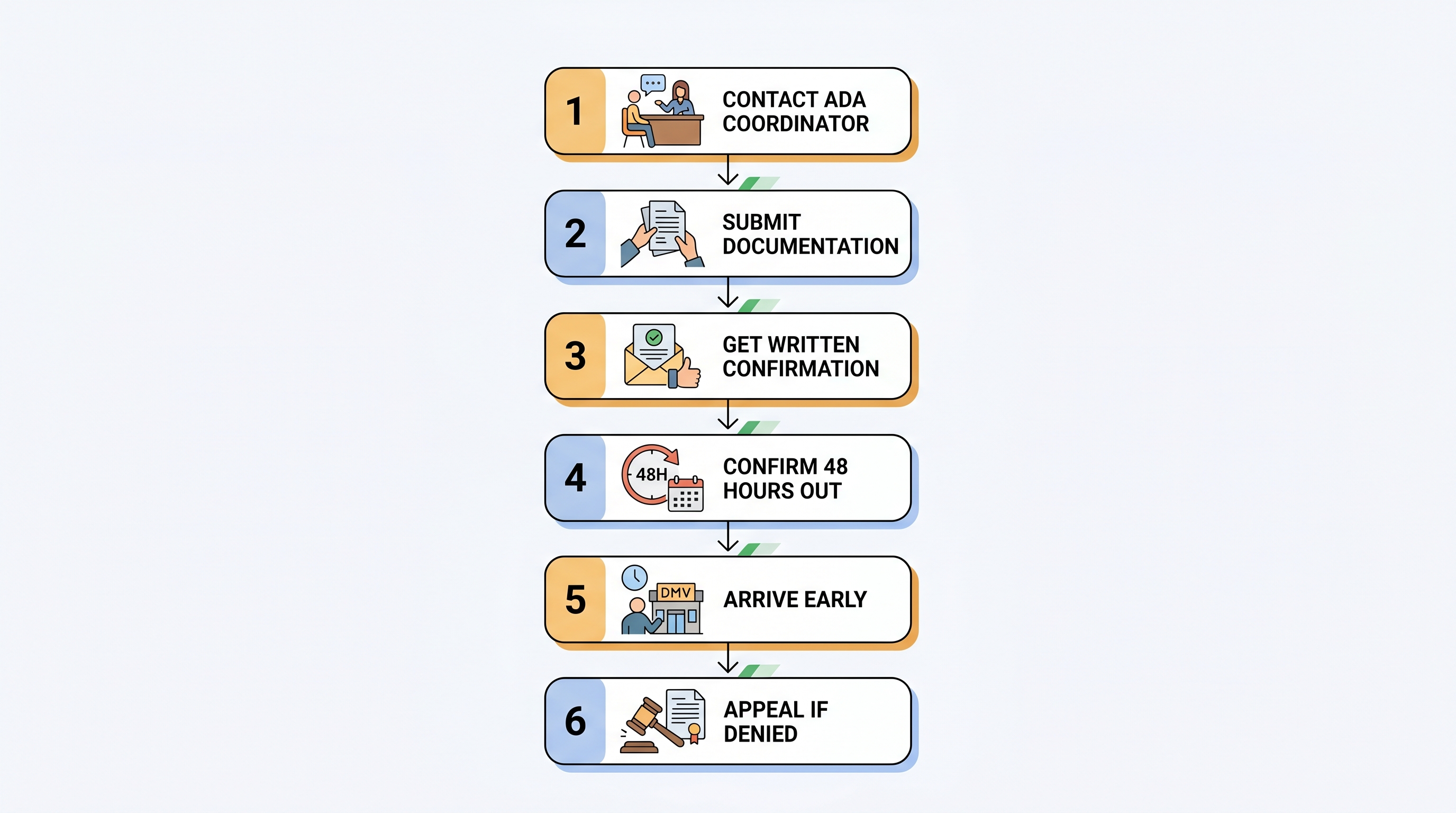
The process is similar across most states:
Step 1: Contact the ADA coordinator. Every state DMV has one. Search "[state] DMV ADA coordinator" or call the main DMV line and ask. Give 2 to 4 weeks of lead time.
Step 2: Provide documentation (sometimes). Some accommodations (interpreter, large print) require no documentation. Others (extended time for cognitive disabilities) may require a letter from a doctor or evaluator.
Step 3: Get written confirmation. Ask for an email or letter confirming your accommodations. Bring it to your test.
Step 4: Confirm 48 hours before your test. Interpreters and adapted testing can slip through cracks. A quick call the day before saves you a wasted trip.
Step 5: Show up prepared. Arrive 20 to 30 minutes early. If your accommodation isn't in place, ask for the ADA coordinator on-site before giving up.
If an accommodation is denied without reason, you can file a complaint with the US DOJ ADA or your state's civil rights office. In practice, escalation is rare; most DMVs comply quickly.
A restricted license lets you drive within specific conditions. Common restrictions:
Restrictions are not punishments. They're tools that let you keep driving safely when full unrestricted driving isn't appropriate. Many drivers use restrictions for decades and live fully independent lives.
Whatever your accommodation needs, practice is still the biggest predictor of passing.
Visual practice tests for low vision or cognitive differences: Wheelingo uses visuals, sign explanations, and plain-language scenarios that work well for a range of learning styles. Explore state-specific practice tests to see how topics are presented.
Simulators for mobility adaptation practice: Some rehab centers have driving simulators that let you practice adaptive equipment before you take the wheel of a real vehicle.
Recording your practice sessions: Mount a phone on the dashboard and record your practice drives. Watch them back with a family member or instructor. This is especially useful for drivers who process feedback better visually or take longer to integrate verbal corrections.
Our driving test anxiety complete guide has techniques that apply whether your anxiety is situational or related to a disability.
We'll replace this placeholder with a 10-minute walkthrough of the request process.
Can deaf people drive in all 50 states? Yes. No state requires a minimum hearing level for a standard driver's license.
Do I have to disclose a disability on my license application? It depends on the state and the condition. Most states ask about conditions that could affect driving (seizures, severe vision loss). Deafness, wheelchair use, and many cognitive conditions don't require disclosure unless they affect safe operation.
How much lead time do I need to request accommodations? 2 to 4 weeks is typical. For interpreters or adapted vehicles, give at least 3 weeks.
Will my license look different if I use accommodations? Only if a physical restriction applies (corrective lenses, mechanical aids). Accommodations during the test do not appear on your license.
Can I use my own adaptive vehicle for the road test? Yes, in every state. Submit documentation of the equipment in advance.
What if my accommodation request is denied? File a complaint with the DOJ ADA office or your state's civil rights division. Most denials are resolved quickly when escalated.
Disability does not mean no license. The ADA exists to make sure you get the same shot at driving as anyone else, with accommodations that match your specific needs. Hearing loss, vision impairment, mobility limits, and cognitive differences all have established paths to a valid US license. The key steps are: request accommodations early, document what you need, work with a CDRS if adaptive equipment is involved, and practice in your state's actual test format.
Three moves get most drivers with disabilities to a pass: contact the ADA coordinator 2 to 4 weeks early, take practice tests that match your state's format, and go in with written confirmation of your accommodations in hand.
Ready to start? Download Wheelingo for practice tests with visual explanations, or browse our learning roadmap to structure your prep. Your license is your freedom. A few focused weeks of preparation gets you there.