Zero tolerance DUI/DWI laws hit new drivers hardest. Learn limits, penalties, and how to avoid legal trouble.
You've just passed your DMV test. You're legal. You're confident. And then someone hands you keys at a party—and you've had maybe one drink.
One drink. That's all it takes under most state zero tolerance laws for new drivers to lose their license, face fines up to $1,000, and acquire a permanent record that affects insurance, employment, and college admissions.
This isn't a scare tactic. This is what the law actually says. And if you're a new driver—or you're teaching one—you need to understand the specific penalties that apply to you, because they're different and harsher than the limits for drivers over 21.
Most U.S. states have enacted zero tolerance laws that apply specifically to drivers under 21. These laws recognize a simple fact: the teenage brain is still developing judgment and impulse control. The law doesn't care if you feel fine after one beer. If you're under 21 and your BAC is above 0.01%, you're driving impaired in the eyes of the law.
Here's what that means in practical terms:
A standard drink—12 oz beer, 5 oz wine, 1.5 oz spirits—can raise your BAC by 0.02% to 0.03%. That single drink alone can put you over the zero tolerance limit.
Federal law doesn't mandate zero tolerance, but states that don't adopt it lose federal highway funding. So all 50 states have some form of zero tolerance DUI/DWI law for drivers under 21.
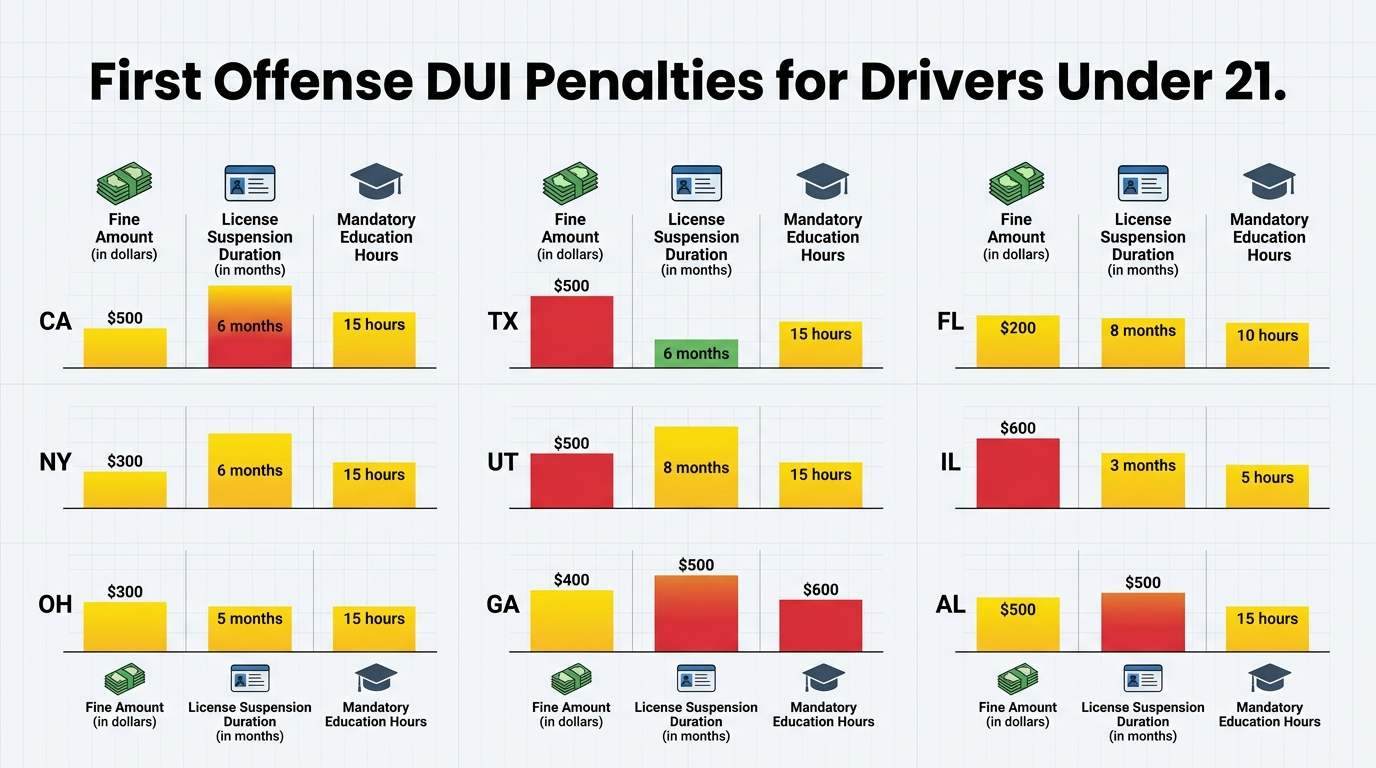
| State | Zero Tolerance Limit | Implied Consent | License Suspension (First) |
|---|---|---|---|
| Alabama | 0.02% | Yes | 90 days to 1 year |
| California | 0.01% | Yes | 1 year |
| Florida | 0.02% | Yes | 6 months (hardship after 30 days) |
| Georgia | 0.02% | Yes | 120 days to 1 year |
| Illinois | 0.00% | Yes | 6 months (minimum) |
| New York | 0.02% | Yes | 6 months |
| Ohio | 0.02% | Yes | Minimum 3 months |
| Texas | 0.02% | Yes | 60–180 days |
Implied consent note: When you sign for your license, you consent to a breathalyzer or blood test if pulled over. Refusing the test often results in automatic license suspension—sometimes longer than if you had taken and failed the test.
Let's be direct: the consequences are steep.
First-time DUI offense (most states):
Second offense (within 5–10 years):
Felony threshold (varies by state):
Beyond the court system, your state's DMV can impose additional penalties:
 Numbers on a page don't tell the full story. Here are three scenarios of how a single DUI decision impacts young drivers:
Jake, 18, gets accepted to his state university on a partial scholarship. At his high school graduation party, he has two beers and drives home. He's pulled over for a broken taillight. BAC: 0.03%.
First-offense DUI conviction. The scholarship is contingent on "maintaining a clean criminal record." Revoked.
Jake now attends community college for two years, incurring $15,000 in additional debt, while his peers graduate four-year degrees ahead of him.
Maya, 19, gets her first DUI. Total court and legal costs: $3,500. But the insurance impact is worse. Her premiums jump from $120/month to $450/month for five years.
Additional cost over 5 years: $19,800.
She can't afford a car. She can't get to her job reliably. She loses the job. For her, the DUI wasn't just a legal problem—it became a financial crisis.
Trevor, 20, was pulled over with a 0.04% BAC. First offense. He did everything right: paid fines, completed the alcohol education program, stayed out of trouble.
Two years later, at 22, he made the same mistake at a friend's wedding. Second offense. Now it's a felony in his state. He's facing 10 days in jail, a five-year felony probation, and a permanent record that makes it nearly impossible to rent an apartment or get hired for professional jobs.
The difference between his first and second offense was four years. And that four years of "staying clean" didn't matter. The law was unforgiving.
It's not arbitrary. The data is clear:
Zero tolerance laws exist because the science shows that even tiny amounts of alcohol impair young drivers disproportionately. Your body processes alcohol the same as an adult's, but your brain's decision-making is still under construction.
One drink isn't about whether you "feel fine." It's about whether your brain—neurologically—can safely operate a 4,000-pound machine at 60 mph.
Plan for zero alcohol consumption as a driver. Not "one drink." Not "just a little." Zero. The safest choice is the legal choice.
If you're going to a party, event, or social situation where alcohol might be present:
DUI checkpoints are legal in most states (with some exceptions like Michigan). Here's what you should know:
The goal isn't to evade—it's to protect your rights while making your way through a legal process.
All 50 states have implied consent laws: by accepting your driver's license, you've consented to a chemical test (breath, blood, or urine) if pulled over for suspected DUI.
Here's what you need to know:
| Aspect | What It Means |
|---|---|
| Breathalyzer refusal | Automatic license suspension (often 6–12 months), plus the refusal can be used as evidence of consciousness of guilt |
| Blood test refusal | May require a warrant; however, police can compel a blood draw with a warrant |
| Urine test | Less common; usually only if breath and blood are unavailable |
| Right to independent test | In many states, after a police test, you can request an independent blood or breath test at your own expense |
Knowing this doesn't mean you should refuse a test—that's a legal decision requiring a lawyer's advice in the moment. But understanding the consequences of compliance vs. refusal helps you weigh your options.
The fastest way to pass your test is consistent practice with real questions. Try Wheelingo free — state-specific questions, instant explanations, and a readiness score that tells you when you're ready.
Q: I'm 20 years old with a 0.01% BAC. Can I be charged with DUI? A: Yes. Zero tolerance laws apply to all drivers under 21 regardless of BAC above the threshold. You'd face misdemeanor DUI charges, fines, license suspension, and mandatory alcohol education. One drink is enough to cross this threshold.
Q: Does zero tolerance apply if I'm on my permit or provisional license? A: Yes. In fact, many states have additional restrictions on provisional licenses beyond zero tolerance, such as limits on passengers and nighttime driving. Violating these conditions can result in longer license suspension even without a DUI conviction.
Q: What happens if I get a DUI with my permit (before getting my full license)? A: Most states will suspend or deny your license upgrade. You may be required to wait longer, retake the road test, or complete additional driver improvement courses. A DUI on your permit is still a criminal charge.
Q: Can I get a DUI for prescription or over-the-counter medications? A: Yes. You can be charged with DUI for driving while impaired by any substance—prescription medications, OTC cold medicine (like DayQuil), or even marijuana in legal states. Impairment is the issue, not whether the substance is illegal.
Q: If I refuse a breathalyzer, will the charges be dropped? A: No. Refusing actually makes your case harder legally. The refusal is usually admissible in court as evidence, and you lose the breathalyzer result that might have been lower than the officer's suspicion. Consult a lawyer, but refusal isn't a legal defense—it's a penalty generator.
Q: Will a DUI conviction show up on a background check? A: Yes. Criminal convictions show up on standard background checks. This affects job applications, housing, professional licenses, and more. Some states allow expungement after a period, but that requires a legal process and a clean record in between.
Q: How long does a DUI stay on my record? A: Permanently, unless expunged. Expungement is possible in some states after 3–7 years of clean driving, but it requires filing a petition and meeting strict criteria. Even then, it may still appear on background checks for certain purposes (law enforcement, commercial driving).
Wheelingo's defensive driving practice teaches you to recognize risky situations before they happen—including high-risk drinking scenarios. Recognizing peer pressure, understanding the true consequences of impaired driving, and knowing your exit strategy are skills you can practice and build.
The goal isn't just to pass your DMV test. It's to develop the judgment and awareness to keep yourself and others safe for decades of driving ahead.
A single drink and a car key is a moment of weakness. But the consequences—lost scholarships, criminal records, financial ruin, or worse, someone hurt or killed—are a lifetime of weight.
Zero tolerance laws exist because the science is clear: young brains and alcohol don't mix well behind the wheel. The law isn't trying to ruin your life. It's trying to save it.
Your future depends on one simple choice: don't drive impaired. Not ever. Not even once.
If you're a new driver preparing for the road, understanding DUI laws is just one part of comprehensive road safety. Learn about defensive driving strategies, practice situational awareness, and develop the judgment to make safe choices every time.
Your license is a privilege. Keep it—and your life—intact.
Sources & Further Reading: