Distracted driving kills 3,000+ people yearly. Learn the dangers, statistics, and how to break the phone habit.
A Snapchat notification pops up on your phone. Just one second to check it. You glance down at your lap.
In that one second, at 55 mph, your car travels 80 feet—without you looking at the road.
That's the length of a school bus. Blind.
And in that one second, everything can change. A child runs into the street. A car suddenly brakes. A pothole becomes catastrophic. And in the time it takes you to process what's happening, you've already caused a crash that injures or kills someone.
This isn't hyperbole. This is the daily reality for thousands of families who've lost someone to distracted driving.
The numbers are staggering: 3,522 people died in distraction-related crashes in 2021 alone. That's 9 deaths per day. And distracted driving crashes are increasing, even as overall traffic deaths have stabilized.
The worst part? Most of these deaths are preventable. They're not the result of reckless speeding or drunk driving. They're the result of a choice to check a text, adjust a playlist, or read a social media notification instead of paying attention to the road.
This guide breaks down what distracted driving actually is, why your brain can't safely do two things at once, and how to develop the habits that keep you—and everyone around you—alive.
Distracted driving is any activity that diverts your attention from driving. It includes:
| Type | Examples |
|---|---|
| Visual Distraction | Looking at your phone, checking mirrors, reading billboards |
| Manual Distraction | Texting, adjusting the radio, eating, reaching for something |
| Cognitive Distraction | Thinking about a conversation, daydreaming, being emotionally upset |
Most people think distracted driving means texting. In reality, texting is just one form—and it combines all three: you look at your phone (visual), use your hands to type (manual), and your mind is on the message (cognitive). It's the perfect storm of distraction.
But a driver eating a sandwich is also distracted. A driver thinking about an argument with a friend is also distracted. A driver adjusting their radio is also distracted.
All of these take attention away from the single most important task: controlling a 4,000-pound vehicle moving at 60 mph.
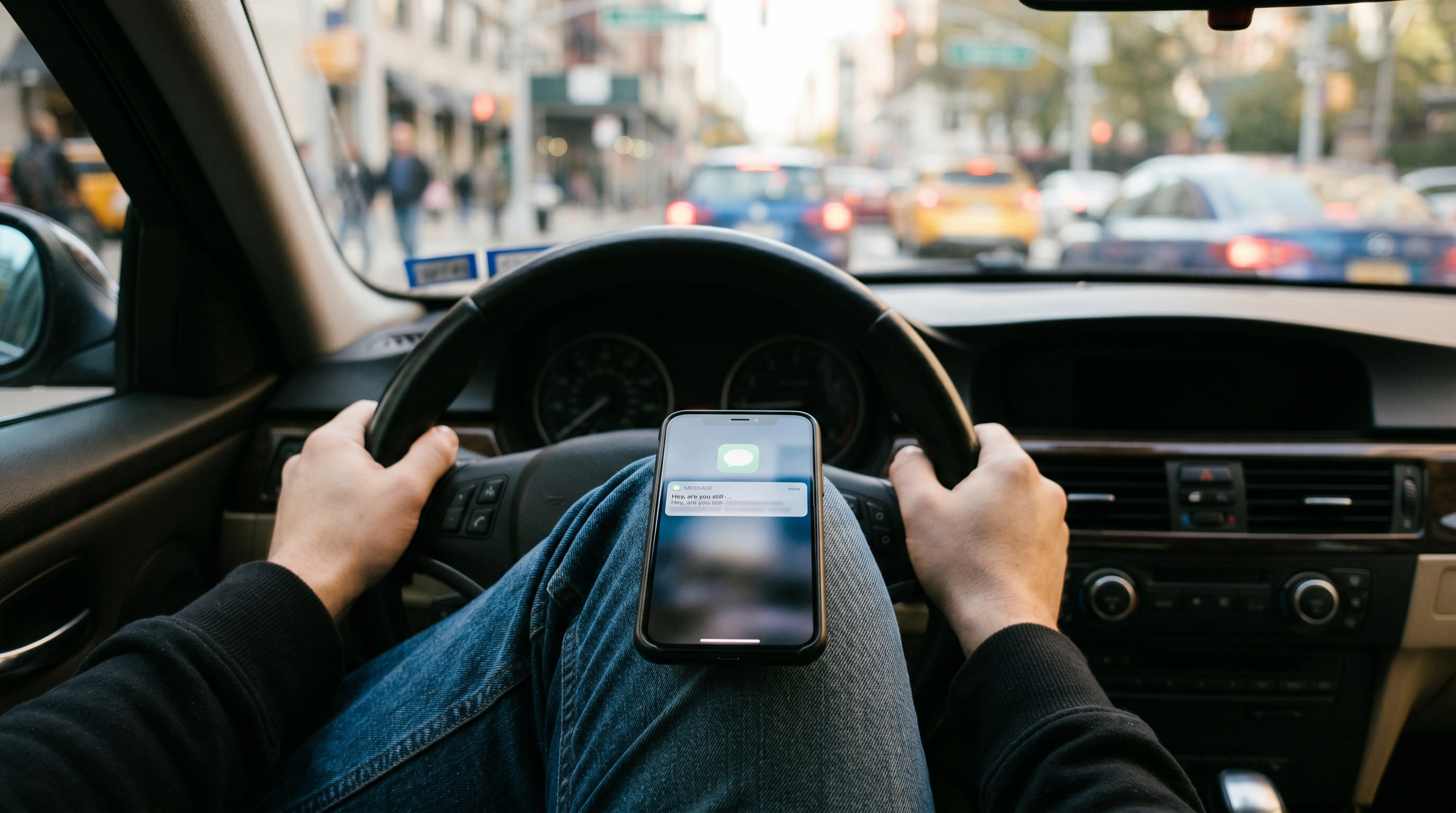 Here's the uncomfortable truth: your brain cannot actually multitask.
When you try to text and drive, your brain doesn't split its attention equally between both tasks. Instead, it switches between them—rapidly, but not simultaneously. Every time it switches, there's a delay called "task-switching cost."
The task-switching cost is significant:
Research from the National Highway Traffic Safety Administration (NHTSA) shows:
For comparison: a football field is 100 feet. In one second of looking at your phone, you travel most of a football field without seeing the road.
The statistics are sobering:
| Statistic | Source | Implication |
|---|---|---|
| 3,522 deaths (2021) | NHTSA | 9.6 deaths per day from distracted driving alone |
| 391,000 injuries (2021) | NHTSA | Major injuries from distracted crashes yearly |
| 1 in 4 teen crashes | CDC | Distraction is a factor in 1 in 4 teen driver crashes |
| 96 million texts/day while driving | Various studies | Drivers send texts at a rate of ~23 per second |
| 23x crash risk (texting) | VTTI | Texting while driving is the single most dangerous distraction |
| 4.6 seconds off-road (text) | NHTSA | Average time eyes are off road per text |
| Drivers 16–19 years old | CDC | Highest proportion of distracted driver fatal crashes |
| 11x crash risk (teens + phone) | NHTSA | Teens using phones have 11x higher crash risk than other drivers |
The takeaway: Distracted driving kills more people than drunk driving. And unlike drunk driving, it's legal. You can't be arrested for eating a burger while driving, even though it increases your crash risk.
But you should be.
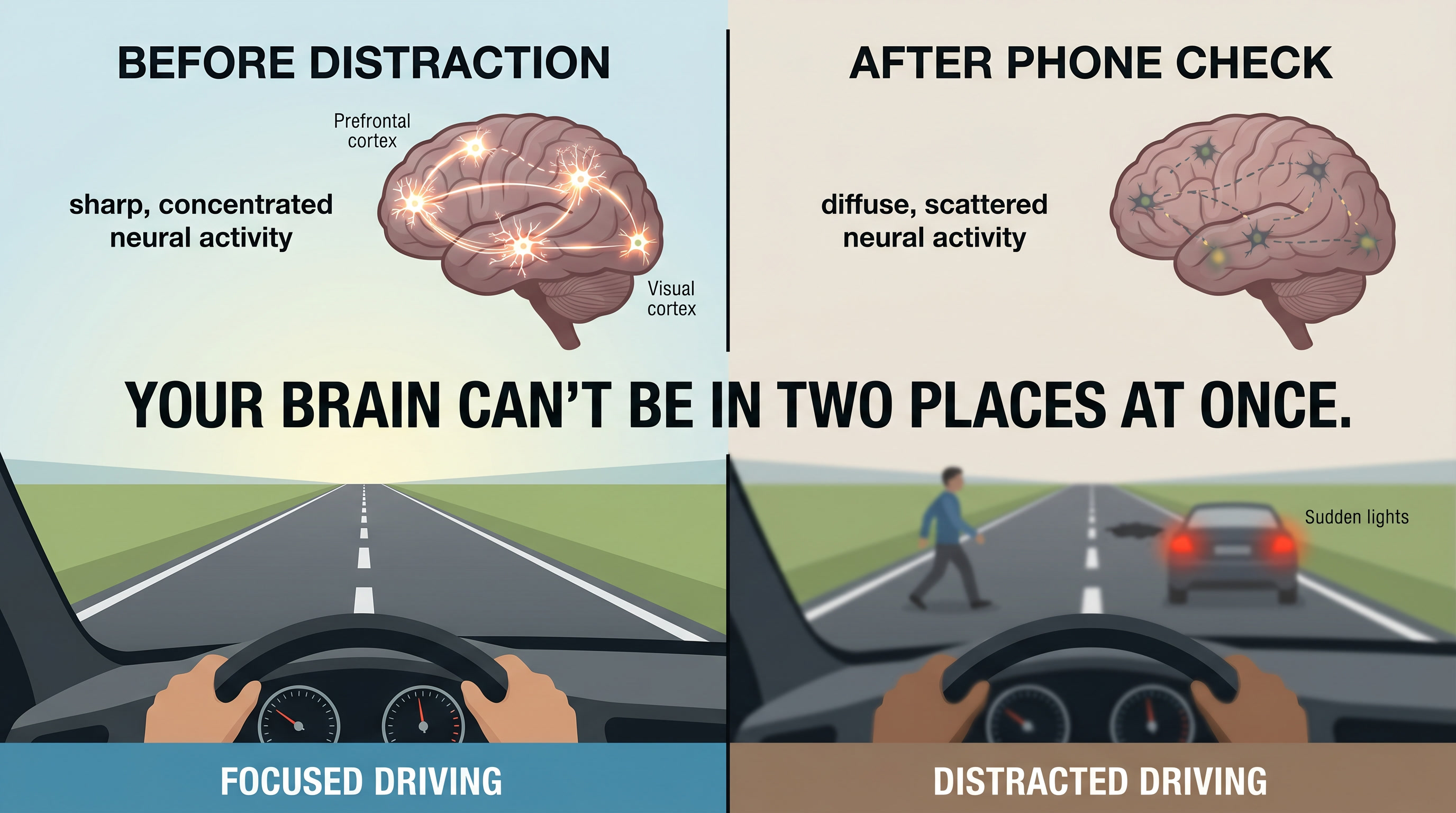
The situation: Emma, 17, is driving to school on a busy suburban street. Her best friend sends her a Snapchat. A small notification appears at the top of Emma's phone screen, which is mounted on her dashboard.
Emma thinks, "I'll just peek at the notification for one second."
The distraction: Emma glances down. She sees the notification, but the sender's name is cut off. She picks up her phone to see the full message. That's 2–3 seconds of looking at the phone.
What happens: A car ahead of Emma suddenly brakes (the driver in front stopped short to avoid a pothole). Emma, whose eyes have been on her phone, doesn't notice. She doesn't react. By the time she looks up and sees the brake lights, she's only 15 feet behind—too close to stop.
Emma slams on her brakes. Her car barely stops, but the car behind her (driven by a 62-year-old woman named Margaret) can't stop in time. Margaret hits Emma's car at 25 mph from behind.
The consequences:
The real cost: Emma checking a notification for 2–3 seconds cost her family tens of thousands of dollars, cost Margaret her health, and caused lasting psychological trauma to both.
And Emma didn't even intend to cause a crash. She thought one notification was harmless.
The situation: Marcus, 18, is driving home from work. He's thinking about a conversation he had with his girlfriend earlier—they had a disagreement, and Marcus is replaying the conversation in his head, thinking about what he should have said.
Marcus isn't looking at his phone. His hands are on the wheel. But his mind is elsewhere.
What happens: A pedestrian (a 10-year-old child) runs into the street from between two parked cars, chasing a ball. The child is invisible to Marcus because they're small and hidden by the parked cars until the last second.
Marcus's eyes are looking at the road, but his brain is processing his girlfriend's words. When the child suddenly appears, Marcus's brain needs time to register the hazard, process the danger, and signal his foot to brake.
That cognitive delay—the 0.5–1 second his brain needs to switch from "relationship problem" to "child in road"—is enough. Marcus can't stop. He hits the child at 30 mph.
The consequences:
What could have prevented this: If Marcus had recognized he was distracted and pulled over for 10 minutes to collect himself before driving, this never happens.
The situation: Zoe, 16, is eating a burger while driving through a drive-thru pickup lane into afternoon traffic. She's using one hand to eat, one hand to steer.
She drops a french fry on her lap. Without thinking, Zoe takes her hand off the wheel to brush it off her pants. For 2–3 seconds, she's driving with one hand, and her eyes are partially on her lap instead of the road.
What happens: The car in front of Zoe makes a sudden right turn into a parking lot. Zoe, distracted and with reduced steering control, doesn't react fast enough. She clips the rear corner of the turning car.
It's a minor collision. No one is seriously injured. But the damage and insurance implications are significant.
The point: Eating while driving might seem harmless. But it divides your attention and compromises your steering control—exactly when you need full control for emergency maneuvers.
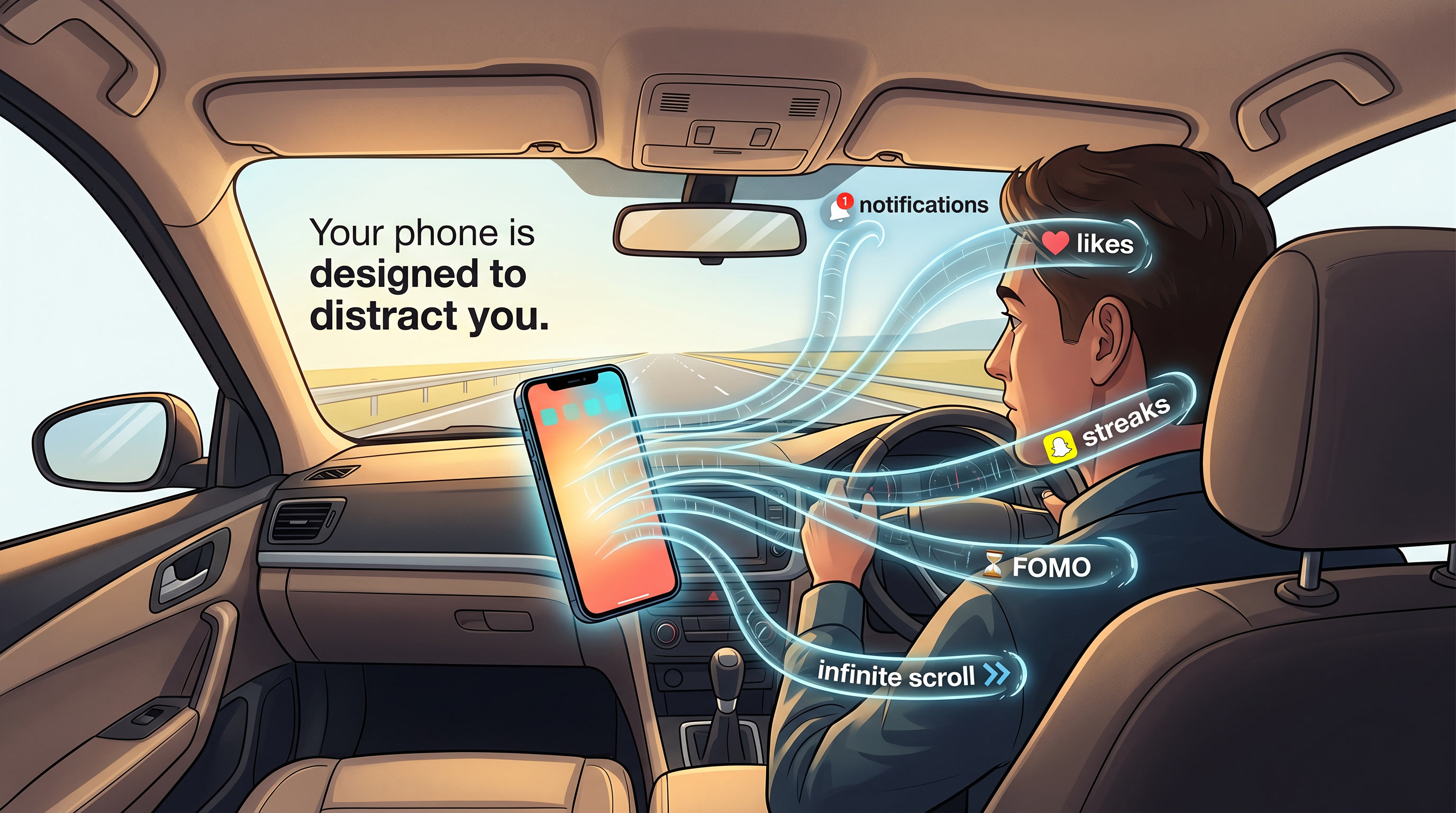
This is important to understand: Your phone isn't just distracting by accident. It's distracting by design.
Tech companies employ teams of psychologists and engineers to make their apps and notifications as attention-grabbing as possible. Features like:
These features are designed to exploit your brain's reward pathways and create compulsive checking behavior.
When your phone buzzes in your pocket, that's not an accident. That's a notification designed by a team of smart people specifically to make you want to check it immediately.
And when you're driving, that impulse—to check your phone—fights against your judgment. And for many drivers, the impulse wins.
Understanding this isn't an excuse. It's an explanation. Your phone is designed to be addictive. But you have the power to resist that design. You can silence your phone, put it in the trunk, or use an app that blocks notifications while you drive.
 While texting gets the most attention, distracted driving includes many behaviors:
| Distraction Type | Examples | Risk Level |
|---|---|---|
| Phone use | Texting, calling, navigation, social media | Critical |
| Eating/drinking | Eating, spilled drink, reaching for food | Moderate |
| Passengers | Rowdy friends, children, arguments | Moderate–Critical |
| Radio/audio | Changing stations, adjusting volume, searching playlists | Low–Moderate |
| Grooming | Makeup, combing hair, fixing clothing | Low–Moderate |
| Navigation | Looking at GPS, missing turns, fidgeting with maps | Moderate |
| Daydreaming/fatigue | Thinking about personal issues, drowsiness, eye fatigue | Critical |
| Adjusting controls | Climate control, window buttons, seat adjustments | Low |
The hierarchy: Anything that takes your eyes off the road (visual distraction) is more dangerous than anything that just divides your attention (cognitive distraction). But all distractions increase crash risk.
The fastest way to pass your test is consistent practice with real questions. Try Wheelingo free — state-specific questions, instant explanations, and a readiness score that tells you when you're ready.
Q: Is hands-free phone use safe while driving? A: No. Research shows hands-free voice conversations cause similar cognitive distraction as hand-held phones. Hands-free is legal in most places, but it's not safe. The safest choice is no phone use while driving.
Q: If I just quickly glance at my phone, how much time is that really? A: Even a 2–3 second glance at 55 mph means you travel 160–240 feet without looking at the road. If a child runs into the street, a car brakes suddenly, or a pothole appears, you won't see it in time to react. That's not "quick"—that's a lifetime of danger.
Q: Is talking on the phone while driving bad? A: Yes, but texting is worse. Talking (hands-free) increases crash risk by 1.3x. Texting increases crash risk by 23x. Both are distracting, but texting diverts your eyes, hands, and mind.
Q: Can I use voice-to-text instead of texting? A: Voice-to-text is legal in most states, but it's still cognitively distracting. Composing a message—even verbally—takes mental effort. The safest choice is not to send or receive messages while driving.
Q: What's the safest thing to do about my phone while driving? A: Put it in the trunk, in a bag in the back seat, or completely turned off. If it's not accessible, you can't be tempted. Many new drivers use apps like "Do Not Disturb While Driving" to automatically silence notifications when the phone detects motion.
Q: If I'm a passenger, is it okay to use my phone? A: Yes. You're not responsible for vehicle control. However, loud notifications or conversations might distract the driver, so be mindful of that.
Q: Is adjusting the radio really that dangerous? A: Compared to texting, no. But it's still a distraction. Adjusting a radio for more than 2–3 seconds increases crash risk compared to not adjusting it. Preset your favorites before driving.
Q: What about eating while driving? A: Eating is a lower-risk distraction than texting, but it's still a distraction. You're using a hand for food instead of steering, and your attention is partially on eating instead of driving. If you're hungry, eat before driving or pull over safely.
Q: Is daydreaming really distracted driving? A: Yes. Cognitive distraction—your mind being somewhere other than on the road—is a real and significant cause of crashes. Emotional distress, mental fatigue, and daydreaming all count as distractions.
Wheelingo's situational awareness training teaches you to:
A text, a notification, a social media update—it will all still be there when you stop driving.
The child you might hit with your car won't wait. The car that might suddenly brake in front of you won't slow down to give you time to react. The pothole that might blow out your tire won't move.
Every single death from distracted driving is preventable. No notification is worth a life. No text is worth a crash.
The choice is yours. Put your phone away. Keep your eyes on the road. Keep your mind on driving.
Your life, and the lives of everyone around you, depend on it.
Make the right choice. Every drive. No exceptions.
Related Articles:
Sources & Further Reading: