Learn safe rain driving techniques, speed adjustments, and hydroplaning prevention. Master wet road skills before your DMV test.
Rain is one of the most underestimated driving challenges new drivers face. Unlike ice or snow, wet roads feel manageable—until your car doesn't respond the way you expect. The statistics are sobering: rain causes 74% of all weather-related crashes, and weather factors into 21% of all traffic crashes nationwide, according to the Federal Highway Administration.
Here's the good news: rain doesn't require panic or superhuman reflexes. It requires adjustment—of your speed, your following distance, and your awareness. Master these fundamentals now, and you'll not only pass your driving test confident, but you'll survive your first year of independent driving without incident.
This guide walks you through everything your state's DMV expects you to know about wet-road driving, plus practical techniques that go beyond what the test covers. By the time you finish reading, you'll understand not just the rules, but the why behind them.
 When water sits between your tire and the road, it creates a barrier. Your tire's treads are designed to channel water away, but if water accumulates faster than treads can clear it—or if your tires are worn—you lose direct contact with the asphalt. This is hydroplaning, and it happens silently. No skid warning. No grinding sound. Your car just stops responding to steering or braking.
This is why the DMV tests rain scenarios in the written test and why examiners specifically observe your behavior in wet conditions. They're not being harsh—they're keeping you alive.
The second reason rain is harder: it reduces visibility and reaction time. Wet windshields, fogged windows, and the glare of oncoming headlights on wet pavement all compress your decision window. You have less time to see hazards and less traction to respond to them. Combined, these factors create a crisis.
New drivers often respond to rain by gripping the wheel tighter and tensing up. That's the wrong instinct. Tension leads to jerky movements, and jerky movements on wet roads can trigger skids. The right instinct is deliberate, smooth inputs and significantly reduced speed.
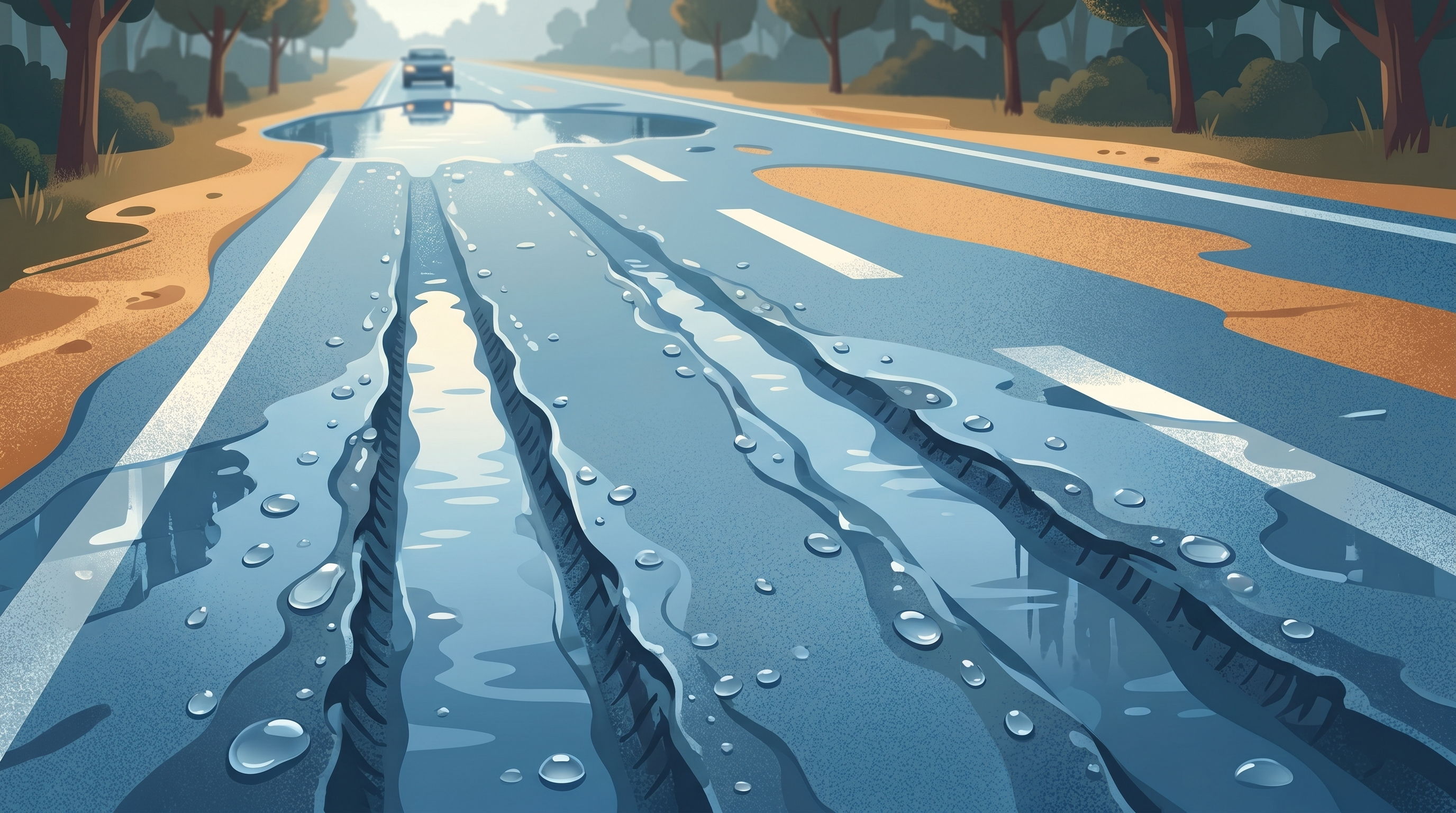 Your tire's grip depends on friction between rubber and asphalt. Friction is reduced when water is present, but the amount of reduction depends on depth of water, tire tread depth, and vehicle speed.
| Factor | Risk Level | What to Do |
|---|---|---|
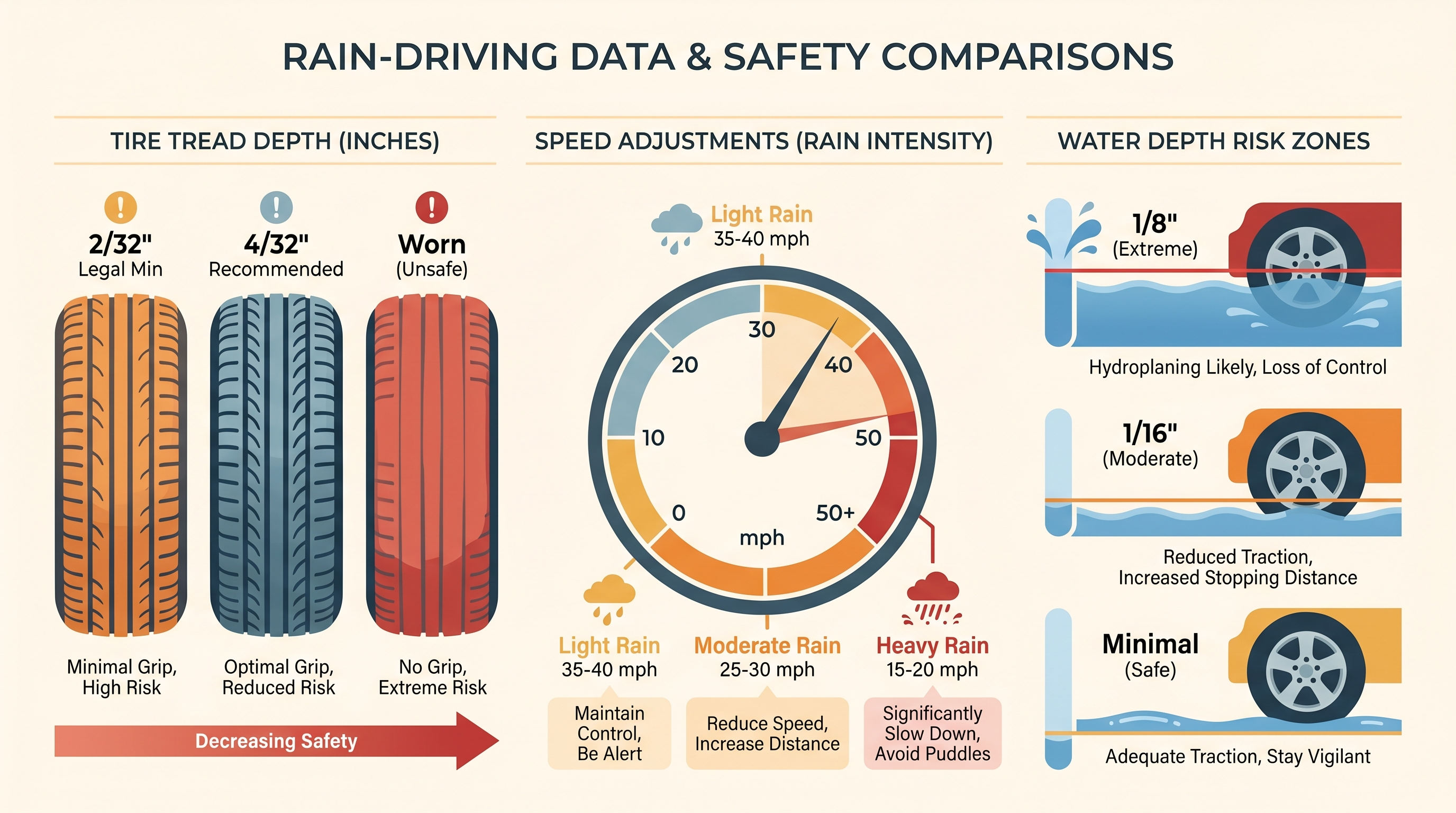
| Water Depth | 1/8 inch or deeper | Avoid. Water is deep enough to cause hydroplaning at normal speeds. |
| Tire Tread | Less than 2/32 inch | Illegal. Replace immediately. These tires can't channel water. |
| Tire Tread | 2/32–4/32 inch | Legal but risky in heavy rain. Safe in light rain. |
| Tire Tread | 4/32 inch or deeper | Safe. Treads effectively channel water even in heavy rain. |
| Speed | 35+ mph on flooded road | Extreme risk. Hydroplaning likely. Reduce to 20 mph. |
| Speed | 30–35 mph on wet road (light rain) | Moderate risk. Follow 6-second rule. Watch for puddles. |
| Speed | Below 30 mph on wet road | Low risk. Safe for most new drivers. Examiners expect this. |
| Road Surface | Smooth asphalt (new highway) | Higher hydroplaning risk. Water sits on smooth surface. |
| Road Surface | Textured asphalt (older road) | Lower risk. Texture helps drain water. |
Most of this table is testable knowledge. Your state's DMV will ask about tread depth, safe speeds, and hydroplaning causes. Memorize the relationships: shallower treads + deeper water + higher speed = hydroplaning.
Examiners watch your speed more closely in rain than in clear conditions. Why? Because speed discipline is the single strongest predictor of wet-road crashes. Lower speed = more traction margin = fewer crashes.
| Conditions | Normal Speed | Rain Speed | Adjustment |
|---|---|---|---|
| Light rain, good visibility | 55 mph | 35–40 mph | Reduce 25–35% |
| Moderate rain, reduced visibility | 55 mph | 25–30 mph | Reduce 45–50% |
| Heavy rain, poor visibility | 55 mph | 15–20 mph | Reduce 65–75% |
| Standing water on road | 55 mph | 10–15 mph | Reduce 75–80% |
The rule of thumb is simple: halve your speed. If the posted limit is 55 mph, drive 27 mph in moderate rain. This isn't timid—it's smart. Examiners expect this discipline on test day.
 Hydroplaning isn't random. It's predictable, which means it's preventable. Here are the specific steps.
Use the penny test: Insert a penny (Lincoln's head down) into your tire's deepest tread groove. If you can see the top of Lincoln's head, your tread is too shallow. Replace the tire. For wet-weather driving, aim for 4/32-inch depth (dime test: insert dime—if you see the top of Roosevelt's head, you're at 4/32).
A tire pressure gauge costs $5. Check pressure monthly and before long trips. Underinflated tires are more prone to hydroplaning because they flex more and can't channel water effectively.
Speed is your primary control. On wet roads, your car's top braking performance drops dramatically. Here's why: when you brake, friction goes into stopping. When you also turn, friction splits between stopping and cornering. On wet roads, that friction budget is already halved.
Use the 6-second rule: Pick a fixed object ahead (a road sign, lamppost). When the car ahead passes it, count "one-Mississippi, two-Mississippi..." until your car reaches it. In clear conditions, aim for 3 seconds. In rain, aim for 6 seconds. This distance absorbs reaction time and gives you room to stop without locking brakes.
Smooth is safe. Sudden inputs—sharp turns, hard braking—break traction on wet roads. If you must brake and turn at the same time, brake first (while driving straight), release the brake, then turn. This sounds slow. It is. That's the point.
Water tends to pool in tire ruts on highways. The center lanes (where fewer cars drive) often have better drainage. If you see standing water, do not drive through it. Reduce speed and move to the side of it. A few seconds of delay beats hydroplaning.
Watch these advanced wet-weather driving techniques:
Marcus, a 17-year-old from Florida, scheduled his driving test on a day with scattered thunderstorms. The weather forecast showed rain, but not heavy rain. He figured it was fine. His examiner didn't.
During the first 5 minutes, they approached an intersection with water pooling in the left-turn lane. The light turned yellow 6 car lengths ahead. Marcus accelerated slightly—a reflex—to "make" the light. He hydroplaned in the puddle, the car drifted toward the center lane, and the examiner immediately marked the test as "failed."
When Marcus asked why, the examiner explained: "You accelerated into a puddle. That tells me you don't understand how wet roads work. Even if you'd made the light, I'd still fail you because your judgment was unsafe."
Marcus retook the test two weeks later on a clear day. This time, when puddles appeared, he slowed 10 mph and gave them space. When the light turned yellow 6 car lengths ahead, he slowed and stopped. He passed.
The lesson: Examiners aren't testing your ability to pass yellow lights. They're testing your judgment in rain. That judgment starts with treating water with respect.
Sarah had her license for three months. She'd never been in an accident. She considered herself a "natural" at driving. Then a light rain hit while she was on a two-lane highway doing 45 mph—within the posted limit. She approached a curve and, without thinking about it, turned at normal speed while slightly applying brakes (she was adjusting for a slower car ahead).
The front tires lost grip. The car understeered (pushed straight instead of following the curve). Sarah panicked, jerked the wheel, and the car fishtailed. She over-corrected, the rear wheels caught traction, and the car flipped into a ditch.
No one was hurt. No other cars were involved. But her insurance tripled, and she spent a month worried about medical bills (there were none).
At the hospital, a nurse asked her: "When you turned, did you ease off the brake?"
Sarah realized: she'd been braking and turning simultaneously. On a wet road, that's a recipe for loss of traction.
The lesson: Braking and turning don't mix on wet roads. This is DMV test knowledge, but it's also life-or-death knowledge. The nurse knew it because she'd seen the results too many times.
Your tires are skipping. The road doesn't feel like pavement anymore. The car isn't responding to steering. This is hydroplaning.
Here's what to do—and what not to do:
Don't panic-brake. Braking on wet roads when you're already skidding can make the skid worse. Instead, ease off the accelerator.
Don't jerk the wheel. Abrupt steering inputs won't help if your tires have no grip. Instead, ease the wheel in the direction you want the front of the car to go—gently.
Wait for traction to return. This takes 2–3 seconds, which feels like an eternity. It's not. Let the car slow, let traction return, and steer out of the problem.
If you need to brake, do it gently. Light pressure. No ABS (if your car has it, ABS handles the modulation; you just press steadily).
This is emergency knowledge. Examiners won't test it on the written test. But they'll observe your demeanor in rain, and if puddles appear, they'll note whether you respect the water or act like it doesn't matter. That respect is worth everything.
Your state's DMV will ask: "What is the legal minimum tire tread depth in your state?"
The federal minimum is 2/32-inch. Some states have tested this at 4/32-inch or higher. Check your state's specific requirement.
Here's why it matters: At 2/32-inch depth, treads are barely capable of channeling water. At 4/32-inch, they work reliably in normal rain. Below 2/32-inch, they can't channel water at all—you're risking hydroplaning at even modest speeds.
A simple habit: Replace tires when they reach 4/32-inch, not when they hit the legal minimum. This gives you a safety margin.
Your DMV will test whether you know when to use headlights in rain. The rule: If it's dark enough that you need wipers, you need headlights. Not high beams (unless visibility is severely reduced), but regular low beams. This makes your car visible to oncoming traffic and improves your visibility through the rain.
Wiper maintenance is often overlooked:
Fogged windows are a ventilation problem, not a visibility problem. Use the defroster and crack the window slightly if fogging is heavy. Don't drive blind while adjusting ventilation—pull over first.
Tom was a careful driver. Two weeks before his driving test, he realized a storm was forecast. He went to a closed parking lot on a rainy afternoon and practiced with his instructor. They deliberately drove through wet conditions: puddles, standing water, slick curves. His instructor had him practice smooth braking, practice turns at reduced speeds, practice the 6-second rule with another car.
When test day arrived, a light rain was falling. Tom felt ready. The examiner took him on roads with moderate puddles. Tom slowed, gave puddles space, used smooth inputs. When the light turned yellow 6 car lengths ahead, Tom slowed and stopped—he didn't accelerate into the puddle. The examiner marked him "safe in wet conditions" and Tom passed.
The lesson: Preparation in actual wet conditions beats panic on test day. If you can, schedule a lesson with your instructor during rain. The confidence you build is worth more than any study guide.
The fastest way to pass your test is consistent practice with real questions. Try Wheelingo free — state-specific questions, instant explanations, and a readiness score that tells you when you're ready.
A: Yes. If your wipers are on, your headlights should be on. This is a testable rule on most DMV tests and improves visibility for other drivers. Some states have specific headlight-use laws; check yours.
A: Understeering = car goes straight despite turning the wheel (front tires lose grip). Oversteering = rear of car slides out (rear tires lose grip). On wet roads, front-wheel-drive cars (most common) typically understeer. If your car understeers, ease off the accelerator and gently straighten the wheel. The car will find grip again.
A: No. Cruise control can cause you to accelerate unexpectedly if the car starts to hydroplane. In rain, you need full manual control over throttle and braking.
A: Slow enough that you can feel the tires gripping and the car following your steering input. If you feel any tire slip or the car drifting wide, you're going too fast. Test this in a safe area before your real test.
A: Yes, unless absolutely necessary. Passing requires acceleration and lane changes—both increase risk on wet roads. If you must pass, do it on a straight section where you have full visibility, and be extra cautious.
A: Yes, they're designed for it. Winter tires work better in cold rain; summer tires work better in warm rain. But all-season tires are a safe middle ground. What matters is tread depth (at least 4/32-inch for wet weather) and proper inflation.
Wet-road driving isn't isolated knowledge. It connects to several other testable skills your DMV will evaluate:
Defensive Driving Guide: Rain scenarios are common defensive driving tests. Predicting hazards (like standing water) and adjusting proactively is defensive driving in action.
Essential Driving Skills & Maneuvers: Smooth steering inputs, progressive braking, and curve navigation all apply to rain. Master these skills in clear conditions, and they transfer to wet conditions.
What to Expect on DMV Test Day: If rain occurs during your test, the examiner is specifically watching for speed discipline, following distance, and smooth inputs. This guide prepares you for exactly that.
On your state's practice tests, you'll encounter scenarios like:
Practice these scenarios with Wheelingo's state-specific tests. Each question includes explanations tied to your state's DMV rules. You won't just memorize answers—you'll understand the why behind each rule. That understanding is what examiners hear in your explanation when they ask, "Why did you slow down there?"
Check your tires 1 week before your test. Tread depth, pressure, no visible damage. If there's any doubt, replace them.
Check your wipers 1 week before your test. They should clear rain cleanly without streaking. Replace if needed ($15–25).
Check weather the day before your test. If heavy rain is forecast, consider rescheduling unless you're confident (which this guide should make you). Light rain is actually fine—examiners expect to see you handle it well.
Practice in rain if possible. Find a closed parking lot, set up cones, and practice braking and turning at slow speeds. Feel how your car behaves when traction is reduced. This familiarity is worth more than a hundred pages of reading.
During the test, remember: Slow is safe. Examiners would rather see you drive 25 mph in moderate rain and pass than see you drive 40 mph and fail. There's no bonus for speed.
Rain driving isn't scary if you understand the mechanics and respect the conditions. Your tires are your only contact with the road, and water reduces that contact. Reduce speed, increase distance, and make smooth inputs. Do these three things, and you'll handle rain better than 90% of new drivers.
Examiners know this. They're not testing your nerves—they're testing your judgment. Show them you understand that wet roads demand adjustment, and you'll pass. More importantly, you'll drive safely for the next 50+ years.
Ready to practice rain scenarios? Try Wheelingo's state-specific practice tests and see exactly which rain questions your state tests. Track your progress, focus on weak areas, and build the confidence that comes from real preparation—not guessing.
Your first year of driving will include rainy days. You'll be ready.