Starting to drive at 40? Here's a realistic week-by-week timeline, what to expect, and how adult learners pass the test faster than teens.
Learning to drive in your 40s typically takes 3 to 5 months from first lesson to full license, including about 20 to 40 hours of supervised practice plus 5 to 15 hours with a professional instructor. Most adults pass the written test in 2 weeks of prep and the road test within 4 to 8 weeks of driving experience. You're not too old, you're not behind, and you actually have advantages over teenage learners.
Maybe you grew up in a city. Maybe you had license anxiety for 25 years. Maybe your partner always drove and now you need to. The reasons don't matter. What matters is that adult learners pass at similar or higher rates than teens, often with less practice time, because you bring focus, pattern recognition, and self-regulation that a 16-year-old is still developing.
This guide gives you a realistic week-by-week timeline for a 40-something starting from zero, plus the cost breakdown, the 3 biggest fears and how to handle them, and real stories from adults who went from permit to license in one season. If you want a head start, a free Wheelingo practice test will baseline your knowledge in 15 minutes.
The data on adult learners is encouraging. Studies cited by insurance actuaries and the NHTSA show drivers who get their license in their 30s or 40s have lower crash rates in their first two years than teens, because adults:
The downsides to starting at 40:
Net effect: 40s learners take a bit longer per lesson but get safer faster once they pass. Most insurance companies treat 40+ new drivers the same as experienced drivers of the same age after a few months of clean record.
Ready to see how your rules knowledge stacks up? Take a free Wheelingo practice test to get a score in 20 minutes.
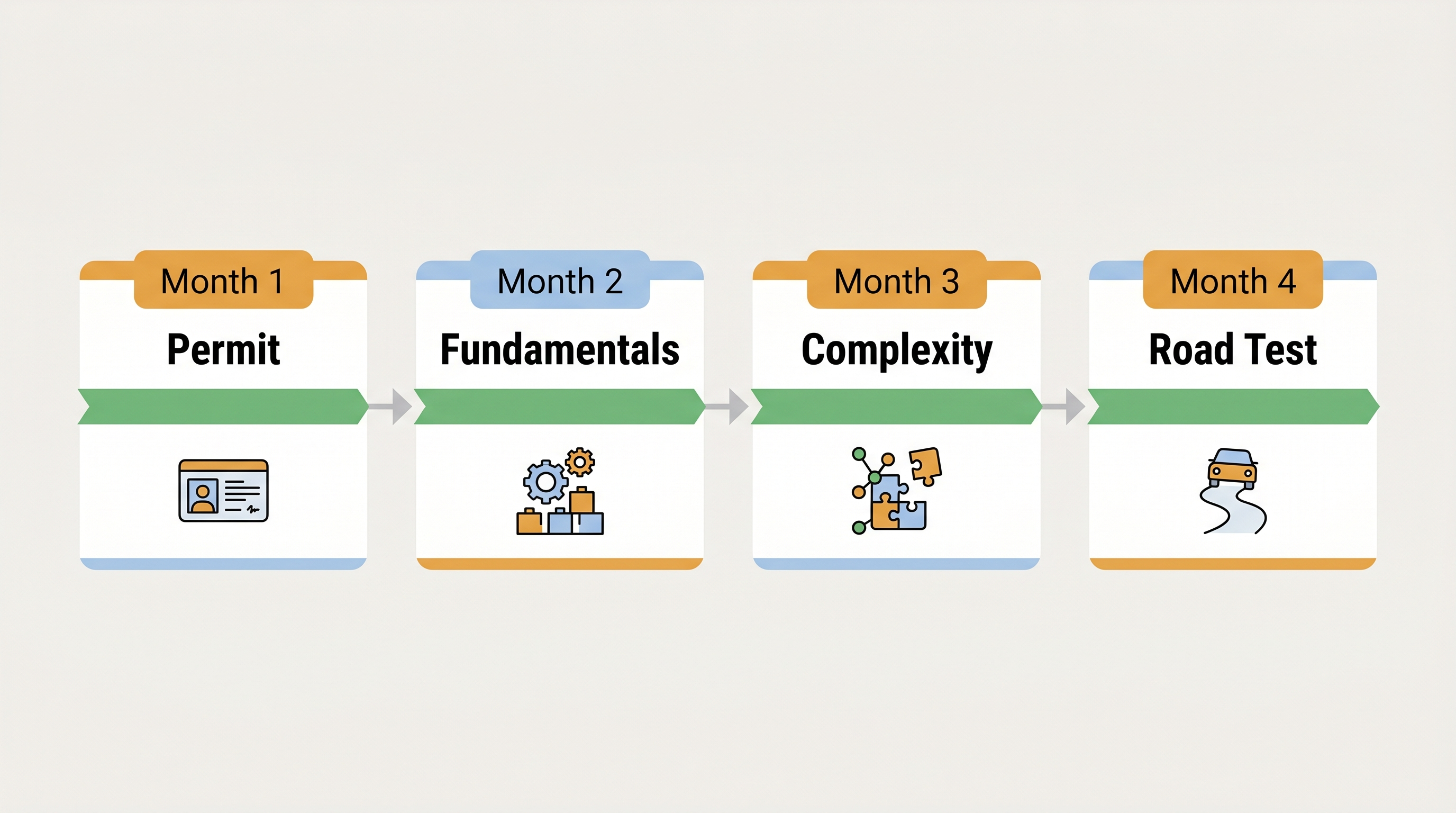
This assumes you're starting from zero, working full time, and can dedicate 3 to 5 hours per week to learning.
Week 1: Decide and organize.
Week 2-3: Study for the written test.
Week 4: Take the written test.
Week 5-6: Parking lots and quiet streets.
Week 7-8: Residential neighborhoods.
Week 9-10: Boulevards and commercial streets.
Week 11: Parallel parking and maneuvers.
Week 12: Highway confidence.
Week 13-14: Test routes and mock tests.
Week 15: The road test.
Week 16: Independence.
Story: Raquel in Minneapolis. Raquel, 42, had lived in New York City for 20 years without a license. She moved to Minnesota for a job and had to drive for work. "I gave myself 4 months. I took 8 hours of lessons at a driving school, practiced 2 to 3 times a week with my husband, and did Wheelingo practice tests during lunch." She passed her written test in week 3 and her road test on the first attempt 14 weeks later. "The hardest part was accepting I'd be bad at it for a month. Once I accepted that, I got better fast."
| Line Item | Cost Range |
|---|---|
| Written test fee | $5 to $50 |
| Learner's permit | $15 to $80 |
| Professional driving lessons (5 to 15 hours) | $300 to $1,500 |
| Practice vehicle (if renting) | $0 to $600 |
| Road test fee | $15 to $50 |
| License issuance | $20 to $90 |
| Optional: driver education course online | $50 to $150 |
| Total | $405 to $2,520 |
Ways to cut cost:
Reality: Highway driving is actually the calmest driving you'll do most days. Everyone moves in the same direction at similar speeds. The mental load is lower than a busy city intersection.
How to build confidence:
Our highway driving first time guide has the complete mental model.
Reality: First-try pass rates for adults range from 50 to 70 percent depending on state. That means 30 to 50 percent of adults don't pass the first time. This is normal, not shameful.
How to handle it:
Reality: No one at the DMV cares. Your examiner has tested 3,000 people. Your instructor has taught 500 adult learners. Your family and friends will be impressed, not judgmental. The only person judging you is you, and that voice gets quiet after the first few lessons.
Story: David in Portland. David, 44, was terrified of being "the old guy" in a driving school. "My instructor's youngest student that week was 16. Her oldest was 68. She told me 30 percent of her adults are over 40." David took 6 lessons, practiced with his wife, and passed the Oregon road test in 11 weeks. "The 44-year-old me was scared of being judged. The 44-year-old licensed me drove my daughter to soccer practice yesterday and felt proud, not weird."
A 16-year-old hears "you're braking too late" as criticism. A 43-year-old hears it as data. You integrate feedback faster because you've been an adult in feedback loops at work for 20 years.
The top cause of teen crashes is risk-taking in front of peers. You don't have this problem. You're happy to drive the speed limit and take the long way.
Teens memorize rules. Adults understand them. Understanding why you yield to the right at a 4-way makes you faster at applying it under stress.
You know you can't learn a whole new skill in one weekend. You schedule, you rest, you return. This pattern-of-life discipline is why adult learners often surpass teen learners in real-world skill within 6 months of licensing.
Story: Yuki in Seattle. Yuki, 47, had never driven. She emigrated from Tokyo at 42 and relied on public transit for 5 years. "I was self-conscious. But my instructor told me something important: 'adults are my easiest students because you already know how to learn.' That reframe changed everything." She practiced 30 minutes every day at 6 am before work and passed her Washington road test 11 weeks after getting her permit.
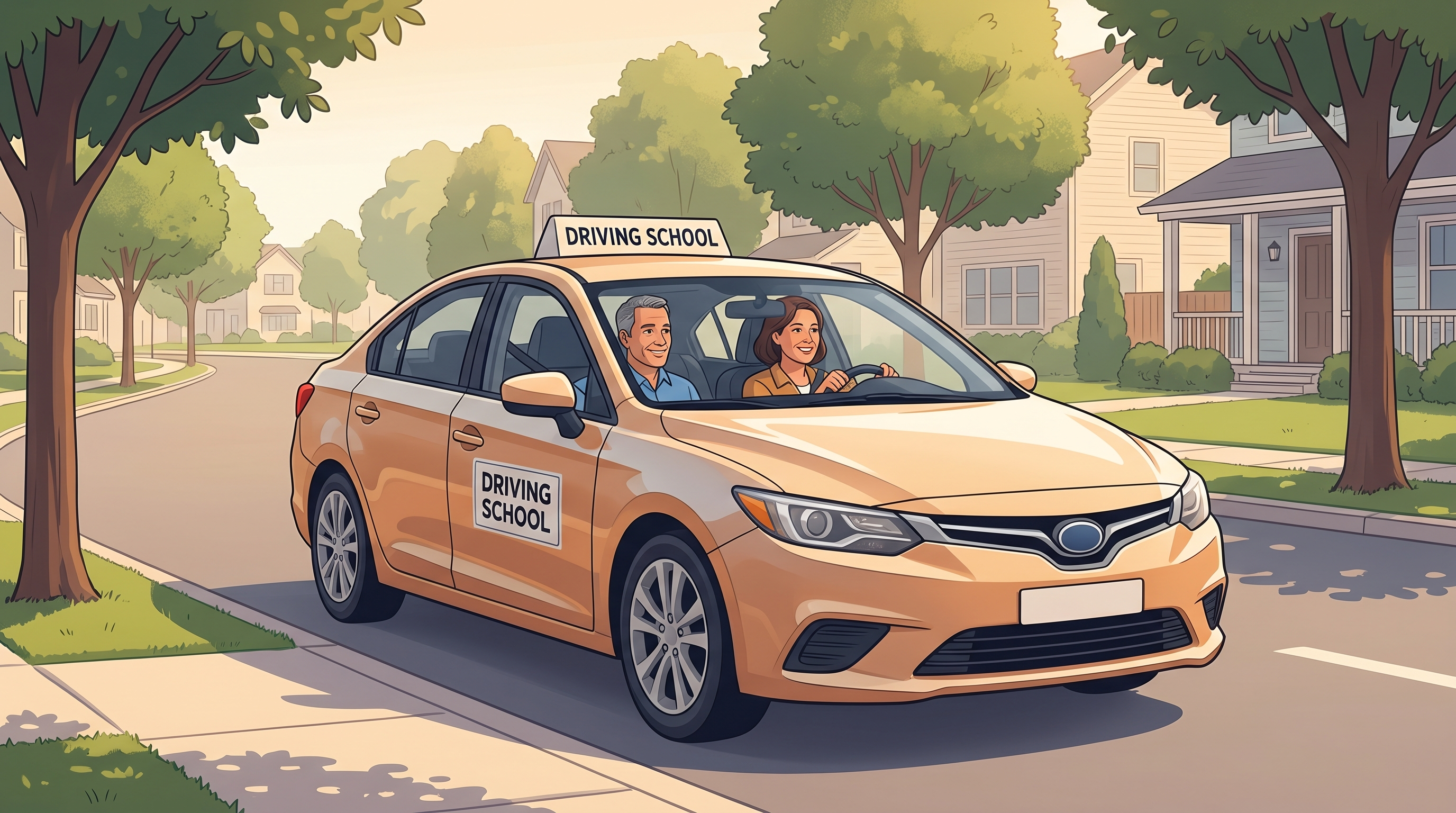
Not all instructors are equal for adult learners. Look for:
Red flags:
Break complex skills into smaller pieces. Instead of "learning to parallel park," learn:
Practice each chunk separately. Then combine.
Short daily practice beats long weekly practice. 20 minutes daily x 5 days = better retention than 100 minutes on a Saturday. This applies to both written test prep and behind-the-wheel practice.
Adults are often better than teens at visualization. Before bed, picture yourself at a 4-way stop, signaling left, making the turn. Your brain rehearses while you sleep.
Mount a phone on the dash and record 30 minutes of a practice drive. Watch it back. You'll catch things real-time feedback can't: hand position, mirror frequency, how wide you're taking turns.
Insurance for new adult drivers:
Registration:
The AAA auto insurance guide has current comparisons.
We'll replace this placeholder with a 12-minute walkthrough of the month-by-month plan.
Is 40 too old to learn to drive? No. Thousands of adults get their first license in their 40s every year. You have advantages teens don't (focus, self-regulation, risk awareness) that often lead to better long-term safety records.
How long does it take to learn to drive at 40? Most adults go from first lesson to full license in 3 to 5 months, including 20 to 40 hours of practice and the written + road tests.
Do I need driving lessons as an adult? Highly recommended. Even 5 hours with a professional dramatically improves your pass rate and your long-term safety. Most adult learners find lessons faster than DIY learning.
Will my insurance be more expensive if I start at 40? Yes, for the first 3 to 5 years you'll be rated as a new driver. Rates drop after you build a clean record.
Can I skip the permit stage since I'm an adult? No, every state requires a learner's permit before the road test, regardless of age. A few states reduce the minimum permit-hold period for adults.
What if I fail the road test? You schedule a retake, usually within 1 to 4 weeks depending on state. Failing once is common and not a reflection on your ability to drive.
Starting to drive in your 40s is one of the most empowering decisions you can make. The timeline is predictable (3 to 5 months), the cost is manageable ($400 to $2,500), and your adult brain is actually built for this kind of structured learning. The only thing in your way is the voice that says you're too late. You're not.
Three moves get most 40-something learners to a license on the first try: take a baseline practice test this week, book your first professional lesson within 30 days of getting your permit, and practice in daily 20 to 30 minute sessions rather than weekend marathons.
Ready to start this week? Download Wheelingo for state-specific written test prep, or walk through our learning roadmap to structure your 4-month plan. Your first solo drive at 44 feels exactly as good as someone else's first solo drive at 16. Maybe better, because you've waited for it.