Pass the New York DMV written test. Format, study tips, common mistakes, and strategies to score 70%+ on your first try with focused prep.
New York's DMV written test is one of the more challenging state exams you'll take—but it's also very fair and 100% beatable with solid preparation. With over 1.2 million New Yorkers holding learner permits at any given time, this test is a critical milestone for the state's drivers.
The New York DMV written knowledge exam tests deep understanding of traffic laws, not just surface-level facts. That's actually good news: it means rote memorization won't work, but genuine learning absolutely will. If you put in 1–2 weeks of focused prep, you'll walk into that test center confident and ready.
 New York's DMV written test is surprisingly short: just 20 multiple-choice questions. Each question has four answer choices. You mark your answers on a computer touchscreen at the DMV office, and your score is instant.
You need 14 out of 20 correct to pass—that's 70%. This is lower than most states (Texas requires 80%), but the questions are trickier. A 70% pass rate on a harder test is roughly equivalent to an 80% pass rate on an easier test.
The test is untimed. You'll typically finish in 10–15 minutes, but you can take longer if you need to review answers. Most people rush through and make careless mistakes—don't be one of them.
You can retake the test the same day if you don't pass, but you'll pay another exam fee.
| Test Element | New York Details |
|---|---|
| Total Questions | 20 |
| Passing Score | 14 (70%) |
| Time Allowed | Untimed (typically 10–15 minutes) |
| Question Type | Multiple choice, 4 options each |
| Computer-based | Yes (touchscreen) |
| Retake Same Day | Yes (additional fee required) |
| Languages Offered | English, Spanish, and others |
Content breakdown:
New York has strict ID requirements. Bring everything on this list—missing one document means a rescheduled appointment.
What to bring:
Cost (2026 rates):
New York's permit is valid for 5 years. You have plenty of time to complete your driving test (road test with examiner).
Pro tip: New York DMV offices close between noon and 1 PM for lunch, and are busiest 3–5 PM after school and work. Schedule a morning appointment if possible, especially on weekdays.
New York has several driving rules and conventions that differ from other states. The test heavily emphasizes these, so understanding them is critical to passing.
Assured Clear Distance Ahead (ACDA) rule: This is the rule that trips up test-takers. New York's Vehicle and Traffic Law requires that you drive at a speed that allows you to stop within the distance you can see ahead (clear distance). If visibility is limited (fog, rain, darkness), you must slow down. The test includes multiple scenarios testing ACDA logic.
Left-turn right-of-way: In New York, when two vehicles are traveling in opposite directions and both want to turn left, the vehicle turning left must yield to oncoming traffic, even if it has a green left-turn arrow. This is not true in all states. It's a New York-specific rule.
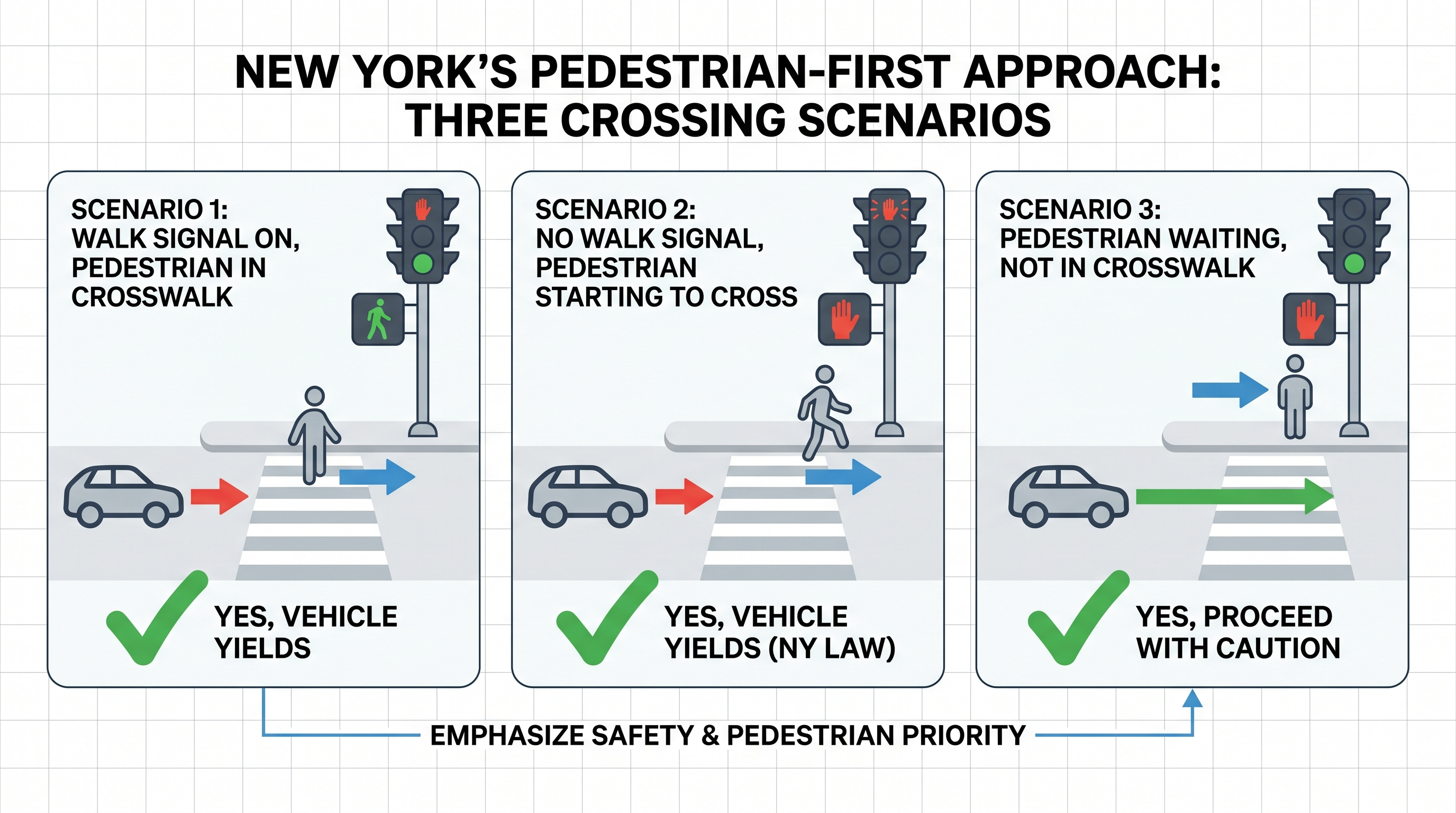
Pedestrian rules: New York is heavily pedestrian-focused, especially in NYC. You must yield to pedestrians in crosswalks, even if the pedestrian hasn't yet entered. The test includes pedestrian right-of-way questions from New York's perspective, which is very strict.
Hand-hold cell phone ban: New York prohibits hand-held device use while driving, even at traffic lights. Hands-free is required. This is tested and carries legal weight.
School bus laws: You must stop at least 100 feet away from a school bus with red lights flashing, from both directions. Passing is a major violation and is tested.
Speed limits near schools: In school zones and areas with high pedestrian activity, speeds are reduced. New York doesn't have a universal "15 mph" rule like some states—instead, signs indicate specific limits (often 20–25 mph near schools).
 Because New York's test is shorter but harder, your study approach must be quality over quantity.
Week 1: Read the handbook and take your first practice test. Download the free New York Driver Manual from the DMV. Read it cover to cover, focusing on chapters on traffic laws, right-of-way, and safe driving. Then take a practice test to see where you stand.
Week 2: Targeted practice and review. If you scored under 80% on your first practice test, focus on the topics where you struggled. Take daily practice tests with Wheelingo's New York-specific questions. Read every explanation, even for answers you got right.
Key topics to master:
Day before test: Don't cram. Do a 15-minute review of ACDA rule and left-turn scenarios. Get solid sleep. Eat a good breakfast.
At the test: Read each question twice before answering. New York's questions are written to be clear, but one misread word can change the answer. Take your time (it's untimed).
What trips people up:
Sophia, 16, from Brooklyn, failed her first attempt with a 65%. She'd studied general DMV rules from online sources but hadn't focused on New York-specific rules. When she retook the test after reading the New York Driver Manual and understanding ACDA and left-turn conventions, she scored 85%. The difference: learning New York's rules, not generic DMV rules.
New York's road sign questions focus on understanding what to do when you see a sign, not just identifying it.
Yellow diamond warning signs: Curve ahead, pedestrian crossing, school crossing, hill ahead, slippery road, deer crossing. The test might ask: "You see a yellow diamond sign showing a school symbol. What should you do?" Answer: Reduce speed and be prepared to stop for children.
Red and white regulatory signs: Stop sign (red octagon), yield sign (white triangle with red border), speed limit signs, turn restrictions, one-way signs. These are straightforward but worth reviewing.
Green informational signs: Highway number, distance markers, directional signs. Less tested than yellow/red signs.
White rectangular signs: Speed limits, no parking, turn restrictions. New York includes specific "No Parking This Side" signs, so pay attention to directional language.
Pavement markings: White lines (same direction), yellow lines (opposite direction), solid lines (no crossing), dashed lines (okay to cross). New York emphasizes these heavily because of urban driving context.
A typical New York test question: "You're approaching an intersection with a yellow light. A pedestrian is starting to cross even though the pedestrian walk signal shows 'Don't Walk.' What should you do?" The answer isn't "go through the light"—it's yield to the pedestrian, even though the signal isn't in their favor, because New York law prioritizes pedestrian safety.
You must schedule your written test appointment in advance. You cannot walk in.
To schedule:
DMV office locations: New York has 24 DMV offices statewide, plus satellite locations. Major cities (NYC, Buffalo, Rochester, Albany) have multiple offices.
Scheduling tips:
For minors (under 18): You must have completed a driver education course before taking the written test. New York requires 30 hours of instruction (classroom, simulation, or online). Many high schools offer this; you can also take it at private driving schools.
The fastest way to pass your test is consistent practice with real questions. Try Wheelingo free — state-specific questions, instant explanations, and a readiness score that tells you when you're ready.
Q: Is the New York test harder than other states' tests? A: It's shorter (20 questions vs. 50–100 in other states) but has trickier questions. A 70% pass rate here is roughly equivalent to an 80% pass rate in Texas or Florida. It's fair, just requires careful reading.
Q: What happens if I fail? A: You can retake it the same day (you'll pay another $10 exam fee). Most people pass within 1–2 tries with proper prep.
Q: Do I need to memorize hand signals? A: Hand signals aren't heavily tested on the written exam, but you'll need to know them for your road test. ACDA and left-turn rules are much more important for the written test.
Q: Can I use my phone or notes during the test? A: No. Phones are not allowed in testing areas. It's a closed-book exam.
Q: How long does the test take? A: Usually 10–15 minutes for the actual test, but plan 45 minutes total including check-in and paperwork.
Q: What's the difference between the learner's permit test and the road test? A: The permit test (written) is what you're taking now. The road test comes later—that's an actual driving exam where a DMV examiner rides with you in your car.
You're 20 questions away from a New York learner's permit. The test is fair, straightforward, and completely passable with focused prep.
Spend this week reading the New York Driver Manual and taking daily practice tests with Wheelingo. Master the ACDA rule and New York's pedestrian-first approach. Review road signs. Practice reading questions twice before answering.
Show up to your DMV office calm, prepared, and unhurried. You've got this.
Start your New York-specific practice sessions now.