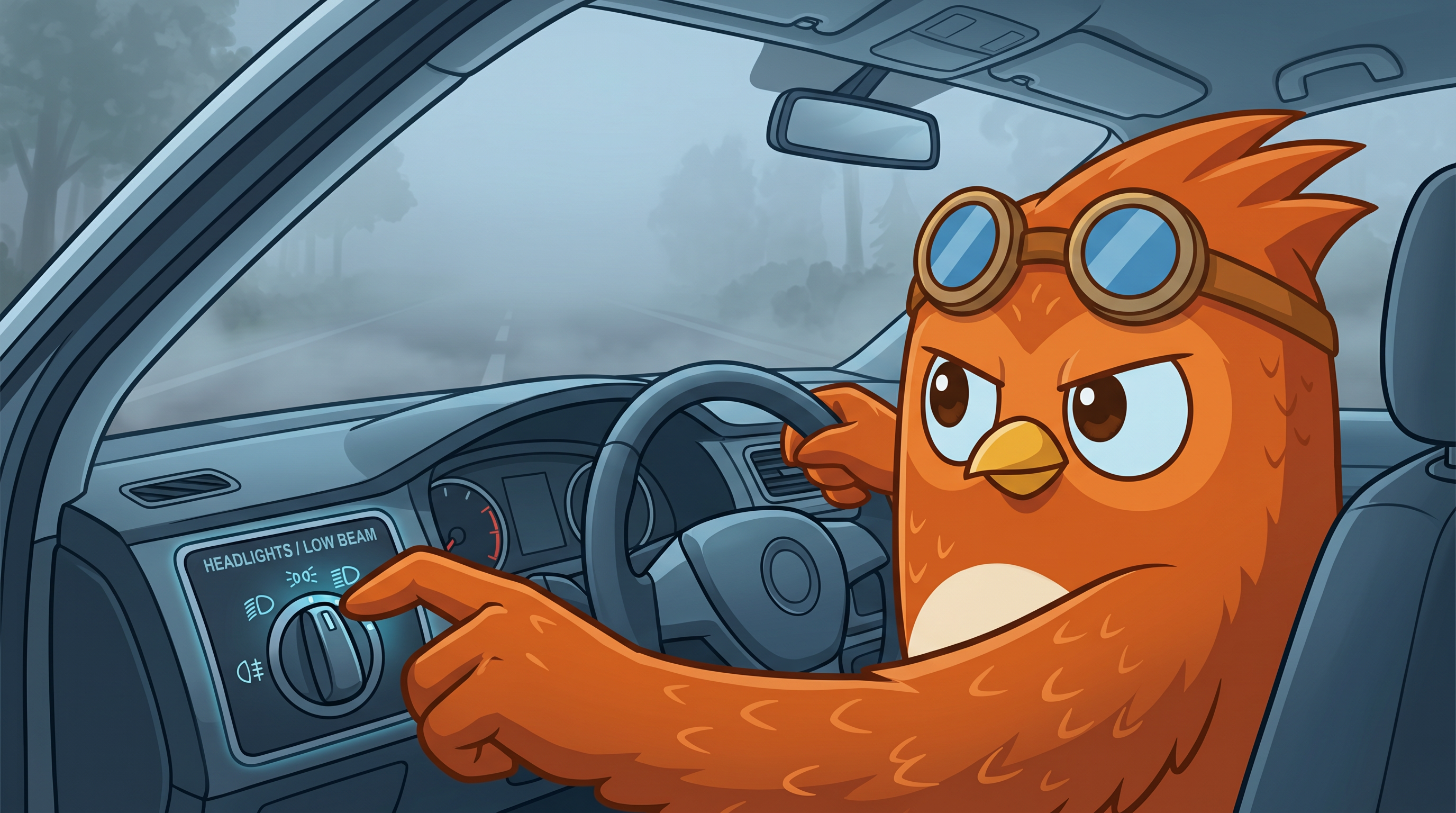
Master night driving with expert tips on headlight use, glare management, and fatigue prevention. Essential guide for new drivers on dark roads.
Night driving is categorically more dangerous than day driving. At night, visibility drops by 90%, depth perception fails, fatigue accelerates, and other drivers' impairment becomes a critical risk. Yet night driving is inevitable for new drivers—commutes, social events, and family obligations don't pause after sunset.
The difference between safe and unsafe night driving is preparation: vehicle inspection, headlight mastery, glare management, and fatigue recognition. This guide covers the specific hazards of darkness and the techniques that keep you in control when vision is compromised.
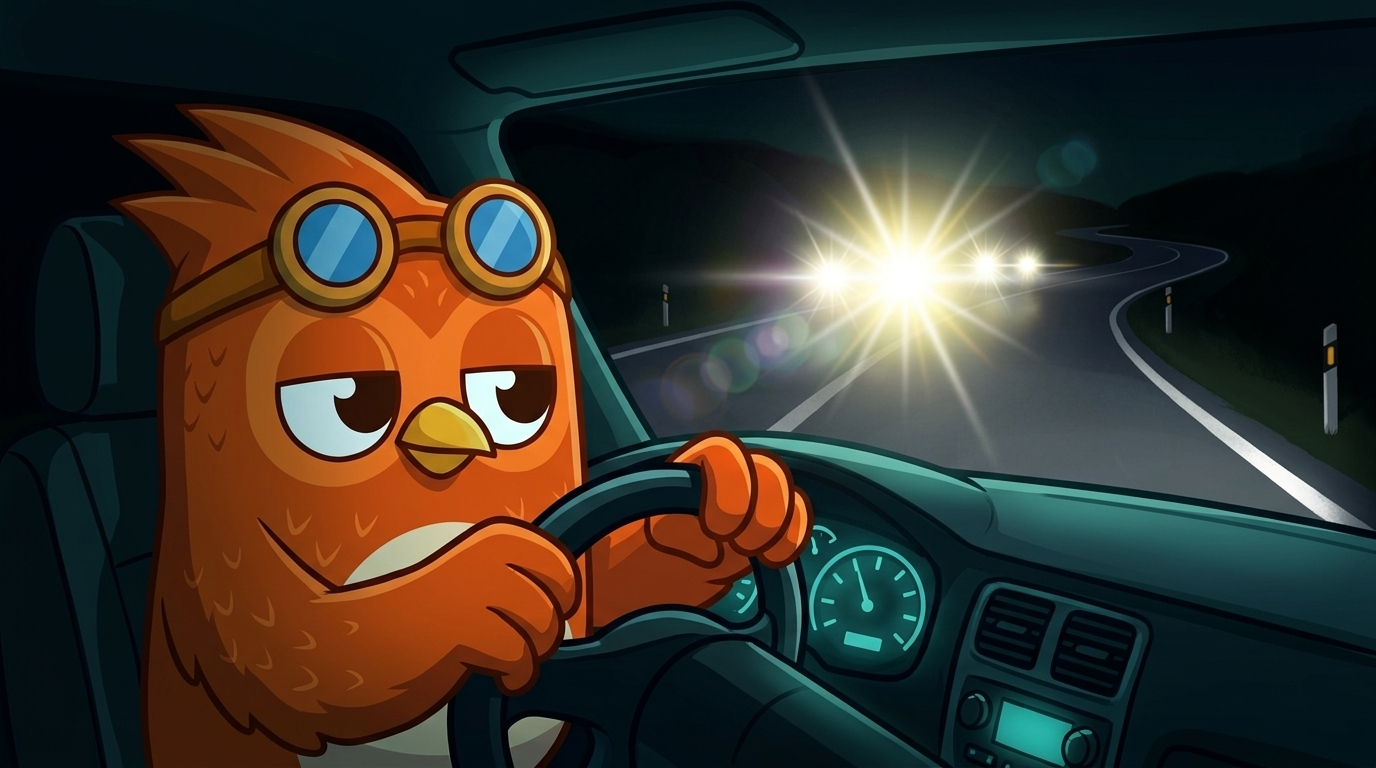 Human eyes require light to see. At night, your only light source is your vehicle's headlights. Headlights on high beam illuminate approximately 350-400 feet ahead at 55 mph. On low beam, visibility drops to 300-350 feet. This is a physics constraint, not a design limitation.
At 55 mph, you travel 80 feet per second. Reaction time is 1.5 seconds (120+ feet). Stopping distance from that speed on dry pavement is 130-150 feet. This means on high beam headlights at highway speed, you have minimal margin between detecting a hazard and your stopping point.
| Time Period | Percent of Crashes | Percent of Miles Driven | Risk Multiple |
|---|---|---|---|
| Daytime (6am-6pm) | 57% | 76% | 0.75x |
| Nighttime (6pm-6am) | 43% | 24% | 1.8x |
| Nighttime impaired driving | 37% of nighttime fatalities | 3% of miles | 12x |
Source: NHTSA Crash Data Analysis
Night driving presents 1.8 times the crash risk per mile driven compared to day driving. When impaired drivers are involved, the risk multiplies to 12 times. This is not opinion—it's statistical reality.
At night, your eyes adapt to darkness through a process called scotopic vision. Your pupils dilate, and rod cells (responsible for low-light vision) take over from cone cells (responsible for color and detail). However, scotopic vision:
When oncoming headlights hit you (high beams), your pupils contract instantly, destroying your scotopic adaptation. Recovery takes 5-10 seconds during which you're essentially driving blind. This is why headlight glare from oncoming traffic is genuinely dangerous.
Before night driving, inspect your headlights for proper alignment and function.
Visual inspection:
Alignment check:
Headlight cleanliness:
Bulb condition:
Jennifer noticed her right headlight seemed dimmer and aimed slightly upward. She ignored it, assuming it was normal variation. During a night drive, an oncoming vehicle flashed high beams repeatedly—a common way drivers signal misaligned headlights. Jennifer had a mechanic inspect; the right headlight was 3 degrees too high, blinding oncoming drivers. After realignment, other drivers stopped flashing her, and her own nighttime visibility improved.
Low beam is your default. Use low beams whenever visibility is not perfect—at dusk, in any rain or fog, in populated areas, whenever another vehicle is ahead or oncoming. Low beams don't blind oncoming drivers and provide adequate visibility for most night driving.
High beam is for dark country roads with no other traffic. High beams approximately double your forward visibility (up to 400+ feet) and are legal on dark, empty roads. However, you must switch to low beams within 500 feet of oncoming traffic and 300 feet of vehicles ahead you're following.
What oncoming high beams do to you:
If blinded by oncoming high beams:
Nighttime glare comes from multiple sources: oncoming traffic, streetlights, wet pavement reflections, and dashboard lights.
Your dashboard reflects in the windshield, creating a dim mirror. This is distracting and reduces visibility.
A dirty windshield multiplies glare. Dust, insects, and road film scatter light, making glare worse.
Some drivers wear dark tinted sunglasses at night to reduce glare. This is counterproductive. Dark lenses reduce already-limited visibility by 20-30%. Avoid sunglasses at night entirely.
Night-driving glasses with amber or yellow tint are marketed to reduce glare. Research shows minimal benefit; these are optional. If you have significant glare sensitivity, amber lenses may help slightly, but are not a substitute for proper technique.
If repeatedly blinded by oncoming high beams:
Fatigue is a silent killer in night driving. At night, your circadian rhythm signals your body to sleep. Darkness, monotonous highway, and engine vibration accelerate fatigue. Fatigue impairs judgment and reaction time as severely as alcohol.
Before night driving:
During night driving:
Emergency fatigue management:
What does not work:
Fatigue is non-negotiable. Your body's need for sleep cannot be overridden by willpower. If you're tired, you cannot safely drive—period.
At night, pedestrians are nearly invisible. Many are wearing dark clothing, have no reflectors, and expect drivers to see them. This is a hazard mismatch: pedestrian visibility is poorest when car visibility is poorest.
Many serious pedestrian accidents occur at night for this reason: drivers didn't see pedestrians until impact was inevitable.
Large animals (deer, moose, cattle) move onto roads at night. Unlike daytime, when animals are usually visible from distance, nighttime encounters happen suddenly.
Night driving is one challenge in a broader set of advanced skills. Build competency through defensive driving techniques, bad-weather driving, and winter hazard recognition. Use Wheelingo's practice modules to train night visibility scenarios and track your progress as you develop confidence in low-light conditions.
The fastest way to pass your test is consistent practice with real questions. Try Wheelingo free — state-specific questions, instant explanations, and a readiness score that tells you when you're ready.
Q: Is night driving more dangerous than daytime driving? A: Yes, statistically it is 1.8 times more dangerous per mile driven. Visibility is reduced, fatigue is higher, and impaired drivers are more common at night. Proper technique reduces this risk significantly.
Q: Should I wear sunglasses at night to reduce glare? A: No. Dark sunglasses reduce your already-limited night visibility by 20-30%, making conditions worse. Avoid sunglasses at night. Instead, use proper headlight technique and manage dashboard/windshield glare.
Q: What's the difference between low beam and high beam? A: Low beam headlights illuminate 300-350 feet ahead and have a downward angle that doesn't blind oncoming traffic. High beam illuminates 400+ feet but will blind oncoming drivers. Use low beams as default; high beams only on dark country roads with no traffic.
Q: How do I know if I'm too tired to drive? A: If you're questioning whether you're too tired, you are. Never drive when fatigued. Pull over, nap for 15-20 minutes, or find a safe place to rest. No destination is worth driving dangerously tired.
Q: Can caffeine keep me awake while driving? A: Caffeine can temporarily increase alertness but doesn't address the underlying fatigue. It can create false confidence—you feel awake but your reaction time is still impaired. Never use caffeine as a substitute for sleep.
Q: What should I do if blinded by oncoming high beams? A: Shift your gaze to the right edge of the road (white line), reduce speed slightly, and wait for the vehicle to pass. Do not retaliate with your own high beams. Your vision will recover in 5-10 seconds.
Q: Are there specific vehicles or roads I should avoid at night as a new driver? A: Highways and high-speed roads are more forgiving at night because there are fewer surprises. Residential streets, local roads with frequent intersections, and rural roads with animals are more hazardous. As a new driver, stay on main roads at night and avoid residential streets until you're confident.
Night driving is a fact of life, not an optional skill. The drivers who stay safe at night are those who respect darkness as a genuine hazard, master headlight technique, recognize fatigue, and drive at speeds appropriate for reduced visibility.
Your headlights show you only 300-350 feet ahead. Build your speed and following distance decisions around that constraint. Maintain your vehicle's lighting and alignment. Never drive fatigued. And remember: no appointment or social event is worth arriving tired or injured.
Get Wheelingo's night driving safety checklist and practice night scenarios through our interactive modules. Master these techniques before your test, and night roads will become routine instead of fearsome.
External References: