Learn school zone and crosswalk rules tested on your road exam. Speed limits, pedestrian right-of-way, and automatic fails explained.
School zone speed limits drop to 15 to 25 mph when children are present, and pedestrians in crosswalks always have the right of way. Both rules are zero-tolerance on your driving test. Violate either and you fail, regardless of how well you drove the rest of the route.
School zones and crosswalks trip up more test-takers than any other "small" category. The maneuvers are simple. The attention required is not. On test day, your mental load is already maxed out, and an unexpected school zone 3 minutes before the end of the route can undo a clean performance.
In 2025, NHTSA reported that pedestrian fatalities in school zones and at crosswalks remained a top safety concern in every state. That is why DMV examiners grade these scenarios with zero tolerance.
Last October, Samuel was cruising at 35 mph through a residential area in Denver. He passed a flashing yellow school zone sign without noticing. The examiner marked "exceeded school zone speed limit by 10 mph" and ended his test early. He had passed every other category. The single missed sign cost him the license.
This guide covers every school zone and crosswalk rule tested on US driving exams. For state-specific practice, start a free Wheelingo test and focus on pedestrian and school zone questions.
Key Takeaways
- School zone speed limits apply when children are present, which includes school hours, flashing yellow beacons, and crossing guard presence.
- Pedestrians in any crosswalk, marked or unmarked, have absolute right of way.
- Failing to yield to a pedestrian is an automatic fail on every state road test.
- Crossing guards are treated the same as traffic signals. Stop when they signal stop, proceed when they signal go.
- School bus stop arms require all traffic to stop on undivided roads, including oncoming traffic in most states.
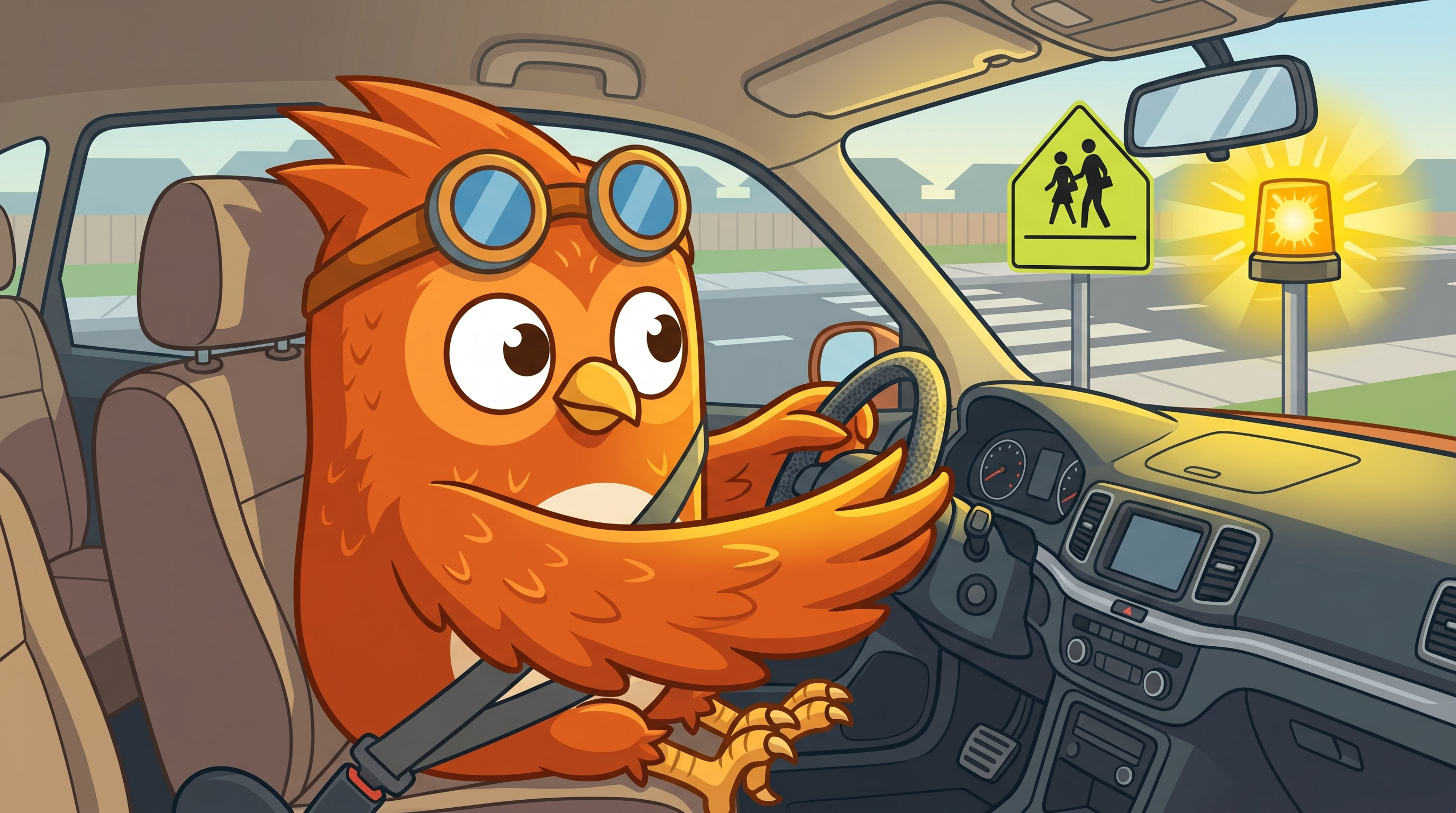
A school zone is a marked section of road near a school with a reduced speed limit during designated hours or when children are present. Every state has slightly different rules, but the core elements are the same.
Indicators you are in a school zone:
On your driving test, examiners expect you to reduce speed the moment any of these indicators are present. The legal limit is not the issue. The visual presence of a school zone is the trigger.
Want to see every school zone sign and scenario before your test? Wheelingo's complete road signs guide walks through every yellow warning sign and its required response.
School zone speed limits are typically 10 to 15 mph below the normal speed limit, but some states set absolute caps.
California: 25 mph when children are present, regardless of posted speed nearby.
Texas: 20 mph in marked school zones with flashing beacons.
Florida: 20 mph during posted hours and when flashing lights are active.
New York: 15 mph in school speed zones when active.
Illinois: 20 mph on school days from 30 minutes before until 30 minutes after class.
Arizona, Georgia, Washington, and others: Range from 15 to 25 mph based on posted conditions.
On your test, the posted speed is the only one that matters. If the sign says 20 mph, you drive 20 mph or slower. Even 22 mph can be marked as a speeding violation.
Chloe, 17, in San Diego, learned this the hard way. She was driving 27 mph in a 25 mph school zone. The examiner wrote "exceeded school zone speed limit." She lost 10 points on a single infraction. On her retake, she dropped to 22 mph in every school zone to give herself a safety margin. She passed.
Crosswalks come in 2 types: marked and unmarked. Both give pedestrians the right of way.
Marked crosswalks have painted lines, either parallel stripes or a zebra pattern. They appear at signalized intersections, mid-block crossings, and school zones.
Unmarked crosswalks exist at every intersection where sidewalks meet, even without paint. The legal extension of the sidewalk across the road is a crosswalk by default.
On your driving test, you must yield to pedestrians in both types. Many test-takers forget about unmarked crosswalks and blow through residential intersections where a pedestrian is stepping off the curb.
The correct crosswalk approach:
Ready to drill pedestrian scenarios? Wheelingo's practice tests include DMV-style questions with real pedestrian right-of-way situations.
Failing to yield to a pedestrian is an automatic fail on every state road test. It does not matter how well you performed every other maneuver. The test ends.
What counts as failing to yield:
The National Highway Traffic Safety Administration classifies pedestrian right-of-way violations as one of the highest-risk behaviors for new drivers. DMV examiners enforce this standard rigidly. Our automatic fail road test guide lists every automatic fail item state-by-state.
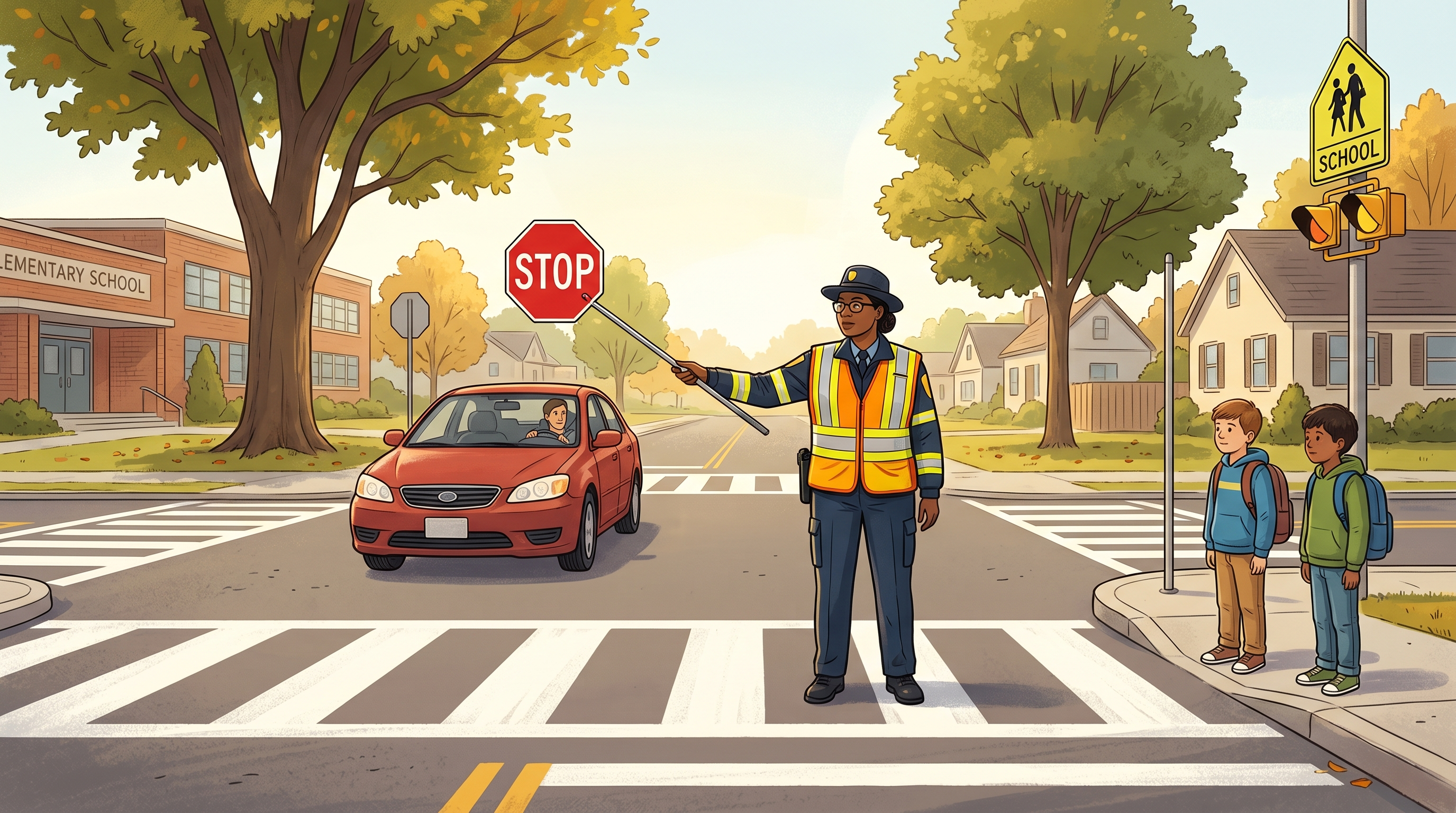
Crossing guards are treated as traffic control officers during their active hours. Their signals override all other traffic signals, including green lights.
When you see a crossing guard:
Do not try to interpret. Follow the guard's gesture exactly. Examiners have zero tolerance for drivers who second-guess crossing guards.
When a school bus activates its flashing red lights and extends its stop arm, all traffic on the same road must stop. The rule varies slightly on divided highways.
Undivided roads: Both directions of traffic stop.
Divided highways with a physical median (grass, barrier, concrete): Only traffic behind the bus stops. Oncoming traffic may continue in most states.
Multi-lane roads without a median: Both directions stop.
On your test, if a school bus activates its lights:
Failing to stop for a school bus is an automatic fail and can also be a criminal citation on public roads in most states.
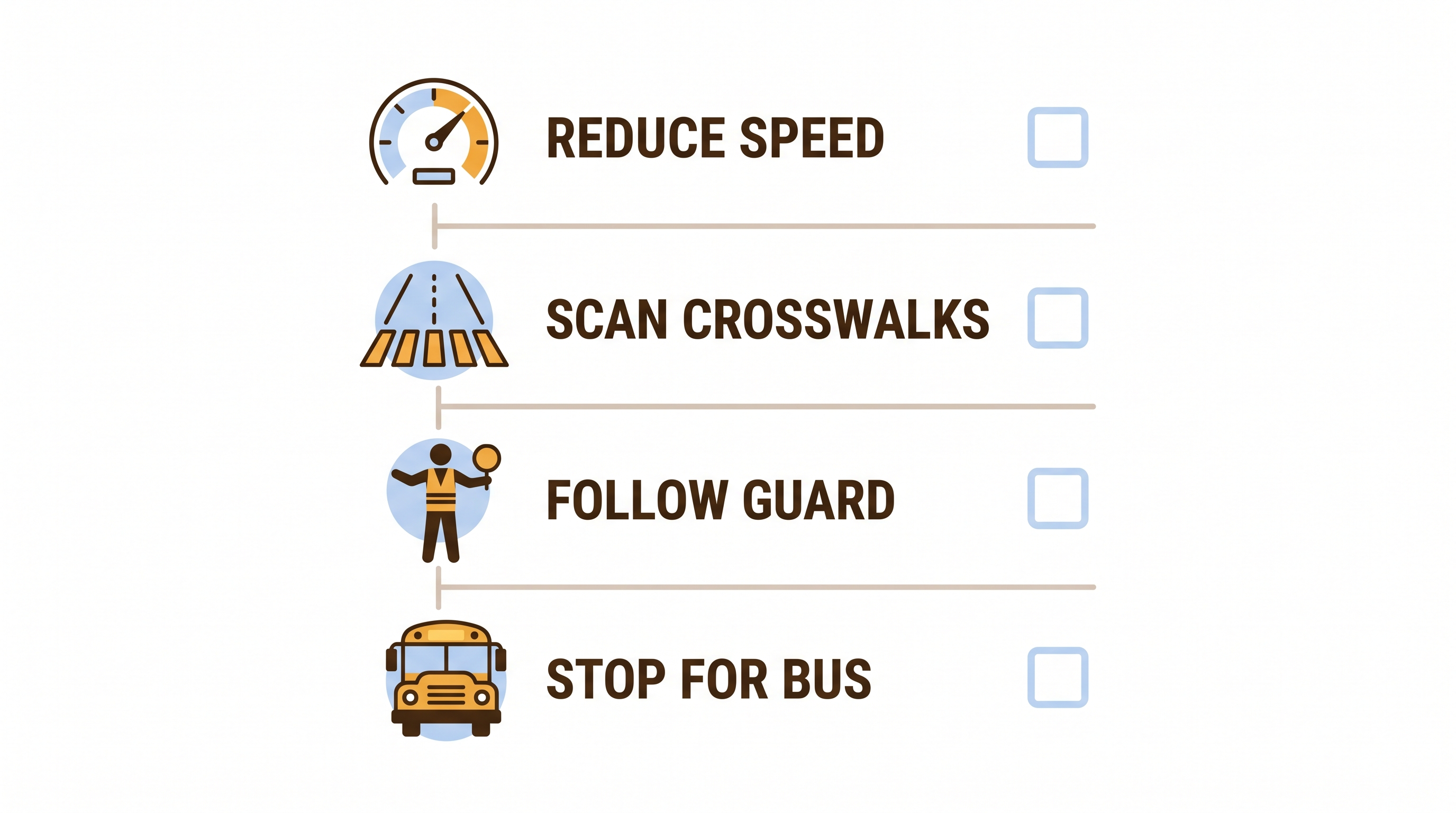
The 5 most frequent failures on road tests:
Failure 1: Not reducing speed in a school zone. You missed the sign or ignored the flashing beacon. Automatic deduction, sometimes an automatic fail.
Failure 2: Edging into a crosswalk while a pedestrian is in it. You inched forward to prepare for your turn, intimidating the pedestrian. Automatic fail.
Failure 3: Turning right on red without a full stop and pedestrian check. You rolled through and missed someone stepping off the curb. Automatic fail.
Failure 4: Ignoring a crossing guard. You passed when the guard had signaled stop. Automatic fail.
Failure 5: Passing a stopped school bus with red lights. Almost always an automatic fail, often a criminal citation.
Tasha, 19, in Tampa, failed her first test on a school zone speeding violation. She had not noticed the sign because it was partially obscured by a tree branch. On her retake, she consciously scanned every street for school zone indicators. She passed with 81 points. Active scanning, not passive driving, is the key to school zone awareness.
Examiners deliberately route you through areas with pedestrian activity. Common scenarios you should expect:
Scenario 1: Right turn at a busy intersection with pedestrians waiting. Stop, check, wait for pedestrians to clear, then turn.
Scenario 2: Mid-block crosswalk at a shopping center. Often unmarked or lightly marked. Scan for pedestrians crossing.
Scenario 3: Residential street near a park. Unmarked crosswalks at every corner. Watch for kids.
Scenario 4: School zone during release hours. Expect children in crosswalks, crossing guards, and school buses all at once. Drop your speed.
Scenario 5: Unprotected left turn with a pedestrian in the receiving crosswalk. Yield to oncoming traffic and wait for the pedestrian.
[YouTube placeholder: "School Zone and Crosswalk Rules on Your Driving Test" - Wheelingo official channel, 5-minute walkthrough covering pedestrian right-of-way, crossing guards, and school bus stops]
Spend 1 week driving past local schools during drop-off and release times. This is the only way to build real pedestrian awareness.
Find 3 schools near your home. Drive past each one during active hours (7:30 to 8:30 AM, 2:30 to 3:30 PM on school days). At each school:
After a week of this drill, school zones will register automatically in your peripheral vision.
At every single intersection, scan sidewalks on both sides before proceeding. Make it a reflex. The scan takes half a second, and it is what prevents an automatic fail.
Learn more about yielding rules on the driving test to sharpen your pedestrian-awareness judgment.
Ready to pass your road test on the first try? Download Wheelingo and drill state-specific pedestrian and school zone scenarios with adaptive practice. Our users pass at 87% first-attempt rates.
School zones and crosswalks are not about complicated rules. They are about active awareness. Practice scanning, reduce speed proactively, and treat every pedestrian as having absolute priority. Do those 3 things and you will pass every school zone and crosswalk situation your examiner throws at you.