Complete list of automatic fail items on the road test. Know what will disqualify you instantly and how to avoid each one.
There are things you can do during a road test that cause immediate failure. Not "you lost points for this." Not "the examiner noted this as a concern." Immediate, irreversible failure.
These aren't judgment calls. They're binary: either you did it or you didn't. And if you did, your test ends.
An examiner doesn't need to watch you for 20 minutes to determine if you're safe. One critical mistake tells them everything they need to know. You're done.
This guide covers every automatic-fail item. Memorize this list. If you avoid these ten actions, you've eliminated the fastest way to fail.
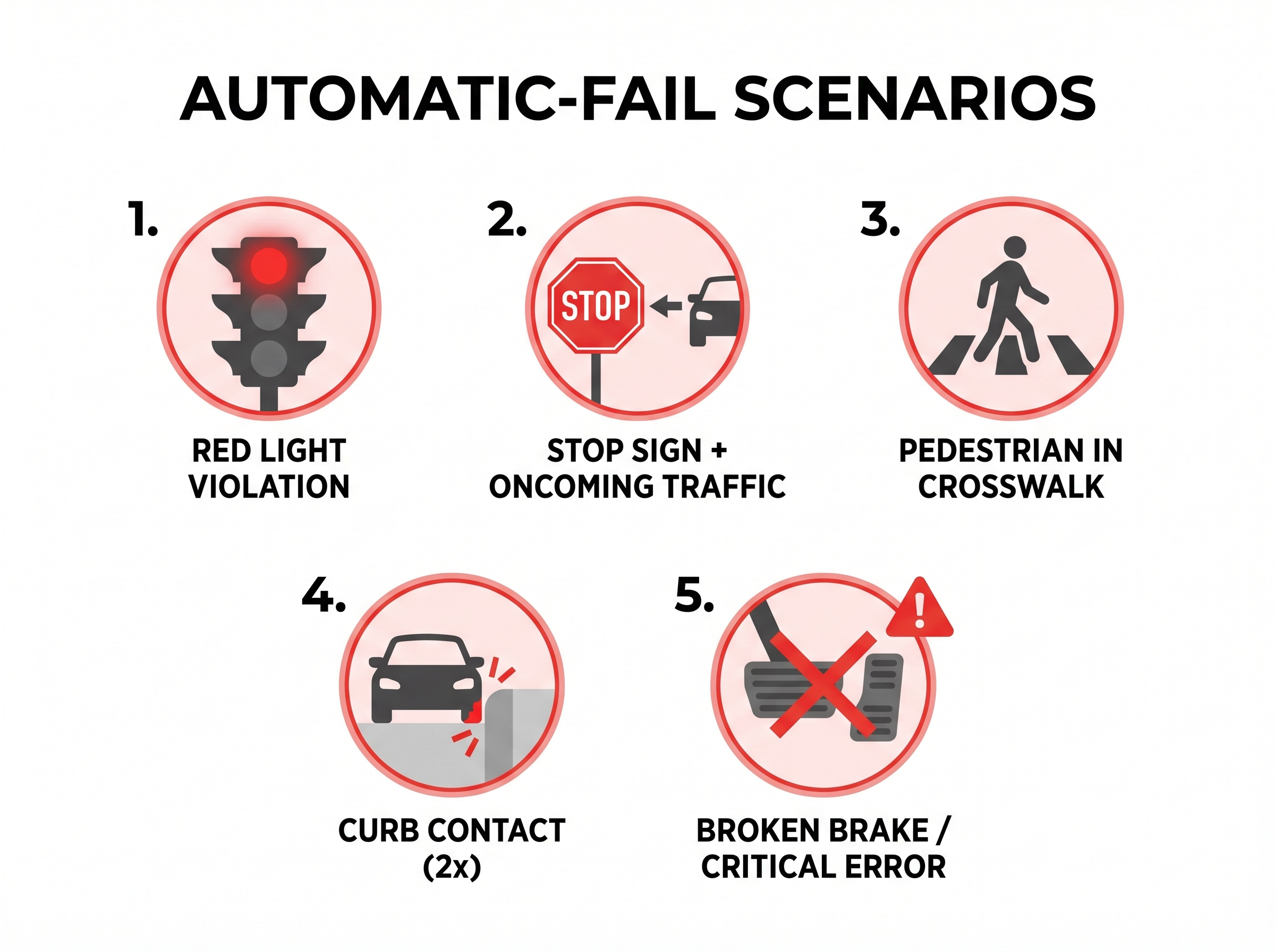
Failing to stop at a red light is an immediate fail. Not a marginal stop or a "rolling stop" that barely counts as stopping. A full, intentional run through a red light.
Similarly, running a stop sign (not stopping at all, just rolling through) is an automatic fail.
Why it matters: Running a red light or stop sign signals either recklessness or complete inattention. Either way, you're a danger to other drivers and pedestrians. One instance proves you're not ready for independent driving.
Real example: James from Illinois was concentrating so hard on his next turn that he missed a red light entirely and drove straight through the intersection. An examiner sitting silently next to him didn't need to say anything—the test ended immediately. "I just didn't see it," James said afterward. "I was thinking about my next turn and missed the light completely." That one moment of inattention cost him weeks of retake waiting.
How to avoid it:
Hitting the curb once? Warning. Hitting it twice? Fail.
The second curb strike signals you've lost control or can't correct. The examiner's concerns jump from "minor vehicle control issue" to "dangerous inexperience."
Why it matters: A parallel park that requires multiple curb strikes shows you don't have spatial awareness or fine motor control. Both are essential for safe driving.
Real example: Brittany from Colorado executed her parallel parking and gently tapped the curb on the first adjustment. The examiner noted it but didn't stop her. She reversed more, over-corrected, and hit the curb again slightly harder. The examiner signaled to stop the car. Test over. Fail. "I thought one tap didn't matter," Brittany said. "But the second one confirmed to the examiner that I didn't have enough spatial awareness to park safely."
How to avoid it:
Stalling once? Acceptable if you restart it calmly and continue. Stalling twice? Automatic fail.
Stalling signals inexperience with the vehicle, clutch control (in a manual car), or an extreme anxiety response. Two stalls mean the problem is systemic.
Why it matters: Stalling isn't technically "unsafe," but repeated stalls signal you don't have basic vehicle competence. A driver who stalls regularly might panic in real emergency situations.
Real example: Marcus from Nevada stalled once at a red light—a common occurrence when he was nervous. He restarted and continued. But 10 minutes later, he stalled again when accelerating from a stop. The examiner marked it as a second stall. Fail. "I was so nervous that I kept hitting the gas without easing off the brake," Marcus said. "The first stall should have been a warning to me to slow down and be deliberate with my pedal control."
How to avoid it:
Broken headlights, non-functioning brakes, bald tires, missing mirrors, non-working seat belts—if your car fails inspection, you don't test. Period.
Why it matters: The car itself must be road-safe. An examiner won't get in an unsafe vehicle. It's not a reflection on your driving; it's a reflection on your vehicle maintenance.
Real example: Nicole from Pennsylvania scheduled her road test and drove to the testing center in her beat-up Honda. The examiner did a quick safety check and found the passenger mirror was broken (held together with duct tape). The test didn't happen. Nicole had to reschedule once she'd replaced the mirror.
How to avoid it:
If you pull into a lane with oncoming traffic, or if your maneuver causes another vehicle to brake hard, swerve, or honk—automatic fail.
Why it matters: This is the clearest evidence you don't understand traffic rules or don't respect them. You've created a dangerous situation where another driver had to react to prevent a collision.
Real example: David from Florida tried to pass a slow car on a road marked "No Passing" and nearly merged into oncoming traffic. A car coming the other direction had to swerve. The examiner signaled to return to the testing center. Test over. Fail. "I thought I had time to pass," David said. "But the examiner said that one illegal pass that nearly caused a collision told her everything she needed to know."
How to avoid it:
If your test includes a parking maneuver and you end up parked illegally (too close to a hydrant, over a curb, in a no-parking zone, blocking traffic), automatic fail.
Why it matters: Illegal parking signals you either don't know traffic laws or don't care. Both are disqualifying.
Real example: Sarah from Massachusetts pulled into a parking space perfectly and shifted to park. The examiner checked the spot and realized they were parked in a "No Parking—Street Cleaning" zone (the sign had different hours on different days). The test was over. Fail. "I didn't read the sign carefully enough," Sarah said. "I focused on the space itself and not on whether parking was even legal there."
How to avoid it:
If you apply the brakes and the car doesn't stop responsively, or if the brakes fail entirely during the test, immediate stop and fail.
Why it matters: A brake system failure is the most dangerous situation possible. The test can't continue.
Real example: This is rare, but it happens. A test-taker's brake fluid was low (from a slow leak). Halfway through the test, the brakes felt soft and spongy. The examiner immediately ended the test for safety reasons. The test-taker had to have the brake system serviced and reschedule.
How to avoid it:
If a pedestrian is in a marked crosswalk (legally crossing) and you don't yield to them, that's an automatic fail. Not a warning. Immediate test termination.
Pedestrians have the right-of-way in marked crosswalks. Period.
Why it matters: Failing to yield to pedestrians is the most likely scenario where a driver causes injury or death. This is non-negotiable.
Real example: Chris from Ohio was so focused on making a green light that he didn't notice a pedestrian in the crosswalk until the examiner said, "Stop the car." The pedestrian was safe because Chris was going slowly, but the failure to yield was an automatic fail. "I saw the pedestrian in my peripheral vision but didn't think she was in the crosswalk," Chris said. "The examiner explained that I need to check crosswalks before proceeding, even with a green light."
How to avoid it:
You or your passengers fail to wear seat belts, or you drive the car without a seat belt on yourself—automatic fail.
Seat belt laws are non-negotiable. The examiner isn't going to sit in a car where you're not following seat belt laws.
Why it matters: Seat belts save lives. Operating a vehicle without one signals either recklessness or ignorance. The examiner won't proceed.
Real example: Marcus from Wisconsin didn't click his seat belt until the examiner specifically asked him to before starting the test. He'd forgotten to buckle it out of habit. The examiner let him buckle it and continue, but some examiners would have ended the test right there. Always wear your seat belt from the moment you sit down.
How to avoid it:
This is a catch-all for behaviors that create immediate danger:
Why it matters: If you do something so dangerous that the examiner fears for their life, the test ends immediately.
Real example: This is rare because most people wouldn't be taking the test if they were impaired or unsafe. But if it happens, it's immediate termination.
How to avoid it:
 For clarity, here are common mistakes that cost you points but aren't automatic fails:
| Mistake | Point Value | Recovery Possible |
|---|---|---|
| Hesitation at a yield sign (but still yield) | 5–10 points | Yes—fix it and continue |
| Mild speeding (5 mph over limit) | 5–10 points | Yes—adjust speed and continue |
| Jerky steering input (but safe maneuver) | 5–10 points | Yes—smooth out and continue |
| One curb touch during parallel parking | 5–10 points | Yes—correct it and continue |
| One stall (but restart smoothly) | 5–10 points | Yes—continue with extra caution |
| Minor signal timing issue (1–2 seconds late) | 5–10 points | Yes—be earlier next time |
| Forgetting to check mirror once | 3–5 points | Yes—improve scanning |
The fastest way to pass your test is consistent practice with real questions. Try Wheelingo free — state-specific questions, instant explanations, and a readiness score that tells you when you're ready.
Q: If I do one of these automatic-fail items, is there any way to recover? A: No. Automatic fail means the test ends. You'll need to retake it after the mandatory waiting period (usually 1–14 days depending on your state). See our guide on retake wait times for state-specific info.
Q: Are these automatic-fail items the same in every state? A: Not exactly. Some states are slightly more lenient (e.g., allowing two minor curb taps in parallel parking before failing). But the core items (running red lights, causing collisions, brake failure, seat belt violations) are universal. Check your state's DMV handbook for the specific language, but assume the items listed here apply in your state.
Q: What if my car's check engine light is on? Does that count as a failed safety inspection? A: Usually not, unless the examiner determines the underlying issue is a safety concern (like a faulty emission system that affects braking). A check engine light from a loose gas cap won't fail inspection. But if you're concerned, have the car scanned and fixed before testing.
Q: If the examiner directs me to parallel park and I get two curb taps, am I automatically failed? A: Yes. Two curb taps in parallel parking is an automatic fail. But remember, the examiner might direct you to attempt it 2–3 times in different spaces. The fail is cumulative within the same maneuver, not across different maneuvers. If you tap a curb in the first space, you need to execute the next space perfectly.
Q: Can I ask the examiner to clarify a direction if I don't understand? A: Yes. If the examiner says "turn left at the next intersection" and you're not sure which intersection they mean, ask for clarification. A clarifying question isn't a failure. What's a failure is ignoring their direction and turning where you think they meant.
Q: What if I need to stop for a medical reason during the test (e.g., I feel faint)? A: Tell the examiner immediately: "I need to stop for safety reasons." Pull over and explain. A medical emergency is different from a driving failure. The test will be rescheduled, not failed. Don't push through if you're genuinely unsafe.
The automatic-fail items on the road test are binary. You either do them or you don't. There's no partial credit, no "it was close," no examiner's discretion.
Memorize these ten items. During your preparation, practice scenarios that could trigger each one and drill how to avoid them. When you're sitting in the driver's seat during your test, keep these in the back of your mind as the hard boundaries you won't cross.
The good news? Most of these are entirely preventable with basic preparation:
Use Wheelingo's practice app to drill scenarios around each of these items. Visualize yourself avoiding each one. By test day, avoiding automatic-fail items should be second nature.
You've got this. One test, ten things to avoid, and a license on the other side.