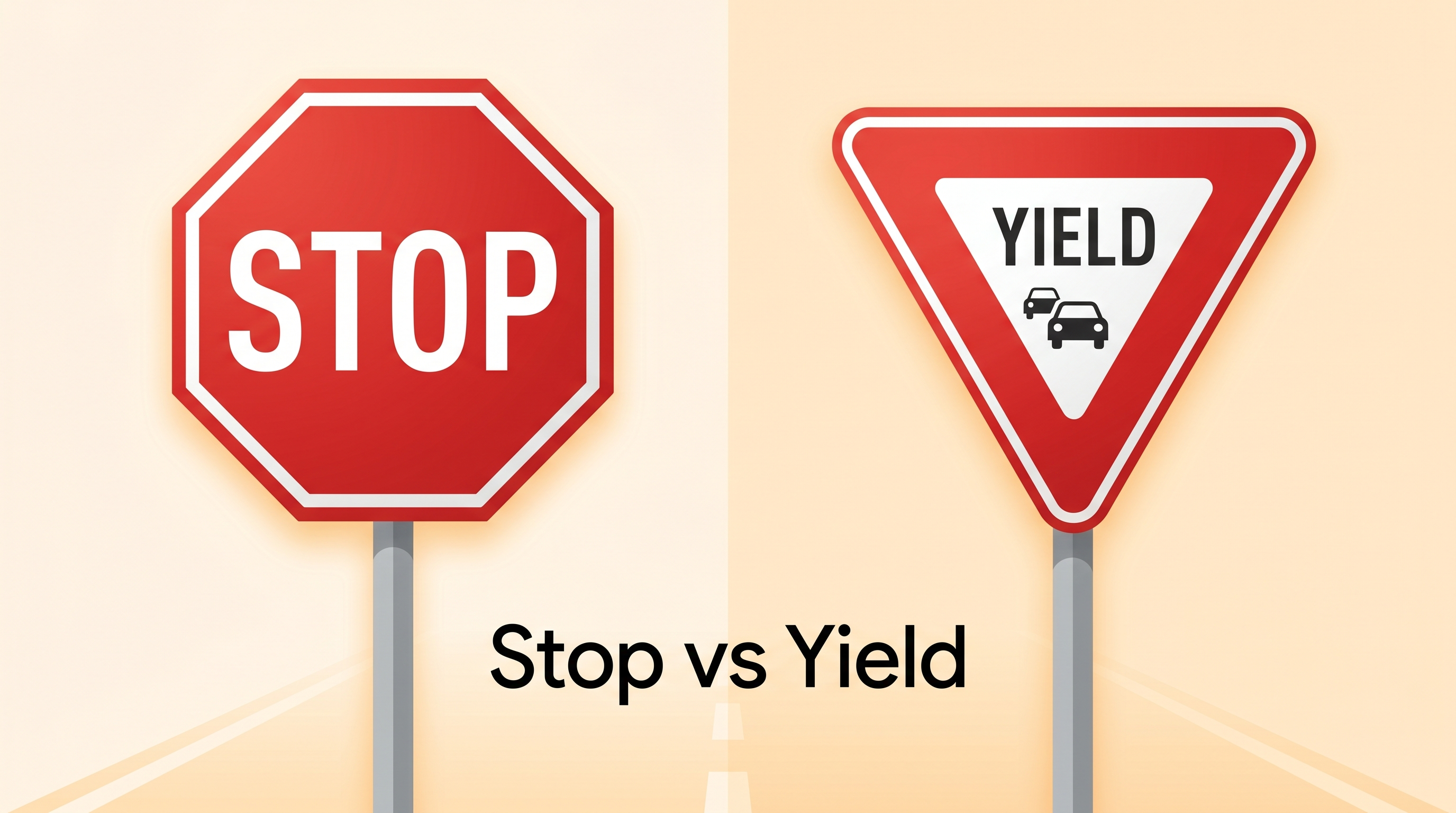
Stop sign vs yield sign on your driving test. Know the differences, avoid the rolling stop trap, and pass your DMV road test with confidence.
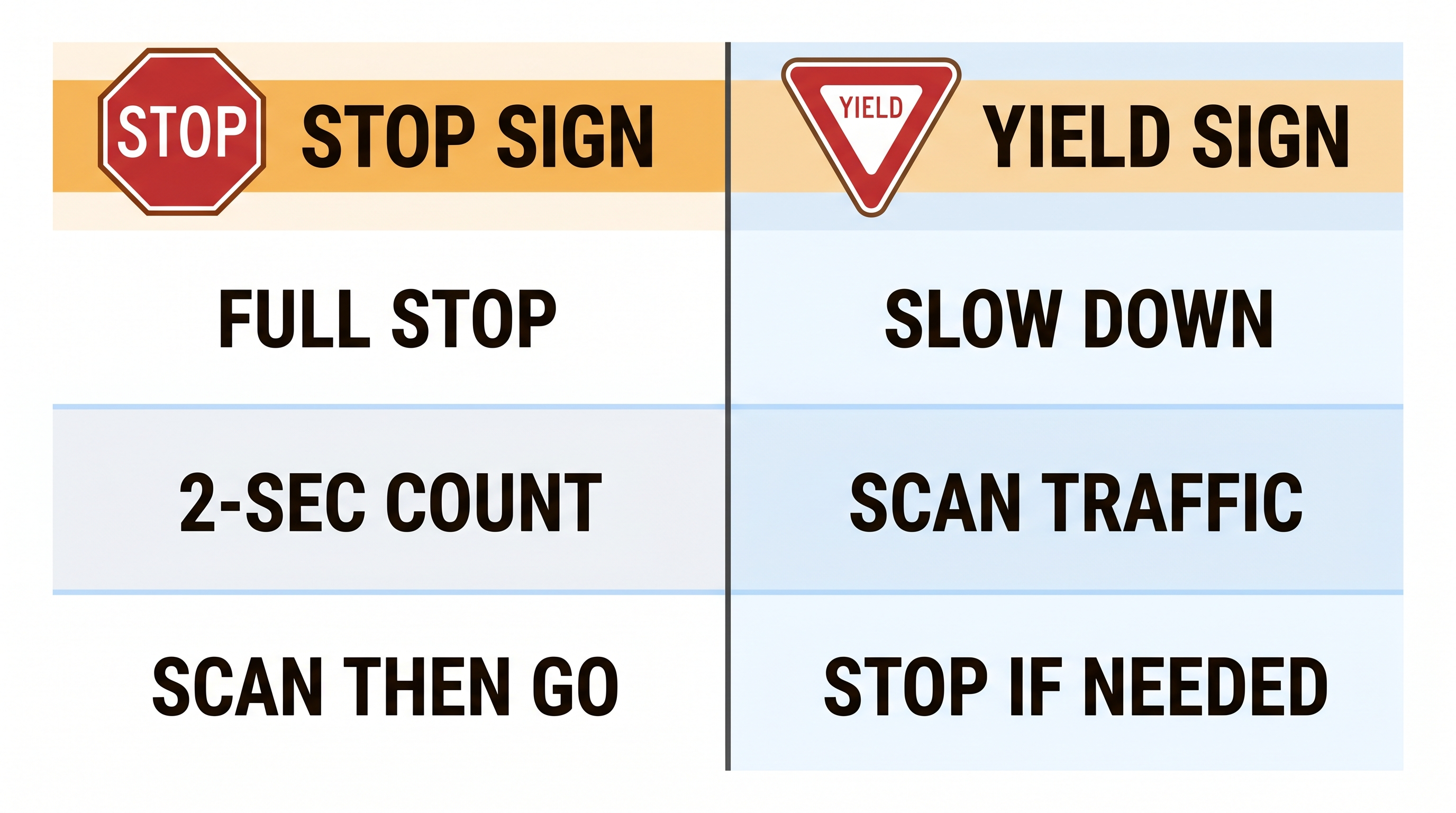
A stop sign requires a complete stop. A yield sign requires you to slow down and stop only if another road user has the right of way. On your driving test, examiners treat these 2 signs very differently, and treating them the same costs you points.
The rolling stop is the single most common deduction on US driving tests. An examiner sees you slow to 3 mph, glance, and roll through. That is not a stop. That is a yield, performed at a stop sign. Instant deduction.
The opposite mistake is just as bad. Coming to a full 3-second stop at a yield sign when traffic was clear. That is poor judgment and a failure to understand the sign. Also deducted.
Knowing the difference between these 2 signs, and more importantly, knowing what the examiner is watching for, is the skill we are drilling in this guide. If you want to practice identifying signs and scenarios before test day, start a free practice test in 60 seconds.
Key Takeaways
- A stop sign (octagonal, red) requires a complete, wheels-stopped stop. Counting to 2 seconds is a good test-day habit.
- A yield sign (triangular, red and white border) requires slowing and scanning. You only stop if another road user has priority.
- Rolling stops are the number-one deduction on US road tests. Examiners can see a 1 mph roll from 20 feet away.
- At a yield sign with no traffic, stopping unnecessarily is also a deduction. Examiners grade judgment, not just caution.
- On multi-way stops, follow the first-arrived, first-served rule with a tie-breaker going to the right.
Before you read a word on either sign, your brain should recognize the shape.
A stop sign is octagonal (8 sides), painted red, and says STOP in white letters. The Federal Highway Administration standardized this shape so drivers recognize the sign even from the back or in poor visibility. If you see an 8-sided sign from any angle, it is a stop sign.
A yield sign is a downward-pointing triangle with a red border and white interior, sometimes with the word YIELD. The triangle shape is unique to yield signs in the US Manual on Uniform Traffic Control Devices.
This shape recognition matters on your driving test. You often see signs from 200 feet away, and your first clue is the silhouette. Train your eye to recognize the octagon and the inverted triangle at a distance so your brain starts preparing the correct action immediately.
Want to master every sign shape before your DMV test? Our complete US road signs guide covers every regulatory sign, its shape, and its required response.
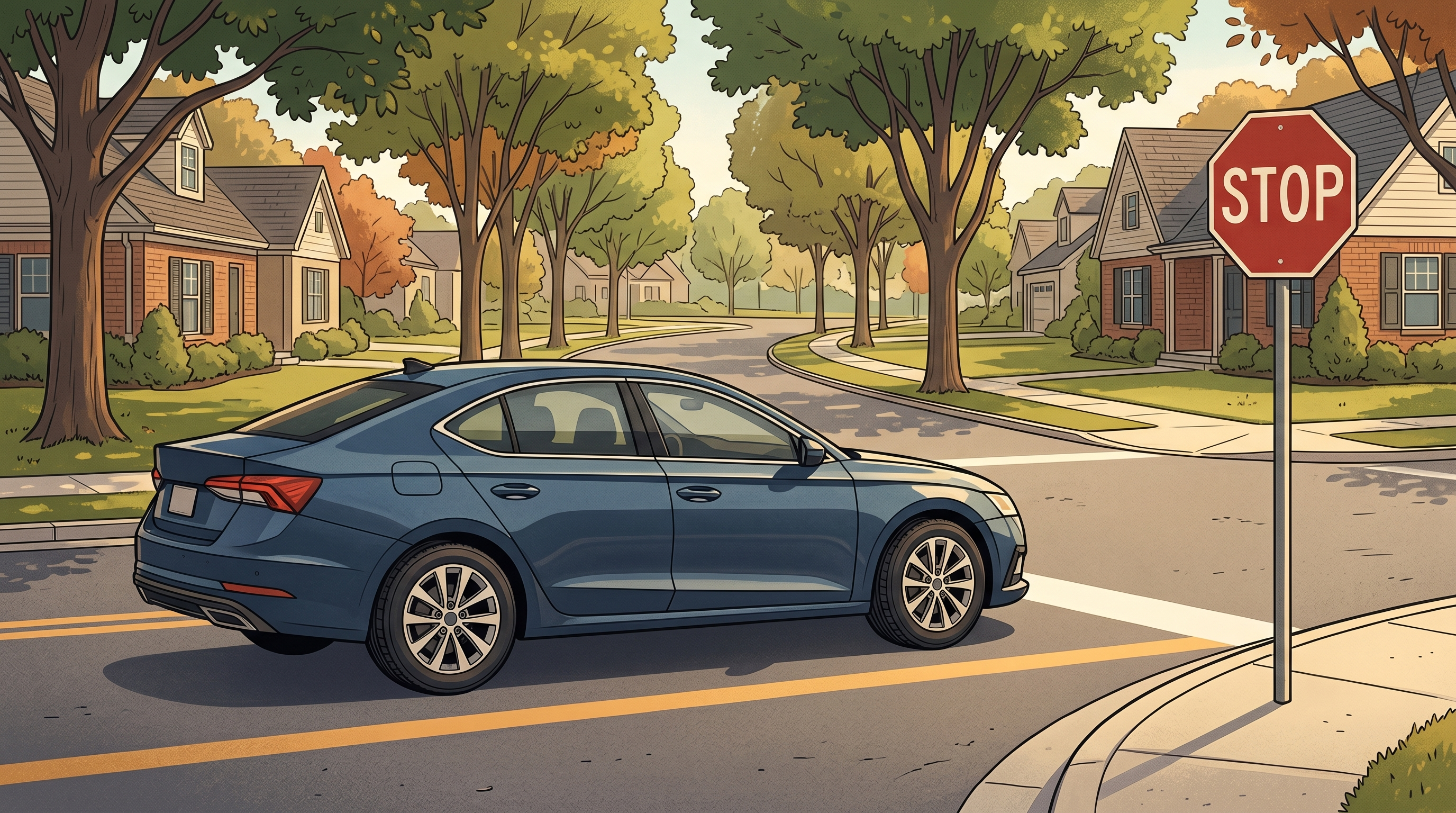
A complete stop means your wheels have stopped rotating. Full stop. No movement. Your examiner is watching your tires, not just your speedometer.
The best test-day practice: stop, count "one thousand one, one thousand two" silently, then proceed. That 2-second pause gives the examiner visible confirmation that you stopped.
Where to stop at a stop sign is just as important as stopping itself:
After the initial stop, you may need to creep forward to see around parked cars or vegetation. This is a second stop. Examiners expect this in obstructed intersections and grade you on whether you actually stopped twice.
Ready to practice stop-sign scenarios with state-specific rules? Wheelingo's app includes DMV-style questions that test your stop-sign knowledge across 50 states.
The rolling stop is the silent killer of road test scores. NHTSA data suggests that rolling stops contribute to a meaningful share of intersection collisions, which is why examiners weight this error heavily.
A rolling stop is any forward motion through a stop sign without the wheels fully stopping. Even 1 mph of continuous movement counts as a rolling stop.
Why it happens:
How examiners catch it:
Jamal, 18, from Atlanta, failed his first road test on 2 rolling stops. The examiner told him afterward: "I watched your tire. It never stopped turning." On his retake, he exaggerated every stop to a full 3-second pause. He passed with 84 points. The lesson: visible stopping matters more than fast driving.
A yield is a slow, observant approach with the option to stop. The key word is option.
The correct yield-sign approach:
At a yield sign, you are graded on judgment, not on stopping. Stopping when traffic was clearly absent is marked as unnecessary, which reads as not understanding the sign.
A yield sign becomes a stop sign the moment another road user has the right of way. Examples:
In any of these cases, a full stop is required, even though the sign is a yield. Examiners grade the correct decision based on traffic, not just the sign.
4-way stops are their own category. Every direction has a stop sign, and the order of priority follows 3 rules.
Our 4-way stop rules guide covers this in more detail, including how to handle the awkward standoff when everyone is waving each other through.
On your test, expect at least 1 four-way stop. Examiners watch whether you correctly sequence the order, especially when multiple cars arrive at similar times.
Some highway on-ramps use a yield sign instead of a merge sign. The rule is the same: you yield to traffic already on the highway.
On a ramp yield:
Stopping on an active merge ramp when traffic is flowing is an automatic fail in most states. Yielding means preparing to stop, not stopping unnecessarily.
The 6 most common failures examiners mark:
Failure 1: Rolling stop. Reduced speed but no full stop. Most common deduction.
Failure 2: Stopping past the line. You stopped, but your front tires crossed the stop line or crosswalk.
Failure 3: Only one stop at an obstructed intersection. You stopped at the line but did not creep forward for visibility before entering.
Failure 4: Unnecessary stop at a clear yield sign. Full 3-second stop when no traffic was present. Marked as poor judgment.
Failure 5: Failing to yield at a yield sign. Rolled through at 20 mph without slowing. Marked as failing to observe.
Failure 6: Wrong order at a 4-way stop. Proceeded out of turn, forcing another driver to brake.
Maria, 24, in Houston, failed 2 times on the same issue: rolling stops. On her third attempt, she used Wheelingo's practice tests for 3 weeks, drilling stop-sign scenarios. On test day, she counted to 2 at every stop. She passed with 88 points. Consistent, visible stopping habits build by practice, not willpower.
[YouTube placeholder: "Stop Sign vs Yield Sign: Driving Test Demonstration" - Wheelingo official channel, 4-minute video showing the correct approach for each sign type]
Most stop and yield rules are uniform nationwide, but test scoring varies.
California examiners are strict on stop-line placement. Stopping past the line is a guaranteed deduction, and 2 such errors can fail the test.
Texas weights 4-way stops heavily. Expect at least 1 on your test, and know the tie-breaker rule.
Florida examiners watch for the creep-forward at obstructed intersections. Not creeping is a deduction.
New York tests yield signs on merge ramps specifically. Know how to yield without stopping unnecessarily.
Illinois grades rural uncontrolled intersections, where neither sign exists. Yield to the right.
Spend a week practicing every stop and yield sign in your neighborhood with intentional focus.
Drive a route with at least 20 stop or yield signs. At each one:
After the drill, count how many rolling stops or unnecessary stops you made. Target zero by the end of the week.
Narrate every intersection for 1 week. "Stop sign, full stop, 2-second count, clear, go." Saying it builds the motor habit. By day 5, the actions become automatic.
Want a structured path to mastering all 50 regulatory signs? Wheelingo's learning roadmap has a dedicated signs module with adaptive practice.
Stop and yield signs are not complicated. They are about habits. Build them through repetition, and your test-day execution will be automatic.
Ready to pass your road test on the first try? Download Wheelingo and practice state-specific sign scenarios with adaptive difficulty. 87% of our users pass their first attempt.