
Master four-way stop rules: right-of-way priority, simultaneous arrivals, and clear communication. Pass your DMV test and drive safely at any intersection.
Four vehicles arrive at a four-way stop simultaneously. Who goes first? Everyone looks at each other. Someone waves. Someone else goes. The entire intersection becomes a confused dance of uncertainty.
This scenario plays out thousands of times daily at four-way stops across North America. The rules seem unclear because drivers overthink them. But the rules are simple and hierarchical: there's a clear priority order that settles almost every scenario.
This guide explains the four-way stop right-of-way rules, covers the edge cases (simultaneous arrivals, unclear situations), and walks you through real scenarios. You'll learn how to communicate clearly, when to yield, and when to proceed confidently.
A four-way stop is an intersection where all four directions have stop signs. Each vehicle must come to a complete stop before proceeding. Unlike traffic lights (which are automatic), four-way stops require drivers to judge right-of-way and communicate through clear, confident actions.
Four-way stops are used when:
Four-way stops are safer than two-way stops at complex intersections because they eliminate the "hide in a blind spot and wait for traffic" strategy.
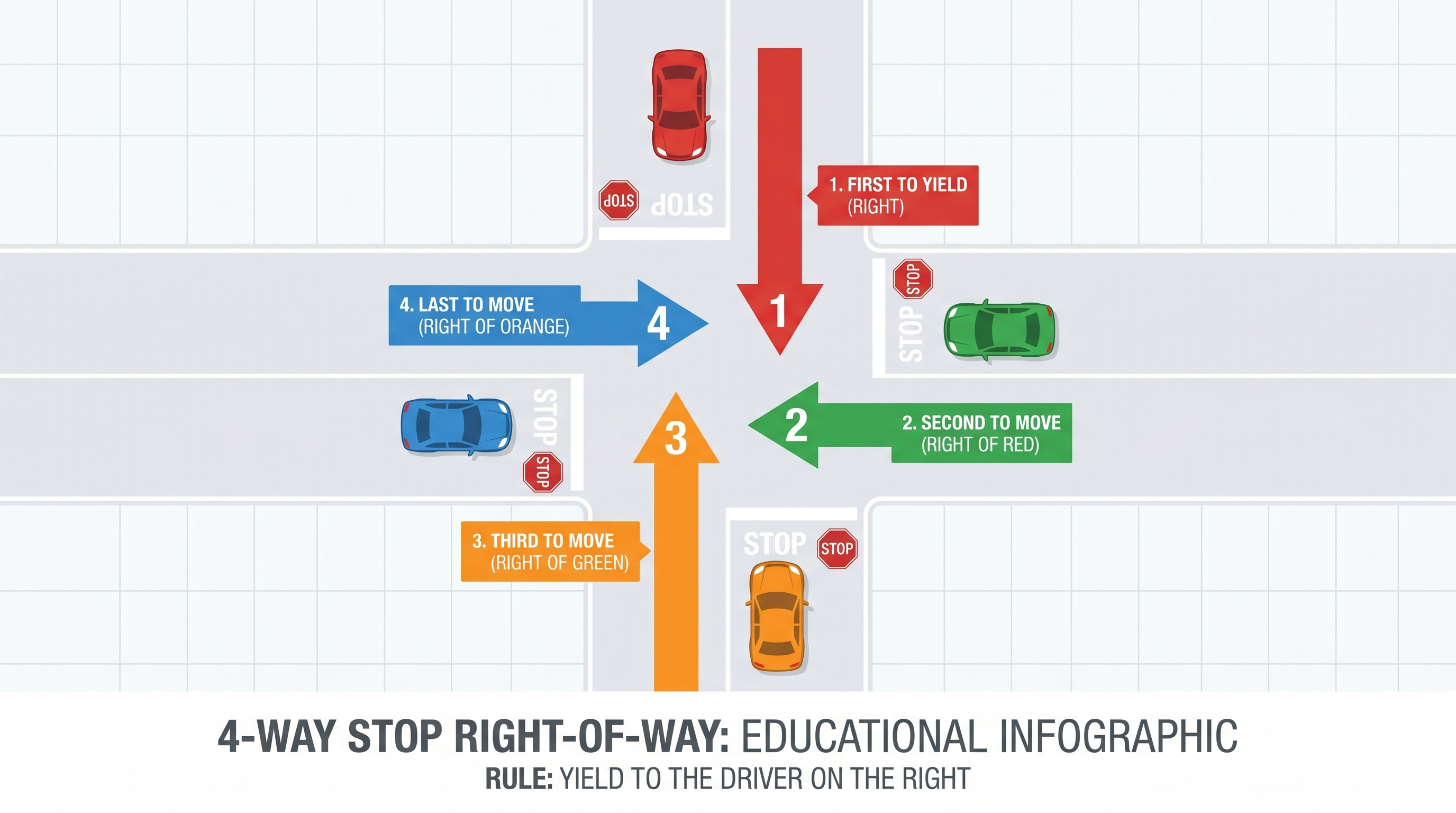 The hierarchy is simple and absolute:
The vehicle that comes to a complete stop first has the right to proceed first.
Example: You arrive at the intersection and stop at your stop sign. A vehicle on the right side of the intersection arrives 2 seconds later and stops. You have the right of way. You may proceed.
This rule eliminates confusion in 80% of real-world four-way stop scenarios.
If two or more vehicles arrive at the intersection at the same time (within 1 second of each other), apply the following tie-breaker rules in order:
If one vehicle is going straight and another is turning left across its path, the straight-going vehicle has priority.
Example: You arrive simultaneously with a vehicle across from you. You're going straight; they're turning left. You proceed; they wait.
Example 2: You and a vehicle to your right arrive simultaneously. You're turning left; they're going straight. They proceed; you wait.
Right-turning vehicles have priority over left-turning vehicles (though both yield to straight traffic).
If both vehicles are going in the same direction (e.g., both turning right), the vehicle on the right has priority.
Example: You and a vehicle on your left both arrive simultaneously and both want to turn right (in different directions). The vehicle on your right yields to you.
The right-hand priority rule: When all other factors are equal, the vehicle on the right has priority.
As you approach a four-way stop:
Stop behind the stop line (if marked) or at the edge of the intersection.
Critical detail: A "complete stop" means zero forward motion. Your vehicle must be fully stopped for at least 1-2 seconds. Rolling stops are illegal and can result in a ticket or test failure.
Look at all directions and apply the hierarchy:
Take 1-2 seconds to assess the situation. It's better to pause and be certain than to guess and collide.
Once you've determined that it's your turn:
Confidence matters: Other drivers are watching you. If you proceed with clear, confident motion, they understand it's your turn and will wait. If you hesitate or wave, they get confused.
At every four-way stop, yield to pedestrians crossing in any direction:
| Mistake | Why It Fails | How to Fix |
|---|---|---|
| Rolling stop (not fully stopping) | Illegal; automatic DMV test failure | Come to a complete stop for 1-2 seconds; zero forward motion |
| Waving someone through | Confuses others; you can't guarantee their path is safe | Just proceed with confidence when it's your turn |
| Hesitating when it's your turn | Confuses other drivers; deadlock at intersection | Assess right-of-way quickly, then proceed with clear motion |
| Turning left without yielding to straight traffic | Collision risk; test failure | Left turns always yield to straight traffic |
| Not scanning all four directions | Miss oncoming traffic; safety risk | Look at all four stop signs; assess all four directions |
| Not stopping fully (stopping past stop line) | Illegal; safety hazard | Stop behind the stop line, not beyond it |
| Not yielding to pedestrians | Safety hazard; automatic test failure | Always yield to pedestrians; they have priority |
| Proceeding without determining right-of-way | Collision risk; test failure | Take 2 seconds to assess; know whose turn it is |
Marcus approached a four-way stop with vehicles arriving from three other directions simultaneously. He froze, unsure whose turn it was. All four vehicles stopped and waited. Finally, someone waved. Marcus got confused and someone almost hit him from the right.
Two weeks later, Marcus understood the rules and practiced them: "Straight beats turning. Right beats left." At the next complex four-way, two vehicles arrived from opposite directions. One was going straight; the other was turning left. Without hesitation, Marcus knew: straight wins. He waited one second for the straight-going vehicle, then proceeded. The interaction took 3 seconds total and was perfectly clear.
Jessica arrived at a four-way stop and determined it was her turn. She proceeded without noticing a pedestrian stepping off the curb to cross her path. She had to brake hard. The examiner marked it down: "You must always check for pedestrians before proceeding."
On her retest, Jessica added a pedestrian-check step: after determining right-of-way, she glanced left and right one more time for crossing pedestrians before releasing the brake. She passed.
Most states score four-way stops on a 0-3 scale:
| Score | Criteria |
|---|---|
| 3 (Excellent) | Complete stop, clear assessment of right-of-way, proper yielding, no hesitation when appropriate, yields to pedestrians |
| 2 (Good) | Complete stop, slight hesitation, correct right-of-way determination, clear pedestrian awareness |
| 1 (Passing) | Complete stop, minor confusion on right-of-way, but resolves safely, pedestrian awareness |
| 0 (Fail) | Rolling stop, failure to yield, collision risk, doesn't yield to pedestrians, or causes traffic deadlock |
Examiners watch for these specific behaviors:
At the stop:
Right-of-way assessment:
Proceeding:
Hit these checkmarks, and you pass four-way stop navigation.
Use this decision tree to determine right-of-way:
| Scenario | Your Action |
|---|---|
| You arrive first (at least 1 second before others) | Proceed after checking for pedestrians |
| Vehicle on right arrived first | Yield |
| Vehicle on left arrived first | Proceed |
| Vehicle across from you arrived first | Yield |
| You and vehicle on right arrived simultaneously; you're both going straight | Yield (right-hand rule) |
| You and vehicle across from you arrived simultaneously; you're both going straight | Proceed (you have right-of-way) |
| You arrive simultaneously; you're turning left, opposite vehicle is going straight | Yield (straight beats left turn) |
| You arrive simultaneously with vehicle on right; you're going straight, they're turning left | Proceed (straight beats left turn) |
| No other vehicles present | Proceed after checking for pedestrians |
| Pedestrian crossing your path | Yield (pedestrians always have priority) |
The fastest way to pass your test is consistent practice with real questions. Try Wheelingo free — state-specific questions, instant explanations, and a readiness score that tells you when you're ready.
Q: Is a rolling stop acceptable at a four-way stop? A: No. A complete stop is required by law. Your vehicle must be fully motionless for at least 1-2 seconds. Rolling stops are illegal and are an automatic failure on the DMV test.
Q: What if I'm not sure who arrived first? A: If you're genuinely unsure, yield. It's safer and more socially correct to wait 2-3 extra seconds than to guess and cause a collision.
Q: Should I wave someone through a four-way stop? A: No. Waving creates confusion and false expectations. Instead, proceed with confident, clear motion. Other drivers will understand it's your turn and will wait.
Q: What if someone waves me through when it's actually their turn? A: Politely wave back and do not proceed. Proceed only when it's genuinely your right-of-way. Waved-through crashes happen frequently; never depend on someone else's wave.
Q: What if two vehicles are turning left across from each other simultaneously? A: Both can proceed at the same time if they're turning left and not blocking each other. You're not in each other's path. However, to be safe, let the first vehicle turn before you, or wait for the next cycle.
Q: How long should I wait at a four-way stop? A: Wait 1-2 seconds after coming to a complete stop, assess right-of-way (1-2 seconds), then proceed. Total time at a four-way stop is typically 3-5 seconds per vehicle. Never rush; it's better to take 5 seconds and be certain than to guess and risk a collision.
Q: What if a vehicle approaches without slowing down? A: Assume they won't stop. Yield and let them pass. Don't assume others follow the rules; drive defensively.
Q: Do I signal at a four-way stop? A: Signal your intended direction before or as you proceed (same as any intersection). Signal right if turning right, signal left if turning left, no signal if going straight.
Week 1: Single Four-Way Mastery
Week 2: Right-of-Way Rules
Week 3: Complex Scenarios
Week 4: Confidence and Consistency
Most drivers are four-way stop–ready after 6-8 hours of deliberate practice on this skill.
Master all intersection types and traffic scenarios:
Four-way stops confuse drivers because they require judgment, not automatic signals. But the judgment is simple: Who stopped first? That's it. In the rare case of simultaneous arrivals, straight traffic beats turning traffic. Right beats left. Everything else yields.
Stop completely. Assess the situation in 2-3 seconds. Proceed with confidence. If you hesitate, others will hesitate, and the intersection becomes a frozen tableau. If you proceed clearly, everyone understands it's your turn.
Practice on real four-way stops for 6-8 hours. Get comfortable with simultaneous arrivals. Build muscle memory around complete stops. Within a few weeks, four-way stops become automatic.
On your DMV test, you'll handle four-way stops with the confidence of someone who's practiced a hundred times. You'll stop completely, assess right-of-way clearly, and proceed without hesitation. The examiner will see safe, controlled, confident driving.
Ready to master every intersection type? Download the Wheelingo app and practice every scenario with video guides and real-time feedback. Track your progress toward test-ready confidence.
External References: