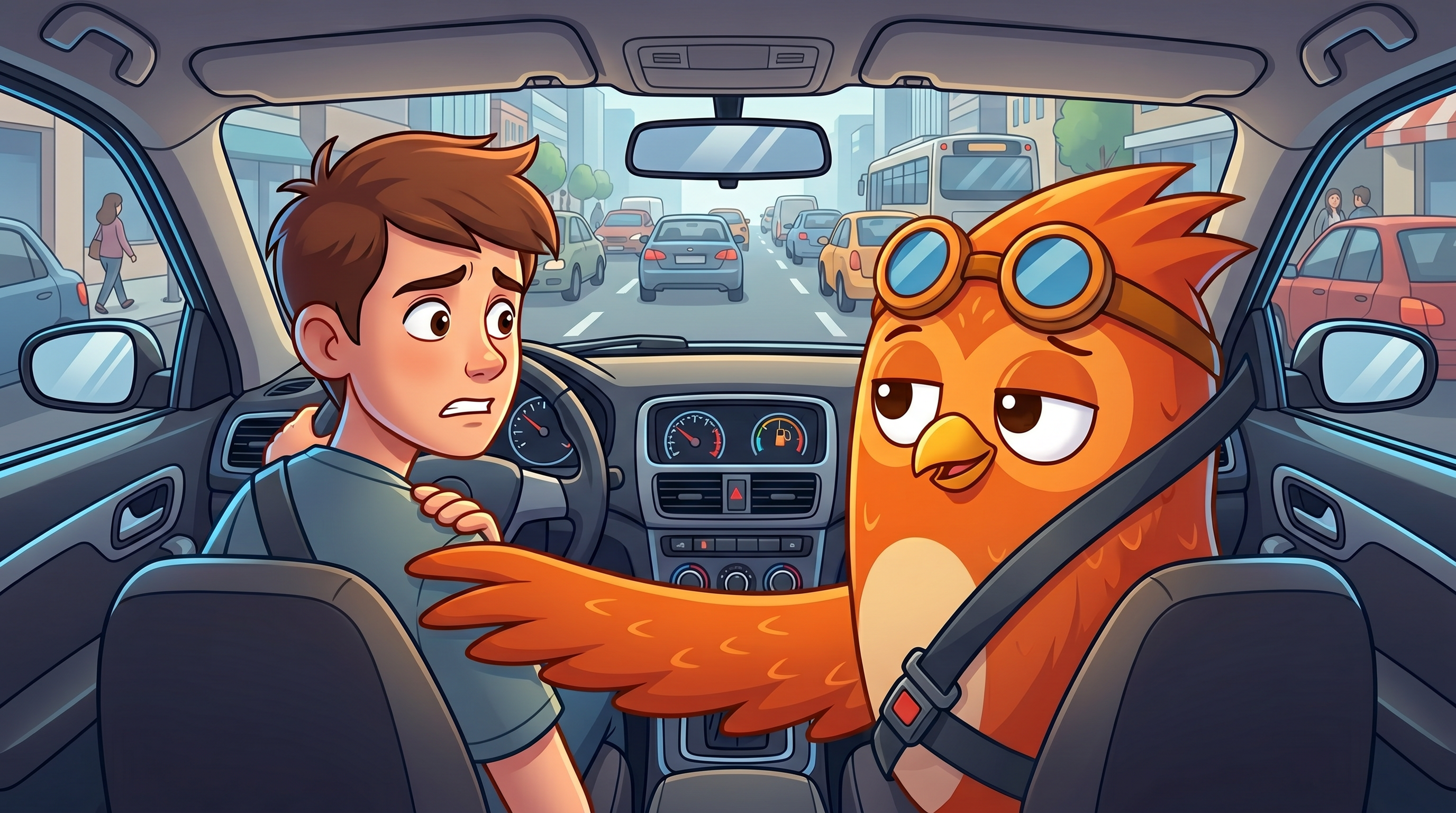
Master the art of being a calm passenger when your teen is learning to drive. Expert tips to manage anxiety, build teen confidence, and improve safety.
Your hands are gripping the door handle. Your foot is pressing into an invisible brake pedal. Your jaw is clenched so tight you might crack a tooth. Your teen is driving 25 miles per hour in a residential area, and you feel like you're in a scene from an action movie.
This is the reality for millions of parents: watching your child learn to drive can trigger anxiety you didn't know you had. And here's the thing—your teen knows. Teenage drivers are acutely attuned to parental fear. When you tense up, flinch at turns, or inhale sharply at intersections, your teen becomes more anxious, more hesitant, less confident. Your anxiety becomes their anxiety.
The good news: you can rewire this. Being a calm passenger is a skill. It's learnable. And it's one of the most important gifts you can give your teen driver.
Your anxiety isn't irrational. Statistically, the deadliest age for driving is 16–19. According to the CDC, motor vehicle crashes are the leading cause of death for U.S. teens. Your nervous system is correctly identifying a real risk. But here's the problem: hypervigilance doesn't reduce that risk. In fact, it increases it.
What happens when you're anxious in the passenger seat:
What happens when you're calm:
The paradox: the calmer you are, the safer the drive becomes.
Your body sends signals long before you speak. If you're visibly tense, white-knuckling the door handle, or bracing for impact, your teen notices. You can't hide it, so don't try. Instead, manage your physical anxiety before you buckle in.
Pre-drive body reset routine (10 minutes before driving):
4-7-8 Breathing (4 minutes): Inhale for 4 counts, hold for 7, exhale for 8. This activates your parasympathetic nervous system and lowers cortisol (stress hormone). Do this five times before getting in the car.
Progressive Muscle Relaxation (3 minutes): Starting at your toes, tense each muscle group for 3 seconds, then release. Work up through calves, thighs, core, shoulders, and jaw. This counteracts the automatic tension response.
Cognitive Reframing (2 minutes): Remind yourself: "My teen has logged X hours of practice. They've been trained on this maneuver. I'm here to support, not control. My anxiety is mine to manage, not theirs to fix."
Hands and Posture Check: Before stepping into the car, shake out your hands. Roll your shoulders. Practice sitting with your hands resting on your lap—not braced on anything. This is the posture you'll maintain while driving.
Pro tip: Do this routine every single time, even if you don't feel particularly anxious. Building the habit makes it automatic. When a surprise hazard appears, your body will already be in a calm baseline, so your reaction is measured, not explosive.
Ambiguity breeds anxiety. If your teen doesn't know what you're going to correct, and you don't know what feedback style they're expecting, every moment feels loaded.
Pre-drive conversation framework:
Start this before getting in the car, not during:
You: "Before we head out, let's set some expectations for today's drive. What would be most helpful feedback from me?"
Listen. Your teen might say: "Just tell me if I'm going to crash," or "Let me figure things out first, then tell me what I could improve," or "Only tell me critical safety stuff."
Then clarify your role:
"Okay, here's what I'm going to do: I'll stay quiet during the drive unless there's an immediate safety issue. I'll let you navigate and make decisions. After we park, I'll ask you what you noticed and felt confident about. Then we'll talk about anything you want feedback on."
This three-step framework—quiet driving, self-reflection, then feedback—gives your teen autonomy while ensuring safety oversight.
Sample pre-drive check-in:
| Topic | What to Say |
|---|---|
| Route | "We're going to the grocery store on Maple Street. Do you feel comfortable with this route, or should we take a different way?" |
| Duration | "This drive is about 12 minutes each way. We'll head out at 3 PM and should be back by 3:45." |
| Your role | "I'll be quiet during the drive. Let me know if you want me to navigate or if you've got it." |
| Feedback style | "After we drive, I'll ask you three things: What felt smooth? What was challenging? What do you want to improve?" |
| Emergencies | "If there's an immediate safety issue, I will speak up. Otherwise, I'm here to support, not direct." |
This is the hardest part for most parents: shutting up. Your instinct is to guide, direct, warn, and teach. But constant commentary does the opposite of what you intend.
Every time you say "Slow down," "Check your mirror," or "Watch that car," you're:
The Silent Passenger Pledge:
During the drive, you speak only if there's an immediate safety threat: an oncoming vehicle, pedestrian in the road, run-away brake failure. Not "you're speeding by 2 mph" or "that was a wide turn." Only life-threatening.
What to do instead of talking:
Jennifer's Story: Jennifer couldn't stop backseat-coaching her 16-year-old son Marcus. "Slow down... check your mirror... watch that intersection." Marcus would tense up, his driving would get jerky, and Jennifer would get more anxious. After reading about the silent passenger approach, Jennifer set a goal: stay silent the entire drive except for emergencies. The first three drives were hard—she had to sit on her hands and bite her tongue. But by drive four, Marcus noticed. His shoulders dropped. His steering was smoother. By drive eight, he was confidently navigating unfamiliar roads. "When I stopped narrating, he started trusting himself," Jennifer said. "And I actually felt safer because I could focus on the road instead of coaching."
Anxious energy needs somewhere to go. Instead of venting it in the passenger seat, channel it into pre-drive preparation. This gives you a sense of control and ensures actual safety logistics are handled.
Pre-Drive Safety Checklist:
This checklist shifts your anxiety from "I'm terrified my teen will crash" to "I'm systematically ensuring this drive is as safe as possible." That's a much healthier mindset.
Post-drive feedback matters. But the way you ask questions shapes how your teen responds and whether they actually retain the lesson.
Instead of corrective feedback, use reflective questions:
❌ Bad: "You were going too fast through that turn."
✓ Good: "How did you feel about your speed through that turn? What would you do differently next time?"
❌ Bad: "You didn't check your mirror."
✓ Good: "What do you think you could have checked before changing lanes?"
❌ Bad: "You almost hit that car!"
✓ Good: "Did you notice that car was turning? What gave you the first clue?"
These questions force your teen to think about their driving, not just accept your judgment. They build self-awareness and confidence.
Post-drive framework (5 minutes, after you're parked):
"What felt confident today?" Listen. Celebrate small wins. Even if the drive was rough, there were moments of good judgment.
"What was challenging?" Your teen's self-awareness is often accurate. They know where they struggled.
"What's one thing you'd do differently next time?" This shifts from blame to growth. Your teen is solution-focused, not defensive.
"How can I help with that?" Maybe they need to practice night driving. Maybe they need a professional instructor for parallel parking. Maybe they just need to know you believe in them.
Here's the reality: some of your anxiety won't go away. Your teen is driving, and there are real risks. But you can manage the intensity of that anxiety so it doesn't overflow into the passenger seat.
Anxiety management techniques for parents:
| Technique | How to Use | When to Use |
|---|---|---|
| 4-7-8 Breathing | Inhale 4, hold 7, exhale 8. Repeat 5 times. | Before each drive, or when anxiety spikes. |
| Grounding (5-4-3-2-1) | Name 5 things you see, 4 you can touch, 3 you hear, 2 you smell, 1 you taste. | When anxiety feels overwhelming. Brings you into present moment. |
| Cognitive Reframing | Replace "They're going to crash" with "My teen is learning a skill under safe conditions." | When catastrophic thinking kicks in. |
| Physical exercise | 20 minutes of walking, running, or yoga before driving sessions. | A few hours before each drive to burn off anxious energy. |
| Journaling | Write down your fears. Then write evidence that contradicts each fear. | Once a week to identify anxious patterns. |
| Talking it out | Call your co-parent or a friend. Name the specific fear. Get perspective. | When you need to vent (not to your teen). |
The fastest way to pass your test is consistent practice with real questions. Try Wheelingo free — state-specific questions, instant explanations, and a readiness score that tells you when you're ready.
Q: Is it ever okay to grab the dashboard or the armrest when my teen is driving?
A: Try not to. Your teen will see it and feel your fear. If your anxiety is so intense you can't keep your hands calm, take a break from driving for a few days. Practice the breathing techniques separately. The goal is genuine calm, not white-knuckle control.
Q: What if my teen is actually making dangerous mistakes? Shouldn't I correct them?
A: If there's an immediate safety threat (oncoming vehicle, pedestrian in the road, mechanical failure), yes—speak up clearly. For non-emergencies (slightly wide turns, minor speeding), wait until after the drive to discuss. Your teen's brain is already processing the road; interrupting them makes things worse, not better.
Q: My teen gets defensive when I give feedback. How do I handle that?
A: Use the reflective question approach instead of corrective feedback. Let them self-identify mistakes. If they're genuinely defensive, that's a sign you might be criticizing too much or too harshly. Back off for a few drives. Let them rebuild confidence.
Q: Is it okay to be more anxious with certain drivers (sons vs. daughters, cautious vs. aggressive)?
A: Check your assumptions. Research shows that parental anxiety is often influenced by gender stereotypes, not actual driving skill. If you notice you're calmer with one teen and panicked with another, examine why. Are there real safety differences, or are you projecting expectations?
Q: What if I'm still super anxious after weeks of practice?
A: Consider talking to a therapist. Some parental anxiety runs deep—maybe you have your own trauma around driving, or general anxiety disorder. A professional can help you develop coping strategies so your anxiety doesn't limit your teen's development.
Q: Should I let my teen drive in bad weather, at night, or in heavy traffic?
A: Yes, but gradually. Your teen needs exposure to these conditions to build competence. Start with light rain, then harder rain. Start with dusk driving, then true night. Build incrementally. These experiences are non-negotiable—they directly impact safety.
Here's what you need to know: the way you show up in the passenger seat today shapes your teen's driving habits for years.
Teens who have a calm, supportive coach in the passenger seat:
Teens who have an anxious, controlling coach in the passenger seat:
The choice is yours. And the good news: it's never too late to shift from anxious coach to calm supporter.
If you've been an anxious passenger and want to change, try this:
Drive 1: Do your pre-drive breathing and muscle relaxation. Stay completely silent. After the drive, ask the three reflective questions. Don't offer feedback even if you're dying to.
Drive 2: Same silent approach. After, ask your teen what they felt confident about. Celebrate one thing specifically.
Drive 3: Silent drive. Afterward, ask what was challenging and let them problem-solve first before offering suggestions.
Drive 4: Silent drive. After, ask what they'd do differently.
Drive 5: By now, you should both feel more comfortable. Introduce the pre-drive conversation to set expectations explicitly.
By drive 5, you'll have built new neural pathways. Anxiety will still pop up, but you'll have tools to manage it. Your teen will feel the difference.
Being a calm passenger when your teen is learning to drive is one of the most underrated parenting skills. It's not about pretending you're not nervous. It's about managing your nervous system so your teen can develop theirs.
Your teen is learning to drive—a complex, high-stakes skill that requires focus, judgment, and confidence. The single best gift you can give them is a parent who believes in their ability to learn, who trusts their judgment, and who stays calm enough to let them practice.
That's the parent who produces safe, confident drivers.