Master snow and ice driving with expert tips on tire safety, braking, and vehicle preparation. Essential winter driving guide for new drivers.
Winter transforms roadways into unpredictable hazards. Snow accumulation, ice patches, and reduced visibility create conditions that demand deliberate technique and heightened awareness. Whether you're navigating your first winter behind the wheel or refining your skills, understanding how to drive in snow and ice is fundamental to safe, confident driving.
This guide covers practical winter driving strategies, vehicle preparation, and emergency recovery techniques that reduce accidents and keep you in control when roads are compromised.
 Winter driving hazards fall into three categories: reduced traction, reduced visibility, and vehicle vulnerability.
Traction loss occurs because snow and ice reduce friction between tire and pavement. A tire's grip depends on rubber compound, tread depth, and road surface. Below 45°F, all-season tire rubber hardens, losing flexibility and grip. Ice presents the worst conditions—only a thin film of water exists between tire and pavement, meaning virtually no mechanical grip.
Visibility reduction happens through snow fall, accumulated snow on pavement, fog, and glare off white surfaces. Reduced visibility delays hazard recognition and response time, the cornerstone of accident prevention.
Vehicle vulnerability includes battery performance (reduced in cold), engine oil thickness (sluggish cold starts), and decreased brake fluid responsiveness.
| Condition | Percent of Winter Crashes | Average Fatality Rate |
|---|---|---|
| Snow/Sleet | 24% | 1.3 per 100M miles |
| Ice | 15% | 1.8 per 100M miles |
| Cold (no precipitation) | 34% | 0.9 per 100M miles |
| Wet pavement | 22% | 0.7 per 100M miles |
Source: NHTSA Winter Driving Analysis
These numbers underscore that winter driving is objectively more dangerous. The solution isn't avoidance—it's preparation and technique.
 Vehicle preparation determines whether you maintain control during crisis moments.
Tire selection is non-negotiable. Winter tires (marked with the three-peak mountain and snowflake symbol) are engineered with softer rubber compounds and aggressive tread patterns. Testing shows winter tires stop 25-40% shorter on ice compared to all-season tires. If budget allows, dedicated winter tires on their own wheels eliminate seasonal swaps and reduce wear.
For those using all-season tires, ensure tread depth is at least 6/32 inch (use the penny test: insert Lincoln's head upside-down into tread; if you see the top of his head, tread is insufficient).
Battery performance drops 30-50% in cold. Have your battery tested before winter; a weak battery may fail to turn over the engine on the coldest mornings.
Engine oil thickens in cold. Use the manufacturer's recommended winter viscosity (often 0W-20 instead of 5W-30 for extreme climates). Thick oil restricts flow, slowing engine start and reducing lubrication initially.
Fluid check-up includes verifying windshield washer fluid contains freeze-preventative (not summer formulation) and that coolant concentration is correct for your region.
Braking system inspection ensures pads have adequate thickness and brake fluid is clean and properly filled.
Spend 30 minutes in autumn preparing; this investment reduces winter mechanical failures significantly.
The single most important principle for winter driving: abrupt inputs cause skids; smooth inputs maintain control.
Your tires have a finite grip budget. Every steering input, acceleration, and braking demand draws from that budget. When demands exceed available grip, the tire loses contact with the pavement—a skid.
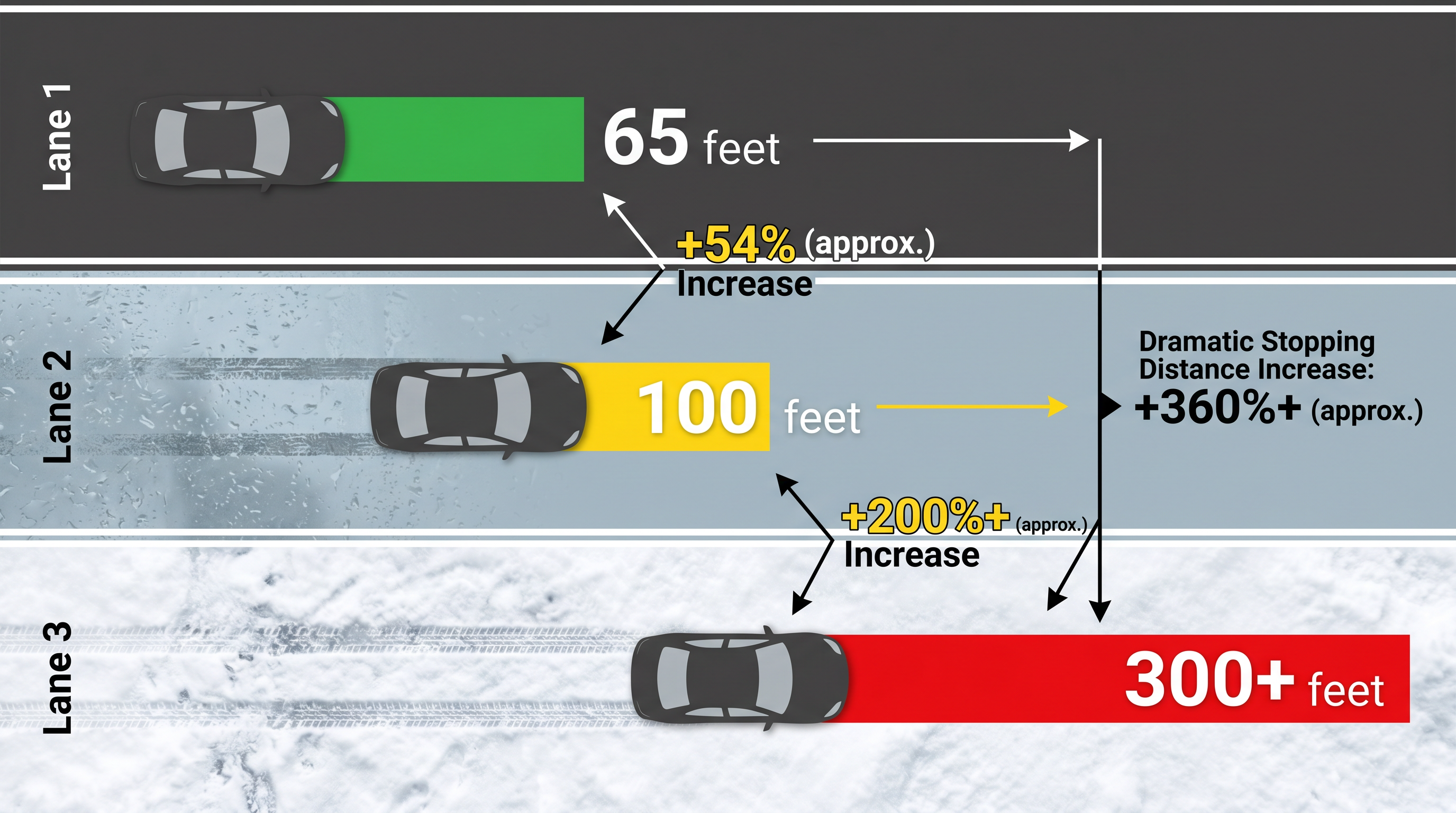
Reduce speed by 50% below posted limits on snow; on ice, reduce by 75%. Speed multiplies stopping distance exponentially.
| Surface | Speed | Stopping Distance |
|---|---|---|
| Dry pavement | 30 mph | 65 feet |
| Wet pavement | 30 mph | 100 feet |
| Snow | 30 mph | 150-200 feet |
| Ice | 30 mph | 300-400 feet |
Source: FHWA Braking Study
Increase following distance to 8-10 seconds behind other vehicles. Count the seconds between when the car ahead passes a fixed point and when your car reaches it. On ice, 10 seconds translates to roughly 200+ feet at 15 mph.
Accelerate smoothly and gradually, even on straightaways. Wheel spin wastes grip and may trigger traction control to disengage, removing your margin.
Avoid jackrabbit starts. Smooth pressure on the throttle allows tires to grip and accelerate the vehicle, not spin against the pavement.
Turn the steering wheel slowly and deliberately. Abrupt steering inputs exceed the tire's grip budget, causing the rear or front to break traction.
Anticipate turns far in advance. Brake before the turn, not during it. Braking and turning simultaneously demand more grip than available. Complete braking while the wheels are straight; then apply steering input as you gently accelerate through the turn.
Avoid sudden direction changes. If you need to swerve, make one decisive movement—do not hunt for the right position. Hunting (oscillating the wheel back and forth) destabilizes the vehicle.
Never brake hard on snow or ice. Hard braking locks the wheels, which actually increases stopping distance because a locked, skidding tire generates less friction than a rolling tire.
ABS (Anti-lock Braking System) prevents wheel lockup by pulsing the brakes automatically. If your vehicle has ABS:
Without ABS, use threshold braking: apply maximum brake pressure without locking the wheels. This requires practice. Find an empty, safe lot and test your vehicle's braking threshold to develop feel.
Sarah, a new driver, encountered unexpected ice on a mountain descent. Her instinct was to brake hard and grip the wheel tightly. Instead, she remembered the principle: smooth inputs. She eased off the throttle (no acceleration), maintained gentle steering pressure, and applied gradual brake pressure. Her vehicle remained stable and she descended safely. A driver who braked hard would have locked wheels and potentially skidded off the road.
Modern vehicles include Electronic Stability Control (ESC) or traction control, which detects wheel slip and applies individual brakes or reduces engine power to restore grip.
Traction control is your ally in most winter conditions. Leave it on. It reacts faster than any human and can prevent skids before they develop.
However, understand its limits: traction control cannot overcome physics. It cannot make a tire grip pavement it physically cannot grip. In rare situations (deep snow, stuck on an incline), traction control's interventions may prevent you from rocking free. Most vehicles have a traction control button to disable it temporarily.
Test your traction control in an empty parking lot before winter arrives. Accelerate gently and note the feel when it engages (a pulsing sensation). This familiarity removes surprise if it activates during driving.
Four-wheel drive (4WD) and all-wheel drive (AWD) improve traction during acceleration. With power sent to all four wheels, you're less likely to spin wheels on snow during takeoff.
However, 4WD/AWD do not improve braking or steering. Once wheels are locked (braking) or sliding (oversteer), all-wheel drive provides no advantage. Drivers in 4WD vehicles often become overconfident and drive faster in winter, actually increasing accident risk.
This is critical: A front-wheel drive vehicle with winter tires will outperform a 4WD vehicle with all-season tires in winter conditions.
If your vehicle begins to skid, remain calm:
Front-wheel skid (understeer): The front tires lose grip and the nose pushes straight despite steering.
Rear-wheel skid (oversteer): The rear slides outward and the vehicle rotates.
Practice emergency maneuvers (safely, in a controlled environment) to build muscle memory. Reaction time in actual emergencies is fractions of a second—training removes hesitation.
Learning winter safety is foundational. Build broader driving skills with our guides on defensive driving techniques, first-time solo driving preparation, and rainy-weather driving. Practice these scenarios through Wheelingo's interactive practice modules and track your progress and improvements as you master hazard recognition.
The fastest way to pass your test is consistent practice with real questions. Try Wheelingo free — state-specific questions, instant explanations, and a readiness score that tells you when you're ready.
Q: Is 4WD essential for winter driving? A: No. A front-wheel drive with winter tires outperforms 4WD with all-season tires. 4WD helps with acceleration on snow but doesn't improve braking or steering. Winter tires matter far more than drivetrain.
Q: Should I use snow chains in winter? A: Chains provide additional traction in deep snow but require installation skill and slow driving. Winter tires handle most conditions; use chains only in extreme mountain snow or ice where tires alone are inadequate. Check local regulations; some regions require chains at certain elevations during winter.
Q: Can I use cruise control on snowy roads? A: No. Cruise control maintains speed and may accelerate if wheels slip, destabilizing the vehicle. Manual speed control gives you immediate authority to ease off throttle if traction changes.
Q: How do I know if I'm driving too fast for conditions? A: If you cannot stop within the distance you can see ahead, you're too fast. On snowy or foggy roads, visibility may be 200 feet. At 30 mph, stopping distance is 150-200 feet on snow—meaning you must drive 20 mph to stop within visible range. Adjust speed accordingly.
Q: What if my vehicle is stuck in snow? A: Rock the vehicle gently: accelerate slightly to build momentum forward, then reverse. Repeat, inching forward and backward. Avoid spinning wheels; this compacts snow and reduces traction. If stuck, call roadside assistance rather than risk overheating the engine or stranding yourself further.
Q: Do I need winter windshield wipers? A: Winter wipers have thicker frames and heated blades to prevent ice accumulation. They perform better in freezing rain but aren't mandatory. Ensure your windshield washer fluid contains freeze-preventative and works reliably.
Winter driving demands respect. Snow and ice are objective hazards; you cannot wish away physics through confidence or experience. Instead, you can master technique: smooth inputs, proper vehicle preparation, and anticipatory planning transform winter from daunting to manageable.
The drivers who stay safe in winter are those who slow down, increase following distance, and practice deliberate control before conditions demand it. Start with autumn vehicle preparation, spend an hour in an empty parking lot practicing emergency maneuvers, and commit to the principle that smooth, gradual inputs are always correct.
Download Wheelingo's winter driving checklist and practice winter scenarios through our interactive modules. Master these techniques before your test, and winter roads will never intimidate you again.
External References: