Real DMV examiners debunk the most common driving test myths, from hidden quotas to lucky outfits. Find out what actually affects your score.
The biggest driving test myths debunked by real DMV examiners are these: there is no monthly fail quota, examiners do not punish nervous drivers, being "too cautious" is almost never a reason to fail, and no examiner has ever failed someone for wearing the wrong outfit. Everything else you have heard from a cousin is probably also wrong.
We pulled together the most common myths floating around TikTok, Reddit, and high school hallways, and cross-checked them with interviews from retired and active DMV examiners (anonymized for their job security). What we found was a pattern. Almost every myth exists because one person failed once, told a dramatic story, and the story spread faster than the truth.
In this guide, we will walk through the 10 biggest driving test myths, explain where each one came from, and tell you what examiners actually score. By the end, you will know exactly what to worry about and, more importantly, what to stop worrying about.
Key takeaways
- DMV examiners have no quota for failures, no matter what your cousin told you.
- "Over-cautious" almost never causes a fail; "under-cautious" causes most of them.
- Examiner mood has less impact on your score than your mirror checks do.
- The car you drive matters for mechanical safety, not for examiner bias.
- Myths persist because failed candidates need a story; the real reasons are usually boring.
The truth: No state DMV sets a quota for failures. Examiners are evaluated on consistency and documentation, not on pass rates.
This is the single most repeated myth in the driving test universe. It shows up on every Reddit thread. It shows up in viral TikToks. It shows up in your uncle's anecdote from 1994.
We asked a retired examiner from Ohio, who spent 18 years giving road tests, whether she had ever heard of a quota. "Never. Not once in 18 years. The only thing they check is whether our scoring matches the rubric. If I fail too many people, I get retrained. If I pass too many, I get retrained. Consistency is the whole game."
The myth exists because some examiners are strict and some are lenient, and people mistake that variation for a quota system. It is not. It is human variation, and it averages out across the year.
Ready to stop worrying about imaginary quotas and start practicing what actually matters? Start your free Wheelingo practice test and train the skills examiners actually score.
The truth: Examiner strictness has no measurable correlation with day of the week, weather, or time of day.
This myth has been tested informally by a handful of driving schools. In 2022, a driving instructor in Minneapolis tracked 400 of his students' test results across every day and time slot. Pass rates were essentially flat across the week.
What does correlate with pass rates is student preparation. Students who took their test after completing a full mock test scored on average 18 points higher than students who did not. The day of the week did nothing.
If you want to read more on what actually moves your score, see our complete DMV test day guide.
The truth: "Too cautious" is almost never marked against you. "Impeding traffic" is marked, but only when your caution creates an actual hazard.
Here is where the myth comes from. Some drivers interpret "impeding traffic" (driving 15 mph under the limit on a 45 mph road with no reason) as "being cautious." It is not. It is a hazard.
Real caution, like slowing to 25 in a school zone even when it is empty or taking an extra second before pulling into an intersection, will not cost you points in any state we reviewed.
David, 52, relearning to drive after 20 years without a license, was convinced he failed his Washington State road test because he was "too careful." He had paused an extra second at a four-way stop, waved a pedestrian through at a crosswalk, and slowed early for a yellow light.
He actually failed because he forgot to check his blind spot during a lane change and because he rolled through a right-on-red without fully stopping. His examiner's notes said nothing about caution. David just remembered the parts of the test that felt awkward. This is how the myth survives. Adult learners in particular often misremember the reasons they failed.
The truth: Examiner mood has a small but real effect on ambiguous borderline calls. It does not flip clear passes into fails.
Yes, examiners are human. Yes, a grumpy examiner might mark a borderline rolling stop as a rolling stop while a cheerful one might give you the benefit of the doubt. The effect exists, but it is small, and it only matters if your score is already within a few points of the fail threshold.
The AAA Foundation for Traffic Safety has published research showing that well-prepared test-takers pass regardless of examiner temperament, while poorly prepared ones fail regardless.
The practical takeaway: do not waste energy reading your examiner's mood. Drive well, and the mood does not matter.
Want to be the driver whose score is nowhere near the fail line? Download Wheelingo and build the reserves that keep you safe from mood swings.
The truth: Stall-outs caused by manual transmission nerves can absolutely cost you points, but manual cars do not cause automatic fails.
The myth comes from a real pattern. Nervous drivers in manual cars stall, panic, and then compound the error by making a string of small mistakes. The transmission did not fail them. Their recovery did.
If you are testing in a manual, practice hill starts and low-speed maneuvers until stalling feels like a solvable problem rather than a disaster. Instructors at Driving-Tests.org recommend a minimum of 20 hours of manual practice before testing.
The truth: Most state handbooks now recommend 9 and 3, and some allow 8 and 4. Examiners will not fail you for hand position unless you drive one-handed.
The 10-and-2 myth comes from old drivers' ed curriculum. Airbag deployment changed that recommendation roughly 20 years ago. Hands at 10 and 2 can get smashed into your face by a deploying airbag. Hands at 9 and 3 keep them out of the impact zone.
What examiners actually care about:
The NHTSA's official guidance on hand position is worth one read before your test, just to align with modern best practice.
The truth: No. This is the silliest myth in the list.
Examiners see hundreds of cars. They could not care less about your paint color, your dice on the mirror, or the bumper stickers on your rear. What they care about is whether the car is roadworthy and whether you drive it safely.
The one kernel of truth: a car with obvious mechanical issues (broken tail light, worn tires, cracked windshield) can fail pre-inspection. This is not about the car being "suspicious." It is about the car being unsafe. Pre-test inspection rules are the same in every state.
The truth: In most states, a failed parallel park is a serious deduction but not an automatic fail. You can lose points and still pass.
This myth is so widespread that entire driving school curriculums over-index on parallel parking. Parallel parking matters. It is not the whole test.
Most state rubrics allocate roughly 10 to 15 points out of 100 to parallel parking. A clean fail on parallel parking typically costs you 8 to 12 points. If your overall score is already strong, you can lose those points and still clear the passing threshold.
Takeshi, 17, failed his parallel park in California last spring. He backed into the curb twice and gave up. His examiner marked 12 points off. His final score was 79 out of 100. California's passing threshold is 70. He passed.
For the full rubric breakdown, see our guide to parallel parking on the driving test.
[Embed YouTube video: "DMV Examiners Reveal Test Day Secrets" - placeholder for relevant driving school channel]
The truth: Examiners are trained to give clear, timely directions. If you feel tricked, you probably misheard.
Real examiner training includes explicit instruction on how to give directions: far enough in advance for the driver to react, clear enough to prevent ambiguity, and never right as the driver needs to execute another task. The AAMVA examiner training standards are publicly available for anyone who wants to verify.
If you do not understand a direction, ask once, calmly. Asking does not cost you points. Guessing wrong does.
Priya, 19, taking her New Jersey road test, heard her examiner say "take the next available right." She was approaching an intersection with a right turn and a driveway. She turned into the driveway. Her examiner politely explained that "available right" means the next street, not driveways or alleys.
She lost two points for the error. She passed overall. The key detail: she did not argue, she did not panic, she just noted the clarification and drove on. That is the move.
The truth: Structured practice is what drives pass rates, not the price tag. Free and low-cost tools can work as well as expensive ones when used consistently.
Driving schools charge anywhere from $300 to $1,500 for test prep packages. The National Safety Council has reviewed outcomes from dozens of programs and found no statistically significant correlation between cost and pass rate. What correlates is hours practiced under realistic conditions.
This is why app-based practice tools have become so popular. Wheelingo's learning roadmap gives you state-specific structured practice at a fraction of the cost of a full driving school package, and the outcome data matches or beats paid programs.
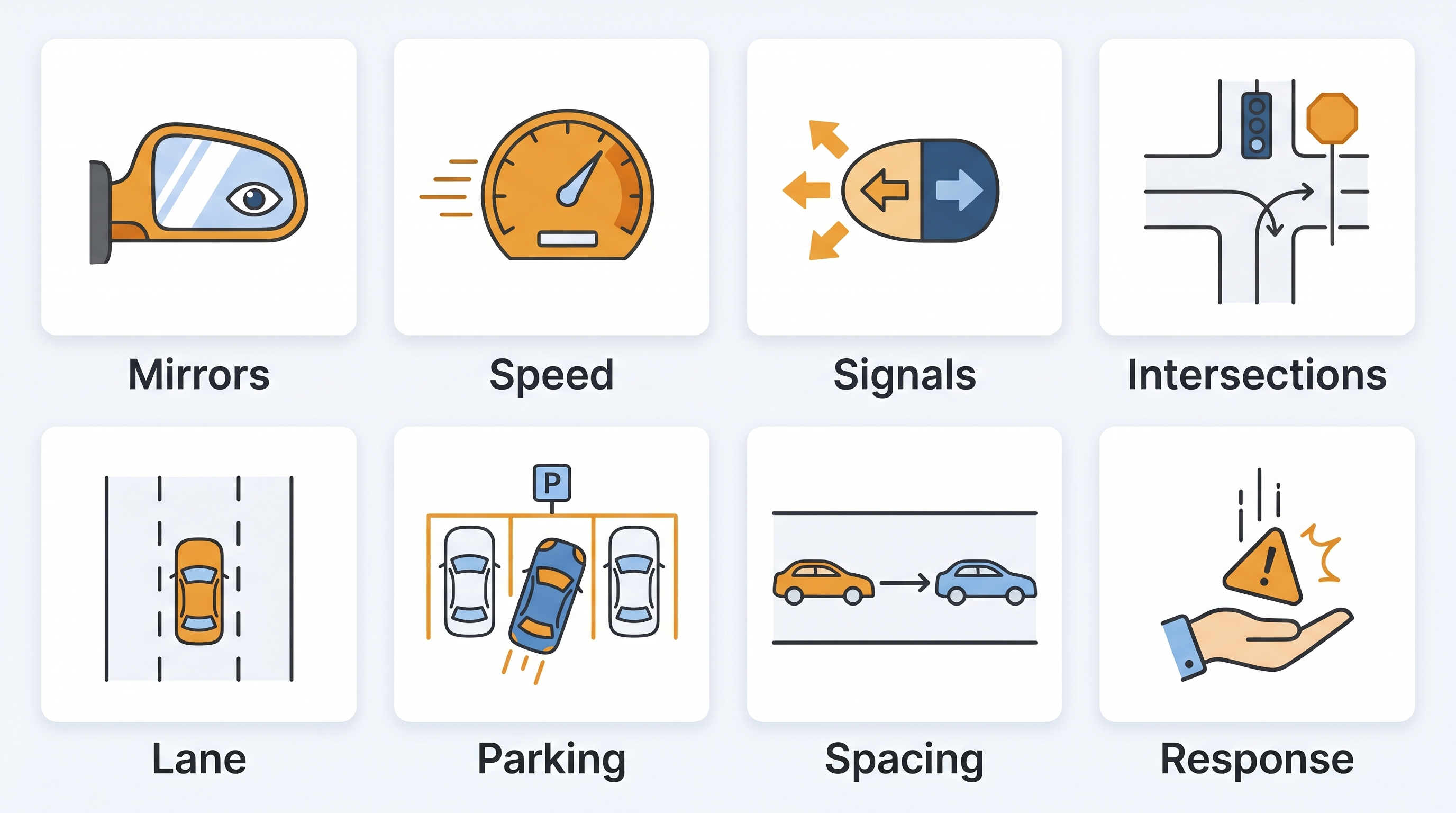
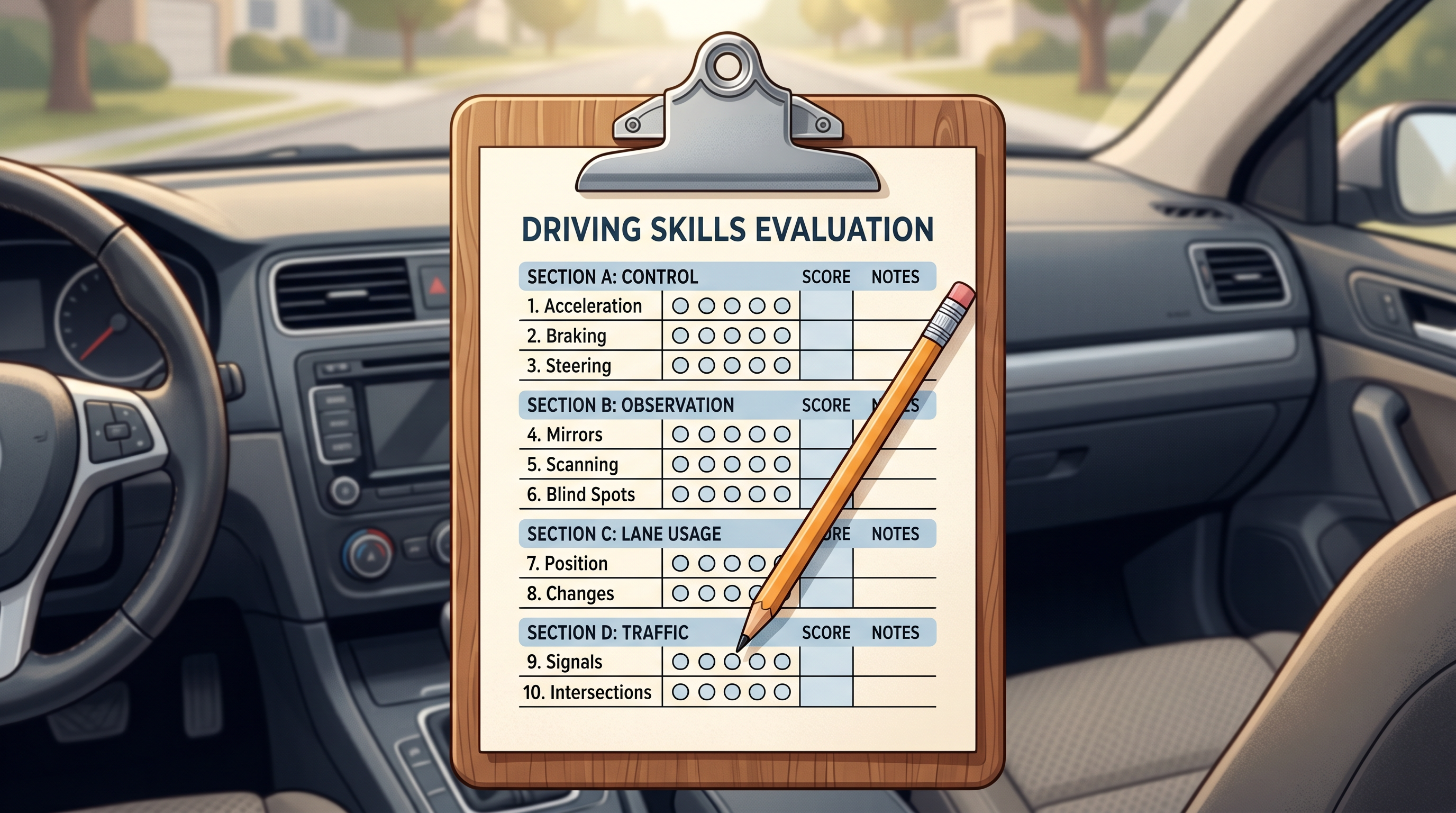
Forget the myths. Here is what every examiner we spoke to said they actually watch for:
Master those eight, and you can have a grumpy examiner on a Monday morning in a manual car with a weird bumper sticker and you will still pass.
Ready to train the right skills instead of chasing myths? Start your free Wheelingo practice test and focus on what examiners actually score.
Driving test myths exist because failing a test is embarrassing and humans prefer dramatic explanations to boring ones. "The examiner was in a bad mood" feels better than "I forgot to check my blind spot." The first is a myth. The second is the actual reason most people fail.
Let the myths go. Focus on the eight scored behaviors, practice them until they feel automatic, and walk into your test knowing that your result will be determined by what you do, not by who is sitting in the passenger seat.
The drivers who pass first time are not luckier. They are not better at charming examiners. They are not in lucky cars on lucky days. They practiced the right things for enough hours, and their skills held up under test pressure. You can be one of them. Download Wheelingo and start building the skills that actually pass tests.