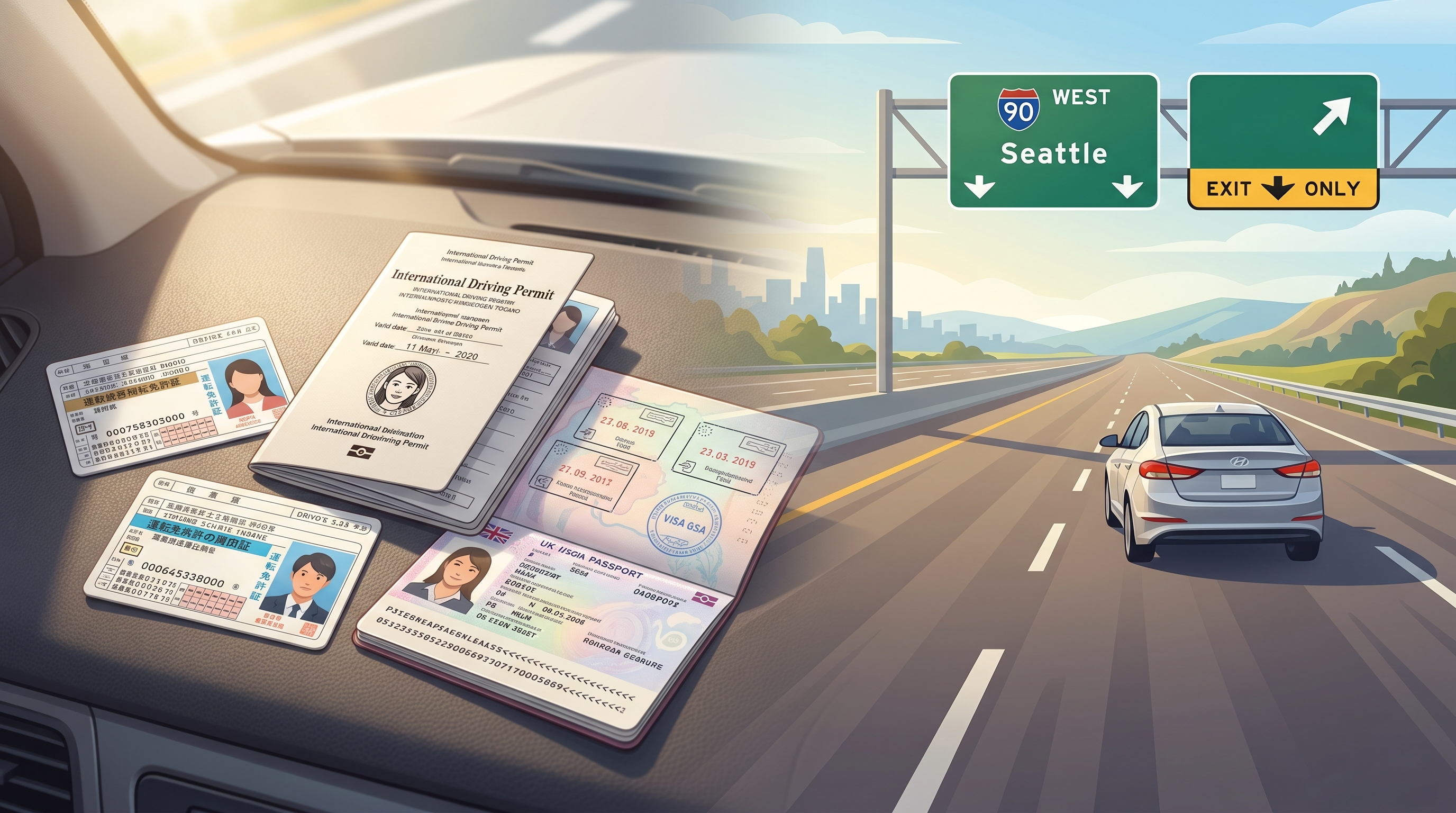
Complete checklist of required documents and items to bring to your DMV driving test appointment. Don't forget these essentials.
You've studied hard, practiced your three-point turns, and know the road signs cold. But test day can derail quickly if you show up unprepared—not for the exam itself, but for the bureaucracy that precedes it. One missing document can mean a rescheduled appointment and weeks of waiting to try again.
This guide walks you through every item the DMV expects on test day, organized by category so nothing slips through the cracks. We've included a state-by-state breakdown because—frustratingly—different states have different requirements. The good news: you can prepare now and walk in confident.
No matter which state you're testing in, the DMV will ask for these five items. Bring originals, not photocopies (with one exception: certified copies of documents like birth certificates are acceptable).
This is the foundation of your DMV appointment. Acceptable IDs include:
What if you don't have a photo ID yet? This is surprisingly common—especially for first-time drivers under 21. The DMV allows you to bring a combination of non-photo IDs instead (school ID + birth certificate, for example), but call your local DMV first to confirm they accept this substitution.
Real experience: Marcus, 19, showed up with an expired passport and his high school ID. The examiner initially flagged it, but the supervisor confirmed that one expired photo ID plus a valid non-photo ID fulfilled the requirement. He tested that day. Had he not brought the second ID, his appointment would've been cancelled.
You must prove your Social Security number—this is non-negotiable in all 50 states. The DMV uses it to verify you're not already licensed in another state and to prevent fraud.
Acceptable documents:
Pro tip: If your Social Security card is damaged or lost, request a replacement from the Social Security Administration before your DMV appointment. They mail replacements in 1–2 weeks. Alternatively, bring a W-2 or recent pay stub instead—it's faster.
The DMV verifies you actually live where you claim to live. This prevents people from testing in multiple states simultaneously. Acceptable documents (must be dated within the last 60 days):
Common mistake: Bringing an old utility bill dated 6 months ago. The DMV will reject it. Get a current one—most utilities let you download a recent statement online in minutes.
Real experience: Jennifer brought her electric bill, but it was dated 90 days prior; she'd been traveling. The DMV rejected it. She didn't have a secondary proof of residency with her. Her appointment was cancelled. She had to reschedule two months later and bring both a utility bill and a bank statement to be safe.
This confirms you're who you say you are and that you meet the age requirement (typically 16–17 for learner's permit, 18+ for full license).
Acceptable documents:
Note: If your birth certificate is from a U.S. territory (Puerto Rico, U.S. Virgin Islands, Guam), bring the certified copy. The DMV will accept it.
Every state has a written application form—usually the DL-44 (California), MV-44 (New York), or a state equivalent. Some DMVs require you to fill it out beforehand; others hand it to you when you arrive.
Check your state's website to see if you should:
Filling it out in advance saves 10–15 minutes at the counter.
The five essentials above are universal. But some states add extra layers. Here's what differs:
| State | Additional Requirement | Notes |
|---|---|---|
| California | Proof of California residency (60 days) + Social Security verification | No out-of-state licenses accepted as photo ID |
| Texas | Two forms of ID required | One must be a government-issued photo ID |
| Florida | Proof of lawful presence (passport, state ID, visa) | Applies to all drivers, not just immigrants |
| New York | Proof of Social Security number + two proofs of residency | Stricter than most states |
| Arizona | Proof of legal presence in U.S. | Birth certificate + passport accepted |
| Illinois | State ID Application (DL-1a form) must be completed onsite | Some sections cannot be pre-filled |
| Pennsylvania | Vision certificate (if required by your county) | Some counties require recent eye exam proof |
| Georgia | Proof of current residency (under 60 days) | Leases and utility bills only; no bank statements |
Your move: Go to your state DMV website and search for "road test requirements" or "documents needed." Print the checklist and cross items off 72 hours before your appointment.
Print this and check off each item before you leave home:
| Category | Item | Required? | Notes |
|---|---|---|---|
| ID & Verification | Government-issued photo ID | Yes | Original only |
| Second form of ID (if your state requires) | Conditional | Check your state | |
| Social Security card or W-2/pay stub | Yes | Proof of SSN mandatory | |
| Birth certificate (certified) | Yes | Required for proof of name/age | |
| Residency | Utility bill or lease (within 60 days) | Yes | Current or recent only |
| Secondary proof of residency | Conditional | Some states require two | |
| Application | Completed DL form (or blank) | Yes | Check if pre-filled or blank |
| Test-Day Items | Appointment confirmation (printed or phone screenshot) | Yes | Proves your slot |
| Glasses or contacts (if applicable) | Yes | Required if you tested with them | |
| Medical certificate (if required) | Conditional | Hear/vision restrictions only | |
| Vision test waiver (if eligible) | Conditional | Some states allow this | |
| Proof of insurance (sometimes asked) | Conditional | Rarely required; call ahead |
The DMV does not require:
You've got your documents. Now—set a phone alarm for 20 minutes before your appointment. Here's your final walkthrough:
If you arrive and realize you're missing one required document, do not panic. Here's what happens:
This is why the 72-hour check matters. If you discover a missing document three days out, you can often get it in time. If you discover it at the counter, you're stuck.
Real experience: David realized 48 hours before his appointment that his proof of residency was undated. He called his utility company, downloaded a current bill in 10 minutes, and printed it. He brought both the old and new copy just to be safe. He tested on schedule.
The fastest way to pass your test is consistent practice with real questions. Try Wheelingo free — state-specific questions, instant explanations, and a readiness score that tells you when you're ready.
Q: Can I use a foreign passport as my photo ID? A: Yes, as long as it's valid or expired within the last 6 months. A U.S. passport is preferred, but not required. Some states (like Texas) accept foreign passports if you have a visa or I-94 card as secondary ID.
Q: What if I lost my Social Security card and can't get a replacement in time? A: Bring a W-2, tax return, or recent pay stub instead. The DMV accepts any document with your SSN printed on it. A letter from your employer stating your SSN works too.
Q: Can I bring a phone screenshot of my residency proof instead of the original document? A: No. The DMV requires original documents or certified copies. Screenshots are not accepted. If you have a digital-only bill, download it and print it, or call your provider and ask them to mail a copy.
Q: What if my name on my birth certificate doesn't match my ID? A: Bring both documents plus a marriage certificate, divorce decree, or court order showing the name change. The DMV will make a note and verify the legal change before you test.
Q: Is there anything I should NOT bring to the DMV? A: Leave at home: weapons, large bags, pets (except service animals), children (if you're testing alone—some states require a minor to have a guardian present during the written test), and any documents with sensitive information you don't want photocopied.
Test day anxiety doesn't need to include document panic. Gather your checklist, cross-reference your state DMV website, and organize everything in a single folder 72 hours before your appointment. Arrive 20 minutes early. Hand your folder to the counter staff, and let them verify everything while you catch your breath.
You've earned this moment through practice and study. Master the written test first with Wheelingo's practice exams—and then walk into the DMV with confidence, documents in hand, ready to drive.