What to expect on the DMV written test: question types, time limits, passing scores, and study strategies by state.
The DMV written test often feels like a mystery. You've studied, memorized road signs, and reviewed the driver's manual, but you don't know exactly what you'll face when you sit down at that computer terminal or paper test. How many questions? What topics? How much time do you get? What score do you need to pass?
This guide dismantles that mystery. We walk through the exact format of the DMV written test, show you sample questions, explain the scoring system, and reveal what differs state-to-state. By the time you finish reading, you'll know precisely what to expect—and you can practice with confidence.
The American Association of Motor Vehicle Administrators (AAMVA) sets broad guidelines for DMV tests across all states. While each state has minor variations, every test follows this basic structure:
Test Topics (Universal):
What You Won't See:
Real experience: Aiden studied for three weeks using a third-party app that focused heavily on "trick questions." When he sat for the actual DMV written test, he found it straightforward—mostly direct questions with clear answers. He passed on his first try because the actual test was simpler than he'd anticipated. The key insight: study your state's handbook, not hypothetical "gotchas."
DMV written tests use three primary question formats. Understanding each helps you answer faster and more accurately.
Format: A question with 3–4 answer options. Only one is correct.
Example: When approaching a red light, you should:
Answer: b
Strategy: Read the entire question and all options before answering. Eliminate the obviously wrong answers first. The DMV tends to include one "trap" answer that sounds plausible but is incorrect.
Format: A statement. You select "true" or "false."
Example 1: A solid white line between lanes means you may cross the line to change lanes. Answer: False (you cannot cross a solid white line)
Example 2: Pedestrians always have the right-of-way in a crosswalk, even if the signal tells you to go. Answer: True
Strategy: Be literal. Read for exceptions. Words like "always," "never," and "only" are rarely true in driving law—there are almost always exceptions.
Format: A statement with a missing word or phrase. You type or select the correct answer.
Example: The legal blood alcohol concentration (BAC) limit for drivers under 21 is ______. Answer: 0.0% (or "zero")
Strategy: These are often fact-based. If you've memorized numbers (BAC limits, speed limits, stopping distances), these questions are straightforward. If you haven't, guess the most reasonable value.
Your DMV written test will be presented in one of two formats:
Real experience: Priya took the written test on a computer. She didn't realize she could flag questions and review them later. She spent 8 minutes on one confusing sign question, then had to rush through the last 10 questions. She passed, but with a lower score than she expected. Pro tip: if you're unsure, flag and move on. Review flagged questions if time remains.
Different states test differently. Here's what to expect in major states:
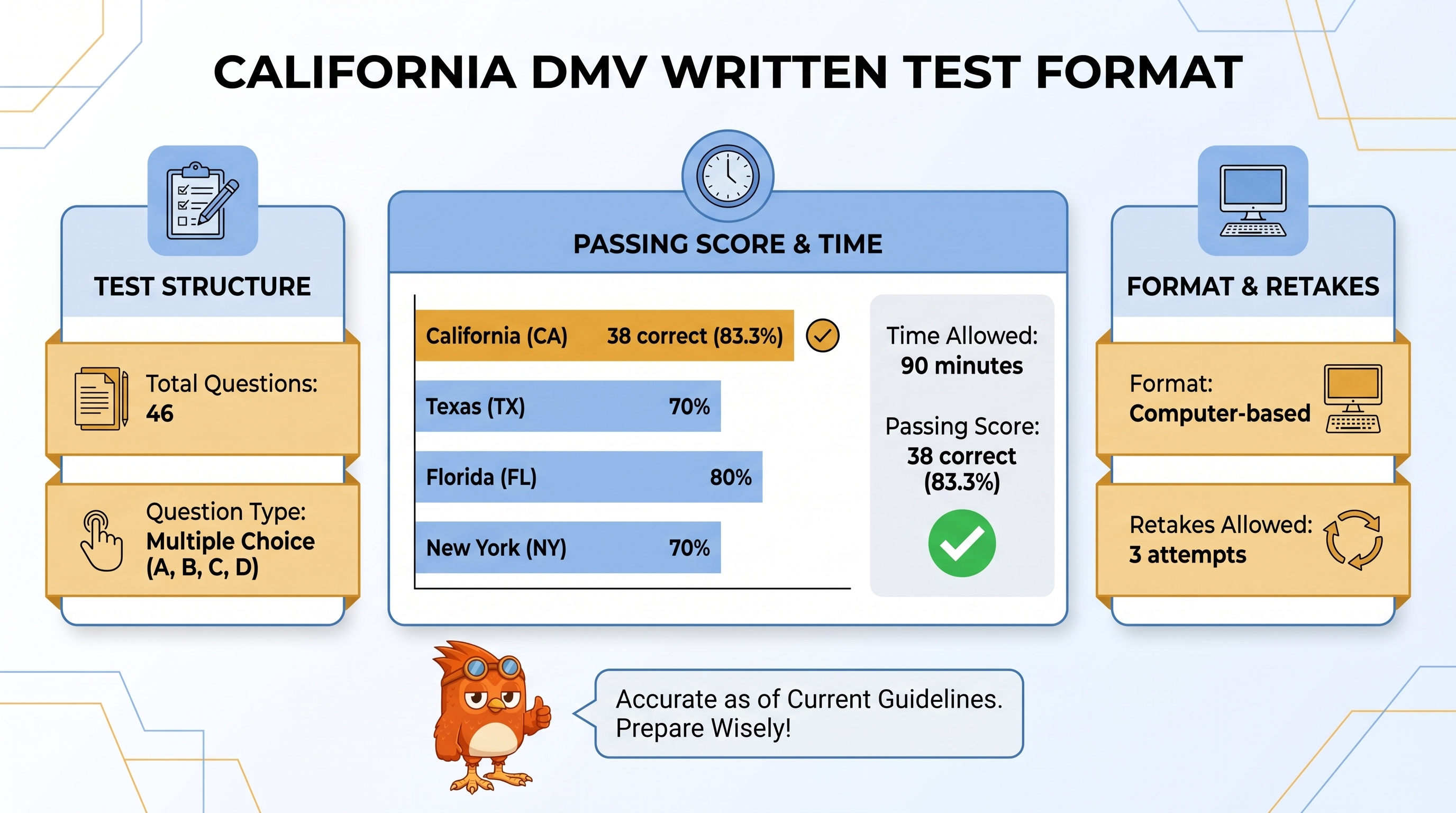
| State | # Questions | Time Limit | Passing Score | Format |
|---|---|---|---|---|
| California | 36 | 30 minutes | 30/36 (83%) | Computer |
| Texas | 30 | 20 minutes | 24/30 (80%) | Computer |
| Florida | 40 | 30 minutes | 32/40 (80%) | Computer |
| New York | 20 | 20 minutes | 14/20 (70%) | Computer |
| Pennsylvania | 18 | 10 minutes | 15/18 (83%) | Paper or Computer |
| Arizona | 40 | 30 minutes | 32/40 (80%) | Computer |
| Illinois | 35 | 30 minutes | 28/35 (80%) | Computer |
| Georgia | 40 | 30 minutes | 32/40 (80%) | Computer |
| Colorado | 30 | 20 minutes | 24/30 (80%) | Computer |
| Washington | 40 | 30 minutes | 32/40 (80%) | Computer |
Note: Some states increase the time limit if English is not your first language. Ask the DMV staff—you may qualify for extra time, and it's provided without penalty.
Here's a realistic distribution of question topics across a 40-question test:
| Topic | Estimated # of Questions | Coverage |
|---|---|---|
| Road Signs | 8–10 | Diamond, triangle, circle, rectangle signs; their colors and meanings |
| Right-of-Way Rules | 6–8 | Intersections, roundabouts, pedestrians, yield scenarios |
| Speed & Following Distance | 4–6 | Speed limit laws, safe following distance (3-second rule) |
| Turning & Lane Changes | 4–5 | Legal turning procedures, lane change safety, blind spots |
| Parking & Stopping | 3–4 | Where you can/cannot park; stopping for emergency vehicles |
| Lights & Signals | 3–4 | Traffic light meanings, hand signals, brake lights |
| DUI/Impairment Laws | 2–3 | BAC limits, consequences, implied consent laws |
| Pedestrian & Bicycle Safety | 2–3 | Right-of-way for pedestrians, bicycle laws |
| Seat Belts & Child Seats | 2–3 | When required, age/weight restrictions for child seats |
| Miscellaneous (Mirrors, Headlights, etc.) | 2–4 | Vehicle inspection, safety equipment, weather driving |
Here are 10 representative DMV written test questions to practice. Try answering before looking at the explanations.
1. (Multiple-Choice) When you see a yellow traffic light, you should:
Answer: b Explanation: Yellow means the light is about to turn red. You should be prepared to stop, not accelerate or continue.
2. (True/False) You may pass a school bus if its red lights are flashing and the stop arm is extended, as long as you drive slowly.
Answer: False Explanation: You must always stop when a school bus's red lights are flashing, regardless of speed or distance. This is one of the strictest laws in driving.
3. (Multiple-Choice) At a four-way stop, when two vehicles arrive at the same time, who has the right-of-way?
Answer: b Explanation: When two vehicles arrive simultaneously at a four-way stop, the vehicle on the right has the right-of-way.
4. (Fill-in-the-Blank) The safe following distance between your vehicle and the vehicle ahead is at least _______ seconds under normal driving conditions.
Answer: 3 (or "three") Explanation: The 3-second rule is the standard safe following distance. In bad weather, increase it to 6+ seconds.
5. (True/False) A solid white line between lanes means you can cross it to change lanes, but a dashed white line means you cannot.
Answer: False Explanation: It's the opposite. A DASHED white line allows lane changes. A SOLID white line prohibits lane changes.
6. (Multiple-Choice) When a red traffic light is showing, but a police officer is directing traffic, you should:
Answer: b Explanation: When a police officer is directing traffic, their instructions override traffic lights. Always obey the officer.
7. (True/False) It is legal to make a right turn on a red light after coming to a complete stop and yielding to pedestrians.
Answer: True (in most states) Explanation: In most states, right turns on red are legal after a complete stop and pedestrian check. However, some states and intersections prohibit this—look for "No Right on Red" signs.
8. (Multiple-Choice) What does a diamond-shaped yellow sign mean?
Answer: b Explanation: Diamond-shaped signs are warning signs. They alert you to potential hazards (construction, slippery road, pedestrian crossing, etc.).
9. (Fill-in-the-Blank) The legal blood alcohol concentration (BAC) limit for drivers age 21 and older in most states is _______.
Answer: 0.08% (or "point zero eight" or "eight hundredths") Explanation: 0.08% BAC is the federal standard across all states for drivers 21+. For drivers under 21, it's 0.0% in most states.
10. (Multiple-Choice) Before changing lanes, you should:
Answer: d Explanation: All three actions are necessary. Mirrors, blind spot, signal, and legality check. Do all four before moving.
Scoring Method: Most DMV tests are scored by counting correct answers and converting to a percentage:
Example:
What If You're Close to Passing? If you scored 79% on an 80% test, you failed. There are no partial credits or rounding up. Most states will allow you to retake after 7 days.
Retake Rules by State:
| State | Days Until Retake | Cost |
|---|---|---|
| California | 1 day | Free retake if failed |
| Texas | 1 day | Free retake |
| Florida | 1 day | Free retake |
| New York | 1 day | Free retake |
| Pennsylvania | 1 day | Free retake (written only) |
Knowing the format helps, but anxiety can still derail your performance. Here's what works:
Practice under timed conditions: Use Wheelingo's practice tests to simulate the real test. This builds confidence and trains your brain to work within time constraints.
Take deep breaths before starting: Sit down, take three slow, deep breaths (4 seconds in, hold 4 seconds, exhale 4 seconds). This lowers your heart rate and sharpens focus.
Read each question twice: Once to understand, once to spot trap answers. This takes 30 seconds but prevents careless mistakes.
Flag and move on: Don't spend more than 1–2 minutes on any single question. Flag it, move forward, and return if time allows.
Remember the passing score: You don't need 100%. You need 70–83%, depending on your state. Most test-takers are too harsh with themselves.
Real experience: Maya went into her DMV written test convinced she'd fail. On Question 7, she encountered a question about a traffic sign she didn't recognize. Instead of panicking, she reminded herself that she only needed to pass about 28 out of 35 questions. She skipped it, finished the test, and scored 31/35—a solid pass. The confidence of knowing you don't need perfection matters.
The fastest way to pass your test is consistent practice with real questions. Try Wheelingo free — state-specific questions, instant explanations, and a readiness score that tells you when you're ready.
Q: Can I skip questions on the computer test and return to them later? A: It depends on your state's testing system. Most computer-based tests allow flagging; some don't. Ask the DMV attendant before you start. If you can't return, answer everything in order.
Q: What happens if I don't finish the test in time? A: Your answers up to that point are graded. Unanswered questions count as incorrect. This is why pacing matters—don't dwell on hard questions.
Q: Can I bring a calculator for math-based questions? A: No. Calculators are not permitted, and the written test rarely includes calculations. Questions like "What is the safe following distance at 55 mph?" have pre-determined answers (not math).
Q: Are the questions randomized, or is it the same test for everyone? A: Most states randomize questions from a large question bank. You and the person sitting next to you may see different tests, but they cover the same topics. This prevents cheating.
Q: If I fail, do I have to pay again to retake? A: Most states allow one free retake within 7 days. After that, you may have to pay again. Check with your state DMV.
Q: How long does it take to get my results? A: On computer-based tests, you usually get your score immediately after submission (sometimes after a short wait). On paper tests, results come in 1–5 business days. Some states mail results; others let you check online.
Week 1: Study your state's driver manual. Focus on the topics listed above (signs, right-of-way, speed limits).
Week 2: Take full-length practice tests. Wheelingo's practice platform mirrors the actual test format and difficulty.
Week 3: Review your mistakes. Focus on topics where you scored below 80%.
Week 4: Take 2–3 more full-length practice tests. Aim for 85%+ on each. If you're not hitting that, extend your study.
Days Before Test: Do a light review of road signs and high-penalty violations (school buses, right-of-way). Don't cram new material 48 hours before the test.
Day Of: Get good sleep. Eat a light breakfast. Arrive 20 minutes early. Bring all required documents. Take deep breaths.
The DMV written test is designed to ensure you know the rules of the road—not to trick you or make you fail. Once you understand its format, know the question types, and practice under real conditions, the anxiety dissolves. You'll sit down confident and focused.
Master the practice tests now, and walk into the DMV ready to pass.