Master single and multi-lane roundabouts. Yield rules, lane selection, signaling, and safe exit techniques for test success and real-road confidence.
A roundabout is approaching. You're not sure which lane to use. Oncoming traffic circles the intersection. You panic and brake. A car honks behind you.
Roundabouts confuse new drivers because they break the rules you learned at four-way stops. But once you understand the one fundamental rule—yield to traffic already in the circle—roundabouts become simple and much safer than traditional intersections.
This guide explains the physics of roundabouts, walks you through single and multi-lane navigation, shows you when to signal, and clarifies the right-of-way rules that vary by country and region. Whether you're preparing for your DMV test or facing your first real roundabout, you'll know exactly how to handle it.
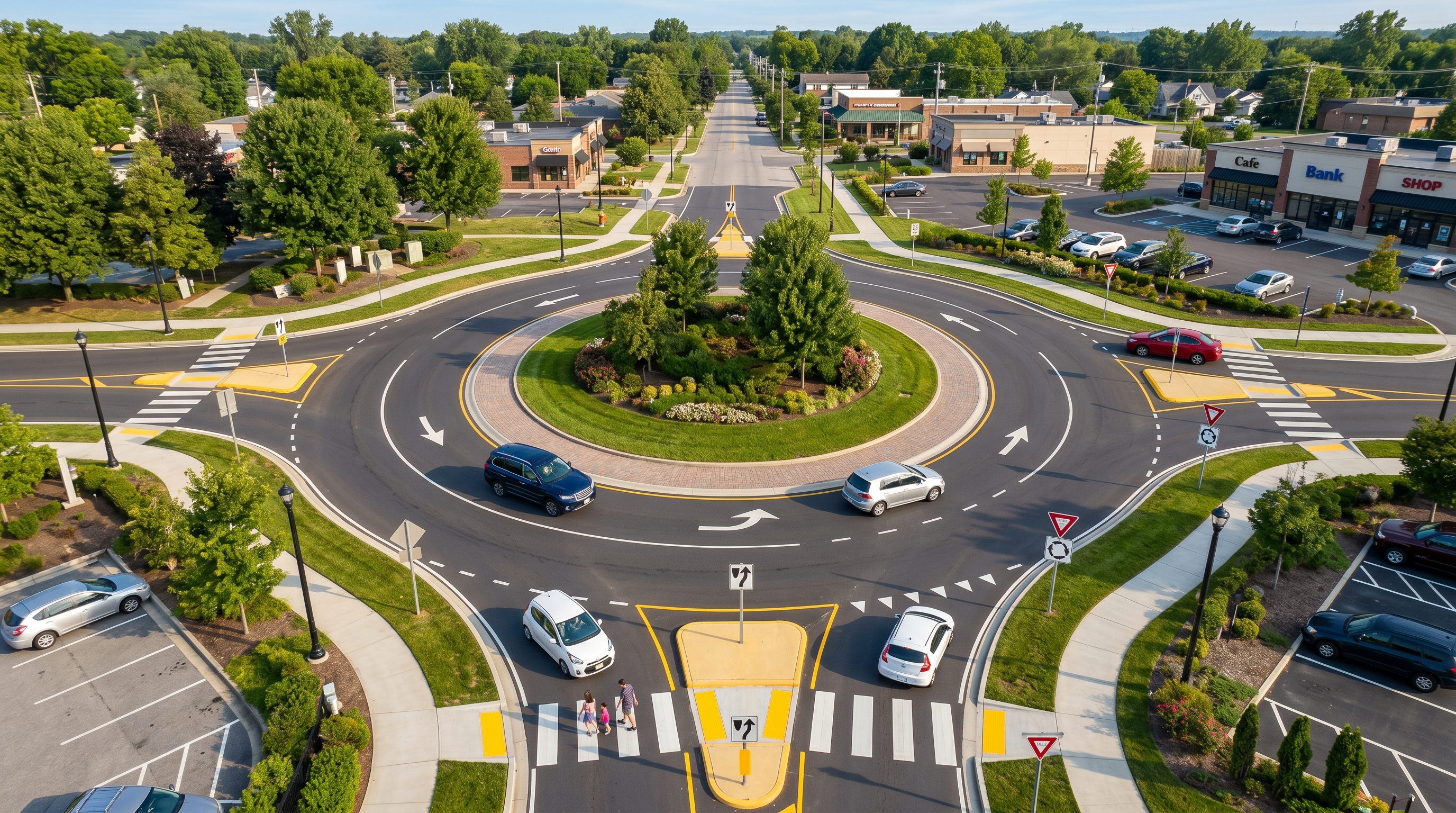
A roundabout (also called a traffic circle or rotary) is a circular intersection where traffic flows counterclockwise (in North America) around a central island. Instead of traffic lights or stop signs, roundabouts use yield rules and continuous flow to move vehicles through safely and efficiently.
Roundabouts reduce crash severity and frequency compared to traditional four-way intersections:
Statistically, roundabouts reduce injury crashes by 75% compared to traditional intersections.
 A single-lane roundabout has one continuous path around the center island. All traffic follows the same lane.
As you approach the roundabout:
Early identification is critical: Know which street you're exiting onto before you enter. If you miss your exit, you circle around and try again—it's safer than crossing multiple lanes or making sudden exits.
The key rule: Yield to any vehicle already in the roundabout.
Yield precedence:
Once the path is clear:
Common mistake: Signaling upon entry. This confuses other drivers—a left turn signal in a roundabout makes them think you're exiting, when you're actually entering. No signal on entry.
As you approach your target exit:
The right-turn signal tells circulating traffic and pedestrians that you're leaving. It's directional—a clear exit intention.
Multi-lane roundabouts (typically at busy intersections) have 2-3 lanes within the circle. The complexity is lane selection and maintaining your lane while circulating.
Most multi-lane roundabouts use directional lane assignment:
Example: You're entering a two-lane roundabout and need to exit onto the third exit (to your left). You enter in the left lane, circle, and exit on the third exit. Entering the wrong lane forces you to change lanes mid-circle, which is dangerous and often illegal.
Approaching a two-lane roundabout:
Critical rule: Don't change lanes while circulating. Enter your correct lane and stay in it until you exit.
Once circulating:
Example: You need the third exit. Enter the left lane. Count: "First (no), second (no), third (yes)." Signal right one exit before, then turn.
| Mistake | Why It Fails | How to Fix |
|---|---|---|
| Entering without yielding | Collides with circulating traffic; automatic failure | Always check right; wait for clear path |
| Signaling on entry | Confuses others; looks lost | Only signal on EXIT, not entry |
| Changing lanes while circulating | Illegal in many jurisdictions; dangerous | Choose correct lane before entering; stay in it |
| Exiting too late | Miss your exit; must circle again | Count exits; start signaling one exit before your target |
| Stopping in the circle | Blocks flow; confuses other drivers | Never brake in the circle unless forced by pedestrians |
| Not yielding to pedestrians | Safety hazard; automatic test failure | Always scan for pedestrians entering and exiting |
| Entering too fast | Can't control if someone enters from wrong direction; unsafe | Enter at 10-15 mph; be ready to yield |
| Not exiting completely | Half in circle, half on exit street; blocks traffic | Turn fully onto exit street; clear the circle completely |
Devon entered a two-lane roundabout and chose the right lane, thinking he'd exit on the second exit. Midway through the circle, he realized he needed the third exit, not the second. He panicked and cut across the left lane, nearly hitting a car. A traffic officer pulled him over: unsafe lane change in a roundabout.
Two weeks later, Devon retested. This time, before entering, he identified his exit clearly: third exit = left lane. He entered correctly, counted silently, and exited perfectly. No lane changes mid-circle.
Priya was focused on checking for cars and entered the roundabout. She didn't notice a pedestrian stepping into the entry path. She had to brake hard. The examiner marked it down: "You must yield to pedestrians."
On her retest, Priya slowed approaching the roundabout and looked left (entry path), right (circulating traffic), and left again (exit path) for pedestrians. She passed.
Most states score roundabout navigation on a 0-3 scale:
| Score | Criteria |
|---|---|
| 3 (Excellent) | Proper yield to circulating traffic, correct lane selection (multi-lane), no extra circulations, signals only on exit, yields to pedestrians |
| 2 (Good) | Yields to traffic, minor hesitation, correct lane selected, clear exit |
| 1 (Passing) | Yields and exits safely, but may require extra circulation or slight lane uncertainty |
| 0 (Fail) | Fails to yield, stops in circle, wrong lane in multi-lane, misses exit without second attempt, or doesn't yield to pedestrians |
Examiners watch for these specific behaviors:
Approaching:
Entering:
Circulating:
Exiting:
Hit these checkmarks, and you pass roundabout navigation.
Standard in the US and Canada. Traffic circles counterclockwise. Yield to traffic on your right (already in circle).
Key rule: Enter from the right; yield to circulating traffic coming from your right.
In most of Europe, you yield to traffic on your LEFT (already in the circle). The direction of circulation is the same, but the yield precedence is different.
If you're driving in Europe: This is the opposite of North America. Check local signage or ask your rental company.
Australia uses clockwise roundabouts (opposite of North America). Circulation direction and yield rules are different.
If traveling to Australia: Expect the opposite flow direction. Adjusting takes 1-2 hours of practice.
Use this table to select the correct lane on approach:
| Target Exit | Lane Choice | Example |
|---|---|---|
| 1st exit (immediate right) | Right lane | Turning right |
| 2nd exit (straight/slight left) | Right lane or left lane (check signs) | Continuing generally straight |
| 3rd exit (left) | Left lane | Turning left |
| 4th+ exits (U-turn) | Left lane | Going almost all the way around |
Many roundabouts have lane markings or signs indicating which exits are served by which lane. Read these before entering.
The fastest way to pass your test is consistent practice with real questions. Try Wheelingo free — state-specific questions, instant explanations, and a readiness score that tells you when you're ready.
Q: What if I miss my exit? A: Continue circulating. You can complete another full circle and exit on your next attempt. It's safer than swerving or braking hard in the circle. There's no "penalty" for circulating extra; it's better to be cautious.
Q: Should I brake in a roundabout? A: Minimize braking. Smooth acceleration and deceleration (using lift-off of the accelerator) are preferable. Brake only if you must stop completely to yield to pedestrians or if traffic forces it. A smooth roundabout requires minimal braking.
Q: Can I turn left in a roundabout? A: Yes. In North American roundabouts, a left turn is simply a longer circulation. Enter the left lane (in a multi-lane roundabout) and exit on your target exit. You don't turn left sharply; you circle left.
Q: What if two vehicles enter at the same time? A: The vehicle on the right has priority. If you're entering from the left and another vehicle is entering from straight across, yield to them. This follows the general right-of-way rule: vehicles on your right have priority.
Q: Are roundabouts better than traffic lights? A: Statistically, yes. Roundabouts reduce severe crashes by 75%. They're also more efficient during low-traffic times (traffic lights still cycle even if no one's waiting). However, they're less efficient during high-traffic peaks when traffic signals are needed.
Q: What's a "mini roundabout"? A: A mini roundabout is a smaller version, often with a painted circle instead of a raised island. The rules are identical: yield to circulating traffic, enter smoothly, exit with a signal.
Q: Do I need to signal at all in a roundabout? A: Signal only on exit. You do NOT signal on entry or while circulating. The only signal in a roundabout is the right-turn signal when exiting.
Week 1: Single-Lane Mastery
Week 2: Multi-Lane Introduction
Week 3: Pedestrian and Cyclist Awareness
Week 4: Varied Conditions
Most drivers are roundabout-ready after 10-15 hours of deliberate practice.
Expand your intersection and traffic skills:
Roundabouts are safer and more efficient than traditional intersections—once you understand the rule. Yield to traffic already in the circle. Identify your exit before entering. Choose the correct lane. Exit with a signal.
The panic dissolves when you stop thinking of roundabouts as mysterious and start thinking of them as a simple yield-and-flow system. Traffic moves faster through roundabouts, and collisions are rarer and less severe.
Spend a few hours practicing on real roundabouts. Start with single-lane roundabouts to build confidence. Move to multi-lane roundabouts once you're comfortable. Within 10-15 hours of deliberate practice, roundabouts become second nature.
On your DMV test, you'll navigate roundabouts with the confidence of someone who's circulated a hundred times. The examiner will see smooth entries, proper yields, and clear exits—not hesitation.
Ready to master all intersection types? Download the Wheelingo app and practice every maneuver with video guides and real-time feedback. Track your progress toward test-ready confidence.
External References: