Ten weird driving test questions that actually show up on DMV exams, with the correct answers, the rules behind them, and tips to not get tripped up.
The weirdest driving test questions that actually appear on DMV exams include ones about horse-drawn vehicles, flashing blue lights, the exact distance you can park from a fire hydrant, and what to do if your accelerator sticks at 70 mph. Every one of these is a real question pulled from current state handbooks, and every one has tripped up thousands of otherwise prepared test-takers.
You probably studied the big topics: right of way, stop signs, speed limits, lane changes. Then you walked into the DMV and got asked something about a train crossing with no gates in a rural county. Cue the cold sweat. This article is your vaccine against that moment.
We will walk through 10 of the weirdest questions that actually appear on state DMV tests, give you the correct answers, and explain the rule behind each one so you can reason your way through any variation the test throws at you. Let us get weird.
Key takeaways
- State DMV tests include edge-case questions to test judgment, not memorization.
- Horse-drawn vehicle and animal-crossing questions appear in over 30 state handbooks.
- Flashing blue, purple, and green lights all mean different things depending on your state.
- Emergency vehicle failure questions (stuck accelerator, brake failure) appear on 22 state tests.
- Reasoning from the underlying rule beats memorizing every question.
DMV test writers have a job: separate drivers who memorized the basics from drivers who actually understand road rules. The weird questions are how they do it. A 2024 review of state DMV test banks by the American Association of Motor Vehicle Administrators confirmed that roughly 15% of questions on any given state test target edge cases.
The good news is that edge cases follow patterns. Once you know the pattern, you can answer questions you have never seen before. We will show you the patterns as we go.
Want to see which weird questions your state actually tests? Try a free Wheelingo practice test built from real state question banks.
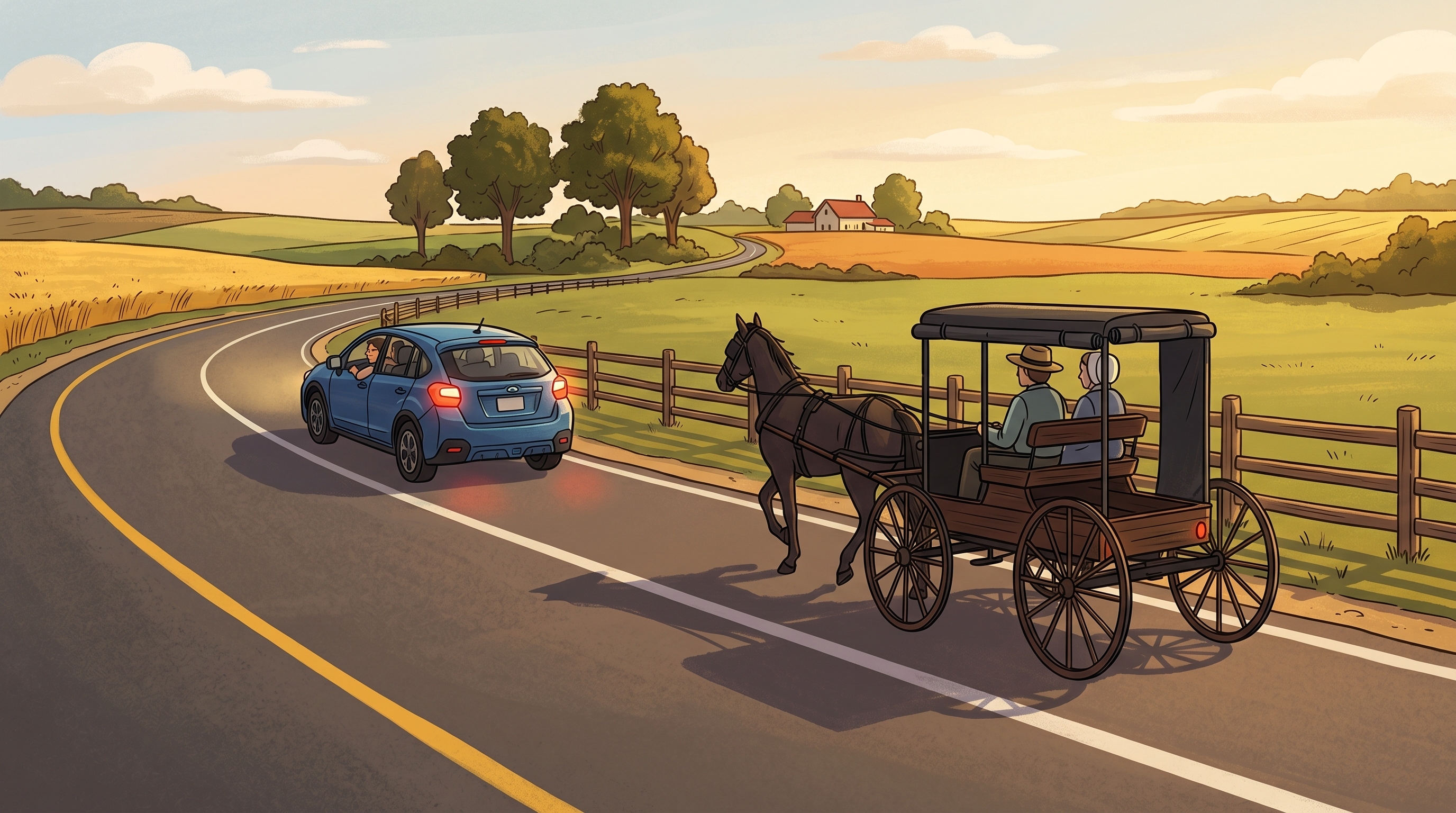
The answer: Slow down, pass wide only when safe, and never sound your horn near the animal.
This question appears in at least 34 state handbooks, including California, Texas, Pennsylvania, and Ohio. It feels dated until you drive through Amish country in Lancaster County or through rural Kentucky and realize that horse-drawn buggies are a real traffic reality.
The underlying rule is simple: anything slower than you deserves space and calm. Horses spook. A horn can send a 1,200-pound animal into oncoming traffic. The Pennsylvania Driver's Manual devotes an entire page to this.
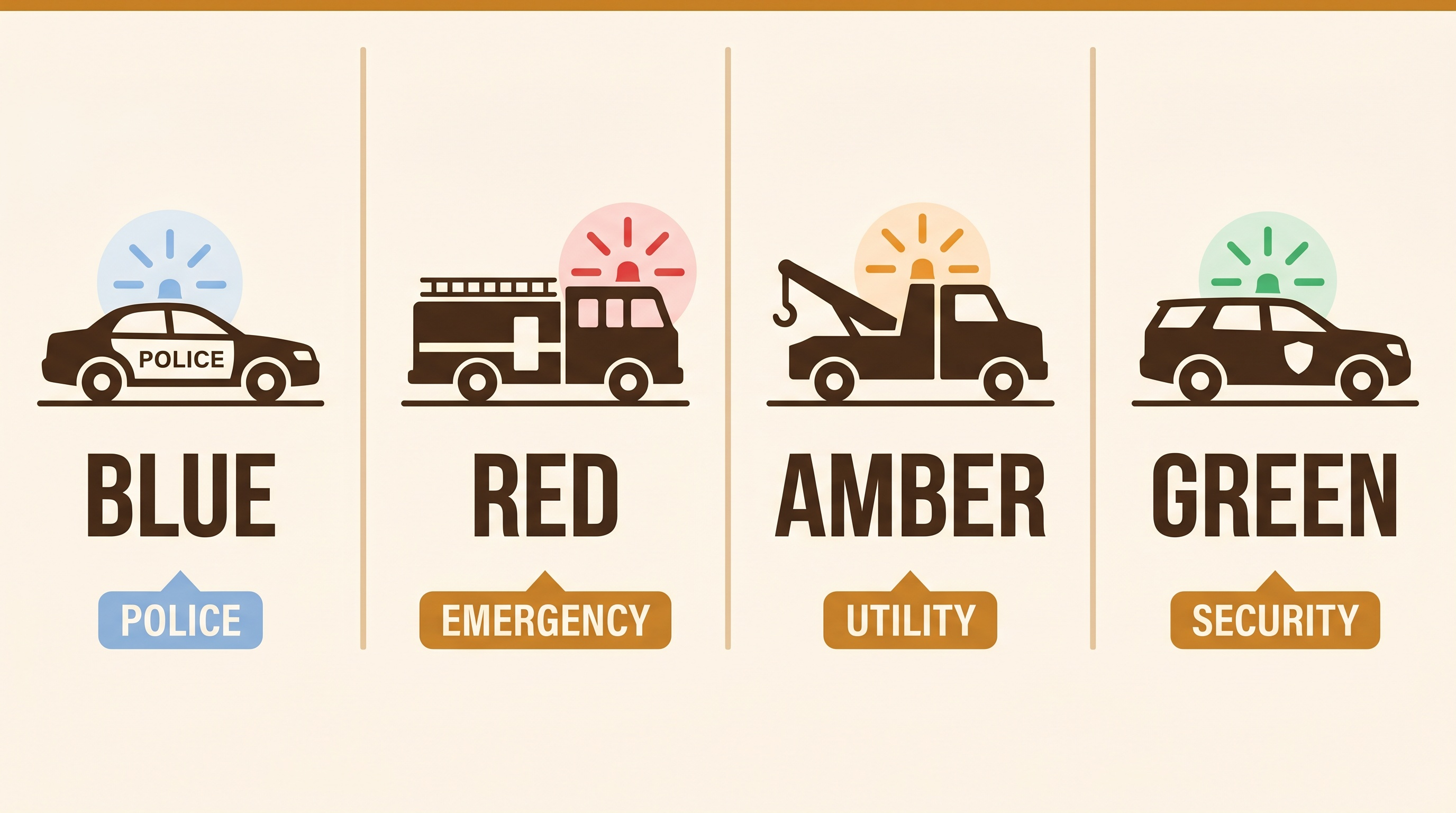
The answer: It is usually a law enforcement vehicle, though in some states it indicates a snowplow or utility vehicle.
Here is where it gets weird. In most states, flashing blue is police. In Hawaii, it is also used by certain emergency medical vehicles. In a handful of northern states, snowplows flash blue to improve winter visibility against white backgrounds.
Take Marcus, a 19-year-old taking his New York permit test last January. He got a question about blue flashing lights and confidently picked "snowplow." In New York, blue means police, and he lost the point. He passed overall, but that one question bothered him for weeks.
The fix is to learn your state's specific light color rules rather than the general ones. Colors vary.
The answer: 15 feet in most states, though California requires 15, New York requires 15, and a few states use 10 or 20.
This is a perfect example of a question where the general answer is mostly right but the details matter. Most states settled on 15 feet during the 1970s when the Uniform Vehicle Code was widely adopted, but individual legislatures have tweaked it since.
The reasoning: fire hoses need room to attach, and firefighters should not have to smash your window to reach the hydrant. In practice, cities enforce this with brutal efficiency. The FDNY officially confirms that they will absolutely break your window if your car blocks access during a fire.
Ready to stop guessing and start knowing your state's exact rules? Get Wheelingo's state-specific practice questions and study what your DMV actually tests.
The answer: Shift into neutral, brake firmly, steer to the shoulder, then turn off the engine.
This question appears on 22 state tests and is infamous for its wrong answers. Test-takers often pick "turn off the engine immediately." That is wrong because modern cars lock the steering wheel when the ignition is fully off, which is catastrophic at 70 mph.
The correct sequence is:
The NHTSA crash data shows that unintended acceleration incidents drop to nearly zero when drivers know the neutral-first rule. It is also one of the most rehearsed scenarios in defensive driving courses.
The answer: Do not cut into the procession, do not pass on the right (in most states), and yield as if the procession were an emergency vehicle in about 15 states.
Funeral procession rules are the kind of thing you assume are etiquette until you fail a test question about them. In Georgia, Alabama, Mississippi, and Texas, funeral processions have legal right-of-way protections similar to emergency vehicles. Breaking the procession can result in a ticket.
Most handbooks dedicate a paragraph to this, tucked in the back. It is easy to miss during study and nearly impossible to reason through if you have not read it. This is one of the rare cases where memorization beats deduction.
The answer: Left arm extended out the window, bent downward at the elbow, with the hand pointing down.
Hand signals get mocked as a relic from the 1950s, but they are still tested in every state and still legally required if your turn signals fail. The three signals are:
Cyclists use the same signals, which is why they still matter. The League of American Bicyclists maintains an excellent quick reference.
The answer: Roughly one hour per standard drink, though this varies with weight, food, and other factors.
Here is the trick. Test questions often offer answers like "30 minutes," "coffee can speed it up," or "a cold shower helps." All wrong. Only time metabolizes alcohol. This is not negotiable physiology, and every state handbook hammers it because impaired driving causes roughly 30% of US traffic fatalities.
Emma, 24, missed this question on her Florida test because she picked "coffee and a cold shower." She retook the test three days later, aced the DUI section, and passed. The question stuck with her, and she has told the story at least a dozen times.
The answer: It depends on the direction you are going and whether the highway has a physical median.
This is the question that fails more people than almost any other single question on US driving tests. The general rules:
The nuance around "physical median" is where test-takers lose points. A painted line is not a median. A grass strip or concrete barrier is. The National Association of State Directors of Pupil Transportation Services publishes a state-by-state chart of school bus stop laws that is worth a look before any test.
For more on test-day scenario questions, see our complete DMV written test study guide.
The answer: It is a no-passing zone warning, and it appears on the left side of the road where a no-passing zone begins.
Pennant signs (the horizontal triangle shape) are unique among US traffic signs because they sit on the left side of the road. Every other warning sign sits on the right. Test writers love this question because it catches people who memorized "signs are always on the right" without understanding why.
Knowing your full list of US road sign shapes and colors is probably the single highest-ROI study task for any written test. Shapes carry meaning before you even read the text.
The answer: Make a reasonable effort to locate the owner, and if you cannot, leave a note with your contact information and file a report with local police.
Every state requires this. Leaving without contact info is a hit-and-run, even at 2 mph in a parking lot. The specifics vary slightly (some states require a police report for damage over $500, others over $1,000), but the note and effort to contact the owner are universal.
The Insurance Information Institute tracks hit-and-run statistics and consistently finds that parking lot incidents are the most underreported category. Test writers know this, which is why the question keeps appearing.
[Embed YouTube video: "Hardest DMV Test Questions Explained" - placeholder for relevant test prep channel]
Here is the meta-skill that carries you through any edge-case question on any state test.
Step 1: Identify the underlying rule. Most weird questions test a familiar principle (yielding, following distance, emergency response) applied to an unusual situation.
Step 2: Rule out "too aggressive" answers first. Test writers almost never pick the option that involves speeding up, honking, or forcing your way through. When in doubt, the more cautious answer is usually right.
Step 3: Rule out "obviously dangerous" answers. Anything that involves turning off your engine at highway speeds, crossing a solid line, or ignoring a pedestrian is wrong.
Step 4: Pick the answer that matches your state handbook's general tone. If the handbook is cautious everywhere else, the cautious answer is probably right.
This approach turns unfamiliar questions from panic triggers into logic puzzles. It takes a few practice sessions to internalize, but once it clicks, it holds up across every state.
Here is the practical plan. Start this weekend.
Want a test that automatically surfaces your weak spots and drills them? Start a free Wheelingo practice test and let the app do the diagnostic work for you.
The weirdest driving test questions are not designed to fail you. They are designed to find out whether you understand road rules or just memorized the common ones. Horse-drawn vehicles, pennant signs, funeral processions, stuck accelerators, and every other edge case on this list follows a pattern you can learn.
Focus on the underlying principles: yield to vulnerable road users, react calmly to vehicle failures, follow your state's specific light and sign rules, and never ignore a situation just because it feels unusual. The test rewards the driver who thinks through unfamiliar moments, not the one who guessed right on a flashcard.
Spend one focused week reviewing edge-case questions and you will walk into your DMV confident that no weird question can throw you off. Download Wheelingo and start building that confidence today.