Master every yielding rule tested on your driving exam. Intersections, merges, pedestrians, emergency vehicles. Avoid costly deductions and pass.
Yielding on a driving test means giving the right of way to another road user before you proceed, and the rule changes based on where you are. On your test, examiners will put you in at least 3 yield scenarios, and each one has a different correct answer.
Most test-takers think yielding means stopping. It does not. Yielding means you give up your turn if someone else has priority. Sometimes you roll through. Sometimes you stop completely. Knowing the difference is what separates a pass from a fail.
In 2025, the Insurance Institute for Highway Safety reported that failure-to-yield errors contributed to a significant portion of intersection crashes. That is exactly why your examiner is testing you on this.
Nadia learned that the hard way in Phoenix. Making an unprotected left turn on green, she assumed the oncoming car would stop. It did not. She jammed the brakes, the examiner marked "failed to yield on left turn," and her test ended 4 minutes in. She had studied parallel parking for 6 weeks and never drilled the yield rules. It was her single biggest mistake.
This guide covers every yield scenario tested on US driving exams. If you want to practice these scenarios before test day, start a free practice test and focus on right-of-way questions.
Key Takeaways
- A yield sign means slow down, look both ways, and stop only if another road user has the right of way. It is not an automatic stop.
- On an unprotected left turn, oncoming traffic always has the right of way. You yield, they go.
- Pedestrians in marked or unmarked crosswalks always have the right of way over turning vehicles.
- Emergency vehicles with lights and sirens require you to pull right and stop, regardless of which direction they are traveling.
- Failing to yield to a pedestrian is an automatic fail in every state.
Yielding is the act of giving priority to another road user. The National Highway Traffic Safety Administration defines the right of way as the right to proceed first in traffic, and yielding is the deliberate decision to let that right-of-way holder go.
Your examiner is scoring 3 things on every yield opportunity:
A yield sign is the most literal version. But examiners test yielding dozens of times on a road test, not just at yield signs. Every unprotected left turn, every merge, every pedestrian crossing is a yield decision.
Want a structured way to learn every yield scenario? Wheelingo's learning roadmap has a dedicated right-of-way module with state-specific rules.
A yield sign (triangular, red and white) tells you to slow down and prepare to stop if necessary. A stop sign (octagonal, red) requires you to come to a complete stop regardless of traffic.
On a driving test, examiners grade yield signs differently than stop signs. At a yield sign, you are deducted for stopping unnecessarily when the road was clear. You are also deducted for failing to slow or check for traffic.
The correct yield-sign approach:
Examiner Mike, a 12-year veteran in Dallas, says the most common yield-sign fail he sees is the unnecessary full stop. "They treat every yield sign like a stop sign. I mark them for poor judgment and unnecessary delay. It looks like you do not understand the sign."
See our complete US road signs guide for the difference between every regulatory sign your DMV tests.
Intersection yielding is the highest-scored category on most road tests. There are 5 core rules you must know cold.
When you are turning left across oncoming traffic with no green arrow, every oncoming vehicle has the right of way. You wait for a gap. If no gap opens before the light turns red, you pull forward into the intersection and complete the turn as the light changes.
This is the most commonly tested scenario on road tests because it happens everywhere. Examiners want to see patient judgment, not aggressive timing.
Right on red is permitted in most states after a full stop, but you yield to all cross traffic and pedestrians. Many test-takers stop briefly and turn, missing a pedestrian stepping off the curb. That is an automatic fail.
At a 4-way stop, the vehicle that stopped first goes first. If 2 vehicles arrive simultaneously, the vehicle on the right has priority. If 2 vehicles arrive simultaneously opposite each other, both can proceed if neither is turning left. Our 4-way stop rules guide covers this in depth.
At a T-intersection, the vehicle on the terminating road (the stem of the T) yields to traffic on the through road (the top of the T), regardless of signs. The through road has the right of way.
When no signs or signals control the intersection, the vehicle on the right has the right of way. This is rare but tested. Rural test routes sometimes include uncontrolled intersections specifically to grade this rule.
For deeper coverage, see our right-of-way rules at intersections breakdown.
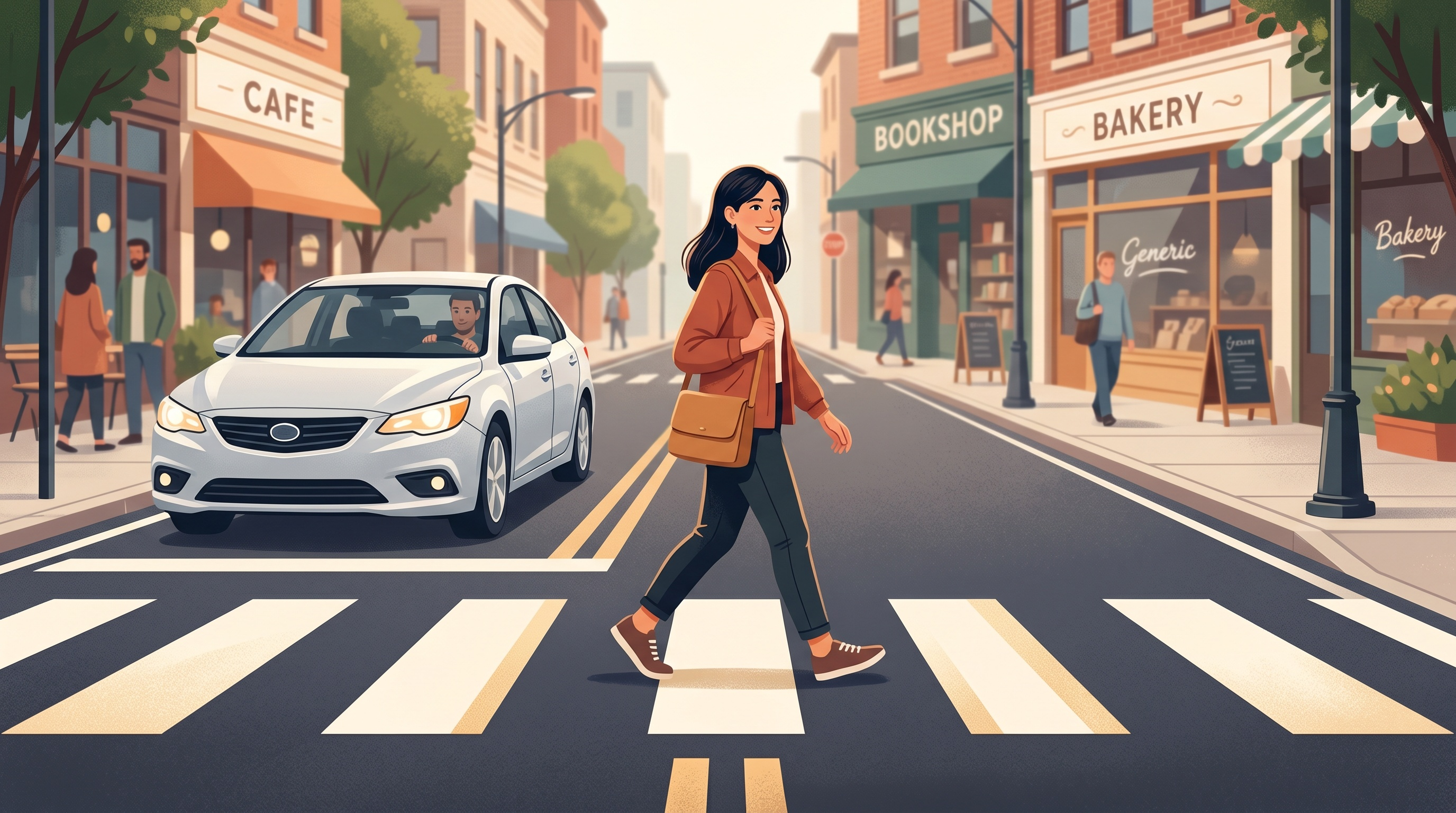
Every state treats pedestrian right-of-way as a critical test item. Failing to yield to a pedestrian is an automatic fail on most state road tests, full stop. No second chance.
Pedestrians have the right of way in:
The test scenario: You are turning right at a green light. A pedestrian steps off the curb into the crosswalk. You must stop completely and wait until they are fully across your half of the road plus one lane. Not until they reach the other curb, but until they are safely past your path.
Ready to drill pedestrian scenarios before test day? Wheelingo's practice tests include state-specific pedestrian right-of-way questions from actual DMV test banks.
When you see or hear an emergency vehicle with active lights and sirens, you are required to pull to the right edge of the road and stop until it has passed. This applies regardless of whether the vehicle is behind you, in front of you, or on a cross street.
Exceptions:
Failure to yield to an emergency vehicle is an automatic fail on every state road test.
Merging onto a highway is a yield situation. The traffic already on the highway has the right of way. You match their speed, identify a gap, and merge smoothly without forcing anyone to brake.
Examiners grade merging on:
A common failure is stopping at the end of the merge lane. Unless traffic is completely stopped, never stop on a merge ramp. It creates a hazard and is almost always an automatic fail.
Every state requires you to stop when a school bus has its red lights flashing and its stop arm extended, with one exception: on a divided highway with a physical median, oncoming traffic may continue in most states.
On your driving test, if a school bus activates its lights:
This rule applies on two-way roads without a median regardless of which direction you are traveling.
[YouTube placeholder: "Yield Rules on Your Driving Test: Every Scenario Explained" - Wheelingo official channel, 5-minute visual walkthrough of unprotected left turns, pedestrian crossings, and emergency vehicle yields]
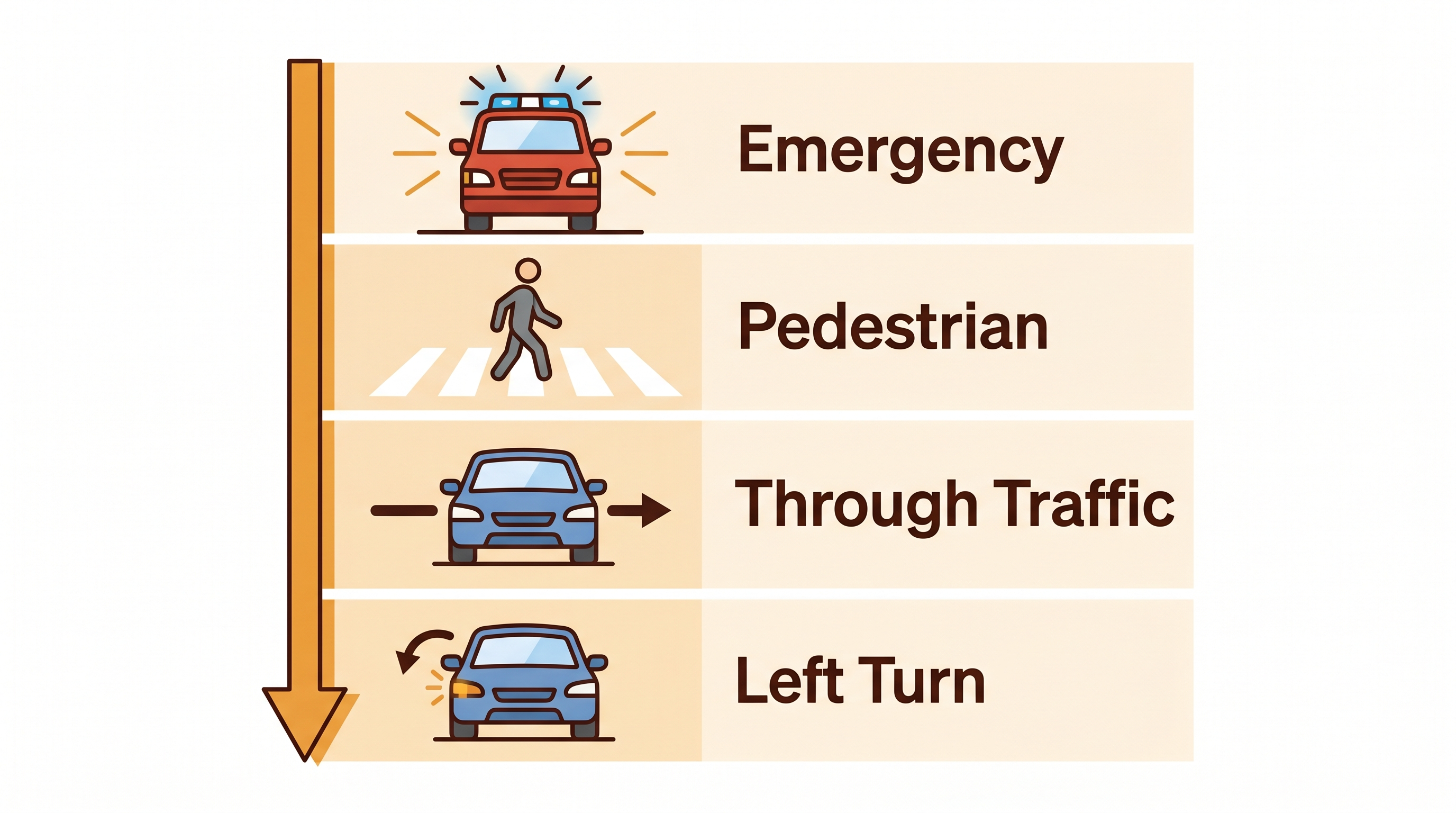
The 5 most common yield failures examiners mark, based on IIHS crash data and DMV scorecards:
Failure 1: Forcing a left turn through oncoming traffic. You saw a gap that was not really there. The oncoming car had to brake. Automatic deduction, sometimes a critical fail.
Failure 2: Rolling through a yield sign without looking. You slowed but did not actually scan for cross traffic. Examiner marks "failed to observe."
Failure 3: Not stopping for a pedestrian stepping off the curb. Even if you had time to turn, the pedestrian was in a crosswalk. Automatic fail.
Failure 4: Stopping unnecessarily for an emergency vehicle going the opposite direction on a divided highway. In most states, this is not required, and it creates a traffic hazard.
Failure 5: Stopping on a highway merge ramp. Unless traffic is stopped, this is almost always a fail.
Dmitri, 34, an adult learner in Chicago, failed his first road test on a single pedestrian-yield error. He turned right on red and missed a woman stepping off the curb 15 feet away. On his retake, he drilled pedestrian scenarios for 2 weeks using Wheelingo's practice tests. He passed with 91 points.
Most yield rules are consistent across all 50 states, but a few variations can catch you off guard.
California requires you to yield to pedestrians in unmarked crosswalks at any intersection, even if the pedestrian is only stepping off the curb.
Texas has strict emergency vehicle rules. You must yield and slow down for any stopped vehicle with flashing lights on the shoulder, not just police and fire.
New York City test routes test bike lane yields specifically. Turning right across a bike lane requires you to yield to cyclists.
Florida has aggressive school bus rules. Failing to stop for a school bus is an automatic fail and can be a criminal citation on public roads.
Illinois tests uncontrolled intersections in rural test routes more than most states. Know the "yield to the right" rule cold.
Ready to drill every yield scenario your state DMV tests? Download Wheelingo and practice with real DMV-style questions. Our users pass at an 87% first-attempt rate.
Yielding is not about hesitation. It is about judgment. Know the rules, read the traffic, make the call. The examiner is watching for confident, correct decisions, not excessive caution. Practice the scenarios, know your state's variations, and you will pass.