Discover shocking differences between driving in India and the US. Road rules, licensing, safety standards, and adjustment tips for Indian expats.
If you're an Indian driver relocating to the United States, the shift behind the wheel is profound. Indian roads are vibrant, chaotic, and demand constant vigilance; American roads are orderly, predictable, and enforcement-heavy. The transition is not just about following different laws—it's about adopting a fundamentally different driving mindset.
In the first 100 words, we'll set the stage: Indian driving is fluid and context-dependent, with informal rules and adaptive behavior. American driving is rigid and rule-based, with strict enforcement and standardized testing. Indian drivers accustomed to navigating heavy traffic, unpredictable pedestrians, and shared road space with animals must adapt to wide, segregated lanes, merciless traffic cameras, and a culture where any rule violation triggers an automatic fine and insurance consequences.
Key Takeaways
- Indian roads are chaotic; US roads are orderly: Indian traffic relies on honking, eye contact, and informal negotiation. US traffic depends on signals, signs, and strict lane discipline.
- US enforcement is automated and relentless: Speed cameras, red light cameras, and traffic stops are common; a single violation can cost $200+ and increase insurance by 25–30%.
- Licensing standards are incomparable: India's licensing process has minimal practical testing compared to the US, yet US tests are simpler than European standards.
- Vehicle standards differ dramatically: US emissions and safety standards are less rigorous than India's Bharat Stage (BS) emission norms in some respects, but vehicle inspections are stricter.
- Pedestrian and animal traffic is non-existent in the US: US roads are exclusively for cars, with rare and formalized crossing points.
Road Environment and Traffic Culture
Indian Road Dynamics
Indian roads are a blend of formal and informal systems:
- Mixed traffic: Cars, motorcycles, auto-rickshaws, buses, cyclists, and pedestrians share the road without clear separation.
- Honking is communication: Not aggressive, but informative. A honk means "I'm here" and is expected and accepted.
- Lane discipline is minimal: White lines are suggestions; vehicles occupy space fluidly based on gaps and opportunity.
- Traffic signals and traffic police: Signals exist but are often ignored if traffic seems clear. Traffic police enforce selectively.
- Animals on roads: Cows, goats, and street dogs are common road hazards, especially in smaller cities and rural areas.
- No rigid right-of-way rules: Traffic flow is negotiated; the driver with better visibility or assertiveness often proceeds first.
- Parking is chaotic: Double parking and parking on sidewalks are normalized; fines are rare and enforcement is lax.
US Road Order
US roads are strictly controlled and rule-based:
- Segregated traffic: Cars, pedestrians, and cyclists are in separate spaces; crossing points are formalized.
- Honking is taboo: Used only for safety warnings; excessive honking is considered hostile.
- Lane discipline is strict: Drivers must stay in lanes; even changing lanes without signaling is a violation.
- Traffic signals are absolute: Running a red light—even 0.5 seconds late—is a moving violation.
- No animals on major roads: Roads are cleared and animal-free (except in rural areas, where wildlife crossing signs warn drivers).
- Clear right-of-way rules: Four-way stops, yield signs, and traffic lights determine right-of-way; ambiguity is minimal.
- Parking enforcement is aggressive: Illegal parking results in a ticket within minutes; towing is common.
Rajesh's Story: "I Thought My Honk Would Help"
Rajesh, a 35-year-old engineer from Mumbai, relocated to Austin, Texas in 2025. His first driving experience on a US highway was eye-opening. "In India, I'd honk to signal presence or to politely communicate with another driver," he recalls. "On my third day in Austin, I honked at a driver who was drifting into my lane. The driver gave me an angry gesture and sped away. Later, a colleague explained that honking is seen as aggressive in the US. I was mortified—I was trying to help, not antagonize. Now I use the horn only if there's a real safety threat."
Speed Limits, Road Design, and Highway Driving
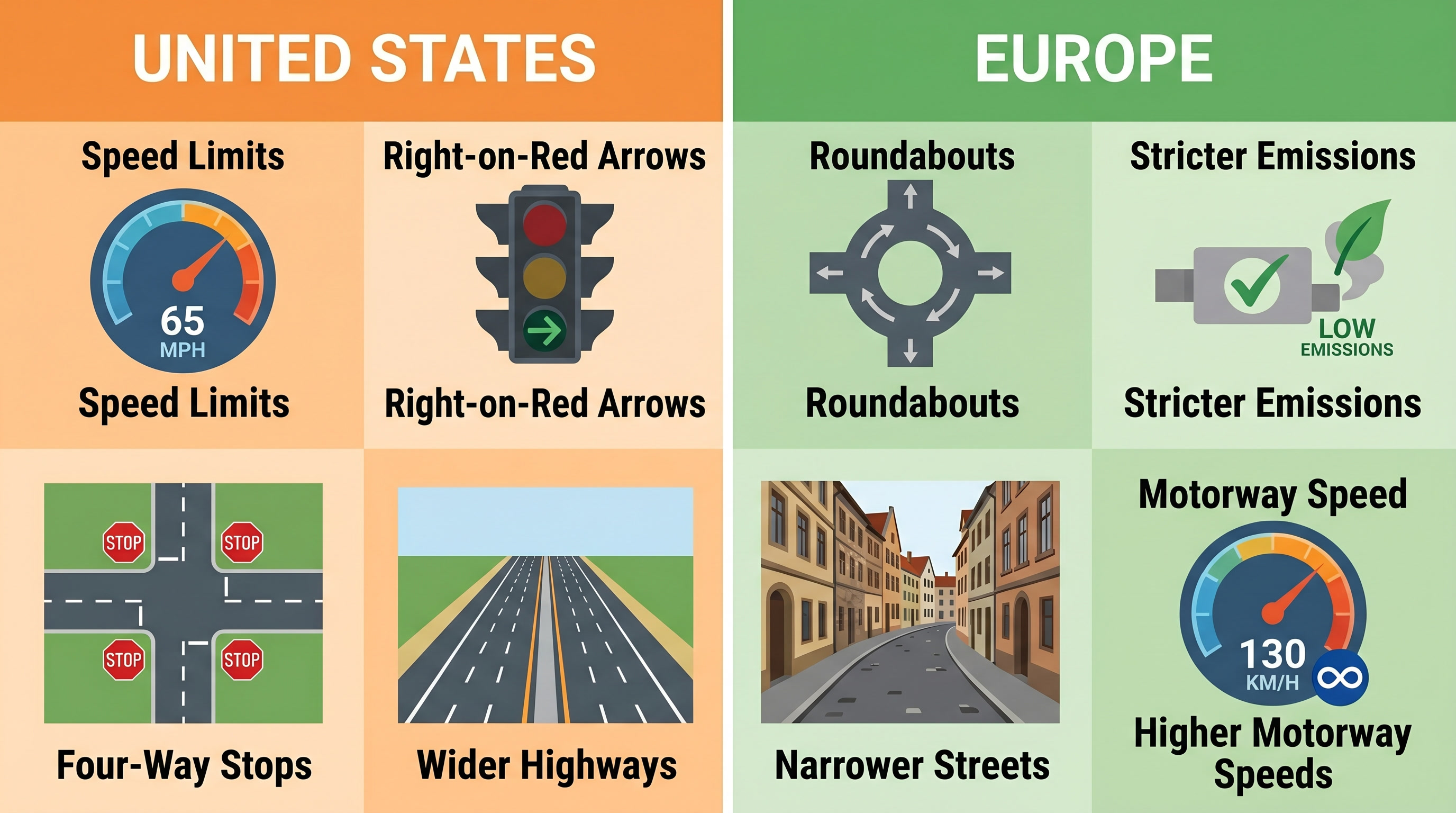
| Aspect |
United States |
India |
| Highway Speed Limit |
65–75 mph |
80 km/h (50 mph) on national highways |
| Urban Speed Limit |
25–45 mph |
40–60 km/h (25–37 mph) |
| School Zones |
15–20 mph |
40 km/h (25 mph) |
| Road Conditions |
Smooth, well-maintained |
Variable; potholes and unpaved sections common |
| Lane Markings |
Clear white lines |
Faded or absent in many areas |
| Speeding Fine (10 mph over) |
$150–$300 |
₹500–₹1,000 ($6–$12) |
| Automated Camera Enforcement |
Widespread (31 states) |
Limited; mainly in metro areas |
Highway Design Differences
US highways are built for speed and volume:
- Interstate highways: Divided, controlled-access roads with on/off ramps
- Wide lanes: 12 feet per lane (compared to 9 feet in India)
- Gentle curves: Designed for 65+ mph driving
- Minimal roadside obstacles: Clear shoulders and berms
- Weather preparation: Roads treated for ice, drainage systems for heavy rain
Indian highways are built for mixed traffic and cost efficiency:
- National highways: May be divided (NH66 in South India) or undivided (common in North India)
- Narrow lanes: Often 7–8 feet per lane with no shoulder
- Sharp curves: Designed for lower speeds; overtaking is risky
- Roadside hazards: Potholes, debris, stray animals, temporary structures
- Minimal weather management: Flooding is common during monsoon; winter ice is rare (except in Himalayas)
Traffic Laws and Enforcement
US Traffic Law Enforcement
The US prioritizes automated and visible enforcement:
- Speed cameras: Present on 65–75 mph highways, school zones, and urban roads in 31 states
- Red light cameras: Common in metro areas; a violation can cost $75–$400
- Traffic stops: Police conduct stops for speeding, lane violations, and broken taillights
- Penalties are steep: A speeding ticket at 10 mph over the limit costs $150–$300; at 25+ mph over, fines exceed $500
- Insurance impact: One violation can increase premiums by 20–30% for 3–5 years
- Demerit points: Tracked on your driving record; too many points result in license suspension
Indian Traffic Law Enforcement
India has a less automated and more discretionary system:
- Traffic police: Enforce at intersections and busy roads, but gaps are common
- Speed enforcement: Minimal on highways; stricter in cities and school zones (though enforcement is selective)
- Speed cameras: Present in metro areas (Delhi, Bangalore, Mumbai) but absent in many regions
- Fines are low: A speeding ticket typically costs ₹500–₹1,000 ($6–$12) compared to US fines
- Bribery is common: Drivers often negotiate fines with police rather than paying official amounts
- License points: An emerging system in some states, but enforcement is inconsistent
- No insurance linkage: A traffic violation doesn't automatically increase insurance premiums
Driver Licensing and Testing
US Licensing System
Each US state has its own licensing requirements:
- Minimum age: 16–18 depending on state
- Written test: 30–50 questions; passing score 70–85%
- Practical driving test: 15–30 minutes; evaluated on basic maneuvers and lane discipline
- Renewal: Every 4–8 years; often online
- Cost: $10–$50 per license; $20–$100 for renewal
- No retesting on renewal: Age-based retesting only in some states (65+ years old)
Indian Licensing System
India's licensing is centralized (Ministry of Road Transport) but decentralized in execution:
- Minimum age: 18 years old
- Written test: 30 questions (30 minutes); 16/30 passing score
- Practical driving test: 8–10 minutes; evaluated on basic maneuvers only
- Renewal: Every 5 years
- Cost: ₹200–₹500 ($2.50–$6) for license; ₹100–₹200 for renewal
- No retesting on renewal: License renewal is automatic if no violations
- Fraud is rampant: Many drivers purchase licenses without taking tests; enforcement is weak
Key Differences in Testing Philosophy
The US test emphasizes rule adherence (signals, lane discipline, stopping at stop signs). The Indian test emphasizes basic vehicle control (steering, braking, parking). Neither test includes highway driving, night driving, or weather-specific scenarios in most cases.
Priya's Story: "The US Test Felt Strange"
Priya, a 26-year-old accountant from Bangalore, passed her Indian driving test on her first try in just 10 minutes. When she moved to California in 2024, she expected the US test to be similar—straightforward and quick. "The written test was longer than I expected, with lots of questions about right-of-way and specific scenarios," she says. "The driving test was longer too—about 20 minutes. But what surprised me was that the evaluator was looking for precise things: signal before every turn, stay centered in the lane, come to a complete stop at stop signs. In India, the test was much looser. The inspector cared that you could steer and brake; he didn't care about signals or lane position. I realized the US test was teaching a completely different driving philosophy."
Vehicle Standards, Emissions, and Safety
US Vehicle Standards
- Emissions: Required in 31 states; others have minimal or no testing
- Inspections: Annual or biennial depending on state
- Safety standards: NHTSA sets federal standards; all new cars must pass crash tests
- Airbags and stability control: Mandatory
- Emission limits: Less strict than India's Bharat Stage IV (BS-IV) in some cases, though the US has strict PM (particulate matter) limits
Indian Vehicle Standards
- Bharat Stage Emission Standards: BS-VI (implemented 2020) is stricter than US EPA Tier 2 for NOx and particulates
- Pollution Under Control (PUC): Annual emissions certificate required
- Safety standards: SIAM (Society of Indian Automobile Manufacturers) follows international standards, but enforcement is inconsistent
- Airbags: Mandatory in new cars since 2018
- Vehicle age limits: Taxis and commercial vehicles are scrapped after 15 years; private vehicles have no age limit (but older vehicles have stricter emissions testing)
Parking, Urban Driving, and Traffic Management
US Parking
- Abundant parking: Free parking is standard outside urban areas
- Metered parking: In cities, parking costs $1–$3 per hour
- Enforcement: Strict; expired meters result in tickets within minutes; towing is common
- Parking lots: Most buildings have dedicated parking
- No street parking chaos: Illegal parking is rare; the consequences are swift
Indian Parking
- Scarce in cities: Street parking is common and unorganized
- No metering in most areas: Parking is free or involves informal payments to security guards
- Enforcement: Weak; parking on sidewalks and double parking are normalized
- Paid parking: Present in malls and upscale areas, but costs are minimal (₹20–₹50 per hour, or $0.25–$0.60)
- Organized chaos: Drivers pack cars tightly; side mirrors are regularly broken
Pedestrian Rights and Safety Culture
US Pedestrian Culture
- Pedestrians have strong right-of-way: Drivers must yield at crosswalks, even if unmarked
- Jaywalking fines: Pedestrians face fines for crossing outside designated areas
- Driver liability: Hitting a pedestrian in a crosswalk places liability on the driver, even if the pedestrian was distracted
- Safety infrastructure: Sidewalks, crosswalks, and traffic signals are designed to separate pedestrians and vehicles
- No animals on roads: Stray animals are non-existent; wildlife is fenced or managed
Indian Pedestrian Culture
- Pedestrians are vulnerable: Drivers often don't yield; pedestrians cross at any point and must be assertive
- No jaywalking concept: Pedestrians are expected to navigate traffic; crossing infrastructure is minimal
- Driver liability is limited: Hitting a pedestrian often results in negotiated settlements rather than legal liability
- Animals are common: Stray cattle, dogs, and other animals are road hazards
- Mixed-use spaces: Sidewalks are used for parking, vending, and informal commerce; clear separation is rare
Adjustment Tips for Indian Drivers in the US
For Indian Drivers Relocating to the US:
- Suppress the honk impulse: Honking is considered hostile, not helpful. Use the horn only for imminent safety threats.
- Stop at every stop sign: In India, you might roll through a stop sign if traffic is clear. In the US, come to a complete stop. Officers actively look for "rolling stops."
- Signal every move: Change lanes, turn, even when no cars are visible. Signaling is expected and a failure to signal is a moving violation.
- Respect lane discipline: Drive straight in your lane. Drifting is a violation. If you need to change lanes, signal and check mirrors carefully.
- Understand four-way stops: If two or more drivers arrive simultaneously, yield to the driver on your right. If unsure, wave the other driver through.
- Expect traffic cameras: Assume you're being recorded. Speed limits are enforced via automated cameras, not just police.
- Don't negotiate with police: Unlike India, bribing a US police officer is a felony. Pay fines or contest them in court.
- Prepare for defensive driving: US drivers are more law-abiding but also more distracted (cell phones). Assume other drivers might drift or brake suddenly.
- Use a DMV prep app: Each state has different rules. Use Wheelingo's practice tests to master your specific state before test day.
- Start in lower-traffic areas: Build confidence on residential streets before tackling highways and busy intersections.
Start Practicing Today
The fastest way to pass your test is consistent practice with real questions. Try Wheelingo free — state-specific questions, instant explanations, and a readiness score that tells you when you're ready.
FAQ
Q: Can I drive in the US with my Indian driver's license?
A: Yes, for up to 12 months in most states. However, you should carry an International Driving Permit (IDP) as supporting documentation. For rentals and police stops, the IDP is strongly recommended.
Q: How do I get an International Driving Permit?
A: Apply at a Regional Transport Office (RTO) in India before you leave. The process takes 1–2 weeks and costs about ₹50–₹100. The IDP is a translation of your Indian license and is valid for one year.
Q: Is the US driving test harder or easier than the Indian test?
A: The US test is longer and more rigorous in its philosophy. The written test asks about specific scenarios and right-of-way rules, not just mechanical knowledge. The driving test evaluates rule compliance (signals, lane discipline, complete stops), whereas Indian tests focus on basic vehicle control.
Q: Do I need to change my insurance policy when I move to the US?
A: Yes. Indian insurance is not recognized in the US. You must purchase a new US auto insurance policy. If you have a clean driving record in India, mention it when getting quotes—some insurers will offer discounts.
Q: What's the difference between a speeding ticket and a traffic citation?
A: In the US, speeding tickets and citations are used interchangeably; both are moving violations. In India, the term "fine" is used, and fines are much lower. A US citation includes legal language, court information, and consequences; an Indian fine is often paid on the spot or negotiated.
Q: Can I contest a US traffic ticket?
A: Yes. You have the right to appear in traffic court and present your case or contest the evidence. In India, this process is rare and bureaucratic; in the US, it's a standard legal right.
Conclusion and Next Steps
The shift from Indian to American driving is more than a legal transition—it's a cultural one. Indian drivers who master US road rules gain a new skill set: predictability, rule adherence, and systematic compliance. These habits often make them safer drivers overall.
The good news is that US driving is, in many ways, easier once you understand the rules. There's no ambiguity, no negotiation, no need to read the road like you do in India. Instead, follow the signs, obey the signals, and respect the lanes.
Your first step is to take a state-specific DMV practice test to understand your state's specific requirements. Then, get behind the wheel on quiet streets and build confidence before tackling highways.
Ready to pass your DMV test? Start practicing today with Wheelingo and join thousands of Indian expats who passed with confidence and are now driving safely in the US.
Internal Links
Related Articles
External Links