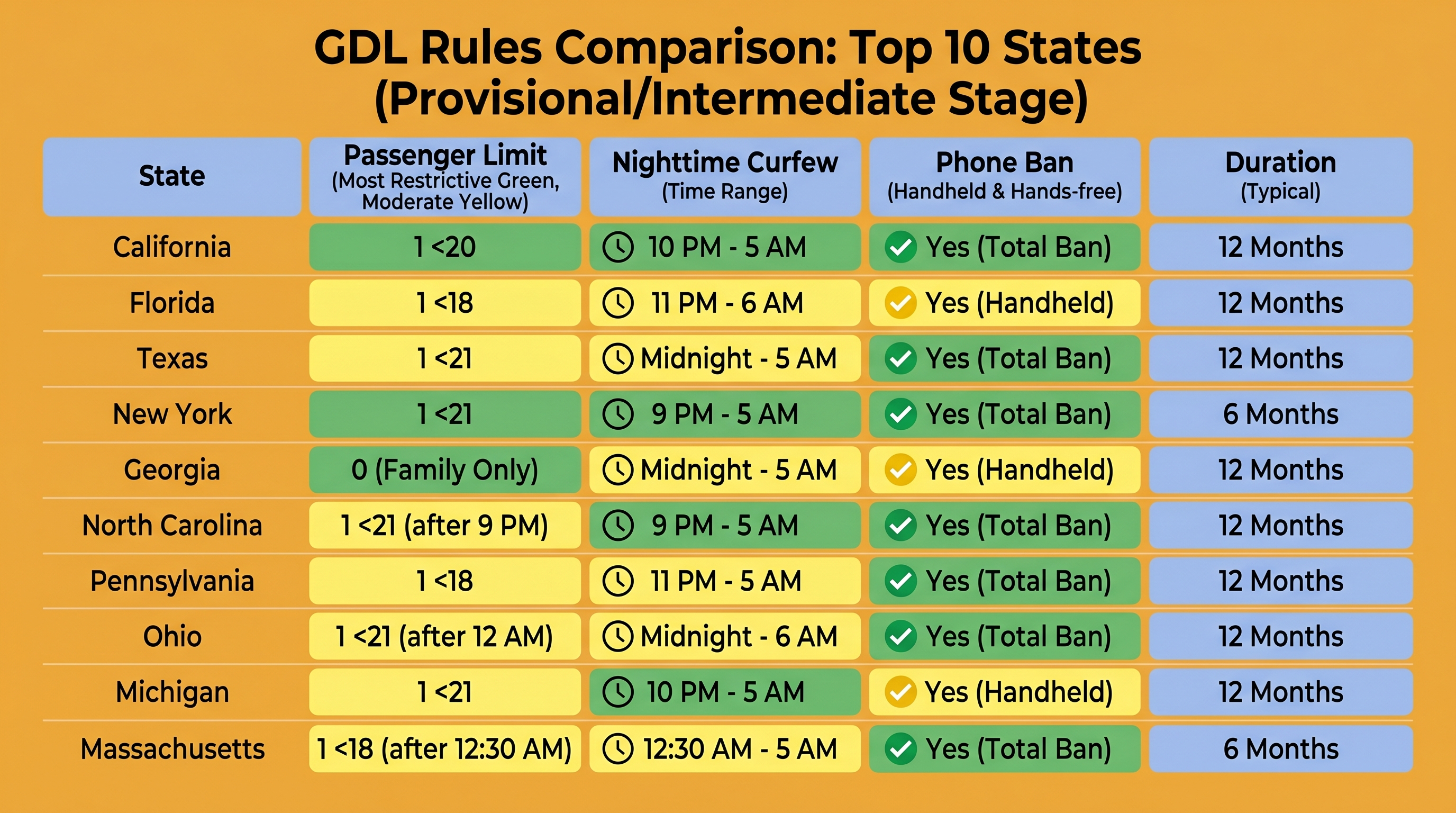
Learn GDL passenger restrictions by state. When can new drivers carry friends? Find state laws, safe driving tips, and how to navigate peer pressure.
The moment you get your license, your friends want a ride. There's something uniquely powerful about being the one behind the wheel, and the social pressure to be "the driver" is real. But here's what research consistently shows: having passengers significantly increases crash risk for new drivers. That's why every U.S. state has graduated driver license (GDL) laws that restrict when and how many passengers new drivers can carry.
This guide breaks down GDL passenger restrictions by state, explains the science behind them, helps you navigate peer pressure, and gives you strategies for managing social situations when you can't yet drive friends. We'll also cover what happens if you violate passenger restrictions and real stories from new drivers who've handled this transition successfully.
The National Highway Traffic Safety Administration (NHTSA) found that:
Why? Because:
GDL passenger restrictions were introduced nationwide (starting in 1996) specifically to address this gap. Over 20+ years of data shows they reduce teen driver fatalities by 10–15%.
Note: GDL laws change year to year. These reflect 2026 regulations; verify with your state's DMV before driving.
| State | Unrestricted License Age | Passenger Limit (Ages 16–17) | Passenger Limit (Ages 17–18) | Restrictions | Notes |
|---|---|---|---|---|---|
| Alabama | 18 | None (unrestricted) | Unrestricted | No restrictions | Intermediate license required at 16 |
| Alaska | 18 | 1 sibling max | 3 passengers | Night/nighttime restrictions apply | Must be 21+ passengers after 9 PM |
| Arizona | 18 | 1 passenger max | 3 passengers | Nighttime driving restricted 10 PM–5 AM | Night exceptions for work/school |
| Arkansas | 18 | 1 passenger (immediate family only) | 3 passengers | Nighttime restrictions: 10 PM–4 AM | Exceptions for immediate family |
| California | 18 | 0 passengers (solo only, first 12 months) | 1 passenger | Nighttime 11 PM–5 AM restricted | Very restrictive; most restrictive state |
| Colorado | 18 | 1 passenger (ages 16–18 family) | 3 passengers | Nighttime 11 PM–5 AM | Siblings allowed; friends disallowed initially |
| Connecticut | 18 | 0 passengers (first 4 months) | 1 passenger | Nighttime 11 PM–5 AM | Graduated phases |
| Delaware | 18 | 1 passenger max | 3 passengers | Nighttime 11 PM–5 AM | 12-month restriction period |
| Florida | 18 | 3 passengers (18+ only, first 6 months) | Unrestricted | Night 11 PM–6 AM | Immediate family only in first 6 months |
| Georgia | 18 | 0 passengers (first 6 months) | 1 passenger | Night 12 AM–5 AM | Very restrictive early phases |
| Hawaii | 18 | 0 passengers | 3 passengers | Night 11 PM–5 AM | Siblings allowed after age 17 |
| Idaho | 18 | 0 passengers (first 6 months) | 1 passenger | Night 10 PM–5 AM | Rural exceptions for school/work |
| Illinois | 18 | 1 passenger max (ages 16–18 family) | 3 passengers | Night 11 PM–5 AM | Family restrictions are strict |
| Indiana | 18 | 3 passengers (first year) | Unrestricted | Night 1 AM–5 AM | Less restrictive on passengers |
| Iowa | 18 | 0 passengers (first 12 months) | 1 passenger (age 18) | Night 10 PM–5 AM | One of the most restrictive states |
| Kansas | 18 | 1 passenger (family members only, first 6 months) | 3 passengers | Night 10 PM–5 AM | Family restrictions |
| Kentucky | 18 | 0 passengers (first 6 months) | 1 passenger | Night 12 AM–5 AM | Two-phase progression |
| Louisiana | 18 | 0 passengers (first 3 months) | 1 passenger | Night 11 PM–5 AM | 3-month solo period, then 1-passenger |
| Maine | 18 | 0 passengers (first 3 months) | 1 passenger | Night 10 PM–5 AM | Short initial solo period |
| Maryland | 18 | 1 passenger max (age 21+, first 16 months) | Unrestricted | Night 11 PM–5 AM (age 17) | Unusual: requires adult passenger |
| Massachusetts | 18 | 1 passenger max (first 6 months) | Unrestricted | Night 11 PM–5 AM | Moderate restrictions |
| Michigan | 18 | 0 passengers (first 6 months) | 2 passengers (age 18) | Night 12 AM–5 AM | Two-phase system |
| Minnesota | 18 | 0 passengers (first 12 months) | 1 passenger | Night 10 PM–5 AM | Very restrictive first 12 months |
| Mississippi | 18 | 0 passengers (first 6 months) | 1 passenger (age 17–18) | Night 11 PM–5 AM | Two-phase graduated system |
| Missouri | 18 | 3 passengers max (first 6 months) | Unrestricted | Night 1 AM–5 AM | Less restrictive on passengers |
| Montana | 18 | Unrestricted (no passenger limit) | Unrestricted | No night restrictions | Least restrictive GDL |
| Nebraska | 18 | 1 passenger (ages 16–18 family, first year) | 3 passengers | Night 1 AM–5 AM | Family-focused restrictions |
| Nevada | 18 | 1 passenger max (first 12 months) | 3 passengers | Night 10 PM–5 AM | 12-month first phase |
| New Hampshire | 18 | 1 passenger max (ages 16–17, first 12 months) | Unrestricted | Night 1 AM–5 AM | 12-month first phase |
| New Jersey | 18 | 0 passengers (first 6 months if age 16) | 3 passengers (age 17) | Night 11 PM–5 AM | Phased approach |
| New Mexico | 18 | 0 passengers (first 3 months) | 1 passenger | Night 10 PM–5 AM | Short initial solo period |
| New York | 18 | 1 passenger max (ages 16–17, first 6 months) | 3 passengers | Night 9 PM–5 AM (age 16) | NYC has stricter rules |
| North Carolina | 18 | 0 passengers (first 6 months) | 3 passengers (age 17) | Night 12 AM–5 AM | Two-phase system |
| North Dakota | 18 | Unrestricted | Unrestricted | Night 1 AM–5 AM | Few passenger restrictions |
| Ohio | 18 | 0 passengers (first 12 months, ages 16–17) | 1 passenger (age 18–19, first 12 months) | Night 11 PM–5 AM | Longest passenger phase in nation |
| Oklahoma | 18 | 3 passengers max | Unrestricted | Night 10 PM–6 AM | Less restrictive on passengers |
| Oregon | 18 | 1 passenger max (first 12 months, ages 16–17) | 3 passengers (age 18–19) | Night 12 AM–5 AM | Graduated phases |
| Pennsylvania | 18 | 1 passenger max (ages 16–17, first 12 months) | Unrestricted | Night 11 PM–5 AM | 12-month first phase |
| Rhode Island | 18 | 0 passengers (first 3 months, ages 16–17) | 1 passenger (age 17, next 9 months) | Night 11 PM–5 AM | Three-phase progression |
| South Carolina | 18 | 3 passengers max (first 6 months) | Unrestricted | Night 12 AM–5 AM | Less restrictive passenger rules |
| South Dakota | 18 | Unrestricted | Unrestricted | Night 10 PM–5 AM | Few passenger restrictions |
| Tennessee | 18 | 0 passengers (first 6 months) | 3 passengers | Night 11 PM–5 AM | Two-phase system |
| Texas | 18 | 0 passengers (first 6 months, ages 16–17) | 1 passenger (age 17–18, next 6 months) | Night 10 PM–5 AM | 12-month total progression |
| Utah | 18 | 0 passengers (first 12 months) | 1 passenger (age 18, next 12 months) | Night 10 PM–5 AM | Very restrictive |
| Vermont | 18 | 1 passenger max (ages 16–17, first 12 months) | Unrestricted | Night 12 AM–5 AM | 12-month first phase |
| Virginia | 18 | 1 passenger max (ages 16–17, first 12 months) | 3 passengers (age 18) | Night 12 AM–5 AM | Graduated phases |
| Washington | 18 | 1 passenger max (ages 16–17, first 6 months) | 3 passengers (age 17–18, next 6 months) | Night 10 PM–5 AM | Phased 12-month approach |
| West Virginia | 18 | Unrestricted (no passenger limit) | Unrestricted | Night 12 AM–5 AM | Few passenger restrictions |
| Wisconsin | 18 | 1 passenger max (ages 16–17, first 6 months) | 3 passengers (age 17–19) | Night 10 PM–5 AM | Phased progression |
| Wyoming | 18 | Unrestricted | Unrestricted | Night 10 PM–5 AM | Fewest restrictions overall |
Key Observations:
Penalties vary by state but typically include:
| Consequence | Typical Severity | Example |
|---|---|---|
| License suspension | Moderate | 30–60 days (varies by state) |
| Fine | Moderate | $50–$250 first violation, escalating |
| Points on license | Moderate | 2–6 points (affects insurance) |
| Insurance rate increase | Major | 15–40% increase in premiums for 3 years |
| Requirement to repeat driver's ed | Minor | 4–8 hours of mandatory education |
| Community service | Rare | 8–20 hours (for repeat offenders) |
| Vehicle impound | Very rare | 30 days (only in extreme cases or repeat violations) |
Real example: A 17-year-old in California violated passenger restrictions by driving two friends home. Citation: $250 fine + 4-point suspension + 2-month license suspension. Insurance premiums increased 30% ($50/month additional cost) for 3 years = $1,800 total impact.
Is it worth it? Almost universally: no.
Aisha was the first in her friend group to get her license at 16. "Everyone expected me to be their Uber," she recalls. "But I was on GDL—zero passengers for the first six months. My friends were genuinely upset."
Aisha's solution: "I was honest. I told them: 'My license gets suspended if I break the rules. I want to drive you, but I can't yet.' Some friends got it; some didn't. But after six months, I was driving them everywhere."
Today, Aisha carries her entire friend group. "The six-month wait was annoying, but it made me a safer driver. I actually appreciate that restriction now."
Lesson: True friends understand GDL rules. Temporary "no" becomes permanent "yes."
Marco thought one friend in the car wasn't a violation. "I'd been driving solo for 11 months. I picked up my best friend for a quick drive to the mall. I got pulled over for a broken headlight."
The officer checked Marco's license. "He saw I had a passenger and I was 17. That was a violation of Ohio's GDL—0 passengers until 18. I got cited."
Marco's violation: $200 fine + 1-point suspension + warning about license revocation if it happened again. "My insurance went up $30 a month. And I was furious at myself, not the law. The rule was clear."
Lesson: "One friend" still counts. Know your exact restrictions before driving anyone.
What they say: "Hey, can you drive me home?" What you feel: Pressure to be helpful, fear of being seen as uncool What to say: "I'm on GDL right now, and I can't carry passengers. My license would get suspended. But I can pick you up after [date when restriction lifts], or we can figure out another way."
Why this works: You're explaining a legal constraint, not a personal choice. No judgment. Future availability.
What they say: "We're going to the mall. You're driving, right?" What you feel: Pressure to be the hero; guilt about saying no What to say: "Not yet—I'm still on passenger restrictions. But let's figure out who else can drive, or I can meet you guys there."
Why this works: You're problem-solving with them, not against them.
What they say: "Oh come on, one person isn't a big deal. Nobody enforces that." What you feel: Social pressure; doubt about rules What to say: "Actually, my license gets suspended if I get caught. I've seen it happen—it's not worth it. I'll drive you when I'm fully licensed, I promise."
Why this works: You're clear about consequences and offering a real future solution.
| Situation | GDL Constraint | Alternative |
|---|---|---|
| Friend needs a ride | Passenger restrictions | Use Uber/Lyft together; your parents drive |
| Group wants to hang out | Can't drive multiple people | Meet them at the destination; take transit |
| Friend group party | Nighttime restrictions | Host a daytime activity at your place; offer early pickup before midnight |
| School/work carpool | Passenger limits | Ride with the school bus or carpool with adult driver |
| Weekend hangout | Combined night + passenger rules | Movie at someone's house (no driving needed) or daytime trip |
Ages 16–17 (Intermediate License)
Age 17–18 (Provisional License, most states)
Age 18+ (Full License)
Total timeline: Most states take 12–24 months to move from 0 to unrestricted. It feels long, but the data shows it works.
The fastest way to pass your test is consistent practice with real questions. Try Wheelingo free — state-specific questions, instant explanations, and a readiness score that tells you when you're ready.
Q: Can I drive my sibling? A: Most states treat siblings as "immediate family" and allow them even during passenger restriction phases. Check your state's specific rules—some allow siblings of any age, others limit to siblings 18+. Verify before driving your younger sibling.
Q: Can I carry a parent as a "passenger"? A: Parents aren't counted as passengers; they're adults. Driving with a parent present is always allowed. In fact, many new drivers find it reassuring.
Q: What if I drive for work or school? A: Most states have exceptions to passenger restrictions for school-related driving and work commutes. You may be allowed to carpool to school or carry a coworker to a job site. Verify with your state's DMV.
Q: Can I get a passenger restriction waiver? A: No. GDL restrictions are legal requirements, not permissions you can negotiate. They exist for all new drivers under a certain age in your state.
Q: What if I'm in a state with no passenger restrictions (Montana, Wyoming)? A: You're fortunate. But statistically, you're at higher risk in crashes with passengers. Drive defensively and be aware that the research showing increased crash risk applies to you too—the absence of a law doesn't change the risk.
Q: How do I know when I can drive passengers again? A: Most states automatically upgrade your license after the restriction period (usually 6–12 months) if you have no violations. You'll receive a new license in the mail. Check your state's DMV website for your specific dates.
GDL passenger restrictions feel restrictive when you're living with them. You're the driver—you want to be the person people rely on. But the data is clear: these restrictions save lives. And the good news is they're not permanent.
In 12–24 months, you'll be unrestricted. You'll drive your entire friend group. You'll have the social freedom you're waiting for. But in the meantime, you're building the skills that make you a safe driver for those friends for decades.
Your friends might not love the "not yet," but they'll benefit from a you who's still alive to drive them in 20 years.
Need to build confidence while managing GDL restrictions? Wheelingo's practice tests and roadmap cover state-specific rules, peer pressure scenarios, and decision-making skills. Our app tracks your milestones—including the day your GDL restrictions lift.
Respect the rules, keep your friends safe, and celebrate each milestone. You're almost there.