Plan your first road trip as a new driver. Vehicle prep, route planning, fatigue management, navigation, and emergency supplies checklist.
The open road, a full tank of gas, friends in the car, and no particular deadline—a road trip represents ultimate driving freedom. For new drivers, it's also a significant step: longer distances, higher speeds (highways), extended focus, navigation, and the pressure of being responsible for a group. The good news? Road trips are entirely manageable with the right preparation.
This guide breaks down road trip planning into specific, actionable steps: how to assess whether you're ready, how to prepare your vehicle, route planning strategies, fatigue management, navigation systems, emergency supplies, and real stories from new drivers who've completed successful road trips. We'll also cover common mistakes and how to avoid them.
Before attempting a road trip, you should have:
| Requirement | Benchmark | Why |
|---|---|---|
| Driving experience | 100+ miles, mix of streets and highways | Prevents overconfidence; builds automaticity in basic skills |
| License status | Clean driving record (no violations) | Violations indicate skill gaps or safety concerns |
| Highway experience | 50+ miles, multiple on-ramps/merges | Highway adds complexity; solo practice is essential |
| Daytime-only driving | 30+ hours | Nighttime adds sensory/cognitive load; master day driving first |
| Vehicle familiarity | Driven the same vehicle 20+ times | You know how it accelerates, brakes, and handles |
| Passenger management | Driven with passengers on local roads | You understand how to manage distraction |
| Navigation experience | Used GPS for 10+ trips | You know how to handle missed exits and reroutes |
| Fatigue awareness | Recognized personal tiredness limits | You know when you need a break |
Honest assessment: If you're not at these benchmarks, one extra month of local driving is worth it. Road trips will still be there.
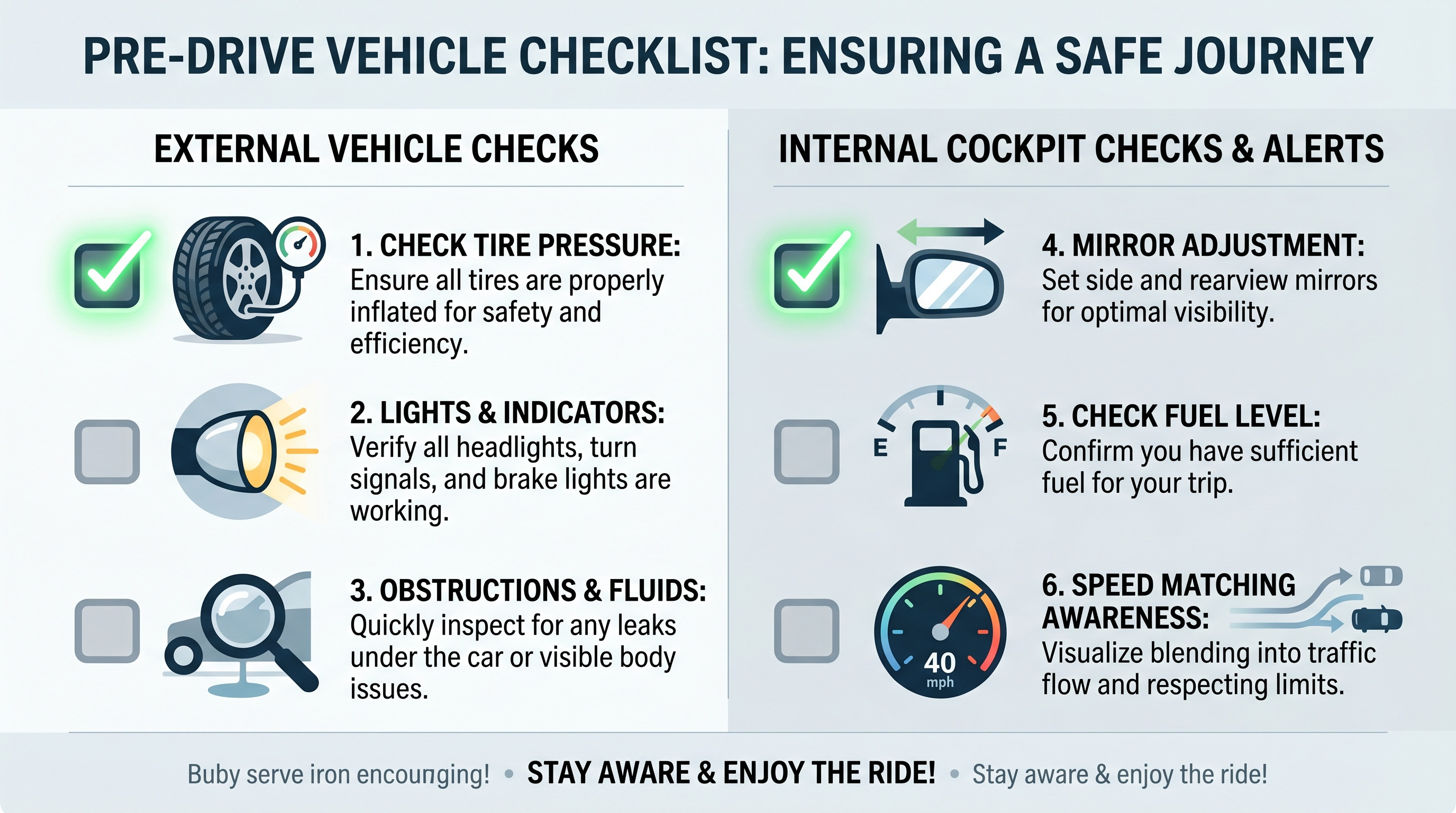 Do this check 2 weeks before your trip, not the day before. A week gives you time to address issues.
Oil level: Check using the dipstick (ask a parent or mechanic if unsure)
Coolant level: Check the coolant reservoir (NOT the radiator cap—it's hot)
Windshield washer fluid: Fill the reservoir (it's clearly labeled under the hood)
Transmission fluid: Check with engine running and in park (automatic) or neutral (manual)
Tire pressure: Check all four tires + spare
Tire tread: Place a penny headfirst into a tire's tread
Brakes: Have a parent or mechanic listen while you brake
Spare tire: Verify it's inflated and accessible
Headlights: Turn on and walk around the vehicle to confirm both work Taillights: Turn on, have a friend check the rear Brake lights: Have a friend stand behind while you brake Turn signals: Flash all four (front left, front right, rear left, rear right) Hazard lights: Turn them on and verify all four blink Wipers: Test on low and high; replace if streaking or chattering
Use Google Maps to:
Rule of thumb: 3 hours of driving = 180 miles at 60 mph average. For your first road trip, plan no more than 5–6 hours of total driving per day.
Fatigue increases crash risk dramatically after 3 hours. Plan stops every 2.5–3 hours.
Key stops to identify:
Google Maps shows rest areas and gas stations. Note their mile markers or GPS coordinates.
For trips longer than 6 hours, plan overnight stops:
Avoid on your first road trip:
Embrace for your first road trip:
Download offline maps to your phone before you leave:
Benefit: If cell service drops, you still have GPS and maps.
Print your route with:
Keep printed directions in a folder on the passenger seat. Refer to them if your phone dies.
Tip: Test your route in a test drive before your actual road trip. Drive the first 30 minutes on a weekend to familiarize yourself with the actual roads and exits.
The NHTSA reports that fatigue causes approximately 6,000 fatal crashes annually. For new drivers, fatigue management is critical because you haven't yet developed automaticity—your brain is still working hard to drive safely.
| Time Driving | Mental State | Risk Level | Action |
|---|---|---|---|
| 0–2 hours | Fresh, alert | Low | Continue driving |
| 2–3 hours | Slight fatigue | Low-Moderate | Start looking for a rest stop |
| 3–4 hours | Noticeable fatigue | Moderate | Stop, stretch, take a 15-min break |
| 4+ hours | Significant fatigue, slower reaction time | High | Switch drivers or stop for the night |
Before driving:
While driving:
Fatigue warning signs:
If you notice any of these: Find the next rest stop and stop completely. Call a friend or family member to stay on the phone while you rest, or sleep for 20 minutes.
Devon planned a road trip from Denver to Rocky Mountain National Park (90 miles, 2.5 hours driving). "I did the vehicle check, printed my directions, downloaded offline maps, and told my parents exactly when I'd arrive."
He stopped after 1.5 hours at a rest area, stretched, and grabbed water. "I felt fine, but I wasn't sure how the drive would feel, so I erred on the side of caution." He arrived refreshed and has since done longer road trips.
Lesson: First road trips don't need to be epic. Start small and build confidence.
Jasmine planned a 6-hour road trip from Portland to Seattle. "I used Google Maps but didn't notice it was taking me through Portland city streets for the first 30 minutes. That was terrifying as a new driver—unexpected urban complexity."
She pulled over at a parking lot, switched her route to the highway approach, and rerouted. "It cost me 20 minutes, but I learned to test my entire route in a practice drive first."
Lesson: Simulate your route entirely before committing to it on your actual trip.
Marcus's first road trip (350 miles, 5.5 hours) went smoothly until mile 280. His car overheated due to low coolant. "I hadn't checked fluids before the trip because I thought 'they were fine last week.'"
He pulled over safely, called his dad, and waited 45 minutes for the engine to cool before topping off coolant at a nearby gas station. "It cost us 2 hours and a lot of stress. I now do the vehicle check every single trip, no exceptions."
Lesson: Pre-trip vehicle checks aren't optional—they prevent catastrophes.
| Item | Purpose | Qty |
|---|---|---|
| Jumper cables or portable jump starter | Dead battery | 1 |
| Basic tool kit (hammer, screwdrivers, pliers, adjustable wrench) | Minor repairs | 1 set |
| Tire plug kit or tire repair patches | Slow leak fix | 1 |
| Spare fuses (assorted) | Electrical issues | 1 set |
| Duct tape | Temporary fixes | 1 roll |
| WD-40 or similar lubricant | Stuck parts | 1 can |
| Spare headlight & taillight bulbs | Burned-out lights | 2 each |
| Engine oil (your vehicle's type) | Top-up if low | 1 quart |
| Coolant (pre-mixed or concentrate) | Radiator top-up | 1 gallon |
| Flashlight + extra batteries | Nighttime repairs | 1 + spare batteries |
| First aid kit | Minor injuries | 1 |
| Fire extinguisher | Car fire | 1 |
| Reflective warning triangles | Alert other drivers | 3 |
| Item | Purpose |
|---|---|
| Phone charger (car + wall adapter) | Prevent dead phone |
| Water bottles (3–4) | Hydration and alertness |
| Light snacks (granola bars, nuts, fruit) | Energy without heaviness |
| Sunglasses | Reduce glare and eye strain |
| Tissues | Clean windshield quickly |
| Wet wipes | Refresh hands/face |
| Pain reliever (ibuprofen) | Headache relief |
| Mints or gum | Freshness and alertness |
| Deodorant stick | Feeling fresh |
| Phone mount | Safe GPS viewing |
| Printed directions | Backup if tech fails |
| Handwritten emergency numbers | Backup if phone dies |
| Cash ($50–$100) | Gas, tolls, emergencies |
| Credit/debit cards | Larger purchases |
Departure time: 8:00 AM
| Time | Activity | Duration |
|---|---|---|
| 8:00 AM | Leave home, fresh and alert | - |
| 9:30 AM | Stop at rest area (stretch, bathroom, water) | 15 min |
| 10:30 AM | Continue driving | - |
| 12:00 PM | Lunch stop (sit down, eat, 20-minute break) | 30 min |
| 1:00 PM | Continue driving | - |
| 3:00 PM | Rest area stop (stretch, assess fatigue) | 10 min |
| 4:00 PM | Drive final segment to destination | - |
| 5:00 PM | Arrive at destination (fresh enough to enjoy it) | - |
Total driving time: 8 hours Total elapsed time: 9 hours 15 minutes Why this works: Three strategic stops break up the drive, prevent fatigue, and ensure arrival with energy to enjoy your destination.
What to do: Do NOT brake suddenly or swerve. Instead:
Time cost: 10–20 minutes. Acceptable.
What to do: Trust the physical road signs. GPS can lag or have outdated data. Road signs are current. Take the exit the signs indicate, confirm your location via offline maps, and reroute if needed.
What to do: Don't speed up to "make up time." Adjust your expectations. Call your destination if you'll arrive late. Focus on driving safely in the congestion.
What to do: Stop now. Fatigue makes the last hour more dangerous than the first. Rest for 20 minutes, then complete the drive refreshed.
The fastest way to pass your test is consistent practice with real questions. Try Wheelingo free — state-specific questions, instant explanations, and a readiness score that tells you when you're ready.
Q: How long should my first road trip be? A: 3–4 hours of total driving (roughly 150–250 miles). This is long enough to feel like a road trip but short enough to manage fatigue and handle the psychological pressure. After 3–5 successful road trips of this length, increase to 5–6 hours.
Q: Should I drive at night on my first road trip? A: No. Stick to daytime driving (7 AM–6 PM) for your first 10+ road trips. Nighttime introduces visibility challenges and fatigue risks that compound the newness of road tripping.
Q: What if my friend wants to drive my car during our road trip? A: Only allow this if your car is insured for them and they're an experienced driver. On your first road trip, you should be the primary driver for liability and learning reasons. Future road trips? Share the driving.
Q: Is it safe to road trip alone (no passengers)? A: Technically yes, but for your first road trip, bring at least one trusted passenger. They help manage navigation, keep you accountable on breaks, and provide company during fatigue-prone hours. Solo road tripping is an excellent skill, but build passenger road trips first.
Q: My destination is 12 hours away. Should I make it a 2-day trip? A: Absolutely. 12 hours of driving is too much for a new driver in one day. Plan an overnight stop around the 6-hour mark. You'll arrive refreshed and safe.
Q: What if my car breaks down in the middle of nowhere? A: Stay calm, turn on hazard lights, and assess the situation:
Q: Do I need roadside assistance membership? A: Highly recommended. AAA Plus membership (about $150/year) covers towing, lockouts, and battery jumps. For your first road trip, ask your parents to add you to their AAA membership or purchase a year of coverage yourself.
Use this checklist 2 weeks before your road trip:
Vehicle Checks:
Route Planning:
Personal Preparation:
Packing:
Final Steps (Day Before):
A road trip is more than transportation; it's independence. It's proving to yourself that you can navigate complexity, manage your own vehicle and fatigue, and reach your destination safely. It's a genuine milestone.
The checklist in this guide isn't busywork—every item prevents a problem that could turn your road trip from fun into stressful. Vehicle checks prevent breakdowns. Route planning prevents getting lost. Fatigue management prevents crashes. Checklists prevent the "did-I-forget-something?" anxiety.
Your first road trip won't be perfect. You might miss an exit, misjudge how tired you are, or discover your car makes a weird noise. That's normal. What matters is preparation, caution, and the willingness to make safe choices (like stopping early if you're tired, rerouting if you're lost, and fixing issues before they become emergencies).
Ready to build the skills for a successful road trip? Wheelingo's practice tests cover highway driving, navigation, and decision-making under pressure. Our progress tracker marks your journey to independence, and our app keeps you accountable for every skill you build.
Prepare thoroughly, drive safely, and enjoy the freedom that road trips represent. Your road trip is waiting.